Spella Ho
CHAPTERS 1-10
The New Atlantic Novel
SPELLA HO
BY
H. E. BATES
The editors regard this as the most remarkable story that has come out of England in the last five years. Those are big words — but this is a big book!
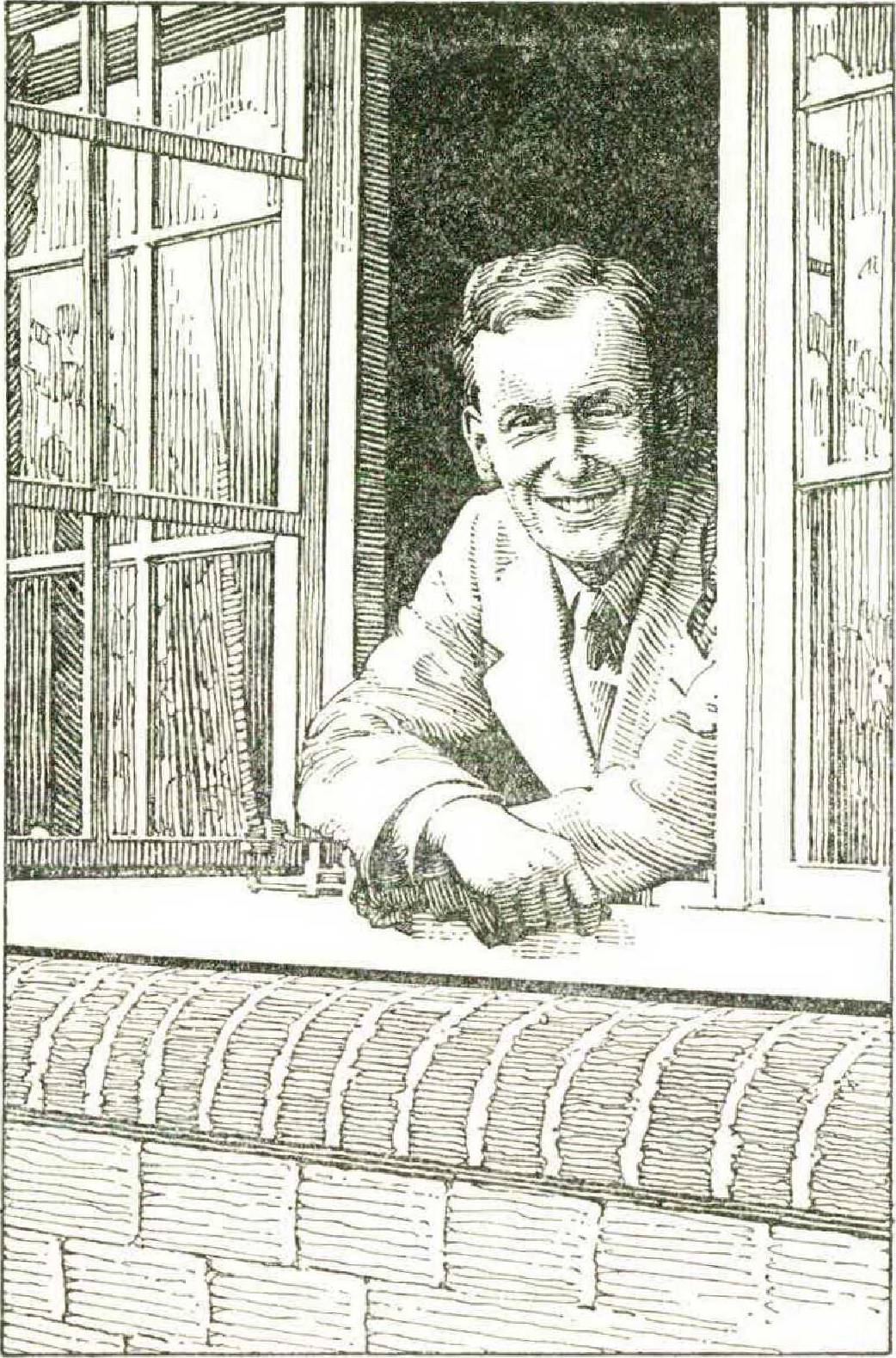
iL E. BATES was born in the English Midlands thirty-three years ago. Writing was his first trade, and from it he has never deviated. He began at the age of seventeen, serving his apprenticeship as a junior reporter on a country newspaper. By nineteen he had fnished his second book, The Two Sisters. This novel, prefaced by Edward Garnett, was published in 1926. It was followed by twelve other books in as many years, half of them collections of short stories — short stories of such originality and excellence that they soon established the author as the ablest of his generation in this medium.
In the best Fleet Street tradition, Mr. Bates wrote reviews for the Spectator, the Morning Post, and general articles of all kinds for almost every newspaper in London. Since there is a streak of the farmer in him, he wrote two books on English country life. But fiction was his calling, and, having proved his skill within the short compass, he went on to master the novel. The Poacher and A House of Women were books whose promise did not escape English and American critics — a promise which has reached fulfillment in Spella Ho.
Spella Ho has for its setting the English Midlands made famous by Arnold Bennett and D. H. Lawrence. It has for its theme the rise from grinding poverty of a great man, Bruno Shadbolt. At twenty, the year his mother died, Bruno had already reached manhood, a swart, powerful, ugly figure, miserably poor, illiterate, with almost no assets except physical strength and courage. Through his being there ran a vein of iron determination which was to give him power over men and an irresistible magnetism for women. From women, young and old, he learned what he needed to know about life. His career as it ranges from 1873 to 1931 is inseparably bound up with Spella Ho, the great country house near which he was born; his story is one of immense vitality, incident, and color.
With each twelve months of the Atlantic
THREE GREAT BOOKS OF THE YEAR
SPELLA HO
BY H. E. BATES
I
THE day before his mother died, in the winter of 1873, Bruno Shadbolt made three journeys to Spella Ho, hunting for coal. The house stood like some huge shell, empty and desolate, on the bare hillside above the many tough little copses of oak and haw that were characteristic, at that time, of the lower land. Built in the twenties, squarely, out of the white soft limestone of the locality, with the immense blood-veined cornerstones of iron, the house shone that afternoon as though with frost against the distances of a sky that was full of unfallen snow. In the shelter of the copses and more still under cover of the house, there was an odd suspense and silence over things: trees rigid as iron, clouds like lead, the few birds going over on dumb wings. It was the middle of January, and it seemed like the dead core of the year.
Bruno was then twenty. The Shadbolts had reckoned for some years to have and lose a baby every year. That made him the eldest boy of a family of five. His mother was forty-three. Already an old woman, worn out by miscarriage and childbirth, she was dying of consumption, though no one called it that. They called it, when they called it anything at all, a decline.
It was a mysterious thing, and no one, least of all the Shadbolts, could do much about it. Bruno had no name for it and he did not understand it. He understood only one thing: that the house was cold. Though he had tacked new sacking over the window holes, and had bunged up the door cracks, it was no use. All that day his mother had moaned and muttered that one single complaint, like a dirge: it was so cold; she would tell him, repeatedly, that it was the coldest day she had ever known. At last she made him feel her hands. As long as he lived he never forgot the horror of them. It was as though her hands had died before the rest of her body. The coldness clung to them like some invisible and terrible sweat. Her fingers seemed to paint his own with some peculiar weak moisture. It struck down to his heart. That decided him to go for the coal.
The coal belonged to Spella Ho, the house, and originally there had been fifteen tons of it. He knew this because, a year before, he had helped to load and cart and stack every lump of it. His father, Matt Shadbolt, had the job: the last good job he had had and the last good job, now that the house was empty, he would possibly ever get.
His father ran a carrier’s van, Tuesdays and Thursdays, to Thrapston and St. Neots, both market towns down the river, making up the rest of the week with odd jobs of all sorts, carting lime, coal, offal, dead pigs, leather, tar, even coffins, anything. He was a small man, taciturn, morose, a steady and occasionally violent drinker. He had had the coal job out of sympathy: fifteen tons of it to be carted up the three miles from the wharf on the river to Spella Ho and stacked there under the north wall by the gardens, out of sight, in his own time, and almost at his own price. The job took, counting the days they could not work, more than three weeks. At the end of it there had been left a cartload of sweepings-up, more dust than coal, which the Shadbolts took home and burned. Up to that time Bruno had never seen coal burn.
As he went from home to Spella Ho that afternoon, for the first journey, wearing across his shoulders, like a cape, the sack he had brought, he was obsessed by one thought and one particular idea. He was not excited by it. He was obsessed by the simple fact that coal meant warmth and that warmth, in turn, meant life. His mother was cold, ill; how ill he did not know, but his idea was that warmth could cure her. He could take enough coal from Spella Ho, every day for the rest of that winter, to keep her hands from that awful coldness, and no one would know. No one would miss it. And it was quite possible that in spring, as a result, she would get better.
As he went up the slope of the house, under the big elms of the park, keeping close to the iron fence of the covert of young fir, it began to snow.
He had not seen anyone about Spella Ho for weeks, almost months. He looked at the house, more out of habit than anything, every day of his life. It had sixty chimneys. They were arranged in four great vault-like blocks above the flat roof leads, impressive, monumental, and, against the dark snow-sky, in some way symbolical of the whole useless emptiness of the place.
At the back of the house, behind the walled-in gardens, wedged in between the wall and back entrance, was a yard of flagstones. Here the coal was stacked like a black wall. Bruno took the sack off his shoulders and filled it with lumps of coal about the size of turnips. It was simple — so simple that, for one moment, he was uncertain. Then he stood still. He looked about him and listened. He looked at the house; windows and doors and chimneys all had the same empty deadness as the land itself. Nothing happened. It was all dead and silent, as it must have been for a long time and as it would be, perhaps, for a long time to come. He could see here and there, at the windows, tatters of curtains. The sun had blistered the paint work and now snow was falling on it in calm dead flakes. He took the sack in his hands, but he could not lift it, and he set it down again. He took out four or five turnips of coal and then managed it, swinging the sack up over his shoulder.
He took the coal across the mile of fields to the Shadbolt place and hid it all, except for two lumps, under a heap of coarse hay in the yard. The two lumps he took into the house. The Shadbolts lived, and ate and died, in one room. His mother was dying in that room. She was sitting in a rocking chair, rocking herself gently backwards and forwards. He startled her as he came in. She jerked up her head in alarm, and he saw her, at that moment, as he had never seen her before and as he never had time to see her again — as an old woman. She was not washed. Her uncombed hair hung about her face like an old dog’s. She was too weak to smile and she must have been almost too weak to see, because when he put the lumps of coal on the gray remains of the fire she made no comment. All the time, because he felt she must be tired, he said nothing.
The coal was freckled with snow, but it was so dry and the room so cold that it did not melt until after he had blown the fire a bit and the first coal flames had broken out, yellow and orange. His mother watched the flames in a trance; she had eyes like little mottled pebbles. They seemed hard and dead and yet burning. They were characteristic of her whole self: she was so bitterly cold and yet burnt up by sickness; she was dead and yet just alive. After watching the flames for a moment he left her and went out. It was already midafternoon and he reckoned on making at least another journey.
He made it in about an hour. He brought back the same quantity of coal, hid it as before, under hay, but in a different place, and took another two lumps into the house. The fire was burning strongly and he could feel the new warmth of the room as he went in. But he was struck most by the change in his mother. She was in a state verging on hysteria.
‘ Where’d you git that coal? Where’d you git that coal?’ she said. ‘Bruno, where’d you git it?’
‘Ah, what coal?’ he said.
‘You nicked it,’she said. ‘You bin nicking it.’
‘It’s outa that lot we carted up to Spella Ho. Them sweepings-up. I bin raking out behind the stable and I found it.’
‘We used that up.’
‘Only the slack,’ he said. ‘We got a lot left yit. Ten or a dozen lumps.’
‘You bin nicking it,’ she said, excited. ‘You bin nicking it from Spella. You bin nicking it. I seen you. I seen you go up and now I just seen you come back. You bin nicking it and now you’re telling lies, top on it.’
‘Who’s telling lies? I never bin near Spella, for weeks.’
‘You bin up Spella twice sartnoon — I sat here and see ye. You bin nicking that coal from Spella. Now take it back.'
He did not say anything. He stood with the two lumps of coal in his hands.
‘You git every bit of that coal and take it back to Spella. Go and git every bit of it and take it back.’
Not speaking, he went over to the fire and put on it the two lumps of coal he was holding.
‘Yes, and them too! Take ’em off. Take ’em off afore they git alight. Go on, take it off!’
Sullen, he took the coal off. A small cloud of smoke lingered about each lump like a puff of dust. He set his face, so that its already thick squat lines seemed foreshortened.
‘Ah, and you can pouch,’ she said. ‘You can pouch, but it won’t make no difference. Go an’ git every bit o’ that coal and take it back to Spella.’
He went out. He hated her and yet at the same time he was afraid of her, and afraid for her. Outside it was snowing hard, out of a darker sky. He found the first lot of coal and uncovered it and put half in the sack. That was all he meant to take. He was about to cover up the rest with hay when, by some chance, he looked at the window, and there she was, watching him. Her face, close against the window and doubly white with the light reflection of snow, looked unearthly. It was a dying face, and for one moment he was scared of it. As he watched, her lips moved, making motions of insistence, telling him to do what he had not done. ‘ Go on,’ he knew she was saying, ‘Go on.’ So, very slowly, he uncovered the rest of the coal and put it, lump by lump, into the sack.
Then, looking up, he saw her still standing there, and he knew she had not finished with him. Her lips were not moving now. She was pointing. He knew then that she must have watched every movement of his second journey from Spella Ho across the fields and into the yard.
Beaten, he found the second lot of coal and put it all, except one lump, into the sack. He left the lump under the hay, never uncovering it. All the time she watched him.
The snow was already an inch or two deep, and the sack, as he pulled it, made a dark snake track across the white fields to the empty house. It was still not dark, but it was more silent. The snow softened all sound. It was settling now on the roof leads and on the drooping branches of the big evergreens about the house and on the coal. He dumped the coal and folded his sack, and snow began to fall at once on the new coal. He put the rope in his pocket. Standing still, he wondered for a moment what to do. He looked at the house. Whiter than ever now, it also seemed larger. Against and under the falling snow, it had a particular grandeur, no longer forlorn. Then he remembered that he had never seen inside it.
He walked round the house until he found a broken window. He knocked in the rest of the glass with his elbow and then put his arm in and unfastened the catch. He climbed in and shut the window behind him.
He was in a small room, though to him it seemed a large room. It was paneled in white wood, with candlesticks like silver bullocks’ horns on the two larger walls. The floor, polished once but now misty with disuse and damp, was the color of coffee: some fine firm wood that took the sound of his footsteps like a tight drum. He went out of that room and found that it opened into another, much larger, but with the same paneling of pure white, the same candlesticks of silver bullocks’ horns. Only the floor was different: the same wood but now inlaid, in a central circle and for a width of a yard round the walls, with squares and parallelograms of rose, black, and green. The fireplace, still frowzy with dead ash, was enormous, and the dogs were in the shape of arms that were like Negroes’ with iron fists clenched.
He looked round him, twice. He felt he had to be sure that things were actual. So he took his slow second look at everything, fixing with ponderous determination every detail on his mind: the coloring of the floor wood, the fireplace, the dead ash, the gilt crust on the ceiling, the dust bloom on the mantelpiece and the ledges of the windows, the silk shine, almost like snail slime, of the pink bell rope, and finally the snow falling beyond the windows. Then he went out. He went from that room to another. Leaving that, he began to go, with the same fixed deliberation, into every room downstairs. He had no emotion: no surprise at all. His one idea was to see everything, as though he had been sent to survey it all by a very particular authority.
He went, finally, into the hall from which the stairs went up, serpentinefashion, with steps of eight feet width, and iron balustrades figured with grapes and wheat ears held together by iron ribbons, and the great blood-colored banister of mahogany swinging up out of sight. He stood with one foot on the bottom stair for a long time, looking up. He took in the details with the same sharpness of extreme deliberation.
It was getting darker now, and it seemed as though he were standing at the bottom of some upturned well, with the ceiling reflecting, like a dome of water, a vague collection of painted cherubim and seraphim, fat as little pigs. He went up, at last, to look at them, taking every step at the same pace, his hand on the banister, feeling its eggsmooth polish. Like that he walked up the whole flight until he could look almost horizontally and not up at the painting on the ceiling. The balustrade ran for a short distance along the great second-floor corridor, and he stood with both hands on it and stared at the painting. Just below it a great double window dropped almost to the floor. It was like an immense glass panel of falling snow.
He walked slowly, at last, along the corridor. One emotion aroused, he began to feel others: wonder, a slow amazement, and above all a curious sense of attachment to the empty desolation of room after room. There was something about the forlorn dampness of them, the dead echo of his own feet in them, the gloom of their constant silence and the occasional sight, beyond their windows, of falling snow, that he liked without being able to explain why he liked it. He missed nothing. He got impressed on his mind every bell rope, the bits of split moulding where screws had been torn away, the dust, the skewed canecolored blinds, the bits of spidery curtains, the spiders themselves that he frightened across the white or emerald or even yellow walls.
There was another room, with a mirror that had never been taken away. It was fixed to the wall, with a spray of three gilt candlesticks on either side. He had a look at himself in it. That was something else he had never seen: a mirror. He saw himself in the tooshort dung-colored corduroys, the highlapeled, also too-short jacket, out at elbows, the string-tied kip boots, too small, which seemed to be looking at him out of their split, lace-holes. He looked at himself without moving. He was stolid, thick across thighs and shoulders, ugly, in some way impressively ugly. The thick crude lines of his face, his coarse wiry hair and large mouth, gave him the appearance of a refined monkey. He looked at himself, as he looked at everything else, with solid, unmoved, indefatigable determination. It was a pose so fixed that it became, in time, quite dreamy. That brought out a momentary softness of his large gray eyes, so large and motionless that they were fascinating.
That room was his last. He had seen everything.
He got out the way he had come, shutting the window carefully behind him, and then out through a little arbor garden, where tussocks of Christmas rose were blooming, almost sea-green against the whiteness. The snow was falling heavily and silently on the empty garden. A thick crust of it lay on the long white empty rows of forcing frames, another already on the little olive hedges of box. The gates into the garden were locked. He climbed the twelve-foot wall and walked along it, on all fours, monkey-fashion, until he could drop down on the coal on the far side. As he slithered down on the heap, coal and snow clattered down with him. In a few seconds it was silent again: an enormous silence of snow-softened emptiness, of deserted gardens, of the great house without a soul inside it. He walked down across the fields without looking back. He walked at a fixed pace, thick legs wide apart, arms swinging low and with a heaviness that, almost mournful, seemed beyond his years. He walked with head down, eyes on the snow.
It was only when he got to within fifty or sixty yards of the Shadbolt place that he looked up. He looked up, then, for one thing: a light. He could not see it. The house was in darkness, and he knew, then, what to expect. They would be sitting in the dark, the whole family, — Maria, Walter, Else, George, his mother, — waiting for his father. His father was a man who could not bear the darkness.
As he reached the door of the house he looked back. It was still snowing, faster now, and it was more silent. Looking back, he could see Spella Ho. He could just see it, white and square, above the long slope of white grass, under the whitening trees. He looked at it for about ten seconds. Then he went in. But in that moment, going out of one darkness into another, it occurred to him, for the first time in his life, and with the first impulse of consciousness, that somewhere, between himself and Spella Ho, something was wrong.
II
It was as he had expected: they were sitting in the room, in darkness, waiting for his father.
They were waiting, also, for him. At first, since the fire was almost out, he could see nothing. He could only feel them about him in the cold darkness of the small room. Then, as his eyes grew used to the darkness, he saw the five figures: his mother, still in the rocking chair; the two little boys, George and Walter, sitting on the floor; the two girls — Else, thirteen, and Maria, nineteen.
‘How is it?’ his mother said. ‘Does it snow all the time?’
‘Thick,’ he said.
His sisters were sitting on boxes. Maria turned her box over, lengthwise, so that he could sit with her. He felt the thick coarse serge of her skirt as he sat down.
‘Your father en in,’ his mother said.
He did not speak. He was thinking of the one lump of coal still left under the hay. Had she seen it?
‘Wheer you bin?’ George said.
‘Scaringrabbits,’ he said. ‘That’s all.’
They sat in silence. It was not only cold, but he could feel thin drafts, like wires of ice, skimming across the hairs of his neck. His hair had been cut with a basin, bob-fashion. It hung over his ears in thick rat tails, and it seemed, soon, as though he were wearing icicles of hair. At the windows, three panes out of five, there were sacks, enforced by slats of wood, bits of cardboard, nailed on. A piece of cardboard, loose, flapped and slapped in the wind. He could smell the snow. As he drew in his breath it was like drawing up into his nostrils two needles of ice, and once, as he stretched out his hand, he could feel Maria’s hands in her lap, like frogs.
Soon his mother spoke again. Her voice was so feeble, now, that at first he did not catch what she had said. Then he heard her begin to sing. Then he knew what she had said. He got up. At the same time Maria and the rest got up.
His mother was singing, in a voice tender only because of its extreme weakness, the hymn, ‘Sun of my soul, Thou Saviour dear.’ She sang for a few moments by herself; then Maria joined in, then the children, then Bruno. One by one they fell into line and began to march round his mother, Maria leading, in a small circle in the darkness. All the time she led the singing, and all the time he could hear her hand tapping the beat on the chair frame.
They sang the hymn through once; then they sang it completely through again, without stopping the march. Then they sang ‘ O for a thousand tongues to sing.’ They sang that through twice, then sang two other hymns, repeating them and still not stopping, always beating their feet on the floor in time to the music. Then they went back to ‘O for a thousand tongues to sing.’ And gradually, as they sang, Bruno began to feel warmer. The blood trembled in his feet.
At the end of an hour, Shadbolt had not come. Mrs. Shadbolt stopped the singing and they stood still, in the strange dark silence, to listen for the sound of cartwheels. They could hear nothing. Then Bruno went to the door. He stepped out into the snow and was surprised to find, then, how deep it was and how fast it was still coming down.
He went back into the house and shut the door.
‘En he coming?’ they said.
He said no, he was not coming. His mother rocked for a moment in silence, the creak of the chair like a stiff bough in the wind. Then she began to sing again, this time ‘O for a Faith that will not shrink,’ and the children, one by one, joined in, Bruno last. Then, as before, they began to march round and round his mother, she leading the singing in her weak soprano that was now, for some reason, weaker than ever. They sang the hymn through, as always, twice. Then they sang another, and then still more, until almost another hour had gone by. At the end of that time his mother suddenly left off. She seemed tired. The children sat about on the floor and the boxes, in a silence that now seemed strange after the singing. Then, as they sat there, inactivity brought on, for Bruno, the stabs of hunger.
Now, when he felt hunger, the fact did not mean much. He was not only used to hunger, but inured to it, as a man becomes inured, at last, to a sound that has once disturbed him. And just as he was inured to the fact of hunger he was inured also to the fact that God would, in time, do something to dispel it. This was, and always had been, his mother’s creed. And they had been brought up to this. God was watching them; God would provide. They must trust God,
After a short time they sang again, this time sitting down. Then his mother said a prayer. She prayed for some time for Shadbolt. ‘Guide his hand in the darkness, O Lord, and the snow.’ Then she prayed for the nag. ‘Guide thou, O Lord our Redeemer, the feet of the horse over them bridges. Keep him on the right path and the straight path, for Christ’s sake.’ Then she prayed for a time, with growing incoherence, for themselves, for things in general. Then, gradually, she went off into some rambling meditation, no longer coherent, of words and half words, which had no meaning, except that they were a declaration of her faith. Then she ceased altogether. She sat as though asleep, motionless and noiseless. The children sat quiet too.
Suddenly she fell out of the chair. Except for Bruno, the children sat momentarily paralyzed. He sprang up. ‘Git a light! Light the candle, Maria! Light the candle!’ He lifted his mother up in his arms and was surprised to find how light and frail she was. He seemed to have, suddenly, an enormous strength. He put her back in the chair, unconscious, her eyes wide open. The two little boys were crying, and when the candle came, with its tallow stink, he could see the scared white faces of all of them, thin-shadowed, as they bent round her.
‘Git a blanket off the bed and wrap her in it,’ he said to Maria. ‘Git some water. An’ rub her hands.’ He made for the door.
‘Wheer you going?’
‘I’ll be back.’
He went wildly and blindly across the yard. The snow, furious, fell in flat lumps across his eyes. He edged sideways, like a crab. He got to the haystack and it was better there, under the shelter of it, and he could see. He tore away the snow from the hay, still like a crab, scrambling to bury itself. Then he pulled away the hay, feeling with both hands for the hardness of the coal. At last he got the coal. He wrapped it clumsily in great handfuls of dry hay and ran into the house.
His mother had not come round. He put the hay in the fireplace and then began to break up a box with his feel, ponderously, making sounds like small gunshots. The hay smoked and he piled the broken wood on it, blowing it with his mouth. Suddenly the flame sprang up, from smoke to hay and then from hay to wood. He broke up the coal with his feet and hands, and then gradually, with extreme care, he put the coal into the flames, watching it, until at last there was a great glow and the room itself seemed alight.
‘Git the kettle and put on,’ he said.
Maria went into the little back scullery for the kettle. The three children were crying.
‘Git the kids to bed. Tek ’em up wi’ the candle.’
With the children and Maria upstairs, he sat alone with his mother, watching her with one eye and the kettle with the other. The room was full of light. It fell full on his mother’s staring, immobile face. ‘Why don’t she come round?’ he thought. ‘Why don’t she come round?’ The predominant emotion in his heart was not fear, but anger. He knew, more subconsciously than not, that she was dying. He had known that all afternoon. He accepted the fact of her dying stoically. But against the reason for her dying he felt, as he bent over her, trying to rouse her to consciousness, an immense unformulated anger that filled his heart like some huge vaporous pain.
At last Maria was down and the kettle was boiling and they were rubbing his mother’s hands. They drew her, in the chair, close to the fire, so that her feet were against the flames. She did not speak. She sat with a queer resigned look of almost happy disbelief.
It was a look that never quite left her. They gave her sips of hot water. They rubbed her hands and held them by the fire and bathed them in the warm water, but it was always the same. Her hands were as cold as though she were already dead.
They sat up all night, he on one side of her, Maria on the other. Shadbolt did not come. The fire went slowly out. About midnight she asked for some more water. It was still warm in the kettle, but she could not drink it, and it dribbled like weak spittle out of her lips.
All the time the anger in his heart continued. It remained huge and ungovernable, but as the night went on it formulated itself a little. It began to be directed, clumsily, against his first conscious notions of injustice. What kind of injustice it was, who was responsible for it if anyone was responsible at all, he did not then know. It was still connected somehow with the cold and his mother, with Spella Ho and the coal. It had something to do with the snow and his father. Beyond that it had no reason.
Between midnight and six o’clock he must have fallen asleep. When he roused himself his mother was not in the chair. Maria was asleep, clinging with both hands to the rockers. He got up. His mother was lying on the floor, halfway to the door, as though she had dragged herself up, in the night, to look for Shadbolt again. It was so dark still that he stumbled against her dead body.
He woke Maria. They lifted his mother and laid her in a corner of the room and covered her face with the blanket. It was dark and they did not say anything.
He went outside, determined to make another fire. He stepped into a world sunk in snow. It lay in huge crusts on the roof of the house and the hovels and the haystack. He sank into it up to his knees. A low wind was blowing it off the branches of the trees in little bitter dusty clouds. It was like a world of death, wonderfully silent, and it was still dark, but in the east, over Spella Ho, the light was just coming.
III
Up to that time he had lived an existence in which thought had played very little conscious part. He could not read or write.
He had not worked — regularly, at any rate — and for two reasons. First, his father claimed him. Shadbolt was a man of ideals, refreshed daily by the thought that his luck, always out, had turned at last. ‘You stay where y’are. Along o’ me. Content yourself. We’re on a big thing. Bloke in St. Neots.’ He kept Bruno about the yard, feeding and cleaning the pig, burying the privy refuse, cutting the nettles. He took him with him in the small hooded carrier’s cart, to fetch lime from the kilns across the river, offal from slaughterhouses, skins from the tanneries down on the river to be brought up to the little dark thickwindowed shoe factories in Castor. Castor was a place, then, of six or seven hundred people. The Shadbolt house lay about three miles outside it, to the northeast. Shadbolt had a bad reputation. * What’s yourn’s your own. What’s other folks’s is yourn if you can git it.’
Bruno had not worked, apart from this, for another reason. He had had jobs, rook scaring, dock pulling, harvesting, but he had never kept them long. He was not liked. This was something else of which he was aware vaguely, but not consciously. He did not notice it much. What he did notice was that he did not like other people. That, in the end, was the same thing, and because of it the jobs never lasted long. Out of work, he made the journeys with Shadbolt to the markets; they picked up eggs and cabbages and fruit and rabbits and sometimes boots in Castor, one day, and delivered them the next. They took passengers, women mostly. The passengers sat on the side seats, facing each other, under the canvas, with their feet on the parcels and sacks of cabbage and boxes. They always talked a lot, shouting question and answer through the front flap to Shadbolt. Shadbolt did not like passengers. Passengers had eyes; passengers talked. He could have got on very well, a lot better, without passengers.
In his turn Bruno did not like passengers either. He made a point of never speaking to them. He sat silent, almost morose, in the front seat of the cart; or, when the time came, he climbed into the cart by the two iron steps at the back, foraged among the clutter of boxes, feet, and parcels, got the thing he wanted, and lumbered out. The passengers paid at the end of the journey. He took the money. Standing at the rear door, he waited with outstretched hand. At the age of twenty he could not count the money. Since the passengers did not know this, it never mattered. Shadbolt could count it.
Shadbolt was a mastermind. By a system of forgetfulness, cajolery, pure cheating, slick talk on doorsteps, he managed, somehow, to get paid, quite often, at both ends of the journey. He managed even to get paid for things he had not brought and for things he had not done. He managed, about once a month, to lose something — a parcel, a dozen eggs. ‘ Goods Carried at Owner’s Risk, by Order M. Shadbolt,’ he had painted inside the cart. That covered him, and in times of protest the old system of slick cajolery saved him. In times of desperation he pointed to the order printed in the cart. ‘By order. See that? That’s legal. If I lost every blamed egg in the cart it would n’t matter. If I lost every blamed packet it would n’t matter. By order means it’s legal. Means I ain’t responsible. See? It’s the law. Well, I’ll git off. See y’some other time. On a deal. Big thing.’
Bruno had never had his father’s gift for words. He spoke with dull reluctance, with physical difficulty. The huge lips could not frame the syllables, as though they were a heavy trapdoor operated from the brain by some clumsy device of string and pulley. Every now and then the dull mechanism between brain and lips struck and refused to function, leaving him with open speechless mouth. Then suddenly the pulley did work and he spoke. He spoke then with double deliberation, with the intense slow emphasis of someone who has thought for a long time.
In the same way his mind took in the impression of things. It worked with the heavy, almost comic clumsiness of some ancient camera. It made a slow sombre exposure and then, as though to make sure, a second. Then, somehow, the impressions were locked away, the same picture, doubly taken, as fixed and permanent as though chiseled into rock. This gave him the air, almost stupid, of looking at everything twice. Because of it, he never forgot anything.
There were two things he could not understand about his father. Both concerned money, and both were, in reality, the same thing. With the passengers’ fares and the money for the carriage of goods on a twenty-mile journey to St. Neots, Shadbolt would have by noon a pocketful of silver — ten shillings, twelve, occasionally fifteen. The pubs, from noon to midafternoon, accounted for about a third of that. Bruno sat in the cart in the market square and, sometimes for two hours, watched for the doors of pubs to open and let Shadbolt fall out. Shadbolt had a way of going into one pub, going out by the back door, and appearing finally from another.
Bruno knew that his father, then, always had money left, because Shadbolt could never get up into the cart and Bruno helped him, and all the time Shadbolt had one thought in his mind: his money. ‘Is me money all right? ’Ave I still got it? Feel. Feel in me pocket. It’s there, ain’t it? It’s there all right?’ And Bruno would feel in Shadbolt’s pocket for the money.
After that they still had to pick up goods, calling at twenty or thirty shops or houses. This took about two hours. In that time Shadbolt sobered a good deal. They ended up, always, at a house by the river. Bruno had it imprinted imperishably on his mind: a small yellow-brick house with lace curtains — number six, in a row of ten. It had a canary in the window in a basket cage. Shadbolt went into this house by the back and stayed, generally, about twenty minutes, but often longer. By the time he came out, in winter, it would be dark, and in the darkness Shadbolt groped about with half-drunken stupidity for the cart, until at last Bruno helped him up again. But by that time, for some reason, the fact of the money no longer concerned Shadbolt. This never troubled Bruno until one day, heaving his father up by the buttocks into the cart, he put his two hands on Shadbolt’s two jacket pockets and felt them empty.
The problem of his father and that house was one of the few things, before the death of his mother, that he had consciously tried to work out. What happened in that house and what happened to that money?
It was not until after the death of his mother that he found out. He found out by accident. About three weeks after the death of his mother he sat in the cart, in the small dark street, waiting for his father to come out of that house. He sat there for longer than he ever remembered sitting there before, for almost an hour and a half, before he began to wonder what was the matter. It was raining and his hand slipped on the greasy buttocks of the horse as he climbed down from the cart, and the horse shuddered with misery.
Round at the back of the house he could see a light shining down on the wet cobbles. He went round to the small back yard and found the window where the light was. The paper blind was drawn, but he could see into the room through the side slits, and there in the room he could see his father, with a woman. His father had his coat off. The woman was in her chemise, and on the table lay a pair of large mauve corsets, terrifically ribbed. She was a large woman, fascinating and dominating to look at, with black pigtails that were handsome but somehow unpleasant. She and Shadbolt were talking. The window was cracked across the bottom pane, and after a moment the boy could hear, more or less, what they were saying. After a time he saw that they were going through a repetition of the same argument. ‘I gotta git back,’ Shadbolt would say. ‘I tell y’ I gotta git back.’
‘Why? What for?’
‘I got stuff to take. I got the kids.’
‘Kids. Ain’ they old enough to take care o’ theirselves? Ain’ that gal old enough ?’
‘Yeh. But then they’s the stuff.’
‘Stuff. I tell y’ if y’ stop here I can git y’ job as coachman. A smart job. Tips. Free beer. Livery an’ everything. All you gotta do is stop here.’
‘For good?’
‘Well, you can’t be in two places at once.’
‘Ah, dunno,’ Shadbolt said. ‘I dunno. I dunno’s I could n’t be pulled for it.’
‘Pulled for what?’ she said. ‘Talk sense. You go back there and what y’ got? That rabbit hutch, the kids, no woman. You go traipsing all over the show for next to nothing. You got the horse to feed. Kids to keep.’
‘You come there and live.’
‘What? Me?’
‘We can git married. We can smarten the place up.'
‘Talk sense.’
Shadbolt stood silent, in a maze, trying to make a decision. Suddenly the woman put her large white arms on Shadbolt’s shoulders and pressed her enormous body up to him. She took the end of one of her pigtails in her hand and rubbed it softly across his skinny neck, like a brush. Shadbolt seemed bewitched. ‘Well, stop one night,’ she said. ‘Stop just for one night. Matt. Ducky. Stop like you did that night it snowed.'
At the window the words had for a moment no effect on Bruno. He stood staring and listening, unmoved, as though they had not been spoken. Then the woman did almost the only thing which, at that moment, could have moved or impressed him. She repeated what she had already said.
‘Go on,’she said, ‘stop like you did that night it snowed.'
The repetition of the words struck right down into Bruno’s consciousness. He made a decision before he felt there was any need for a decision. He walked straight out of the back yard into the street and got up into the cart. He took the wet reins in his hands and drove off. He made the long drive home, sitting with his arms across his knees, his eyes fixed on the greasy lamp-yellow frame of the horse and beyond it on the solid darkness and rain. He sat with tremendously solid, apparently emotionless immobility. All his emotions were really part of one: hatred. But where he had once fell the emotion vaguely, against nothing, he now felt it solidly, with direct force, against his father. He felt it, all at once, to be part of his life, It was somehow linked up with his anger at the cold, his mother’s rigid honesty, and her death. With it he felt the peculiar necessity of obtaining, against somebody or something, some kind of revenge. He did not then understand it. It was simply there, a form and a reality; and driving home alone, in the darkness and the rain, he was fully aware of it for the first time.
He did not see his father again for twenty years.
IV
It was the first important decision of his life. It was responsible for a problem. ‘How are we gonna manage?’ Maria said. ‘Bruno, how can we git through?’
She was frightened. She saw, before them, a hard time. To him it was immaterial. Things had been so bad that they could, he felt, hardly be worse. Slowly, solidly, he evolved plans. ‘I’ll kip on wi’ the Thrapston round. I can do what he done. And ’stead o’ St. Neots I’ll go Northampton. That ain’t so fur, and it ought to be better.’
At the back of his mind was a single thought. It generated the power necessary for the initiative he must now lake. It drove him out of apathy into resolution. His fat her had had another woman. For a long time, possibly for years, his father had been going to the house with the canary in the front-room window. He had gone in with money and had come out without it. That was wrong; somehow he had to set it right. Not now, perhaps. Not for ten years; perhaps not even for twenty years. But it would come,
‘ I ’ll go Northampton Wednesdays and Saturdays,’ he said, ‘for a start.’
So, on the first Tuesday, he made a tour of Castor, with the cart. He had wanted to paint up on its cover ‘Northampton Market: Wednesdays and Saturdays,’ but neither he nor Maria could form a letter. He went to every shop and house in Castor, telling how he would start, in the morning, on the first of the regular runs to Northampton, and had anyone anything to send and did anyone want to go? That solid, systematic tour took him till late afternoon. At the end of it he had nothing to show except a box of duck eggs and some tobacco for a woman lying in the infirmary, to he delivered with a message: ‘Tom’s well and Hannah’s expecting in July.’ People were suspicious. Where was his father? What was the idea?
He went back to the Shadbolt place, to the scraggy tumble-down hovel and the miserable damp room, in solid despair. He stabled the horse, gave it a handful of the coarse pulled-out hay from the stack, and then stood in the yard, trying to think. To go all that way, fifteen miles and back, for one parcel, for threepence, for nothing — where was the good of it? Yet he knew he must go. He had taken his threepence carriage money and with it he had bought a loaf and a quarter of red cheese. That act had finished him.
Thinking, he stood looking, more unconsciously than not, at Spella Ho, huge, white, and in some way desolate as ever, with its dead chimneys lifted above the wintry trees. And suddenly, looking at the chimneys, he thought of something else: the coal.
Darkness was already falling, and after waiting for a little while he found a sack and went, as he had done on the day before his mother’s death, across the fields to the house. In his mind was almost precisely the same thought as on that day; but where he had then been obsessed by the thought that coal meant warmth, he was now obsessed by the thought that coal meant money. He must have money. There was a gap in his life, and it had, somehow, to be filled up. Money would fill it; the coal would make money. He saw nothing wrong in that. If his father could go into the house with the canary and give away the money that ought, by right, to have been his mother’s and Maria’s and his own, then he could go to Spella Ho and take the coal, and one act would do something to balance the other.
All about Spella Ho it was quiet again in the stormy winter air. As before, he filled the sack with coal, his mind slightly on edge at first, then quite calm. It was almost dark. The enormous shell of the house towered up scpulchrally among the still bare trees. Nothing stirred at all. He dragged the coal back across the dark fields and hid it under the cart seats, ready for morning. Then he found another sack and went back to Spella Ho and filled it and dragged it home, like the first, in the darkness. It began to rain as he came home and he felt secure.
It was still dark when he drove off next morning. He drove without the cart lamps, not seeing a soul. He sat with the same fixed immobility as ever, one thought in his mind: to get rid of the coal, to make money. He rested the horse outside Northampton and gave it a feed of hay from the nose bag. It was about nine o’clock. He drove on in the rain to the infirmary.
He went into the stone building. He found the woman from Castor in a room with four other patients. The place seemed cold and stale. The old woman lay in her small hospital bed, propped up, with her nightcap on, looking like a white cockatoo. She was in a temper. He set the box of tobacco and duck eggs on the bed and said: ‘Tom’s all right and Hannah’s expecting in July, and here’s the bacca and the duck eggs.’
‘Who the bleedin’ hell said anything about duck eggs?’ she bawled at him.
’They did. They sent ’em.’
‘Well, you take ’em back! I never said anything about duck eggs. It’s that damn fool of a gal o’ theirn. She’s deaf. I said for God’s sake send me some bacca and a new pair o’ legs. Legs! Not eggs! I don’ want the damn duck eggs! They taste bad to me! Take ’em back.’
‘All right,’he said.
He took the lump of tobacco out of the box and put the box of eggs under his arm and began to walk out. She called him back.
‘ Here!'
He went back and stood by her. She was a furious little woman, grizzled and tough and shrill as an old bird.
‘What?’ he said.
‘You never washed yourself this morning,’ she said.
He stood silent.
‘And I’ll tell ye another thing. You never had a mossel o’ breakfast.’
He still had nothing to say. She said: ‘You take and git yourself a wash and look a bit decent. You look like some blessed hooligan. And take them damn duck eggs too and sell ’em or do summat to git yourself some vittle. And what’s that whip in your hand?’
‘It’s a horsewhip. I drove in from Castor.’
‘You’d feel it round your backside,’ she said, ‘ if you were one of mine. Coming out mucky! You can’t help your face, but you can keep it clean. You’ll git a lot further if you’re clean.'
That was all she had to say. Bruno went out of the hospital, got up into the cart, and drove on into the town, He was puzzled. What was this about keeping clean? He looked at his hands. The skin was like tree bark, deeply fissured with marks of dirt that had bitten in until they were like old scars. His nails were like claws, long and tough, split and broken, with semicircles of old dirt blacker than the smears of coal on the flesh. He turned his hands over, as he drove, and looked at them, first one and then the other, and then both together. They were hands of extraordinary ugliness and size, with thick crude fingers. They sprang from powerful short wrists. He pushed back his sleeve. His arm was stained by old rivulets of sweat from the elbow downwards.
He took the cart and put it into the dead-end street behind the market place, he took the box of eggs and walked round the market. Eggs were scarce.
‘How much are eggs making, missus?' he said to a woman on a stall.
‘More’n folks can afford.”
’Give me a shilling for these-’ere duck eggs,’ he said.
‘ How many?’
‘Eight,’ he said. ‘They’re good eggs.’
‘You say so. How do I know they ain’t month old an’ more?’
‘They’re good eggs, I tell you,’ he said. ‘I fetched ’em in yesterday.’
‘Sixpence,’ she said. ‘Folks ain’t gone on duck eggs.’
He walked away. He had set his mind on a shilling. A shilling was life. He would get a shilling or nothing. He took the duck eggs back to the cart. Supposing he washed? He thought about it for a moment; then he went to a house and asked the woman who answered his knock for a bucket of water for the horse. She gave him the water and he lifted the bucket into the cart and there, under cover of the canvas, tried to wash himself. Without soap, the water was harsh on his arms and would not soften. It moistened the coal dust so that, shortly, the water was black. He washed his face a little and then dried himself with a piece of sacking.
He went back to the market. The eggs were a windfall; he had to sell them. But he had his mind set on a shilling — a shilling or nothing. ‘How much y’ give me for these-’ere duck eggs, missus?’ he said to a woman on a poultry stall.
‘Don’t you missus me,’ she said.
‘How much you give me?’ he said. ‘Eight eggs.’
‘A penny apiece. Eightpence.’
‘Shillin’ I want.’
‘Want on,’ she said. ‘That’s all.’
He walked off. A shilling or nothing. He found a woman sitting with her egg baskets by herself, away from the market, on the edge of the street.
‘A shillin’ for these-’ere eggs,’ he said.
She looked up at him, with large shrewd eyes. ‘You’d look better,’ she said, ‘if you washed yourself once in a while.’
‘I just washed,’ he said, astounded.
‘It musta bin a lick an’ a promise.’
‘I just washed, I tell y’,’ he said.
‘What with? A hund’ed o’ coal?’
He stared at her, solidly. ‘Coal?’ he said. ‘ You don’ wanna a hund’ed o’ coal, do you?’
‘What else do you sell?’ she said. ‘Pigeon milk?’
‘ I gotta hund’ed o’ coal I could sell y’.'
‘Where? In y’ weakit pocket?’
He told her about it: how it was in a sack, in the cart; how he would bring it. She said, ‘How much?’ — still derisive.
‘A shillin’.’
‘What?’
‘That’s cheap,’ he said, stubborn.
She could only stare at him, in wonder at coal so cheap. ‘A shillin’?’ she cried, after a moment.
‘A shillin’ for the coal. Shillin’ for th’ eggs.’
‘There ain’ no difference, is there?’
‘A hund’ed o’ coal and eight duck eggs. There ain’ no difference. A shillin’.’
‘I never said nothing about difference. I said a shillin’.’
Astonished, she bought. He was to take the coal to an address she gave. The house would be locked, but there was a woman, next door, who would let him into the coal house. He was to ask for Mrs. White. She was a widow.
‘You come in here every week?’ the egg woman said.
' ‘Yeh.’
‘You bring me a hund’ed o’ coal at that price every week?’
‘Yeh. I’ll bring it.’
‘All right. You bring it.’
She gave him a florin. He looked at it. ‘What’s this?’ he said. ‘This ain’t two shillin’.’
‘What ain’t? That’s a two-shillin’ bit.’
He looked at it vaguely, at the Queen’s head, shining silver. It meant nothing to him. It was one coin. Somehow he had fixed in his mind that he must have two. Two shillings, two coins. He gave it back to the woman. ‘Take it back,’ he said. ‘Give me the proper money.’
' Proper?’
‘I want two shillin’s.’
‘That’s two shillin’s, ain’t it?’
“I want a shillin’ for the coal and a shillin’ for th’ eggs. A shillin’ for each.’
In despair, she gave up. She took back the florin and gave him two shillings, separately. He was satisfied. He moved to go. ‘And while you’re down there,’ she said, ‘go into my washhouse and find a mite o’ soap and git some o’ your muck off. And wash your eyes out.’
He found the address: a two-storied house in a plain smoke-bricked row. He swung the coal out of the cart on his back and dumped it against the wall while he knocked at the widow’s house for the key next door. He waited a moment and then the woman came, and he was slightly astonished. She was a woman of less than forty. She was decent, with pinned-up brown hair and a clean sprigged pinafore. She was nice to look at, a real town woman, easy and just a little flash, with the blue cameo brooch at her neck and her polished button boots.
He told her about the coal and the key. She went into the house to fetch the key and then unlocked the next door and took him through the passage and the kitchen to the coal house behind. He dumped the coal and then he told her about the washhouse. ‘She said I could wash. But I got another hund’ed o’ coal to git rid on, and it don’t seem worth it.’
’In the cart?’ she said.
‘Ah,’ he said. ‘A shillin’ a hund’ed.’
‘A what?’
He said it again. She too, like the woman in the market, could not believe it. ‘An’ good coal,’ he said, as though she needed encouragement.
‘Bring it in,’ she said. ‘Bring it in through my place. I’ll have it.’
So he took the coal through her passage and dumped it, as before, into the coal house, in the back yard. The woman said, ‘Come in while I find the money. Step on the mat..’ He stood in the small, neat, whitewashed kitchen, on the doormat, while she found her money. The money was in a green teapot, in a cupboard. The woman gave him a florin. It still did not mean anything to him and he put it in his pocket.
' Here,’ she said.
‘What?’
‘The two shillin’. The change. You said a shillin’.’
He took the florin out of his pocket. ‘Yeh. A shillin’. That’s right.’ He was vaguely aware of something wrong, but he did not understand what.
‘I want a shillin’ change,’ she said.
He took the two separate shillings out of his pocket and held them in his hand. The woman took one. He let her take it, dumb, not understanding. She said, ‘How often are you going to have this coal? ’
' I can git it every week,’ he said.
‘Well, you bring me a hundred every week until the winter’s over.’
‘Yeh. I will.’
‘Every Wednesday?’
‘Yeh. Every Wednesday.’
‘You can come and wash in my kitchen,’ she said, ‘if you like. Wash at the sink.’
She set a bucket of water for him in the sink, and a lump of soap. He put his hands in the water and lathered the soap a little. She said, ‘Have a strip wash. Take your coat off.’
Slowly he took his coat off. There was something here that he had not met before. He did not understand it: the fact of the woman asking him in, asking him to wash, to take his coat off. His conception of life did not include it.
Then, as he took off his coat, the woman gave a small cry of horror. It was directed against Ins shirt. The shirt was an old one of his father’s. It hung on him like a rag, sleeves ripped up, back torn up from the tail. He had on an old pair of leather braces, fixed to his trouser tops with nails, and where the leather had crossed the shirt sweat and rain had brought out a stain the color of cow dung.
‘This the best shirt you’ve got?' she said.
’Yeh.’
’You don’t mean it’s the only one you’ve got?’
‘Yeh.’
‘Take it off,’ she said.
He undid his braces and drew the shirt over his head. He had a body of mature thickness, the hair black and thick already on his chest and armpits, and the woman, having had up to that moment the notion that he was a boy, seemed surprised by it. ' Now git washed,’ she said, quickly.
She went out of the kitchen and he heard her feet above him, upstairs. She came down with a blue-and-white flannel shirt in her hand.
‘How old are you?’ she said.
‘ Twenty.’
‘You’re more than twenty,’ she said.
‘ No.’
She looked at his thick body, its black hairiness, the dirty rivulets of old sweat across the neck and arms. She stood as though slightly fascinated by the very ugliness of it. She said: ‘Ah, go on. You’re more than twenty.’
‘Twenty-one this year. This October.’
‘Ah, well.’ He was telling the truth and it was clear she did not believe him. ‘How you come to be coal-hawking?’
‘Well, it’s my old man’s trade, by rights. He git coal down in big lots, down the river. Then hawk it. This is the fust time I ever bin here.’
She believed him. Though it was unnecessary, he covered up the lie with a slice of truth, quickly: ‘I just lost my mother. Things ain’t very grand.’ That explained the shirt.
It also reminded her of the other shirt. She held it out. ‘It’s a shirt of my husband’s,’she said. *1 got no more use for it.’ She stood holding it; then she saw that, because of his wet hands, he could not take it. So she put it down on a chair, hanging it over the back, so that the empty arms hung loose. Something it was like the limp ghost of the man who had worn it. Bruno stniggled to soap his neck, and as she finished laying out the shirt she saw Ids difficulty.
‘Here, let me do that,’ she said. ‘It would n’t be the first time I’d done it for a man.’
She took the soap from him and got a piece of soft flannel and rubbed the soap on it. She began to rub his neck and back. His physical response was abrupt — so abrupt that it produced in him a sudden anxious and yet weak rigidity of all his muscles. His stomach turned over. He clenched his hands on the sink while his body went through its phases of passion and weakness, and his mind through a dull revolution of thought in an effort to understand what was happening.
‘Turn round,’ the woman said. ‘While I’ve got the flannel in my hands I may as well soap the front as well as the back. Make a good job of it.’
‘Ah.’
‘Your face’ll look a lot prettier after a mite o’ soap and water. I used to say that to my chap. He used to come home like this.’
’What did he do?’
‘He was a furnace worker. Iron furnaces. He got killed there. His clothes were burnt right off of his body.'
She spoke quietly and he was sorry for her. She had clear blue eyes and they were still young. She got the towel and began to dry him, with deliberate gentleness. She said, ‘I got trousers and suits of his. Nice suits. He earned good money. He was particular. No pop-shop stuff for him.’ She felt the tops of his dirty too-short corduroys.
‘You’re growing out of your trousers,’ she said. ‘You finish drying yourself. I’ll see if I can find you a better pair upstairs.'
Two minutes later she called him. She told him to come up, that it was all right. Never mind his boots.
He went upstairs as he was, in his trousers, naked above them. He felt curiously fresh, vigorous. She had some clothes spread out on the patchwork counterpane of the bed. ‘I thought you could fit a pair on,’ she said. ‘I’d give you a pair and be glad to if they’d fit.'
She took a pair of trousers and hung them down from his waist. She touched him. She took another pair and hung them down, and she touched him again. Suddenly he felt an explosion inside himself: a terrific ejection of something blowing him sky-high. He seized hold of her with strength that surprised himself. She put up no resistance. It was a symbolical conquest: woman. He felt himself hurled, like some white-hot trajectory, into manhood.
He remained in that house, with the woman, almost all morning, eating her food, talking.
And that night, as he drove back to Castor in the mizzling winter rain, with the lamps shining dull orange on the back of the horse, he brought reason to bear for the first time on the actions of his life, of that day in particular. The whole of the happenings of that day had been brought about by woman. Up to that time he had not thought about women. Now suddenly he saw that they might be the key to a new kind of life: a life of pleasure, boiled beef, hot steaming vegetables, money, free clothes, passion itself. Why had that woman done so much for him? How was it she would not believe him when he told the truth and yet believed him when he told her a lie? Would another woman be like that? Would any woman take that amount of interest in him, be so generous, give him boiled beef and the invitation to come again?
All this was to assume a great importance in his life. Meanwhile what was most important of all was that now, for the first time, he had money. It had already occurred to him that coal meant warmth, but it was now proved that coal meant money. He saw that money and women were the predominant features of that day, but he felt also that somehow they were bound up with each other. They were the complementary parts of a new power.
For several weeks he continued to go up to Spella Ho, under cover of darkness, to steal two or three hundredweights of coal, always in secret, selling the coal later in Northampton at the old absurd price of a shilling, with the addition, in the case of the widow, of a meal of hot meat and the pleasure of the bedroom. The house never failed to fascinate him: the enormity of it, the emptiness, the bareness of the gardens, the strange air of faded luxury. Occasionally he would go up just before darkness fell, and walk round it, and look in at the windows, and hear the starlings flocking explosively in the silence of the cedars and down the long avenues of limes, and feel inside himself some inexplicable, not fully alive, notion of envy; and once he climbed inside again, walking from room to room in the falling darkness, staring at the staircase and feeling the apple polish of the great upward bow of the mahogany balustrade, until envy turned to mystification, and he was led to try and straighten it all out for himself: the problem of work and women, work and money, luxury and poverty, of the things that were beginning and were to go on shaping his life for a long time.
Then, in the early spring, he had a narrow escape.
V
He was visiting Spella Ho, at that time, three or four evenings each week, fetching the coal. It did not occur to him that it was a crazy undertaking, that it was wrong, or that he might he found out. The days were lengthening and the evenings getting lighter and colder, and often it was six or seven o’clock before he dared to attempt anything. Then one evening he went up earlier than usual, and suddenly, as he crouched there on his knees filling the sack with coal, a man walked into the courtyard.
Bruno lay flat on the coal, his heart going fast. The man came and stood in the centre of the yard and stared about him. He was well dressed. He stared about him for a moment and then pulled a book and pencil out of his pocket and wrote something down. Then he stood back and looked at the house and wrote again. Then he looked at the coal. Then slowly he began to walk away. He stood in the courtyard and coughed into his hand once or twice, and then stooped through the gate into the garden and disappeared.
That was the last time Bruno ever went to Spella Ho for coal. It was a severe blow. Coal was money; money was everything. He was puzzled as to what to do. Then, three days later, something else happened.
He used to stop at Orlingford, five miles from Castor, and pick up parcels at a small general store by the post office. One morning, as he was jerking the reins to go, a small fiery man ran out of the post office, waving an umbrella.
‘Hey! Northampton?’
‘Whoa. Yeh.’
‘Then why the hell don’t you have it up on the cart? Gin us a hand.'
The small man got up into the driving seat. As he climbed up something dropped out of his mouth.
‘Hey, wait a minute.’
He climbed down out of the cart. In the mud lay a cough drop, smoothsucked. He picked it up. He rubbed it on his sleeve and put it into his mouth.
He got up into the cart and Bruno drove on.
‘What say your name is?’
‘Shadbolt/
‘Shadbolt. Why n’t you have it painted up?’
‘ I can’t write.’
‘ You can’t what? You can’t what?'
The little man snapped and chattered in wonder. He kept baring his small yellow teeth like a ferret. He could not believe it.
‘ You mean to tell me you can’t write? How the hell do ye expect to do business if you can’t write?’
Business? A new word. Bruno did not answer.
‘You want your name painted up. Shadbolt. Big letters. “Shadbolt: Carrier from —” Where d’ ye carry from?’
‘ Castor.’
‘“Carrier from Castor to Northampton.” Big letters. Both sides the van. Bigger the better.’
‘All very well for you to talk, mister.’
‘Talk? I’m not talking. I’m telling you. What the hell’s the use o’ traveling with a cart like this, with nothing on it? How d’ ye expect folks to know where you’re going? You’re in business. You gotta be fly.’
Bruno sat silent, arrested. What was this business? Why should his name mean so much?
‘How many people you reckon to take every week?’
‘Two or three.’
‘There y’are. Two or three. Terrible. How many’s this cart hold? A dozen?
What I thought. Then why don’t you have a dozen? Folks don’t know, that’s why. You ain’t told ’em.'
‘I told everybody in Castor.'
‘How? Word o’ mouth? Advertisement?'
Advertisement? Another word he did not know. Bruno sat puzzled.
‘You never had nothing printed? No bills?’
‘ Printed?’
‘There y’ are! What I thought.’ Triumphantly; with a great air of mystification. ‘What I thought. You ain’t awake. You ain’t born.'
All through the journey the little man elaborated that theme: how Bruno was not yet awake, not born; how he ought to be aware, now, that he was in business; how he ought to expand that business, advertise, make folks travel; how he ought to have the name Shadbolt on the lips of the public. How else was he to get known, to do anything, to make money? The little man got worked up, ecstatic, bouncing about on the seat. Money. That was it. Money.
‘Yeh,’ Bruno said, ‘that’s it. Money.'
‘You mean that’s your trouble? No money?'
‘Well—’
‘I know. I know. You ’re a little man. You got no capital. You’re making a start.’ Then suddenly: ‘How much d’ ye want?’
‘Me?’
‘Yes, you. You want money, don’t you? You want your name painted up, bills printed. How much d* ye want? Name your figure. Same interest on all amounts.'
Business, advertisement, capital, and now interest. They were terms which to Bruno meant nothing at all. What was this? A trick? The pulley operating his brain seemed to stick, so that suddenly he could not think. The little man rattled on: —
‘Will a couple o’ pounds do you? Repay monthly. Shilling in the pound interest. You’ll eat that. Won’t know you’re paying it. In a couple o’ weeks you’ll be carrying twenty or thirty people backwards and forwards. Easy. What d’ ye charge? Shilling? There’s twenty or thirty shillings afore you can wink. In six months you ’ll be so smart you won’t know yourself. New horse. Smart van. Look at that nag, now. Look at it. Terrible. How the hell you think folks are going to travel behind a nag like that ? Nothing but bone and guts.’
The question of money settled, it came to a question of the printing. He, the little man, whose name was Coutts, knew of a place there, in Northampton, where printing was good and cheap. He had influence there. He could get a discount. He took a pencil from his pocket and a small rent collector’s notebook. ‘You want something like this.’ He wrote: ‘Shadbolt the Carrier. Castor — Orlingford Northampton. And return. Twice weekly. Wednesdays and Saturdays. Single 1/Return 1/9. All classes of goods carried. Personal supervision. Prompt attention, Cheap rates. Leaves the Green Dragon, Castor, 8 A.M.’ He read it aloud.
Bruno was impressed, but at the same time slightly dubious. He tried to say something, but Coutts rattled on: —
‘I know what you’re thinking. You want to know where the money is, don’t you? If it’s all aboveboard? Eh? That it? Ah! I know. Well, listen. Where d’ ye eat? Midday? Anywhere? Never mind. You come along with me to-day and have some dinner at Porter’s eating house, just behind the market there. Half-past twelve. All you got to do is sign a paper.'
So he went along to Porter’s eating house, at half-past twelve, and there Coutts was sitting at a scrubbed deal table, eating fried onions. He ordered fried onions for Bruno. ‘Fourpence,’ he said. ‘But I get ’em for threepence. I’m a regular. I’ll get ’em same price for you.’
The brown delicious fried onions came on a thick white plate. Bruno shoveled them up and into his mouth with a knife. Coutts, almost finished, wiped his plate with a piece of bread.
‘Good?5 he said. ‘Ah, give me fried onions afore anything. Ease the bowels, free the kidneys, break the wind.’ He belched. ‘Manners.’
He took a sheet of paper from his pocket. ‘Well, here you are. All you got to do is sign this. You better just read it first. Never put your name to anything without reading it.’ He gave the paper to Bruno.
‘I can’t read,’ Bruno said.
‘Eh? I forgot. Clean forgot. Well, I’ll read it.’ He put on a pair of steelrimmed spectacles, held the paper out. ‘All it says is this — it’s just to cover you — it says, “I, Bruno Shadbolt, hereby agree to pay the sum of two shillings per month interest on the sum of two pounds loaned to me by Amos Coutts until such time as capital sum is repaid, delivered under my hand: pro tem.” All you got to do is sign,’ Coutts said.
‘When do I git the cash?’
‘Now! No waiting. That’s what it says. Pro tem. On time. No waiting. All you got to do is sign.'
Coutts had pen and ink on the table. Bruno picked up the pen and made a cross at the foot of the paper. Coutts wrote B. Shadbolt by the side of the cross. Then he blew on the paper and put it in his pocket.
‘Well, that’s that. Another plate o’ fried onions? Then well go to see the printer.’
Bruno had another plate of fried onions, under the impression, for some reason, that Coutts would be paying for it. But towards the end of the meal Coutts pulled some money out of his pocket, counted it, and gave Bruno a sovereign, and then nineteen-and-fourpence in silver and coppers. ‘That’s the money,’ he said. ‘I taken the onions out.’
Bruno wiped his plate with his bread and then put the money in his pocket. Coutts called the waiter and paid for the onions. ‘Three plates, ninepence,’ the waiter said. Coutts gave him the ninepence.
They went out. As they walked along to see the printer Coutts said: ‘I’ll give you a bit of advice. Never pay what folks ask. See? Take the printer. He’ll ask for a pound. Sure to. Leave it to me and 1 ’ll get it done for eighteen shillings. Never pay what folks ask. That’s a mug’s game.'’
All that Coutts said, owing to his habit of repeating almost everything, was deeply impressed on Bruno. He never forgot that first meeting with Coutts: the money, the signing of the paper, the fried onions, and later the dingy little printing house, with its presses and inks and ink smells, where they arranged for the leaflets to be printed. He never even forgot its details: how much the onions cost, howmuch the printing was to cost.
At first the printing was to cost twenty-five shillings. Coutts protested. He and the printer held a small argument. Then Coutts suggested that things could be better settled, perhaps, in private, and they went into a small office, leaving Bruno outside. When they came out, Coutts said, ‘It’s like this. The printer don’t know you. If you can put the money down he’ll do it for twentytwo and six. Five hundred leaflets.’
Bruno took some money out of his pocket. He made a pretense of counting it, but the florins and half crowns and shillings had no meaning for him at all. Suddenly Coutts saw this. ‘Let me count it. You’re all fingers and thumbs,’ he said. He counted out twenty-five shillings and gave the printer twentytwo and six. The printer promised the leaflets for Saturday morning. Coutts and Bruno went out into the street.
Bruno was impressed but puzzled by Coutts. What was Coutts? What did he do for a living?
‘Me?’ Coutts said. ‘I got property.
I speculate. I got interests all over the country.'
Property? Speculation? The words had only the vaguest meaning for him. There was something here, in Coutts, in Coutts’s manner of getting a living, that he could not bottom. He tried to look as if he understood. Coutts shook hands.
‘Well, I shall see you. I’m always about. I’ll see you once a month at least. And don’t forget to get your name painted up.’
He began to jog away on his little frisky legs. Suddenly he turned back.
‘Half a minute. Something else. I been looking at you. You’d go a lot farther if you smartened up a bit. Get yourself a shave or else grow a beard, one or the other. You’ll get a shave for twopence at Wilson’s, round the corner. I go there. He does me for a penny. You tell him you know me.’
In the barber’s chair Bruno sat thinking it out. Interest, speculation, capital, discount, property: the words stood up before him, making the edifice of a new world. It was a world to which he felt drawn, suddenly, by a growing power, not yet fully realized. He felt that he had to know more about that world, that there were things in it which he had to conquer and get straight.
‘Tuppence,’ the barber said.
One of those things was money. ‘I know a man named Coutts,’ Bruno said. ’He told me to say so and you’d do it for a penny.’
‘Coutts?’ the barber said. ‘Ever heard of the forty thieves? Never mind what Coutts says. Tuppence.’
He gave the barber sixpence and then stood in thought, turning over the words in his mind. The barber gave him three pennies and two halfpennies change.
‘How much is this?’
The barber explained, counting the coins. ‘Don’t you understand the value of money yet?’ he said.
‘Not altogether.'
‘Then it’s about time you did.'
He did not answer. He went out of the barber’s shop and up the street, in thought. First the woman, the coal, the boiled beef, the bedroom. Now Coutts. Coutts, money, business, discount, interest, speculation. He rubbed his finger in preoccupied perplexity across his strangely smooth chin. What did il mean? Where did il lead to? It was time he knew. The boundaries of his world were growing. It was lime he understood.
VI
Spella Ho was opened again in the summer of 1874. Bruno woke, one July morning, to see smoke suspended above it in small brown-gray clouds. He climbed the haystack in the Shad bolt yard in order to see it better. Even then he felt he could not believe it.
He had to go down into Castor that morning to fetch up a load of hides from the wharf, and he stopped at the Bell for a drink, and the whole town was full of it: how the house was being opened again, by a family named Lanchester, how the bailiff and the first servants had already come. Then as he went with an empty cart from the tannery back through High Street, making for home, a man named Fortescue hailed him from a shop. Fortescue was the fanciest grocer in Castor. Bruno stopped the cart and got down and went across the street. ‘You going anywhere near Spella?’ Fortescue said.
‘Going there now.’
‘You’re just the man I want. Draw over. I got about a couple o’ hundredweight o’ stuff to go up.’
He drew across the street and Fortescue loaded him up with sides of bacon, baskets of eggs, cheeses, canisters of tea and coffee, bladders of lard, packages of spice, until the back of the cart was almost full.
‘And for God’s sake go careful. Mind them eggs.’
And again Bruno caught the accent of reverence, really fear, inspired not by people but by money. Impressed but not awed, he said: —
‘When do I git paid for this?’
‘They’ll pay you at Spella. Soon as they come. They’ll pay, all right, they’ll pay. I’ve arranged that. You’ll be all right.’
‘They got money?’
‘Plenty. Pots,’
‘Everybody’s making a hell of a fuss about them. What sort of family are they?’
‘Oh, I don’t know what sort of family they are. I don’t know nothing about that. I only know they got money, that’s all.’
Bruno drove off, Fortescue looking after him with something like anxiety, calling: —
‘For God’s sake be careful.’
Bruno drove round under avenues of elm and oak, by the wall of the park, to the front entrance of Spella Ho. For the first time in almost a year the gate was unlocked. He saw the greenish-gold dribbles of new oil on the hinges as he pushed them back. He drove up the long and now summer-dark avenue of limes and round to the back of the house, where the coal stood and where he had so often stood himself. It seemed strange to be there, to see the change brought about by habitation: servants clattering about inside the house, gardeners with green baize aprons digging over the flower beds, shearing the hedges of box and yew, tying the vines and peaches in the great glasshouses. He had so long connected the place with emptiness and silence — and now only the coal remained as he had always known it, the enormous black tomb of his first endeavors to make his start in life.
Servants came and helped him unload the groceries. When they had finished he asked about his money. He had in mind the sum he would ask, the sum from which he determined, even then, nothing should make him depart.
‘You see the bailiff,’ the servants said.
The bailiff could not help. He was a tall, streaky man with a lipless mouth, and he seemed to have gone beyond reverence into fear of something. ‘I got no way of paying you until Mrs. Lanchester comes,’ he said. ‘And she won’t be here until Monday. Can’t you send an account?’
‘What’s an account? I want the money.’
‘Sorry. No means of having your money until Mrs. Lanchester comes. When she comes she’ll pay you, if she thinks fit. If she don’t, she won’t.’
“I’ll call Tuesday,’ Bruno said. ‘She won’t eat me, will she?’
‘Might do that.’
So when he went up to Spella Ho on the following Tuesday he took with him some of his handbills. He reasoned that, with so large a house, many things would have to be carried up from Castor. He reasoned that there was, here, a chance not to be missed.
The bailiff took him into the house by a side door and down the passages and on beyond the great staircase, where he had so often been himself. He knocked at the door of a room and a voice grunted something and Bruno found himself inside the room. It was the small room with the bullocks’-horn candlesticks, and he remembered it well.
The room had been turned into a kind of office, with a long mahogany writing table. The table was strewn with papers kept down by silver paperweights and a vast silver inkstand with wells of cut glass like wine decanters. At the table were sitting Mrs. Lanchester and a young girl. He was never again shocked or surprised by the sight of a woman as he was shocked and surprised at that moment by his first sight of Mrs. Lanchester. He saw before him a woman uglier than himself: an old small woman with a face like some distorted lump of clay, the skin having the same olive iron-blue color and the same shining drawn-smooth texture as a fresh-cut lump of clay.
He faced her. He felt a great desire to look at the girl, but the magnetism of the old lady held him. In turn something about himself seemed to hold her. Her eyes nailed him down, but his own also fascinated her.
‘Shadbolt?’ she said.
It was as though she had shot at him with a verbal popgun. She sucked in her already hollow cheeks, drew slightly back, then ejected the word like a shot of spittle. He nodded. She shot again:
‘Got your bill?’
‘No.'
‘Well, you should have! You should have a bill. Always. How much is it?’
‘Ten shillings.'
lie had fixed his mind on that sum. Nothing was going to shake him from it.
Without saying anything to him she turned to the girl. She said: ‘Louise, pay this man five shillings and write a bill.’ The girl wrote; she wrote stiffly and laboriously, as though her great gray puff sleeves were made of iron. She kept her head bent at an angle of subservience. She had a great frothing mass of small-curled black hair, so that, as she bent her head, she looked almost like a silky spaniel. She wrote without speaking or looking up, with religious deliberation, in obedience to commands that had been spoken too often to need repeating now.
All the time the old woman stared at Bruno. He did not move. He was determined on one thing, inflexibly. She saw the determination in his face and it merely increased her own, and she sat with eyes that never once flickered away from the arrow straightness of longpractised contempt.
At last the girl had the bill written. She passed it across the mahogany to the old lady. She counted out five shillings from a chamois bag and passed that also to the old lady. The old lady read the bill; then she counted the money; then she fixed money and bill together by a finger and thumb and slapped them down across the table; finally she sucked in her cheeks and shot out at him: —
‘Receipt that.’
He did not move. Thanks largely to Coutts, he knew now what a receipt was. He knew what money was; he was beginning to know what it meant and what it could do. He could count.
’I said ten shillings,’ he said.
’You’ll take five and be glad of it and get out!' she shot at him. ‘Receipt that.’
‘No!’
‘Receipt it.’
He did not trouble to speak.
‘Receipt that bill and get out of this room! Before I have you kicked out!’
‘ No!' he said.
’You may as well know now that five shillings is all I mean to pay and all I am going to pay. If I had my rights I should n’t pay you anything. Fortescue should pay you, and next time, by God, he shall pay you.’
‘I don’t care about next time,’he said.
' Very wise of you. There ’ll be no next time. Now receipt that bill.’
‘No.'
‘ Receipt it!’
‘I’ll receipt it for ten shillings and nothing less.'
He slood stocky and imperturbable at the table, opposite her, unawed and unshaken. He felt, quite consciously, that to get that ten shillings was an important thing in his life. It was a test. If he could get ten shillings from her he could get anything from anybody.
‘Who put you up to this?’ she said. ‘Somebody put you up to this. Somebody told you I had money to throw about.’
He did not speak.
‘Well, you may tell whoever put you up to it that I have no money to throw about. I’m an old woman, and what money I have I want. I’ve worked for it. Money has never grown on trees for me.’
Again he did not speak, deliberately.
‘Where do you live?’ she said. ‘On the estate?’
He told her, with a show of independent reluctance that impressed her.
‘What do you do for a living?’
That was his chance. He took one of his hills out of his pocket and passed it over the table to her. She took it, with a special show of grimness. She read it without spectacles, with fiercely focused eyes and slightly side-to-side motions of her head.
‘Who composed this?’she said. ‘You?’
‘Yes.'
‘What’s this about cheap rates? What’s it mean? Cheap for those who can’t pay more?’
’I’m the only carrier in Castor,’ he said.
She put the bill on the table. She smoothed it with her hands.
' l)o you want a job?’ she said.
'1 don’t know,’ he said. ‘What is itC
’I’m raising mv rents on the estate. I want someone to collect them. You’re about the stubbornest person I’ve met for years.’
‘ What do I get?’ he said.
‘Commission,’ she said, just to see how he would take it.
‘No,’ he said.
‘All right, you can have it which way you like. Wages or commission. It’s the same thing in the end.’
’I want wages and commission,’ he said.
‘ You what ? ’
£It’s dirty work. It ought to be worth paying for.'
Her hands stopped smoothing the paper. She sat there in complete blank incredulity, motionless. She sat for almost a minute, speechless, looking at him and beyond him, in anger turning to a sort of acid respect.
’I will pay you,’she said, ‘five shillings a week and a commission of five per cent on all the increases you collect.’
’You think I can’t collect them?’
‘Never mind what 1 think. Do you accept that?’
‘Yes,’ he said.
‘Get yourself a hard hat and a decent necktie and a dicky bit,’ she said. ‘You start next week, after the notices of the increases are out. You bring all monies to me. Don’t take any notice of anybody. Bring it to me. Miss Williamson here will give you a list of tenants. You must see her. You’ll know the people. I expect you here at eight o’clock next Monday morning.’
He agreed, said ‘Good evening,’ and went out. As he went out of that room, with its still shut-up odors of damp and sunlight, he looked back at the table: not at the woman but at the girl. She was still sitting there, like a black spaniel, head down, like some soft tired dog waiting to be taken for a run, and he knew that he wanted to see her again.
VII
He did see her again, but not for some lime. When he went up to the house on the following Monday, looking squatter than ever and slightly absurd in his white dicky front and paper collar and hard black hat and crape tie, it was the bailiff and not the girl who was waiting with the pony and trap and the list of tenants. The bailiff was also wearing a hard hat and white collar and front, so that they looked together like a semicomic pair of ill-doers in disguise, Bruno monkey-like and grim, the bailiff tall and bony, like a starved stork. Bruno had wondered about the job and why the old lady had given it him, and now he saw why. It was because she did not trust the bailiff.
So they drove about the estate from house to house, collecting rents, in silent distrust of each other, hardly speaking. To Bruno il was the easiest job, the easiest money, of his life. But it was also something else. He saw it as the beginning of an immense opportunity. He saw the bailiff and the girl as parts of the mechanism of that opportunity. He felt that he had to see the girl not so much for herself as for the chance she might give him. She had looked so oppressed and abject sitting there, like a curled, kept dog, and yet he did not pity her. His predominant thought was to see her again, and know more about her.
He began to know more about her when, at midday, he and the Hailiff stopped to eat a dinner of bread and cheese at a small pub just beyond the boundaries of the estate. The bailiff, bored and half-angry about things, began to drink gin.
‘What about that girl?’ Bruno said.
‘Who? Oh, the girl. Her. Cold pork, Shadbolt, cold pork. Dead. Would n’t let you look at her. Keep off it. London’s the place for women. Whistle ’em like dogs.’
‘What’s she do? What is she?’
‘Don’t know. Can’t make out. She’s a sort of companion-secretary—God knows what. Keeps the books. Got her fingers right in the pie.’
‘ I got to see her. When can I do that ?’
‘Evening time.’
‘After we git back?’
‘After we’re bleeding well back, worse luck. I wish to hell I was never going back. What a shop. No life. No women. Ah, don’t talk about it. Terrible. Drink up. What a shop.'
Bruno drank porter. The bailiff ordered himself more gin. They talked until midafternoon, or rather the bailiff talked. Bruno had only to listen.
And, listening, he heard a lot that he had not expected to hear: how Mrs. Lanchester had made her money, why she had come to Spella Ho. ‘Sprung from nothing,’ the bailiff said. ‘Made money by twisting people. Never did a minute’s work in her life. No education, no breeding. And crafty as hell.’ Three parts drunk, resting on the pub table with tired India-rubber elbows, the bailiff went beyond reminiscence into confidences. ‘Don’t tell nobody, don’t breathe a word, will you? She taken this place, down here, out o’ the way, because it’s quiet. Twig it? She ain’ known here. And where she is known things is getting too hot for her. Twig it?’
Then, as they drove home, the bailiff, sobering up a little, was frightened. ‘By God, don’t you say nothing. Don’t you say nothing. Don’t mutter a syllable to that lump of cold pork, for God’s sake. I’m supposed to be off the beer. I promised.’
They drove home to Spella Ho. When they arrived, the bailiff took Bruno into the house, by various back entrances, to see Miss Williamson. She occupied a small sitting room in the servants’ quarters, a room of about ten feet square furnished with one cane chair, a deal table, and a bamboo jardiniere. At the window hung coarse wallflower-red curtains which kept out a good deal of light. The girl was sitting at the window, with her hands on the ledge and her head on her hands. She looked uncomfortable and unhappy, and when he came in she only stared up at him with large, surprised eyes, not knowing what to do or say.
He was not sure what to do or say himself. Then he said something about the rents being safely collected, and added, lying: ‘Finch said I better report that to you.’
‘Did Finch get drunk?’ she said.
He was too surprised to speak.
‘He always gets drunk the first chance he gets after the first day of the month. He’s paid then. Are you sure he did n’t get drunk?’
He stood in momentary confusion. She, on the other hand, had a fine calmness. He remembered Finch’s injunctions and stood silent.
‘You can tell me,’ she said.
He looked at her much as he had looked at the old lady, straight and with a determination not to be ruffled, and yet it was not the same. He felt some unspeakable quality of excitement when he looked at her. And after a moment, as though she saw it, she released, much as the old lady had released her words, an extraordinary smile. It struck him flat by its amused frankness.
‘What did you come to see me for?' she said. ‘You know you’re not supposed to come and see me. There’ll be trouble if Mrs. Lanchester finds out.'
‘This is your room, ain’t it?’ he said.
‘It’s where I’m put,’ she said.
He looked round the room. He had been in it before, several times. He remembered it as one of those rooms where he just held the door ajar and stuck his head in to see a pile of forgotten croquet sticks and a litter of light-yellowed papers.
‘This was nothing but a rubbish room,’he said.
‘I know. I cleaned it out myself.'
He looked round the room again. He saw that it had no fireplace. Where the fireplace might have been two large white-doored cupboards had been built in. Then something occurred to the girl.
‘How did you know?’ she said.
‘I worked at Spella once,’ he said quietly.
He knew she did not believe him. But this time she did not say so. She communicated her disbelief by another smile. He did not know what to say. He had wanted to say so much, to find out so much, and he was knocked flat by her astonishing candor.
‘You’re like most men. You think it rather nice to tell lies to women.'
The value of truth had not struck him. He had not even considered truth. Truth was something you told when there was no excuse, no profit, in telling anything else. It was a movable quality. You could engineer it according to need. He had engineered it very often.
Then something happened. He caught the sound of footsteps in the corridor outside. They were slow, slipper-shuffling footsteps, and, looking up, he saw for the first time fear in the girl’s face. She looked at him helplessly. And that second of helplessness and fear rushed the two of them closer together, he knew, than they would have got in a month of talking.
She pushed him into the cupboard without saying anything, and he lay hunched up, in darkness, among a stale litter of papers and dust and disused articles of croquet. He lay there and heard Mrs. Lanchester come in. He heard them talking. And he felt the springing up in himself of some irresponsible excitement, as though he did not care a damn. He had, as he lay there, only one thought in his mind: to see the girl and to see her as often as reason and time would let him. It was not simply that he liked her. It was as if his life had turned a crazy somersault and he was no longer himself.
VIII
When he went up to Spella Ho on the following Monday morning to begin work with Finch, he saw, without being told, that something had happened. Servants were running to and fro in dumb panic, the trap was not harnessed, Finch was not to be seen, and he had the impression of the old lady sitting there, somewhere in the house, like some tyrannical bomb ready to explode.
It was not until Miss Williamson came down to find him in the stables that he knew that Finch had packed his box in the night and gone. ‘Everybody knows it,’ the girl said, ‘except Mrs. Lanchester. He told us all he was going. Now nobody dare tell her. I’ve tried to tell her, but she won’t listen. She wants to talk to him about the rents. Now she’s shouting about for you.’
‘Me?’
‘Yes. You’ve got to go up.’
So, in surprise, he followed her into the house and upstairs, past the great ceiling painting he had often stared at and admired, and into Mrs. Lanchester’s bedroom.
Mrs. Lanchester was still in her bed, a commodious mahogany four-poster with red drapings, and the tassel of her white nightcap was bobbing about in fury.
‘Where’s Finch?’ she bawled at him. ‘Have you seen Finch?’
‘No.’
’Then what’s happened to him?’
He stood at the foot of the bed and stared at her with deliberation. ‘Finch has packed his box and gone.’
‘ What?’
He knew that she had heard and he did not trouble to answer. His indifference heightened her fury, which she turned suddenly on the girl.
‘Why should Finch do this? He owed everything to me. If it had n’t been for me he’d have been in prison. He’d been in trouble. Why should he do it?’
He kept his eyes on that aged and amazingly virile face and said in a voice of no expression at all: —
’For one thing, you did n’t pay him enough.'
She sprang into a fresh frenzy, so that her nightcap was partly dislodged, showing the bald putty-colored head beneath. She began to shout at him. She had not spoken a dozen words before he turned and began to walk out of the room.
She called him back. ‘Come here! Stand here by the bed! Closer, closer. Here, by the table.’
He stood by the bedside table. He saw her daytime wig lying on the mahogany, upturned, like some gray horsehair bird’s nest, He showed, and felt, no excitement at all.
‘Don’t you dare go out of that door,’ she said.
There seemed no need to speak.
‘Now,’ she said.
He continued to look at her, as though to say ‘ And now what?’
But what she said surprised him. ’I want somebody to take Finch’s place,’she said. ‘I want you.'
As though a little surprised herself by what she had said, she added, as though in excuse: ‘If you think you can do it. Can you?’
‘What’ll you pay me?’ he said.
He spoke slowly, with completely unemotional hardness, knowing how hard she could be.
‘I’ll pay you what I paid Finch,’ she said.
‘I want double what you paid Finch,’ he said.
Indifferent, he turned to walk out. She let him gel as far as the door. Deliberately he put his hand on the white glazed knob and turned it. At the last she made some impotent noise of pained acceptance, recalling him.
‘All right,’she said. ‘A pound a week and your keep. You would n’t get a job like it in London.’
‘Put it on paper,’ he said.
At that she raved again, clenching her list at him, shouting, clawing the absurd nightcap off her head with furious fingers. reviling him until a fit of coughing hit her like a blow and laid her back on the pillow. ‘Can’t you trust me?' she whispered. ‘Can’t you trust me?'
‘Do you trust me?’ he said. ‘Did you trust Finch? That was the trouble.’
She had no answer immediately but a small wave of a bone-white hand, a tired and in some way pathetic signal moving feebly against the dark background of bed curtains, dismissing him. Then she revived to say: ‘Get on with the rents. Take somebody with you. You ’ll be carrying money. Take Miss Williamson. She’s got the books.’ And then a last spark of spite: ‘She ought to be safe with you.’
When he left the bedroom the girl followed him out and they went downstairs together. All down the long spacious wine-carpeted staircase they had nothing to say to each other. Many things, as she afterwards said, were troubling her, but only one thing was, and had been for some time, worrying him.
And at the foot of the stairs he told the astonished Louise Williamson what it was.
‘ I can’t read or write,’ he said.
IX
He sold his horse and cart and, having assets of eight pounds, seventeen shillings, went to work and eat at Spella Ho. He saw the old lady every morning at half-past eight. He got to know the way up the magnificent staircase better than he had ever dreamed he could know it. He took orders, catapulted at him in rage or despair or semi-lunatic tears between great spits at the large white chamber pot standing by the bedside, and kept up the illusion that he knew more than he did.
His duties were so simple as to be almost crazy too. Mrs. Lanchester, hating all animals, kept no stock within the hundred and fifty acres of park, across which the sun-faded grass, never cut for two summers, rippled and shook its plumy seeds like corn. In the park every gate was kept locked, and it was Bruno’s duty every morning, before the first interview with Mrs. Lanchester, to see that they were still locked. With a bunch of keys like a jailer’s in his hand, he did a two-hour walk round the grasschoked boundaries, ending at the main gate at the foot of the avenue of limes, which he unlocked for the day. On Mondays he collected, with Louise Williamson, the rents of thirty cottages. For the rest, he had nothing to do but to repeat his tour of the gates in the evenings and be ready to respond, like a bell, to some lunatic and lightning call from the room with the silver candlesticks, where Mrs. Lanchester worked all morning and most of the early evening over ledgers dating back to the forties.
All this gave him much spare time; and in that spare time Louise Williamson, a little scared of the position in which Bruno found himself, offered to teach him to read and write. Since Mrs. Lanchester slept behind drawn blinds every afternoon, it was in the afternoons that they mostly worked. ‘You’ve got to learn, she said, ‘because if she ever finds out, you’re done.’ He saw that himself. And, wanting to learn, he learned quickly.
To him Louise Williamson seemed a girl of considerable refinement. She spoke well, with a slight London accent, and after a time he began to speak with a sort of stiff refinement himself. Listening to her, he was fascinated by the tender, beautiful sideways expression of her small-curled head, always so like a tired spaniel resting and waiting. He had never known, and afterwards knew he never again would know, anyone like her.
She in turn was attracted by several things about him: by his initiative where money was concerned, by his immobile intentness whenever she spoke of it, and most of all by the extraordinary dreaminess that went with his ugliness. She was also troubled by something. Having been brought up religiously, in fear, she was horrified that he did not know the difference between lying and truth.
' What about it’' he said.
‘It’s wrong. Don’t you see?’ she said. ‘ It’s wrong.'
' I never told you a lie,’he said.
‘Yes,’ she said, ‘you did. You said you once worked at Spella, and it is n’t true.'
So he told her about the coal. ‘That’s what I mean about telling lies and being honest,’he said. ‘We wanted that coal. But my mother was too honest.'
‘That coal would n’t have saved her life,’ she said.
’How do you know?’ he said. ‘How can anyone tell?'
One day she was more than usually upset by this and tried to make him promise always, as long as he lived, to tell the truth.
‘As long as I live might be a long time.'
‘Promise all the same.’
‘What good will it do you?’
‘It won’t do me any good. It’ll do you good.’
‘I’ll tell the truth when there’s no use telling anything else,’he said.
‘No. Promise.’
‘You mean if I ever see the chance of making a hundred pounds and could do it by telling a clarker I must n’t do it?’
‘ Yes.'
‘That’s a tall order.’
‘Promise all the same.’
’It’s daft,’he said.
‘It’s not. Jl’s right. Promise,’she said, ‘for me.’
‘No!’
‘Oh, Bruno!'
Suddenly the way she said his name, affectionately, with some implication of despair, broke through his emotion. They were sitting in long-unmown and now almost white-headed grass in the park, and he put his arms around her and kissed her twice, once briefly and tenderly, once at length, with passion.
After that she would talk of only one kind of promise. ‘Promise,’ she would say, ‘to love me as long as you live.’
‘As long as I live,’he would tease her, ‘might be a long time.'
X
They began to live a life of increasing intimacy. They met in Louise’s small sitting room, without a candle, for safety, and if footsteps approached she hid him in the cupboard. He began to see through her eyes into regions of unsuspected tenderness.
Just as secrecy had driven them into intimacy, intimacy very shortly itself began to drive them into the thought of something else: escape. This was, in the very first place, Bruno’s idea. It was an expression of ambition. He longed to be moving. He felt that with Louise, with her education, her gift for figures, they could get away, to a large town, to London perhaps, and start life together. But Louise held back. Rightly she felt that they must have money. How were they going to live? How could they hope to make money?
‘How did Mrs. Lanehester make her money?' he said. ‘She swears she began from nothing.'
‘That’s different.'
‘She made money by speculation. You know she did. Why should n’t we do it ?’
‘That’s just wild talk.'
‘How? What that crazy old tit can do, I can do.'
‘She’s very shrewd and she has n’t always been crazy.'
‘All right,’he said. ‘Take Coutts.’ ‘Who is this Coutts you talk about?’ she said.
He told her; he told her about the agreement. ‘ I should like to look at that agreement,’she said.
’Coutts has got it.'
She looked at him in astonishment. ‘You mean to say you signed an agreement without being able to read it, and then did n’t have a copy?’
Then he saw what a fool he had been. ' You ’ll probably go on paying interest on that loan for the rest of your life.’ She teased him gently. ‘And that might be a very long time,’He looked despondent, angry at his own stupidity. ‘ Luckily it’s probably an agreement that does n’t hold water.’
‘Anyway,’he said, ‘that’s one mistake I shall never make again.'
He had at that time not paid the September and October installments to Coutts. Discussing what to do, they reasoned that it could not be long before Coutts turned up, looking for his money.
In this they were right. Coutts turned up at Spella Ho on a sultry afternoon in late October, having traveled by train as far as Orlingford, walking the rest of the way. He was sweating and in a temper. Being a man of shrewdness, he had brought the agreement with him, prepared to brandish it like a sword. Seeing him sweating across the park, Bruno found Louise, and they met him together at the gate coming in from the park. Coutts began to say what the hell did Bruno mean by not paying his interest? He clenched the agreement in his hands and waggled it in Bruno’s face. Bruno snatched the agreement out of his hands, tore it up, and threw the pieces in his face. He then seized Coutts by coat and breeches and, amazed at his own strength, dropped him over the five-foot iron fence into the park. Coutts stood for about ten seconds, weeping tears of rage, and then ran.
He ran straight down into Castor; and there, first in the Bell and later in the Dragon, began the story that Bruno had beaten him up over some trivial matter of money. ’He bent my arms back until they cracked and then kneed me in the guts and then threw me against a bloody great iron fence.’ A man said; ‘He’ll come it once too often. He damn near got fighting over some rent over at Alf Bailey’s last week.'
‘Kent?’ Coutts immediately seized on this, a matter of money, as something in his own line. ‘What rent?’ Then he heard, in exchange for his own story, the story of Bruno as it was then common gossip in Castor: how he had bitten off more than he could chew over the carrier’s business; how he had nosed his way into the job at Spella Ho; how, as soon as he began to collect them, the rents had gone up. It. was a story inspired primarily by jealousy; Coutts fed it with anger.
' You say that old woman’s dotty,’he said, ‘What’s to prevent him putting the rents up without her knowing and pocketing the difference himself?’
‘You may depend that’s what he bloody well does do,’ a man said.
That night the two stories, feeding each other, ran ail over Castor. Mixed with liquor, they became fantastic. Inspired by jealousy, they began to be heard with hatred. There arose the picture of Bruno as some upstart autocratic giant, stamping on people. It became a public matter, and Bruno himself, for the first time in his life, a public figure.
A young man named Rufus (’hamberlain was in the Bell. He was a head taller than Bruno, a smart fellow, with flashy black eyebrows and beautiful moustaches, who smoked cigars and reckoned himself the best-dressed man in Castor. He was a man who liked sport, and it was he who first suggested that they should go up to Spella Ho, in a gang, get Bruno out, and give him something to remember, ‘It’ll be sport if it’s nothing else,’ Chamberlain said. ‘In any case, who’s going to be bossed about by a nit like Shadbolt?’
Late the following afternoon, Saturday, Chamberlain and about fifty men from Castor, all in beer, with half a dozen scrag-haired women, marched up the avenue at Spella Ho and stood on the terrace in front of the house and chanted for Bruno. ‘Who put the rents up?' they chanted. ‘Come on, Shadbolt, show your ugly mug. Who put the rents up? Who put the rents up?’ They stood there for about ten minutes, whistling and shouting and catcalling, before anything happened. A chamber pot, hurtling down, struck a man on the shoulder, spun him on his back like a kitten, and smashed on the stone flags. The anger of the crowd shot up like an explosion of fire.
‘Shadbolt! The mucky sod!’
They set up a roar at the windows, elbowing about, booing, the women screeching like bony parrots. A man picked up a stone and threw it at the house. It was like a signal for a bombardment. The crowd surged down from the terrace to the flower beds below, searching for stones, then began, at first in frenzy, then more systematically, the smashing of every window on the south side of the house. They threw in competition at the top windows of the attics, shouting for Bruno.
All the time Bruno was not there. He was sitting at home, in the Shadbolt kitchen, in nothing but his trousers, waiting for his only shirt to be washed and dried. Maria had been saying to him: ‘It’s time you got another shirt. You’re getting on in the world and you ought to have two.'
They were still discussing the shirt, which was still not dry, when an undergardener from Spella Ho came tearing across the fields in panic.
‘They’re smashing every window in Spella!'
Bruno put on his jacket, unexcitedly, without waiting for his shirt. He had only one thought: Louise. Not a good runner, he took his time across the fields to the house, saving his strength, nursing a slow but terrific accumulation of anger. He walked, almost marched, with the fixed determination of a man who knew, to a pin point, where he was going.
He walked out of the park into the yard at the back of the house just as the crowd, having broken every window in the front of the house, was surging round to begin breaking those in the back. When they saw him they stopped. It struck them instantly that there had been a mistake.
The crowd fora moment did not know what to do. They had been angry, for about an hour, and violently, with a man who had never been in the house. They felt momentarily ridiculous. Then suddenly anger surged back in them: anger not because he was to blame, but because he was not to blame. He had cheated them and they were doubly furious.
Chamberlain shouted: ‘Here the sod comes!’ Bruno’s jacket flapped open, showing his bare trunk, so that he looked like a man who had just hastily dressed. ‘Looks as if he’s been sleeping with the old woman/
Bruno went straight on, without hesitation, and, as though it had all been steadfastly preconceived, hit Chamberlain a terrific blow in the throat. Chamberlain went mad. He came in and hit Bruno all over the place. He hit him three times in the face, knocking him down, and twice round the back of the neck, with a hook. He slit his left eyebrow as though with the cross slash of a thin knife and then hit him with terrific power under the heart. Bruno was down three times and came up again.
He came up again as though automatically. The blows had no effect at all on his determination. He got up and Chamberlain hit him; he fell down and got up and Chamberlain hit him again. He got up the third time with blood like a vivid splash of ripe fruit all over his face.
Then he hit Chamberlain. It was a blow that afterwards was remembered and talked about for longer than the cause of the fight. He went in and hit Chamberlain, off his balance, a moderate blow in the chest. As Chamberlain staggered Bruno brought his fists together and smashed them down into Chamberlain’s eyes. It was like a double hammer blow. It smashed down as though to squash out the pupils like jelly.
The crowd were thrilled and shocked. Chamberlain was down and they got him to his feet. They pushed him into the fight again. It was a fight that then began to be an exhibition of desperation, Chamberlain staggering about half-blinded, his head in Bruno’s belly, Bruno down, the fight itself moving in circles and then diagonally across the yard towards the wall of coal in the corner, blood and spit and the shouting and bawling of the crowd and the beer spew of a woman clotting about it in a thick pandemonium of excitement.
Finally the men could no longer stand on their feet. They began to hit each other, blinded by blood, in attitudes of falling. Chamberlain fell back in the coal, Bruno with him. They got up and raked the air with despairing semicircles, launching at each other attacks of bloody and almost comic weakness. Finally Chamberlain sprawled forward on his face and could not gel up again.
Bruno stood for a moment stolidly looking at him, for the firsl time indeterminate. A man broke out of the crowd, swinging him round by the shoulder.
‘Damn you, you throwed that pot at me!'
Bruno hit him automatically, almost with indifference. The man staggered back into the crowd, absorbed by faces. Those faces, as Bruno stared at them, waiting for an aggressive motion, seemed for some reason to be swimming in blood. They receded and swayed forward and yet remained. They moved and yet nothing happened.
And after about a minute he knew that it was the end.
(To be continued)