Power: A New Social Analysis
by
[Norton, $3.00]
To read and ponder these eighteen chapters in a region devastated as by war is a strange experience and an illuminating. Within a rifleshot of where these sentences are written lie a million feet of fallen timber, a thousand cords of unwanted firewood, wrenched and twisted railroad track under water. Winter fodder by scores of acres is drowned with cattle that should have consumed it. Every communication wire hangs in broken snarls; every receiving set is voiceless, every road blocked. What wings fly over Prague this morning of September 24? Those of eight hundred Nazi planes, or those of the dove bearing its poisoned olive twig? It is impossible to know. It is impossible because wind and water have wreaked themselves in an elemental paradigm of the force that can loose bombing planes and envenomed doves.
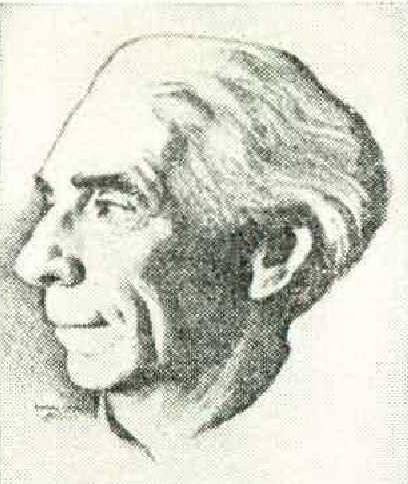
This force is the ‘naked ' or ‘irresponsible’ power of which we read throughout Bertrand Russell’s wise, humane book. He defines it as the sort of power that ‘involves no acquiescence on the part of the subject.’ Yesterday it expressed itself in war-built empires. Today it expresses itself in totalitarian states and in the various drives or drifts toward war and class war. For war is humanity’s Outlet for this insensate power, as the hurricane is nature’s. Its peace, too, is that of the hurricane’s wake — a peace of disrupted communications, of neighbors, communities, classes, whole nations trying hopelessly to understand one another in the dark and able only to pray, scarce knowing for what.
Awareness of this naked, irresponsible power is necessarily implicit in every page of Bertrand Russell’s survey, for there is or may be, as his book shows, a betraying touch of it in every exertion of other specific types of power — the revolutionary, the traditional, the economic, the propagandist, the theocratic. (’Many forms of persuasion — even many of which everybody approves — are really a kind of force.’) The book is, in fact, organized to prove by both history and reason that no one form of power can be regarded as subordinate to any other or derivative from it; that the types of power are always incalculably flowing and merging into one another; that none is good and none evil save by virtue of its results; in sum, that Power in general, Power broadly conceived as ‘the production of intended effects,’ is ‘the fundamental concept in social science . . . in the same sense in which Energy is the fundamental concept in physics.’
If we grant that this central thesis is proved —and in the course of three hundred pages it does, I think, become irresistibly self-proving — we shall have also to accept the author’s common disposal of both the orthodox and the Marxist systems of economics. Both, he shows repeatedly, have tried to isolate a single type of power, that based on economic self-interest, and to treat it as if it were primary and all-determining. ‘To treat economic power as the source from which all other kinds are derived ... is just as great an error as that of the purely military historians whom it has caused to seem out of date.’
But the great objective of Russell’s thinking is not ideological. The problem that interests him is a practical one: the taming of power. If life is to be good for any but the few, the power of governments must be curtailed, yet not annihilated; restricted, but by no means crippled. There must be not enough power to prejudice the’ liberties of individuals and minorities, and still there must be enough to enforce the will of majorities and to get things efficiently done. This delicate and complex problem, the workable balance of power in the good society, — by which is meant the effectively democratic society, —has endless ramifications into our political and economic life, into the sources of public opinion (one of our philosopher’s recurring practical ideas is a press that is nonpartisan because it is omnipartisan), and above all into our system of education from the very bassinet. ‘I should begin in the infant school, with two classes of sweets between which the children should choose: one very nice, recommended by a coldly accurate statement as to its ingredients; the other very nasty, recommended by the utmost skill of the best advertisers. . . . The teaching of history ought to be conducted in a similar spirit.’ If we, like the dictators, began with weanlings, we could rear a generation incapable of both the credulity and the incredulity of the ignorant, immune to the eloquence of the self-interested, intellectually free enough to act by generous emotions, and equipped as individuals ‘to give to human life that splendor which some few have shown that it can achieve.’
WILSON FOLLETT