Turtle at Home
ByWALLACE STEGNER
NOBODY loves a reptile. That is why I have never been able to explain to others my peculiar affection for Achilles. To almost everyone, even those who should know better, reptiles stand for something cold, venomous, repellent. The Adam and Eve story did the reptiles irreparable damage. People do not usually think of reptiles as desirable pets. But Achilles was, and I was fond of him because he was unhuman.
He was a reptile, sure, and his blood was cold, but he was the least harmful of creatures, half gentle buffoon and half philosopher. Between the carapace and plastron that protected him from a hostile world he lived a mild, ruminative, affectionate life, a distinctly unhuman life. When he met disaster it was because for one dreadful moment he was altogether too human. His one tragic flaw of temporary humanity ruined him.
Achilles was a desert terrapin, of the variety once known as “Hollywood Bedbug" because at one time movie stars developed a fad of picking them up and taking them home to scare the maids with. But no movie star ever explored the full possibilities of her bedbug. If any had, cats and dogs would have been as scarce in California as snakes are in Ireland, and desert tortoises would have inherited their place in human affections.
Look at the record. A cat can claw, a dog bite. Achilles couldn’t have hurt anyone if he had tried, which he wouldn’t have. Dogs and cats carry germs, acquire lice and fleas which also carry germs. Neither germ nor flea could find sanctuary on Achilles’ tough rind; he could be flushed off with the garden hose and kept as aseptic as an operating room. Both dogs and cats get diseases, get rabies, get distemper, get eczema, have fits, run in the street and are killed by automobiles, and the children cry. Achilles was completely immune to disease and completely indestructible.
He wandered into the street, yes, and at least three times was run over, but when he heard the thunder and rush of approaching doom he lay down and played he was a traffic button, and if anything ran over him he shrugged it off. Once he was flipped like a tiddlywink into the gutter by a flour truck, but when the earth stopped shaking he poked his head out and looked around and then began clawing himself up onto the curb. You couldn’t have hurt him with an electric hammer.
He was immaculately clean. He didn’t need to be housebroken. He never snoozed in the middle of the hall rug to be stepped on and then smite your conscience with his uplifted paw and his injured eyes. He fitted neatly under the radiators and stayed out of sight. He never came begging to the table. He didn’t have to be put outside at regular intervals. In all the time I lived with him I never once had to groan and slide out of bed and feel for slippers on the cold floor because Achilles hadn’t had his exercise or been taken care of. He took care of himself, and from November until February he simply crawled into a closet out of sight and contemplated his soul. Whenever I opened the closet door, there he was, and I had a comfortable feeling.
Achilles was a comfortable companion. That’s the best word for him. He was comfortable. And when he was awake he was both amusing and instructive.
You do not become friendly with a tortoise overnight. He has a dignity that becomes him, and because the world has taught him to duck, he will duck for quite a while at your approach. But take him into your home, give him the run of the place, let him feel that he belongs, and he will reward you.
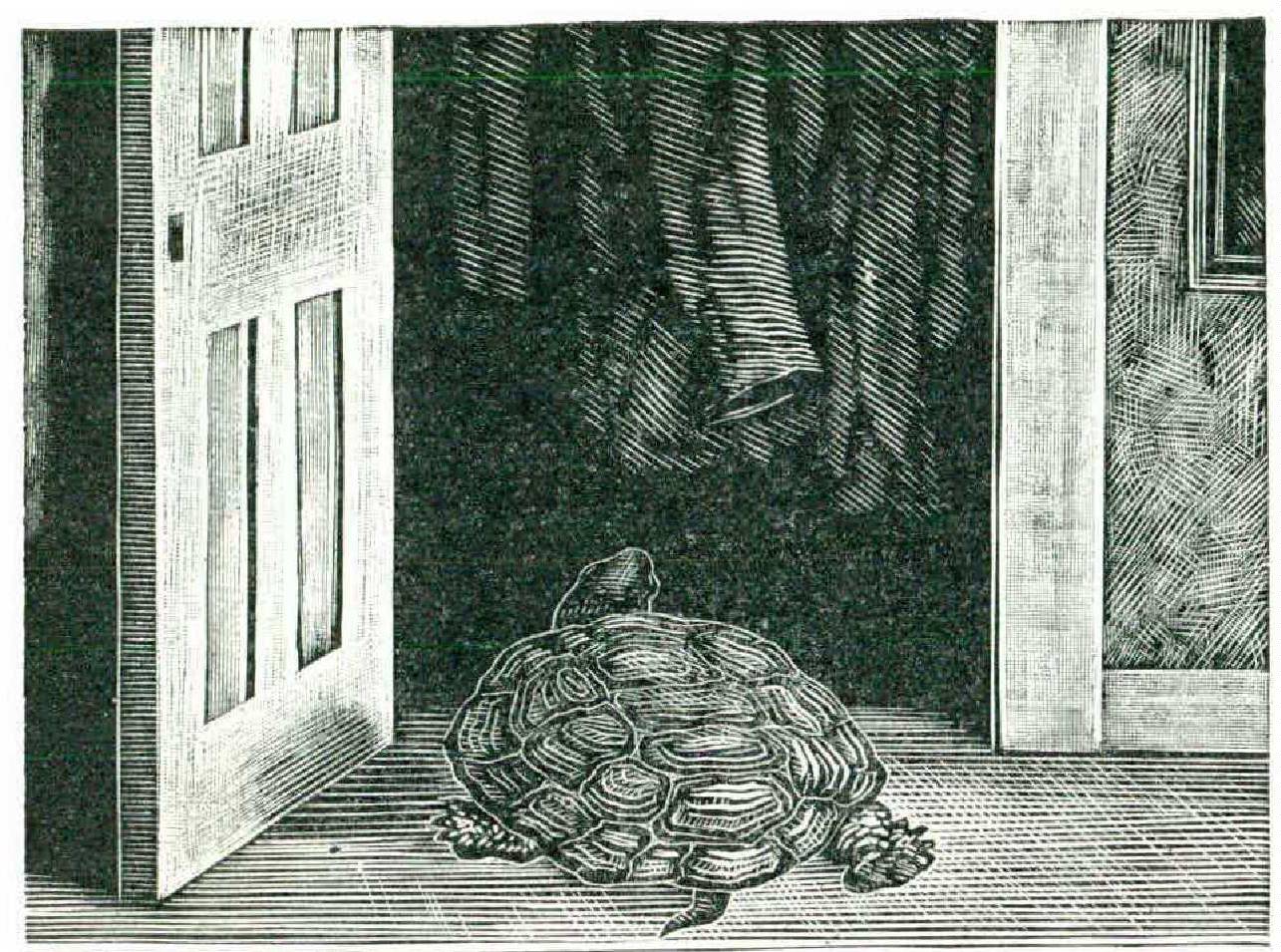
It is best to let him find things out for himself. Put him down in the middle of the floor and let him alone. After a few minutes he’ll stick his horny beak out and look around. If he starts walking, let him walk. Chances are he will demonstrate for you almost immediately that a tortoise is an interested but not inquisitive house guest. He will walk solemnly around the borders of the rug admiring the colors under his nose, elbowing himself along with admirable deliberation.
An instructor in English at Harvard, WALLACE STEGNER is a Westerner by birth and a Vermont farmer by inclination. Here he knocks off work on a long novel to tell us of a friend and companion of his not so distant youth.
If you put a book in the path he has established, he will approach it steadily until it strikes him that here is something that was not here before. He will hiss and pull in his neck and wait to see if the book wants to start anything. If it doesn’t, he will climb over it, bounce on the other side, and resume his walk. He will not go around the book. He will not go around anything. If it is too high to crawl over he will fall asleep comfortably in front of it.
There are distinct advantages to being coldblooded. You or I would fly into a temper and kick the book out of the way, or pick it up and do something about it. Not Achilles. Where our hot blood makes us run ourselves to death in a few years and makes our earthly span a wailing and gnashing of teeth, the tortoise takes life cold-bloodedlythat is, philosophically — and his life expectancy is something over a century.
Cold-blooded he is, and also, in more ways than one, completely self-contained. He doesn’t even have any teeth to gnash over insoluble problems. Insoluble problems put him to sleep. Bad weather puts him to sleep. Anything unpleasant puts him to sleep. And conversely, anything pleasant brings him the pure and undiluted joy that only the innocent and the very wise can know. In his waking months, from February to November, Achilles lived the life of Riley and enjoyed every minute of it.
2
About the end of February he began to thump and rattle around in the closet. When I opened the door the light in his eyes and the sight of my face sometimes put him back in his shell for two or three more days. But eventually he rowed himself out, moving with his peculiarly graceless and apologetic elbowing motion, walking ponderously as an alderman on his flat hind feet. After hibernation his skin hung in folds on his neck and legs, gray old dead leathery skin, but was he bothered by his clownish appearance? Not he. He showed it off. He stood on tiptoe to let light and air get inside his shell. He postured and pranced and preened and did push-ups from the floor with a fine, sensuous, half-lewd delight, and when I picked him up to scratch his neck, or reached in under his shell to tickle him under the arms, he let his legs and tail dangle helplessly, squirmed, wriggled against the lovely tickling. On his face appeared an expression that could only he called a leer.
He was ascetic enough most of the time, but when he went out of training he went with a bang, without reservations, and wallowed in the delights of the flesh. His principal joy in the spring was food. Tethered out on the lawn by a string run through a hole in his plastron, he ate grass like a horse, tearing off beakfuls with a sidewise swinging motion, lifting his wrinkled neck and chewing with his eyes full of placid peace. In an afternoon he could quite literally mow ten square feet of grass. He drank water like a fussy hen, dipping his nose, lifting his neck to let the water run down, leering at the onlookers with his sly and sinful face.
He had a varied diet, naturally. No one who knew Achilles could avoid feeding him, because he took such an obvious and deliberate pleasure in victuals. He loved shell peas, cabbage, string beans. If we had lived together longer I believe I might have taught him to sit up and beg for string beans, which he ate with regular chopping strokes as if his jaws worked on springs. Three bites to a string bean, no more, no less.
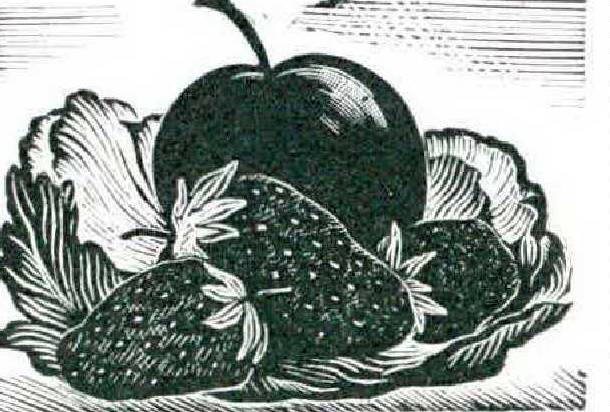
But strawberries were his real fleshpots. They left him giddy, speeded up his reactions, put him almost in a frenzy of bliss. I shall cherish to my last hour the picture of Achilles munching large Marshall strawberries with the juice running down his rhythmic jaws and his whole face beatific. He was Greek, he was Dionysiac, he was young Keats bursting Joy’s grape against his palate fine, he was a Rabelaisian monk with his robe tucked up, glutting himself with pagan pleasures. What reflections of a like charm could one get from the sight of a dog wolfing his carnivorous meals, or a cat washing her face after meat with a fussy, old-maid, New England nasty-neatness?
For three years we lived in perfect harmony, two bachelors who never got in each other’s way, who enjoyed each other’s company, who never took it ill if the other was not in a mood for sociability. And then my landlady, visiting one day, discovered another tortoise, a city gigolo painted all over his carapace in blue and gold, with a gilt border, and brought him home to visit Achilles.
My landlady was an estimable woman, highly religious, and given to humanitarian impulses. Her first thought on seeing this splendid slicker at her friend’s house was to borrow him so that Achilles could enjoy a little company. She knew not what she did.
3
The moment she set the gilded sissy on the rug in front of Achilles the atmosphere was electric. Achilles, a mousy friar beside this court gallant, hissed like a steam cock and ducked. So did the gilded one.
“My goodness,” the landlady said. “They seem afraid of each other.”
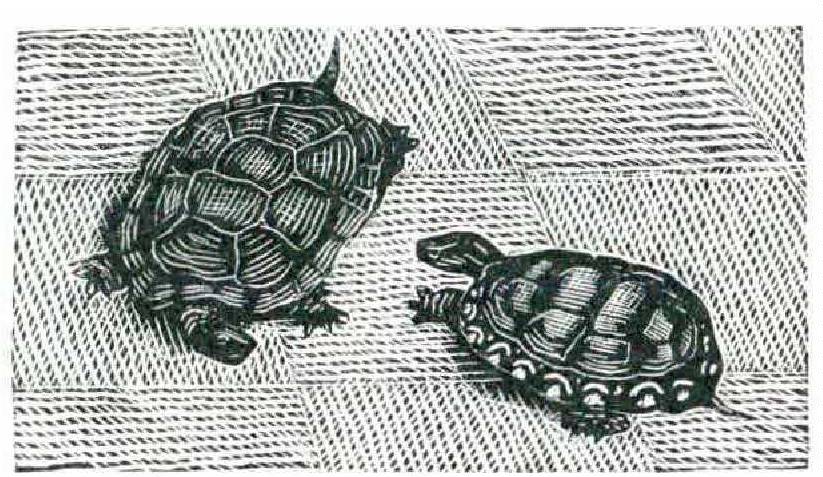
We watched. Slowly Achilles poked his head out from under his shell. The gilded one hissed, and Achilles ducked. Then the visitor poked his head out, and Achilles hissed, and they lay like two concrete pillboxes, immobile and suspicious.
The visitor’s head came out again. He uncurled his tail and let it trail behind. He reached a little with his flippers, digging his painted toenails into the rug, and did a push-up. He stood on tiptoe. If he had had wings he would have flapped them. He hissed.
Achilles hissed back. He watched and waited. “We might see a good fight,” I said, “ if this pretty boy hasn’t been spoiled by civilization.”
“Oh,” the landlady said. “I wouldn’t want. . . . Perhaps we’d better . . .”
“Let ‘em go,” I said, a little grimly. I wanted Achilles to annihilate the gigolo. I had seen him bounce trucks off his back. He was not going to be taken by any town tortoise with painted toenails.
The visiting tortoise was weaving sideward and back, still high on his legs, his neck stretched out. He looked about to rush. Every half second he hissed like a teakettle. Achilles lay with his neck half out, lying close to the floor, and when I looked at him I would have sworn that his face was anything but belligerent, that he wore the same coy leer that he wore when I tickled him.
I had no time to be ashamed of him. The gilded tortoise started a strange weaving walk, stepping high, carrying his domed shell with a clumsy lightness, prancing around Achilles and watching him all the time. Achilles rotated to watch the dance, and his neck stuck out gray and wrinkled, and his beaked face smiled.
The gigolo waltzed all around the rug. He came back to his starting place like a square dancer, sashayed up and sashayed back. Achilles didn’t look fierce, he didn’t look proud. He looked insipid. He liked this sissy.
The truth struck both my landlady and me at the same time. Achilles, the philosophic bachelor, the lusty summer pagan and the winter ascetic, was a lady turtle, and there was no doubt in the world that she was in love.
My landlady, with her mouth open and her face getting red, gave me the kind of look that hangs in the air for ten minutes afterward, and picked up the painted tortoise and fled.
Achilles was pitiful from that moment. For hours after the charmer left she wandered around the rug hissing questioningly. She was no longer philosopher. She was lorn female, and she acted it. For the first time in our acquaintance I saw her unwilling to take life as it came. She could not lie down and go to sleep before this problem. She explored under the radiators, under the sofa. Then she returned to the middle of the rug, where the miracle had happened, and lay down as if waiting for it to happen again. To spare my own feelings, I took her out and staked her on the lawn. But she wouldn’t eat. She lay in the middle of her shell and hissed.
When I went out two hours later she wasn’t there. The broken string lay across the unmown lawn, but Achilles, that Rosalind in boy’s clothing, had disappeared. Whether she ever found her gallant in weathered gilt or not I do not know. Somewhere, perhaps, she did. Amor vincit omnia.