The Trouble I've Had or Victory in the Garden
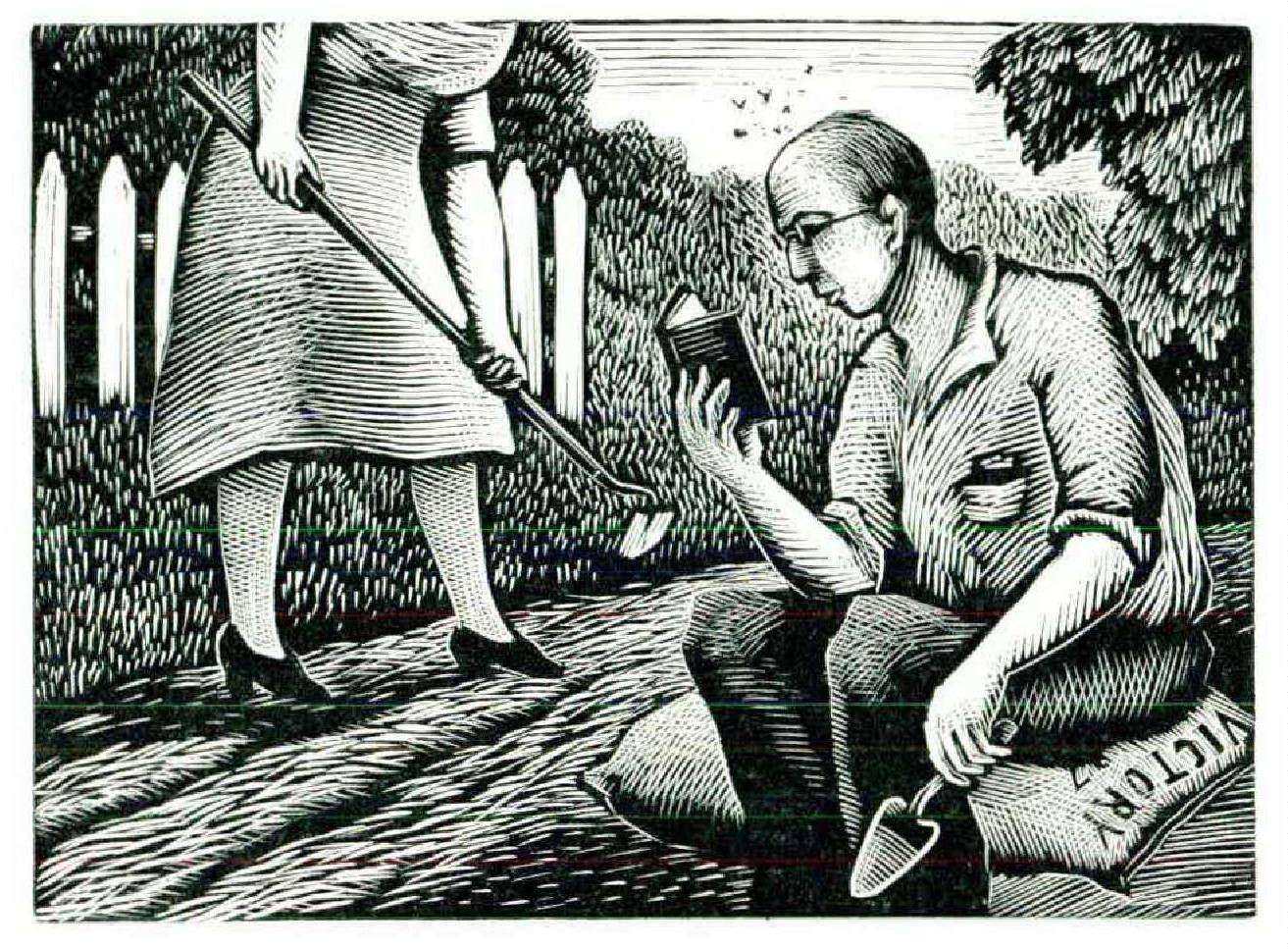
THE trouble with garden books is that you can’t stop reading them. The trouble with gardens is when you stop weeding them. While everyone knows that a vegetable garden is a jealous mistress, garden lovers realize that it becomes an ogress when the fruits come in. The earth will wait for no man when the crops mature. Our family blush en masse when we think of those first tender beans for which we waited so long. They shrewdly concealed themselves under the green leaves until they were too tough to be taken lightly.
The game of hide-and-seek developed in four years to the place where we detected desiccated tomatoes every time we turned away to wipe off the sweat. The garden won the game eventually because we had to go indoors and start canning. No meals, no laundry, no time for our neighbors just processing, and no time to read the canning books to see whether to use cold pack or the so-called fun of our grandmothers. Take it easy on books and gardens; don’t get drugged by books or outwitted by vegetables.
Let us approach the garden book gently. While most things can be found in many garden books, it seems impossible to find all the simple things in one book. Most authors try to catch all comers — the beginning gardener, the one with a little experience, and the one with a good deal of experience. The prayer for simplification is rarely answered.
Let’s assume you have a small piece of land that can be used for vegetables. Don’t get worried, you can grow some. For books, one simple garden encyclopedia or comprehensive garden book plus one modest-priced vegetable garden book will do the trick. Recommended: —
America’s Garden Book, by Louise and James Bush Brown (Scribner, $3.50)
The Garden Dictionary, edited by Norman Taylor (Houghton Mifflin, $7.50)
The New Garden Encyclopedia, edited by E. L. D. Seymour (Wise, $1.98)
The Vegetable Garden, by Edward Irving Farrington (Ralph T. Hale, $1.25)
Grow Your then Vegetables, by Paul W . Dempsey (Houghton Mifflin, $2.50)
How to Grow Food for Your Family, by Samuel R. Ogden (A. S. Barnes, $2.00)
Home Vegetable Gardening, by Charles Hebron Nissley (Rutgers University Press, $1.50; also Pocket Book Edition, $.25)
Next should come two seed catalogues. Take these various items in the spring, mix with a little beer to relieve the confusion.
If you neglect the introduction to each book, which is usually devoted to selling you the idea of a garden, if you pay no attention to bugs and beetles and worms, and forget types of fertilizer and whether it is lime or potash (or Perlmutter), life will be simpler.
2
Turn over the soil on your land as early as possible (it really should be done in the fall). The experts say 1000 square feet for each person, but don’t take them seriously unless you have the labor to deal with so much land. Can you get cow manure? If so, this is ideal. Otherwise ask your seed store for a general fertilizer. This year a general fertilizer, 3-8-7, will be available. If you start too soon to try to differentiate between the fertilizer which is good for root vegetables and the one which is good for leafy vegetables, life will become as sour as your soil probably is. If there is time for a soil test and it is convenient, fine. The vegetable garden should be a little acid.
Start by reading on how to plant a bean, if you like beans, and then perhaps a few words on radishes and lettuce, carrots, corn, beets. Pick the seed catalogues’ major recommendations, particularly where the word “hardy ” comes in. Add any other easy-growing vegetables that you like and then make a simple plan on paper as to how the garden might be planted. You will probably want to keep clear of melons, celery, and tomato seed. Instead, look forward to buying a few tomato plants and onion sets (yellow onions keep better). Pretty soon, although you are still in your armchair, you will have a fair idea of what you can do.
At this point your wife may stop at the bookstore again for another inspiration. I suggest dodging pretty colored picture books, where you pay for color instead of information, unless they are for your children’s cut-outs collection. Such a
book is Vegetable Gardening in Color, by Daniel J. Foley (Macmillan, $2.50).
Watch out for the Helen Hokinson approach with lush prose concealing a garden club speaker with clean fingernails whose “aim is to offer an absolute maximum of information” and who “wants beauty in the vegetable garden” (quotation from Wake Up and Garden, by Ruth Cross, Prentice-Hall, $2.95). But you might want to pick up a volume full of exact drawings, examining some of the drawings first to see if you can understand them. (Best one: The Food Garden, by Laurence and Edna Blair, Macmillan, $2.00). Or you could add that other general vegetable book which many think is tops: A Manual of Home Vegetable Gardening, by Francis C. Coulter (Doubleday, Doran, $2.50).
Someone will soon tell you of those fascinating government or state agricultural pamphlets. They are 99 per cent for professionals, and even though they are cheap, they had better be postponed until your garden grows up.
3
Now with seeds in the closet — and very few are needed (see instructions in the catalogues on number of ounces to so many feet) — and some fertilizer available, a hoe (both a regular one and a scuffle hoe), a spade, a rake, a trowel, you are ready for that spring day to come. If the soil crumbles nicely in the hand, go to it. Extra time to make the ground level not only makes planting easier but will distribute the rain evenly and avoid quick evaporation.
With any but the smallest garden a wheel hoe is essential. The bigger the wheel, the easier it is to push. When you are ready for planting the little seeds which have so much power in them, be sure they are planted thinly in absolutely straight lines —use a line and stake. This will save endless time. Label carefully. And if you are going to use a wheel hoe, measure exactly with the prongs two or three inches off each side, so that they miss the vegetables and throw a little dirt up on the plant stems, thus covering the beginning weeds and saving hand-weeding. Plan to cultivate all the garden every week, not too deeply, but just to destroy that first green cover of weeds that will be six inches high in another week. Seeds go in the ground about three to four times the depth of their diameter. Be sure they are well pressed down.
Now is the time to think of those guests who come for the day or the week-end as the weather improves. The first visit is when the weeds cannot be distinguished from the vegetables. Recommendation: offer one beer for two hours of work. Later, when you can see the vegetables, you might raise the price, get a little more work out of guests, and lose fewer vegetables.
At last you see those dainty rows of green things with the weeds out and life growing. Destroy life. Thin cruelly. Eat what you can of those taken out, but thin anyway, trying to transplant the kinds of vegetables, such as cabbage, which your books say
you can. Don’t be afraid of the little plants, for they are quite hardy if you keep some soil on the roots. Don’t transplant in the hot sun. Press the soil firmly around them in their new home and pour on water.
What to do with the weeds? Pile them in a corner somewhere until you have time later to organize your compost heap, but don’t torture the weed by burning it, as one author suggests.
The garden books fail to mention the value of putting chicken manure under the corn, which is likely to bring it thigh high by July 4 instead of knee high.. A very small amount accomplishes wonders, just as in the old days the Indian put a dead fish under his corn hill. And why won’t the books tell you that if you could get a little pig manure to put under your vines — tomato, squash, cucumbers — you would save any amount of growing time.?
And now, as you eat the first radishes, small lettuce plants, and early onions, is the time to replant the empty rows, not with the same thing in the same place, hut with beets, perhaps, where the onions were, beans where the radishes were. Hoe and thin the corn about now . Don’t touch the bean leaves when they are wet.
4
The barbarians in the form of bugs and diseases begin to attack. Since it would take years to know all about the various forms of barbarians, the easiest thing is to get an allover dust spray from your seed man and put it on when the plants are wet. You can save about everything. If you don’t like the looks of any of the big bugs, you might pick them off and pickle them in kerosene. For entertainment read Insect Invaders, by Anthony Standen (Houghton Mifflin, $3.50). And if you will stroll through your garden every day, it will get used to you. You will begin to spot the things that are going wrong, particularly if you have now reread the sections in the garden books that have to do only with the vegetables you have planted. Most summers the garden tries to dry up. Cultivation, level land, humus delay this, but if you have to water, do it thoroughly — don’t just sprinkle.
One useful tip as to eating your winter vegetables: unless you have a good year’s supply for your family of all the vegetables, keep most of your supply of winter vegetables unused as long as you can buy fresh vegetables cheaply.
Many amateurs get fun by not completing every job, but by varying tasks. For example, cultivate four rows, hand-weed one, replant a row, and then go back to cultivating. Those in the know highly recommend a loaf and a cigarette every hour or so; and as the sweat, pours off, one can say “Look what I done!”