The Spirit of "Eight-Fifteen"
By PAUL BROOKS
THE late automobile was first a toy, then a utility, finally a way of life. The bicycle has had a longer and a spottier career. Like Gulliver’s Travels and the blowgun, an article originally designed for adults became standard equipment for the young.
As a sport, bicycling early lost its amateur standing; the “Boneshaker,” the “Phantom,” the “’Xtraordinary,” and the “Kangaroo” yielded to the prosaic safety bike; the sportsman who used to do his century from dawn to dusk sat down in a smoke-filled arena to watch a six-day professional grind. Now the bicycle is back in the middle of the road, shorn of its fat tires and Superman gadgets. It is an adult instrument, as it has always been in Europe.
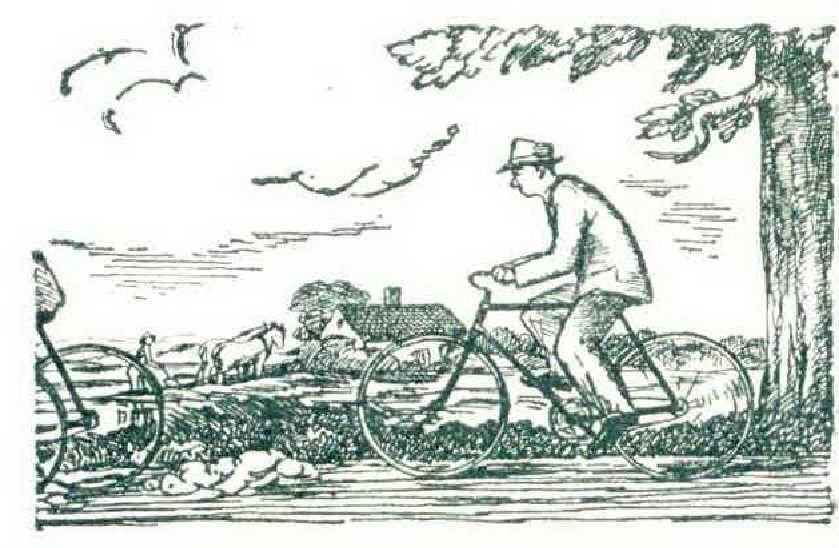
But just because it is a necessity, we need not think of the bicycle in terms of a plow horse. Even the commuter’s trip to the 8.15, prosiest of life’s journeys, becomes on a bicycle a daily adventure. I give you a typical morning in June. Distance to the station 2½ miles, time allowance 15 minutes. At eight o’clock the bicycle is led from its box stall amid garden tools, preserve jars, a Kiddie Koop, and a brooder full of young chicks.
As the rear wheel passes over the electric cord, the light in the brooder goes out. The front tire is soft; the pump, mended with adhesive tape, compensates for lack of pressure with a musical whistle. A turn around the driveway, a nod for the pig and the goat, and we are off, skirting puddles from last night’s rain, posting to the bumps of a washboarded road. We — the Spirit of Eight-Fifteen and I— slow up to check on the neighbor’s garden. Peas already in blossom? But the cutworms have got two of his tomato plants. A chipmunk squeaks across the road, a red squirrel clacks metallically, and the red-eyed vireo is singing, as usual, from the maple by the post office.
Overtaking three cyclists abreast, we face a problem of etiquette. A loud throat-clearing may win road room but leaves the dilemma of riding socially and suicidally four abreast, or scooting ahead to a muttered chorus of “Scorcher!” We scoot ahead, dodging a painted tortoise and zigzagging to squash tent caterpillars (a sport comparable to slalom skiing, and one in which a friend of mine recently broke a leg). The June smells are good: hay in the uplands, wet pine needles in the low —following the bitter skunk cabbage of April, the lilac and apple blossoms of May.
The Spirit of Eight-Fifteen, feeling now like Ferdinand the Bull, shies violently at the ear-splitting klaxon (will they never learn that you can hear them a quarter mile away?) and alien smell of a passing car; but the lowering gates are already in sight, bicycles tangle in the freight house like fishhooks in a tackle box, and the morning race is run.
The evening race is slower, since we remembered to bring home that 50-pound bag of hog feed and a gallon of creosote.
2
“The Effect of the Bicycle on American Apparel of the Forties” will be a subject for future monographs; only a few field notes are now possible. The starched collar is on its way out; not even the crispest executive can keep that well-tailored look while pushing up a long hill in July. Vests and trouser cuffs, already discouraged by OPA, are getting their coup de grâce.
Hatlessness increases in both sexes, for a flapping brim can put you in the ditch on a fast coast, when you’re bent low over the handle bars. The female halter — or better, perhaps, surcingle — has spread from the beach to the highroad; shorts are worn to and from dinner dances (with the party dress safe in the basket), until the movement of right flank and left flank, once military secrets, becomes no longer even confidential.
There has been a similar healthy and astringent development in the social routine. No one in his right mind will cycle four or five miles to dinner unless he can count on red meat, good company, or both. Organized boredom is therefore on the wane. Meanwhile, the remaining social gatherings have taken on an economic tinge. A wedding is more than a receiving line leading to the punch bowl. It is a chance to exchange a quart of strawberries for someone’s extra broccoli plants; a roll of chicken wire for a bag of seed potatoes. As the harvest season approaches, the most formal functions will begin to look like Nizhni Novgorod or the Iowa State Fair. “ . . . we plan to be married in August, when the summer squash is ripe.”