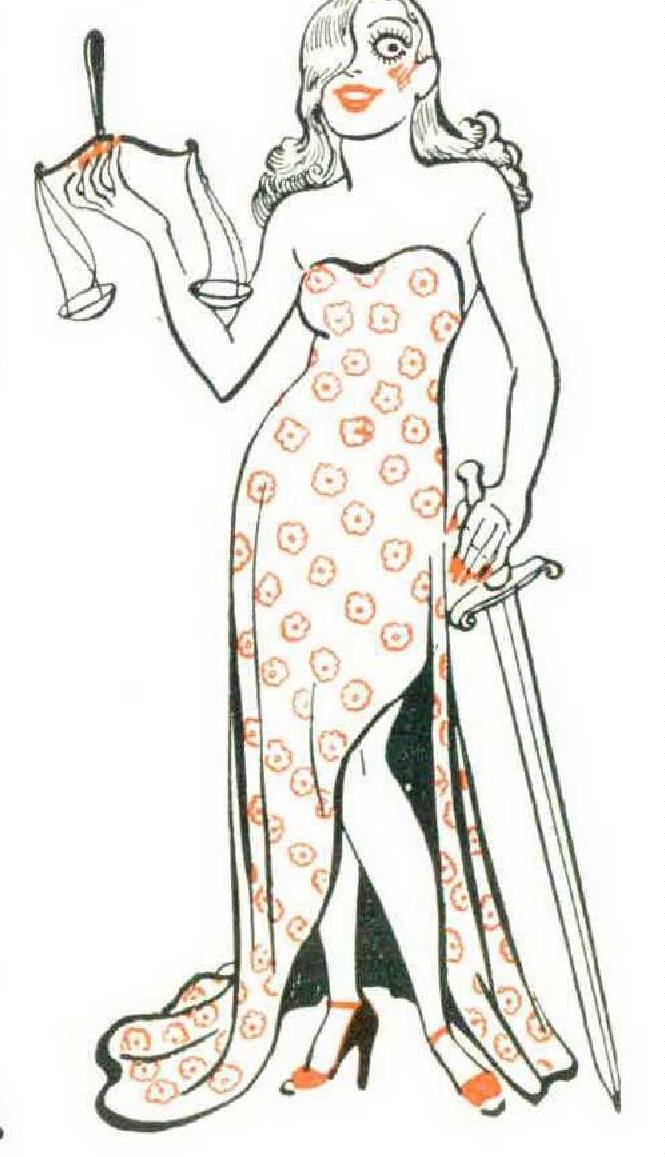
Objection Sustained!
By NEWMAN LEVY

I WAS born and reared in the practice of law. While other boys frivoled away their time with air rifles, slingshots, baseball bats, and similar lethal weapons of youth, I used to sit indoors playing contentedly with a demurrer or a subpoena duces tecum that had been given to me by my doting parents. Demurrers have been abolished in New York State, but I still remember with affection those cherished playthings of my childhood.
These early habits still cling to me. When I go to the movies I like to see a picture about law and lawyers. This is not a busman’s holiday; rather it is a pleasant escape from the realities of my daily occupation.
For the practice of law, as it is revealed upon the screen, bears about as much resemblance to the real thing as Walter Huston does, let us say, to Ambassador Davies. Motion-picture law is a rare and beautiful thing, and if lawyers and judges were not so tied down to crusty tradition they might learn some useful lessons, and the world would be a sweeter and better place.
Judges in the movies are invariably dignified, courteous, and handsome. This is not an important departure from realism, although it is one that will immediately be observed by any experienced lawyer. The judicial charm and urbanity are compensated for, however, by a serene ignorance of the elementary rules of law, a condition that happily does not exist in real life. These judges never fail to sustain the bad objections and overrule the good ones, and their comments from the bench must undoubtedly cause the late lamented Chancellor Kent to spin dizzily in his grave. Their record of reversals on appeal I am sure is staggering.
A few years ago I made a discovery that throws some light upon the eccentricities of Hollywood law. I was visiting a studio where a courtroom scene was being shot. I walked over to the judge’s bench during a lull in the proceedings to examine the ponderous tomes that he was studying so learnedly. One was the Los Angeles Directory for 1992, one was the Motion Picture Register, and there were three novels of Bulwer-Lytton. How can you expect legal erudition from that kind of library? I knew that judge was a fraud the moment I saw how polite he was.
The most fascinating thing to me about a motion-picture trial is its gay, unrestrained informality. Everybody takes part just as in the Town Hall Meeting of the Air, and if Lionel Barrymore is in the courtroom he answers the judge back and calls him Henry.
It’s all nice and friendly. Spectators keep bobbing up from all parts of the courtroom to prompt the witnesses and interject unsolicited remarks into the record. The defense lawyer, who, judging from the way he tries his case, seems to have gone to the same law school as the judge, never bothers to object to the unorthodox procedure. Perhaps he has a premonition that the missing witness, who is speeding along the highway at ninety miles an hour, will arrive just in time to dash into the courtroom, upsetting court officers and spectators, rush into the witness box, and exonerate the defendant by confessing that he did the murder himself. So why should the lawyer worry about an occasional procedural irregularity?
I wonder if the jolly, carefree atmosphere of these trials may not be due to the fact that they generally turn out to be family affairs. It is astonishing how everybody is related. I remember one case in which the defendant was the young lawyer’s long-lost mother, one in which the district attorney was engaged to the defendant’s daughter, and one in which the judge was found to be the childhood sweetheart of the murderer’s mother. It has been revealing to observe how often the judiciary is romantically involved in these cases. Many times in the midst of a discouraging litigation I have wished that the judges before whom I practice had not lived such impeccable sex lives. It would be comforting to know that even though my adversary had me licked on the law and facts, the sour-faced judge on the bench was nursing a secret passion for my client’s aunt.
2
The busy lawyer who spends his days tangled up in the intricacies of legal procedure must be filled with envy at the charming simplicity of the Hollywood system. Take the foreclosure of a mortgage, for instance. Ordinarily this is a job that involves a considerable amount of work, delay, and red tape. In Hollywood, however, all that is needed is to walk into the premises and wave a document with a large seal on it in the face of the frightened victim. Fortunately the method of canceling a mortgage is equally simple. Someone, generally the missing son, dashes in from Alaska, South America, or somewhere, snatches the document, and tears it into fragments. That is all there is to it. No fuss, no red tape, no filing fees.
There is one curious misapprehension I have met repeatedly in motion pictures, and that is that a wife may not be a witness against her husband. I cannot recall how many beautiful girls I have seen cajoled or coerced into unwilling matrimony to seal their lips. Of course, the opposite is the fact. A wife may testify against her husband — which Hollywood could have discovered by the simple device of asking some lawyer. Maybe they found this statement of law in the Los Angeles Directory.
There are dangers in the practice of motion-picture law that might well terrify the genuine practitioner whose greatest occupational hazards are nervous indigestion and disbarment. I do not reler to such elementary risks as drinking poison in the courtroom, which, I am informed, was a customary practice of those real-life mouthpieces, Earl Rogers and Bill Fallon. Any lawyer worthy of the name will take a dose of cyanide in his stride.
No, practicing law on the screen is a man’s job, and the successful practitioner has to combine the qualities of a Demosthenes and a commando. I have in mind as an illustration a masterpiece in technicolor that I saw recently (the name escapes me), in which the guilt or innocence of the defendant depended upon whether the body of the alleged victim was at the bottom of the sea in a shipwrecked vessel. Most of my cowardly associates would have hired a professional diver to go down and find out. Possibly I might have done so myself. But not the lawyer in this case. He said he was going down in a diver’s suit and find out himself if the girl was there.
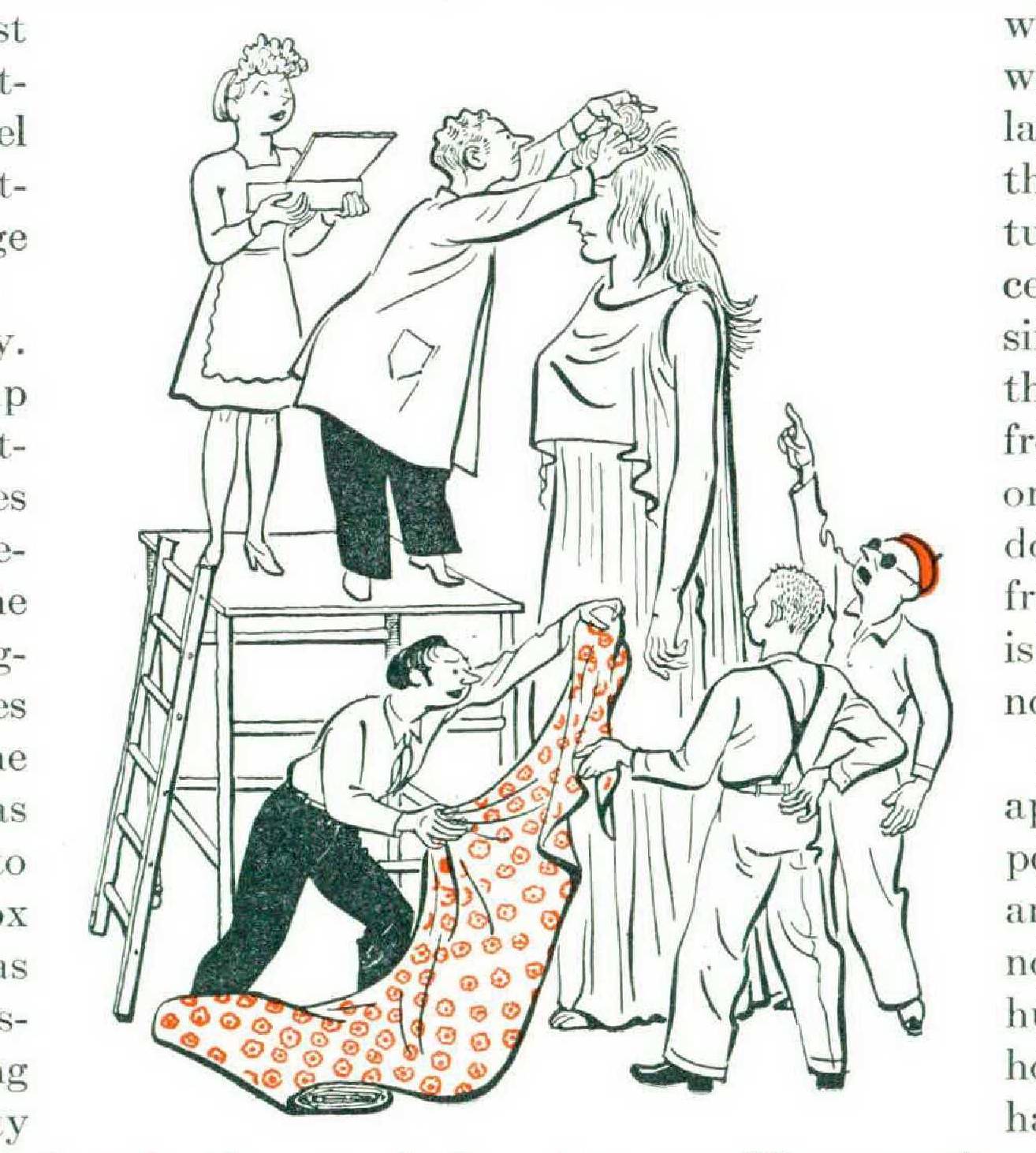
It was what the Lord Chancellor in Iolanthe would have described as “a nice point.” The judge pleaded with him and tried to dissuade him. There was nothing in Pollock on Torts on the subject, nor in Chitty on Pleading. It was doubtful whether even Clarence Harrow had ever donned a diver’s outfit. But this young lawyer was determined, and down he went. After battling with an octopus and also with the real murderer — who happened to be in the neighborhood also in a diving outfit — and after the air tube became hopelessly clogged up, he emerged at length, breathless, but triumphantly clutching a fragment of the corpus delicti. It was the sort of thing that made me proud of my profession and glad that I had not taken up undertaking or plumbing instead.
Sometimes when the daily grind becomes particularly vexatious I wish rather wistfully that I had been admitted to practice at the Motion-Picture Bar. It might be disconcerting to discover that the client I was defending for felonious assault was none other than my little sister who had run away to sea in her infancy, and that the judge who looked so stern and imposing in his silken robe was still cherishing a sprig of mignonette that my mother had given him fifty years ago. But it would be consoling to know that, after I had acquitted my client, Paulette Goddard, Rita Hayworth, and Lana Turner would be waiting in the courtroom to fold me in their arms and tell me what a great guy I was.