The Pea Coat, or Jacket
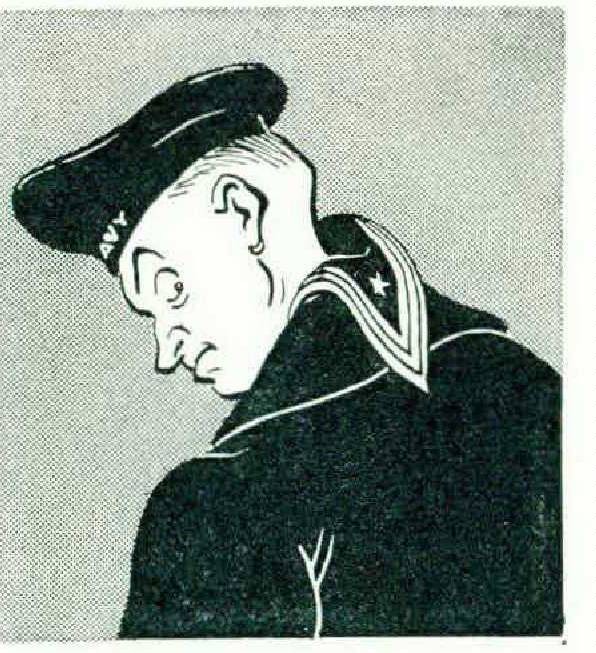
Ever watch a bluejacket maneuvering to put on his close-fitting, short coat without mussing the big, awkward, to say nothing of perverse, collar of his dress jumper?
AS EVERYONE knows, As there are ways and ways of doing things.
There is the right way and the wrong, the good way and the bad, the easy way — and the way most of us do it. In the Navy, however, there is but one way of accomplishing a task. This is known as the Navy Way.
Occasionally, the Navy Way is relaxed to the extent of permitting the doer an alternative; that is, it may allow him his choice of as many as two (2) courses of action. This is true in the case of the donning, or putting on, of the overcoat worn by bluejackets.
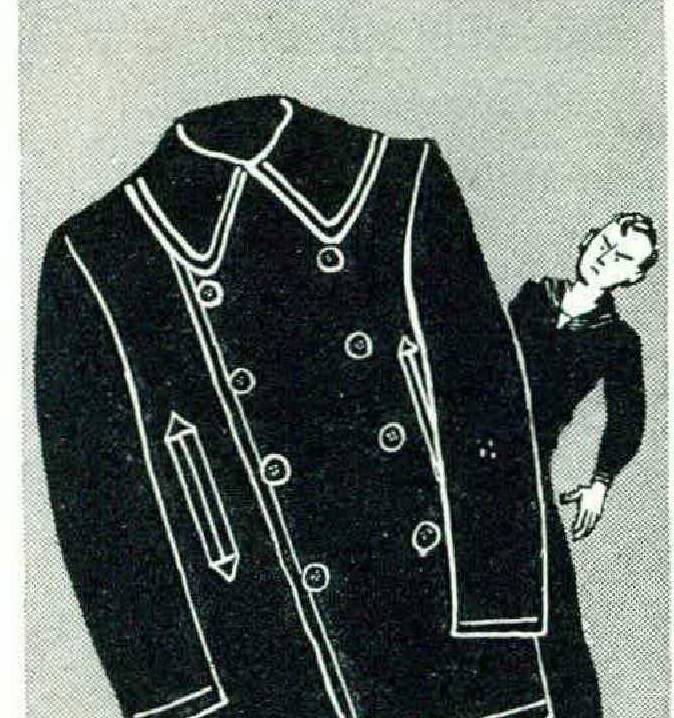
This garment is dark blue in color—at least when new, and for a short period immediately after it leaves the hands of a competent cleaner. It is equipped with twin rows of large buttons, any one of which is likely — nay, guaranteed — to detach itself with or without the slightest provocation; this usually occurs just prior to Captain’s Inspection or when the owner is attempting to shove off hurriedly on a week-end liberty in Boston. Finally, it is of a length designed to permit the wearer to chill his posterior thoroughly on leather bus seats of a winter’s morning while returning from such a liberty.
According to the Navy’s quaint nomenclature, the garment in study is customarily titled a “pea coat” or “pea jacket” — although it is frequently called other things. This name has its origin shaded in antiquity, all research on the subject having proved fruitless.
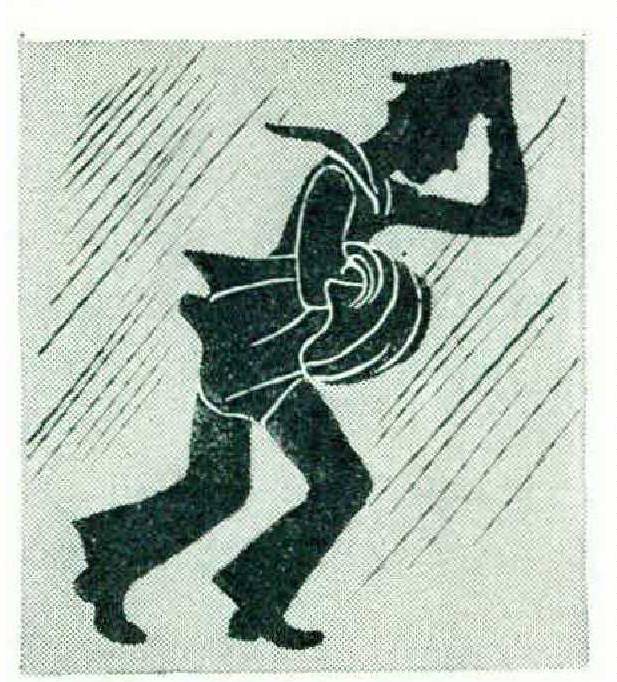
The writer, an antiquarian of some repute, confesses himself baffled as to the source of the vegetable part of the title. Certainly the pea coat, or pea jacket, is not so named because of any legumelike hue — although, on second thought, this might be possible after the wearer has undergone a brisk workout in the mess hall. Nor can it be because of the garment’s texture or weight. After exposure to a Newport (or San Diego) shower, any thought of a resemblance in heft between the jacket, or coat, and a pea, or even a barrel of peas — well, it’s just too ridiculous!
W. S. B. TATE is editor-in-charge of the Service Schools’ section of the Navalog, weekly publication of the U. S. Naval Training Station at Newport, Rhode Island, where he is a Specialist (Teacher) First Class. He received part of his education at Andover and at Middlebury College. This is his first appearance in the Atlantic.
But to return to our original thesis — the putting on of the coat, or jacket. Let us assume a situation. You are a young bluejacket fresh out of a recruit battalion, home on your long-awaited “boot leave.” You have taken your girl to dine in one of your town’s better hostelries. After an enjoyable dinner, you obtain the check from the waiter, indulge in some rapid financial calculations, and, ready to leave, reach for your pea jacket, or coat.
At this point, we must digress for a moment and explain the two methods of installing the garment so that the finished job will conform fairly closely to regulations. The first of these is the Overhead, or “Salty,” method. This entails grasping the garment with both hands in front of one and then — with a series of convulsive movements — elevating it sufficiently to clear the top of one’s head, finally permitting it to settle like a feather over one’s back and shoulders. One detail of this operation is that, during the process, one’s arms should somehow find their way into their respective sleeves. Of course, this is merely a detail.
At any rate, eager to impress your girl, you decide upon the use of the “Salty” method — for the first time in your Navy career, it so happens. At once all hell breaks loose. Through some error of judgment or timing, you have already put on your hat: with your first motion, it lands three tables away. Retrieving it, you try again. This time, using too small a sweep, you uppercut yourself smartly with the collar. A quick recovery off the ropes and you are ready once more. This time you effcct the garment’s trip through space without interruption, and you note with satisfaction that your arms even have sleeves around them. But what’s this? A our first attempt at a sigh of relief reveals a shocking fact: the damned thing is on backwards.
At this point you leer sickeningly at the girl friend, with an “ I planned it that way” expression. Quickly, you remove the coat, or jacket, — although by this time there is no doubt in your mind about what to call it, — and switch your tactics to the use of the second, somewhat more familiar method.
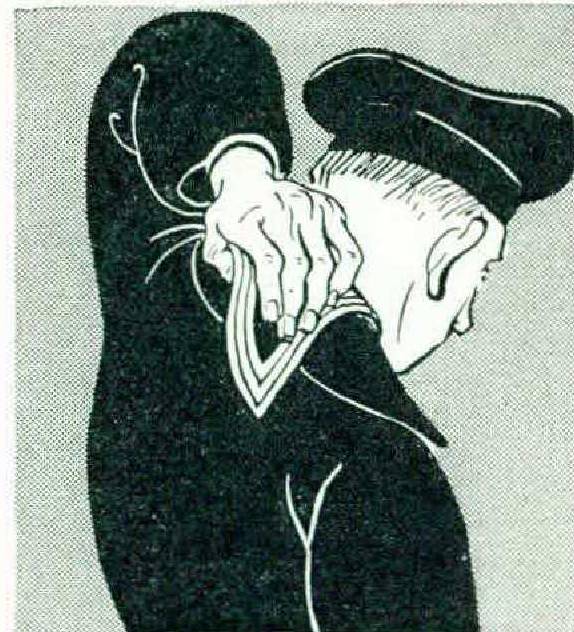
This second method, known as the Reverse Anterior, or “Shrug,” system, was developed, it is now believed, by a Pawnee medicine man who owned a portable wigwam. (Hence “tepee jacket” — later contracted?) It is also, though more formally, called the Physical Drill With Arms method. This involves the conventional successive insertion of the prospective wearer’s arms into the sleeves of the garment, followed by a leaning backward in a manner similar to that used by lady contortionists in picking up handkerchiefs from a stage.
From this position one lunges forward at the psychological instant, at the same time flapping one’s shoulders in a violent, though imaginary, rhumba. Coming to a sudden stop, one determines the success of the operation by an exploratory probing with the hands at the back of the neck. An excessive bunching of heavy cloth at that point indicates the need for further attempts.
You swing, then, into the routine of the “Shrug,” confidently and with even a suspicion of nonchalance. Ah, just as you hoped: success the first time! Grabbing your hat, you put it on—only to find that it will not fit over both your head and your jumper collar, which is now hugging the back of your neck in true Elizabethan fashion. You tear off the jacket, or coat, and try again, backing into a laden coat rack, which topples heavily to the floor. This attempt is also unsuccessful and, what is more, you manage to gag yourself with your neckerchief.
Rallying every resource and all of your determination, you make what is to be your supreme effort. You creep up on the heavy blue nightmare in approved commando style, seize it firmly, take your proper stance, follow every remembered direction explicitly, and eventually succeed in encasing yourself snugly within its folds.
nation, you make what is to be your supreme effort. You creep up on the heavy blue nightmare in approved commando style, seize it firmly, take your proper stance, follow every remembered direction explicitly, and eventually succeed in encasing yourself snugly within its folds.
You escort your patient friend to the door; and a kindly, though firm, old gentleman taps you on the shoulder and suggests that you return his overcoat.
Not long afterwards, on the sidewalk outside the restaurant, you exchange a mutually cold and formal farewell with your erstwhile girl friend. Then you turn and stride away into one of the worst blizzards in New England’s history — your pea coat, or jacket, dangling over your arm.