Corn
By LT. FRANK C. HIBBEN, USNR
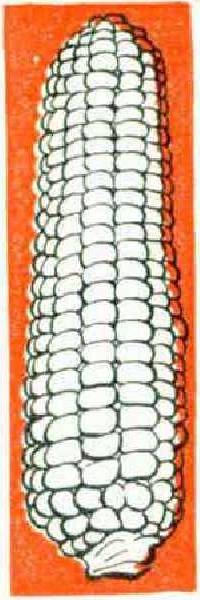
THERE is a humble plant that everybody eats and nobody really knows. Ancient civilizations were based on it; modern America depends on it. It is helpless to grow and seed itself without man, and man is well-nigh helpless without this plant. Man developed it, and it developed early America. This plant is corn, which typifies American agriculture.
In the first place, “corn” is a misnomer. The word “corn” is an old Greek word which means any kind of kernel or grain. In old English writings you can come across the words “pepper corn ” or “ barley corn” meaning grains of these foods. We use the term in “corned beef,” which is beef prepared with “corns” or grains of salt. Corn as we know it should really be called “maize,” for that is the original Indian name for the product. However, if a restaurant advertised maize on the cob, I dare say very few would order that item from the menu.
The very fact that we in the United States use the word “corn” without ever a thought that it might mean something else is indicative of the importance of this plant in our life. Corn is more important than all the other grains grown in the United STates. In farm value, it far outweighs any other grain commodity grown in this country.
Corn is not American because we made it so. It has always been so. When Columbus landed, first in the West Indies and then on the mainland of South America, he found the Indians everywhere growing the plant which they called maize. As the European whites pushed into the eastern fringes of North America and also South America, they were amazed to find Indian tribes of every conceivable variety growing this particular plant. Over most of this area it was the major agricultural product.
Our early settlers were equally amazed to find that this corn which the Indians grew with such skill was already diversified. The Indians were planting and harvesting over three hundred different varieties of corn. When the Spaniards finally penetrated into our southwestern section they found, for instance, that a single tribe, such as the Hopi Indians of Arizona, knew and grew eighty varieties of corn.
The Indians of North America and the northern portion of South America had already developed, by the time white men came, every kind of corn which is known today. The Indians of Colombia and Ecuador grew pod corn, which is a peculiar variety with each kernel enclosed in a separate pod. Popcorn, with its characteristic pointed kernels, was a favorite of the Indians of the Middle West. Flint corn was a favorite of many of the Southwestern Indians, who ground the hard kernels into flour between two stones. Dent corn, which is the yellow corn that we see in the fields of Kansas, Iowa, Illinois, and Ohio today, was a favorite Indian variety in those regions.
The Indian farmers of long ago also had soft corn, starchy sweet corn, and all the varieties of corn which we now plant in our Victory Gardens. They had already developed white corn, red corn, black corn, blue corn, and striped varieties. Even the brightly colored kernels which we call “Japanese corn” were a product of the American Indian. The development of corn is closely identified with the development of America.
When we lightly speak of “developing” such a plant, we are dealing with a process which even today is only slightly understood. The domestication of some plant originally wild is a process which involves literally countless generations of such a plant over immense periods. First there must be a guide with understanding of what he wants, and then other men or guides to carry on the work through generations. In the highlands of Mesopotamia it took possibly 5000 years to develop wheat. In China it took an equally long time to develop rice. Corn is much more highly developed than either of these. And corn was developed entirely in the New World, where man supposedly is not so ancient as in Asia or Europe.
Corn as a plant is peculiar. It is a grass, and a very highly specialized grass.
It did not become so specialized through any fault of its own. Man made it that way. By selection, by crossing, by every horticultural contrivance that man could devise, this plant, which we know as corn, was developed from some innocuouslooking, seed-bearing grass of ancient times.
What vision some ancient fellow must have had to start this process!
Can you imagine some primitive hunter of long ago as he sat at the mouth of his cave after an unsuccessful hunt? This man’s empty stomach had stimulated his mind and he began to reason, which is the process that distinguished this man from the animals which he hunted. A bird was eating grass seeds before him. If only those seeds were as large in relation to the man as they were to the bird! Could they be made larger? Possibly by picking out the very largest seeds and those which tasted the best, and planting them next year, he might have a larger plant with larger seeds. The process was started.
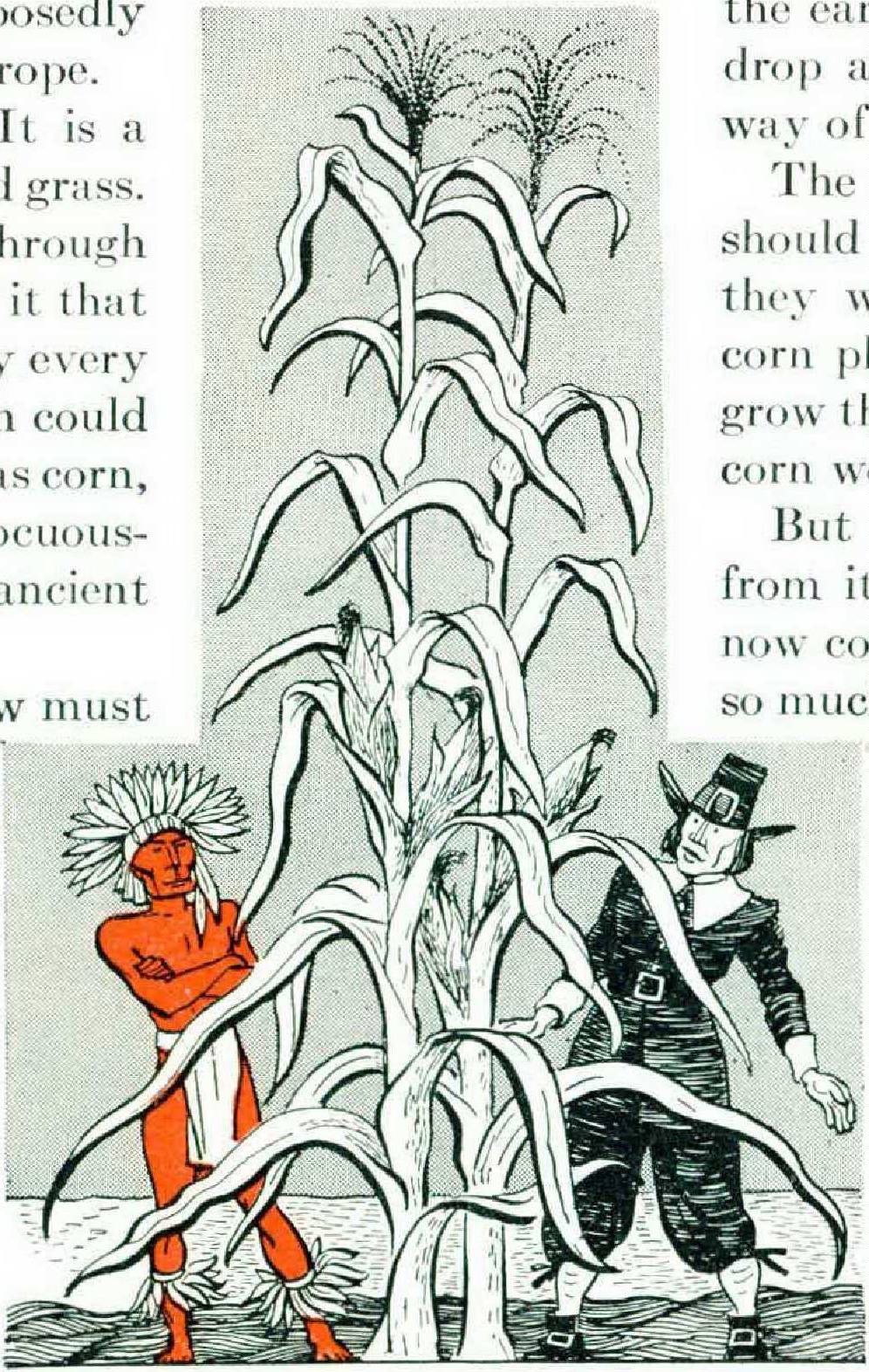
As corn is identified with the development of man so closely, it is of extreme importance to try to trace it back to its original state. Many scientists have attempted to do this, with little success. There is only one seed-bearing grass — which grows in the highlands of Guatemala — which bears any relation to corn as we know it. This grass is called teosinte.
Teosinte will cross-pollinate with corn, but otherwise bears no relation to it, and certainly does not look like corn. Pod corn, which is apparently a native of the northwestern part of South America, may be another ancestor of the corn plant of today.
Whether teosinte or pod corn — or both — was the original ancestor, there is no doubt that the development of the modern corn plant as it was found here when Columbus landed was a very long process. With all that we know of modern horticulture and the development of plant strains, it has been estimated that it would take twenty thousand years by purposeful development to produce the corn plant we know.
To illustrate how highly developed this plant is, it is only necessary to remark that corn has no way of seeding itself. If a corn plant could grow wild, the ear, with the mature kernels, would drop at the foot of the plant, with no way of spreading itself.
The next year, if any of the kernels should sprout from the half-buried ear, they would produce a clump of small corn plants so thick that no ears would grow the second year. The third year the corn would die out completely.
But corn has been developed so far from its original state that the plant is now completely dependent upon man — so much so that it can no longer revert to the wild state. Unless it is cultivated by the hand of man, corn cannot compete with other vegetation; it soon loses out and does not reproduce. Many plants which have been domesticated by man simply turn back to their original form when they grow wild. Corn is so highly developed that it dies out.