Our Slightly Confused Tradition
By W. S. B. TATE
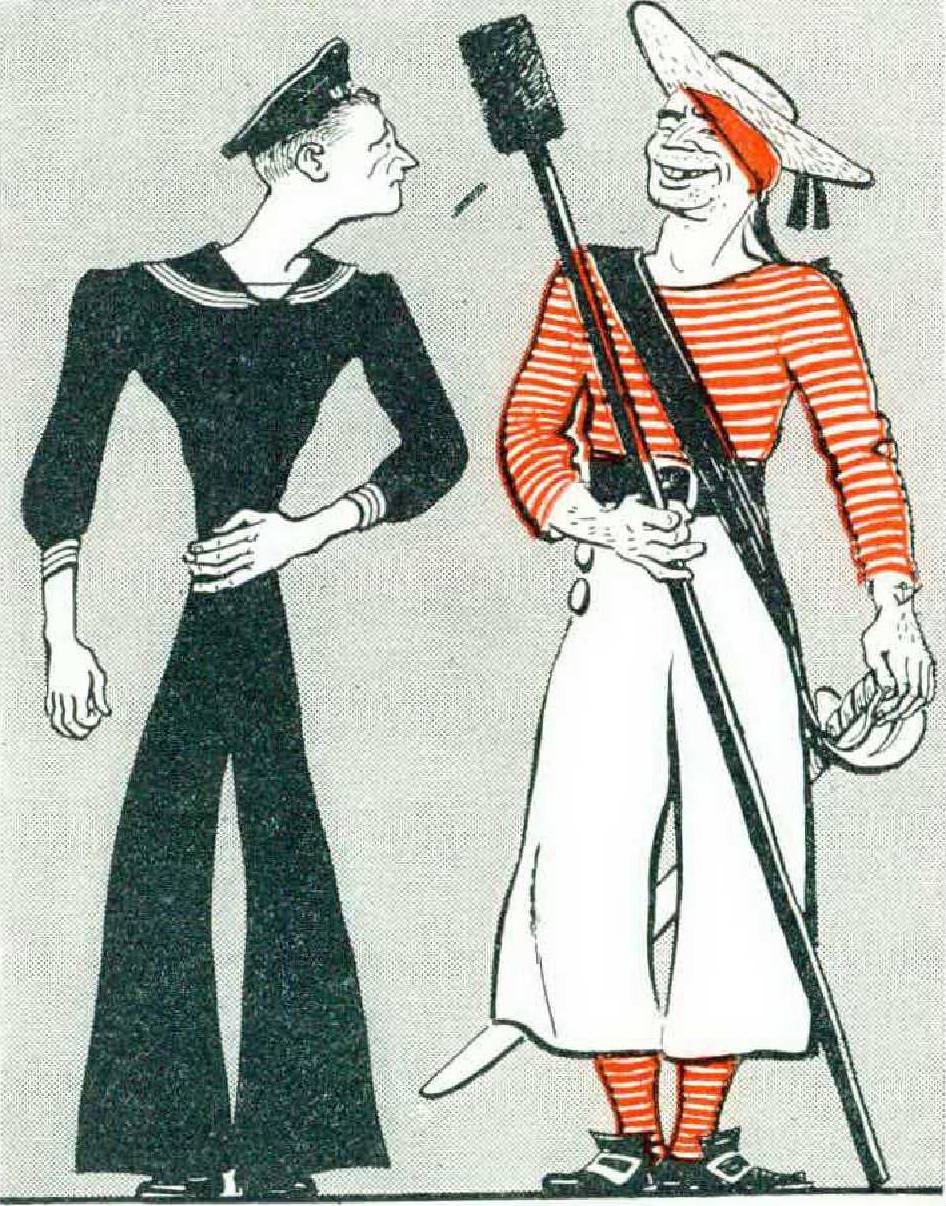
I was a lover of Tradition — a hidebound, pot-soaked lover of it. The Changing of the Guard at Buckingham Palace, the shattering of an emptied wineglass following a toast, Morey’s and the Yale Fence, baked beans on Saturday night— these held for me an ineffable significance. They made me one with a revered past.
Following a certain untraditional event, I heeded my country’s call and planned to become a bluejacket in our Navy — a Navy that is itself wrapped in Tradition, a Navy that seems more Institution than Organization. I was enraptured. My enlistment in that Navy would mean that I could at last express my admiration for things traditional. I thrilled at the prospect of Saluting the Quarterdeck. How I should enjoy the mental calculus entailed in determining the time of day whenever a ship’s clock chimed its double notes. My knowledge of the historic background of the Personal Salute would enable me to render this traditional gesture with a gusto and a polish marking me as a model of military bearing.
With the shrill of an imaginary bosun’s pipe ringing in my ears, I joined the Navy, and overnight my adoration of Tradition became tempered. In my enthusiasm to become a part of Tradition, I had overlooked the fact that, on becoming an enlisted man in the Navy, I must wear a Tradition. I refer, of course, to the bluejacket’s dress uniform, on the specifications of whose components let me refresh your memory.
First, and perhaps most striking, a heavy wool blouse, or “jumper,” theoretically blue, with tightbuttoned cuffs, a V-throat before, and a wide expanse of collar draping the shoulders aft. Constraining this collar, a rolled black neckerchief, loose-knotted and flowing. The whole jumper is so adorned with stripes, stars, bars, emblazonments, embellishments, and what not—these depending on the wearer’s length of service, his type of duty, and the number of times he has been back and forth through the Panama Canal — that it has room, this jumper, for but two minuscule pockets. The outer of these pockets invariably contains a deck of cigarettes, while the inner, which can be reached easily by simply removing the jumper, is entrusted with the sole function of carrying its owner’s most prized possession — his liberty card.
Next the trousers — an essential even in the Navy. Here it is necessary to correct a lay impression that the nether garments of all bluejackets are still bell-bottomed. Wide, yes — but not all are belled; in fact, regulations scowl on the practice. No, when first issued, the legs of the trousers are equal in diameter throughout their length; and it is only after finishing recruit training that some bluejackets — roughly 80 per cent—dash to the nearest tailor shop for a job of “spiking,” or taking in at the knees, which flares their trousers and gives these young salts, they believe, their soigné air.
To continue with the trousers, again we find a dearth of pockets: two more tiny little fellows combining with their mates in the jumper to provide their wearer a total of four pockets and a maximum carrying capacity of perhaps one cubic inch. Thus, if the bluejacket wishes to transport anything bulkier than money or stamps, he must make use of the blouse effect of his jumper; this either makes him appear enceinte or renders him likely to be mistaken for a mother kangaroo out walking her young. After reminding the reader that it is this part of the uniform which features the familiar thirteen buttons, little else can or need be said save to remark that the bluejacket is required not only to wear his pants creased inside out, but to wear them, in the opinion of many, hind side to.
Topping the whole, a round, flanged, flat-crowned, beribboned hat bearing the legend—as though there could be any mistake — U. S. NAVY.
Trying to be fair if not philosophical as I surveyed myself in my new outfit, I decided tentatively that this— this costume must have been retained down through the years because of its extreme practicality. I would make inquiry.
Cornering a grizzled old petty officer, I asked him to satisfy my curiosity. He pressed Lever No. 3 and began. The jumper, he told me, was originally provided with a leather collar to protect it from the oily pigtail affected by Jack Tar of yore. Running my fingers reflectively through my own closecropped thatch, I nodded my informant encouragement.
The hat, he said, was made flat so that it would not be knocked off its wearer’s head by the dangerously swinging booms and gaffs of the days of sail. With a quick sideways glance at a sleek new destroyer riding at anchor in the Bay, I muttered for him to continue.
He told me that the uniform was designed to give its wearer full freedom of movement in the performance of his duties aboard ship, as well as quick access to his limbs should he fall overboard.
With voice cracking somewhat hysterically, I brought the old fellow up short. Why was it, I challenged him, that for a broad-shouldered, normal-waisted man to get in and out of a reasonably fitting jumper required all of his own wriggling exertions plus the zealous administrations of at least two shipmates? And, I snapped, how come a man, if he cared to wear pants that fit, must sacrifice his eternal privilege, his natural right, of sitting down in comfort and without fear? Speaking of pants, I snarled, since when had thirteen buttons (one for each of the original colonies) replaced the zipper in ease and speed of operation? And besides, — I screamed this last reproach at his rapidly retreating back, — who ever heard of bluejackets wearing their dress uniforms at sea in time of war?
Obviously I should get no satisfaction from Navy sources; I must conduct my own research. Surrounding myself with books, I set to work.
I learned that the whole ensemble is patterned after the uniform of the British sailor; that the triple stripes on the collar and cuffs of the jumper commemorate the three great English naval battles
—the Defeat of the Spanish Armada (1588), the Battle of the Nile (1798), and Trafalgar (1805); and that the black neckerchief is worn in mourning for England’s inspiring naval hero, Lord Nelson (1758-1805).
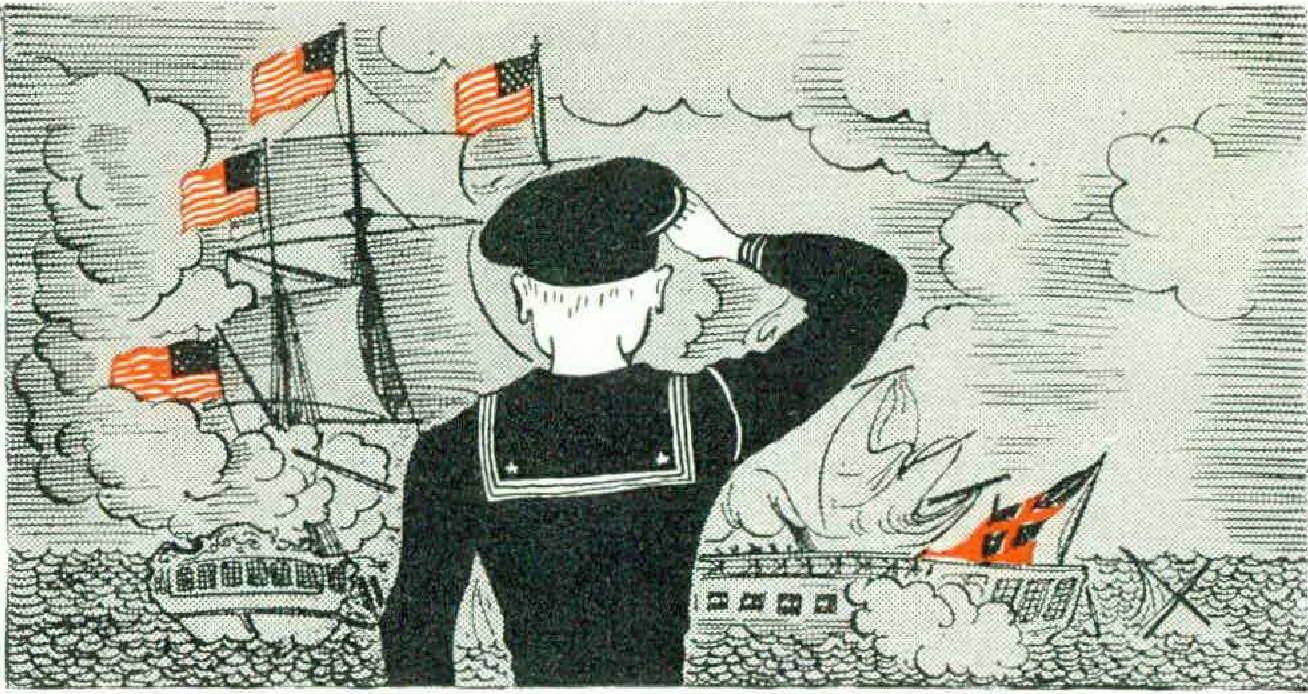
How nice, I thought; how simply dandy. The English are a splendid people. I admire them and their traditions immensely—I really do. I recall being thrilled by the historic accounts of those three magnificent victories. And I have only pleasant thoughts for Lord Nelson.
But if I must wear a uniform that’s steeped in Tradition, why can’t that Tradition be American? Why can’t I commemorate, say, the Battles of Lake Erie, of Mobile Bay, of Manila Bay? (We might even add a fourth stripe for Midway.) And why can’t I mourn our own John Paul Jones —or Decatur or Hull or Lawrence — or Farragut or Dewey?
Shades of Marryat! Whose Navy am I in?