Gamblers

ByFRED SCHWED, JR.
THE heady vice of gambling could not get started until people had discovered the concept of private ownership. We may be sure that very shortly after a system had been established whereby it was possible to own something, all for oneself, this new device appeared whereby one could lose possession of something, suddenly, and without violence.
More people have been gambling more money in recent years in this country than ever before — and our country was never one to be bashful at the tables, the track, the cards, the dice, or the ticker. The only speculative medium we ever eschewed was the tulip.
There are millions of gamblers in the land, and we may as well dismiss the vast majority of them with the fond and impossible hope that they will all win a little. They are doing themselves and others no deep, irreparable injury. But among these millions there are certain hundred thousands who are subtly and terribly different. The family which contains one is, or will be, sorry.
So little attention has been paid to this subtle difference that there is no name for these people. They need a name. If this were the field of liquor, they would be called, not drinkers, but alcoholics, which is a useful distinction. Indeed the entire analogy between drinking and gambling is instructive. Most of us have come to understand the difference between drinkers and alcoholics. There are Countless millions of drinkers, occasional or steady; and if they desisted they might be healthier and wealthier, but that is disputable. They drink for a variety of reasons, derive certain satisfactions, and pay certain penalties. But the alcoholic drinks because he has to. He derives no satisfaction, the penalties are hideous, and he knows beforehand just what they are going to be. It is not, of course, a question of how many c.c. of alcohol he has consumed that sets him off so distinctly and tragically from the other drinkers. It is the attitude in which he approaches his drink. He does not choose to take it; he is compelled to do so; he acts compulsively.
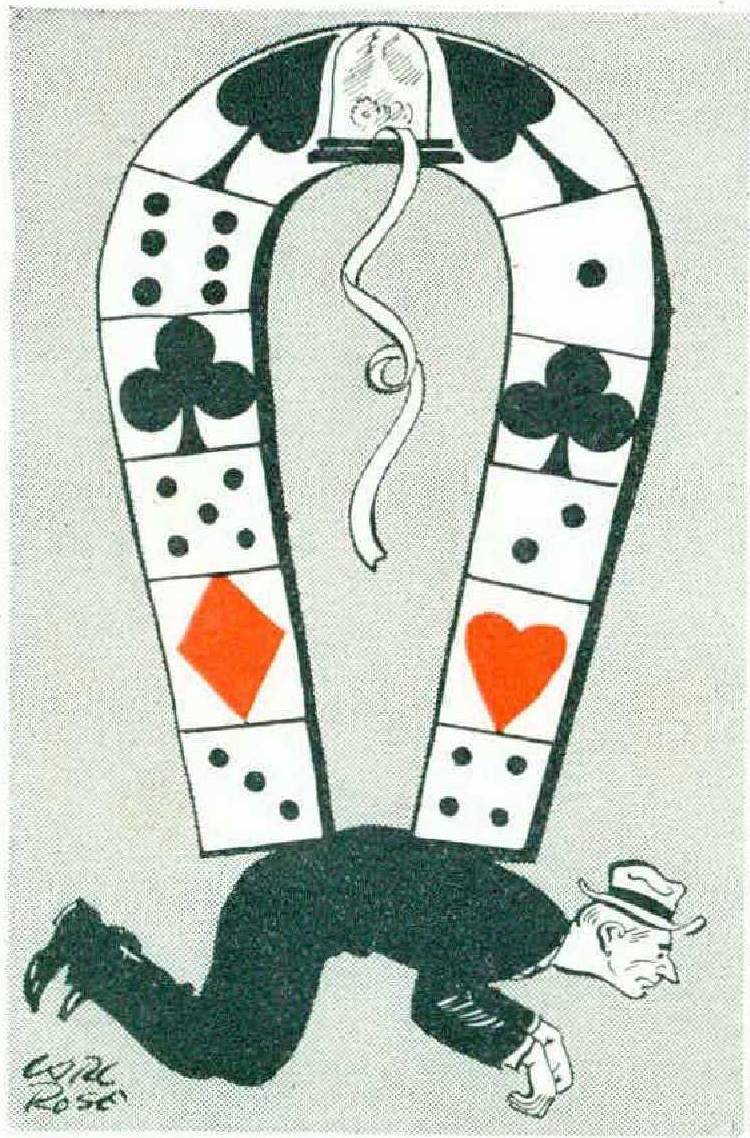
The compulsive gambler, the man for whom we have not yet a singleword name, is similar. There are many reasons for gambling, some of them excellent and some entirely erroneous, but the compulsive gambler is prompted by none of them. He too can predict his fate — in his ease with mathematical certainty, if he knows anything at all about mathematics (and he usually does). Here too the end will be disgrace and despair, with a few other embellishments like bankruptcy and possibly a jail sentence.
The analogy between the compulsive drinker and the compulsive gambler is not perfect, but there is enough in it to be useful in making a start at understanding these tragic and neglected people. I say neglected because the doctors in mental fields have so little opportunity to work on them. Psychiatrists will often agree that compulsive gambling represents a true neurosis. But the people who won’t agree are the compulsive gamblers, and this is entirely understandable.
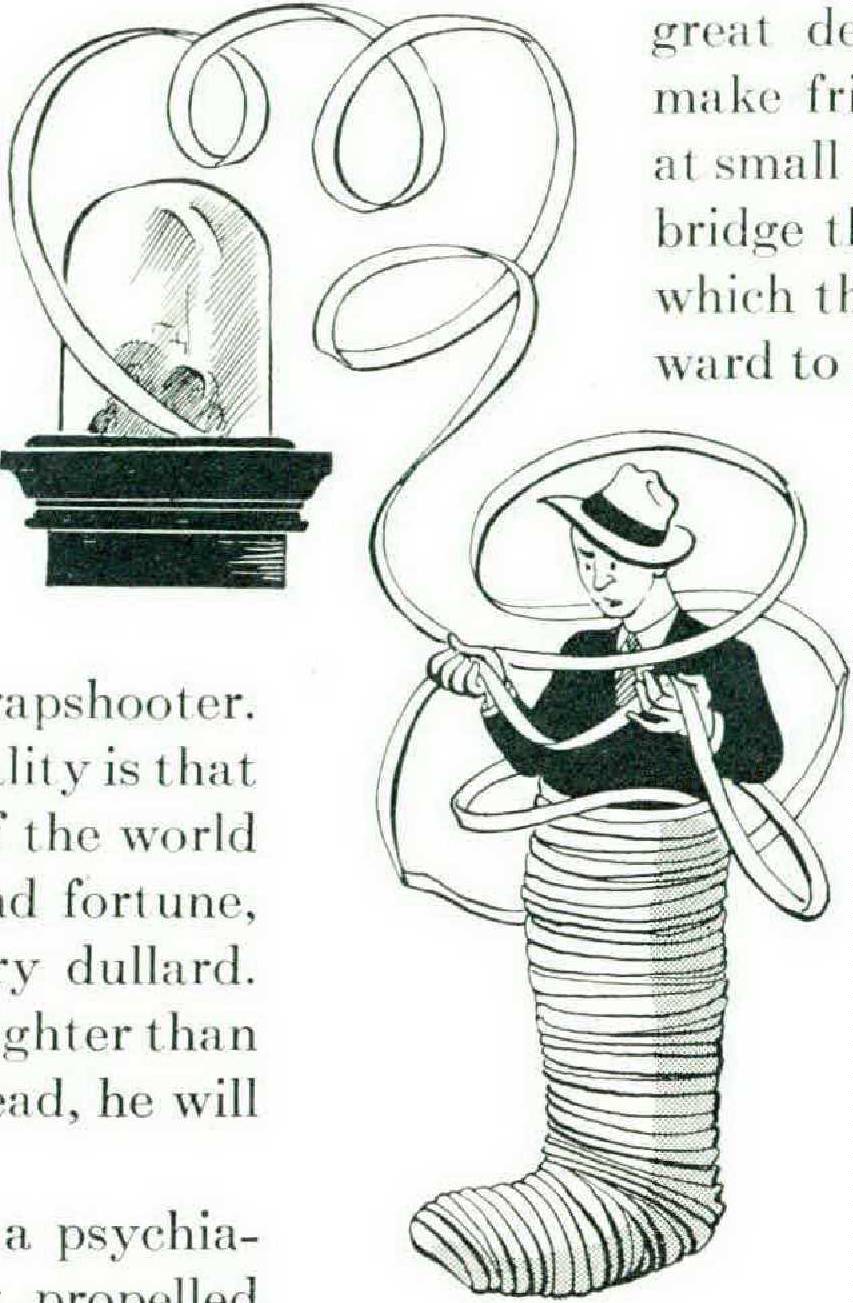
A drunkard can frequently be shown that he is temporarily mentally ill. Not so with a hysterical and persistent crapshooter. The basic assumption of his whole personality is that he is a good deal smarter than the rest of the world and can make his living, attain fame and fortune, without, working all day like an ordinary dullard. The suggestion that, far from his being brighter than others, there is something wrong in his head, he will not entertain fora moment.
Only occasionally do such men reach a psychiatrist’s office. They are almost forcibly propelled there by relatives who reason that the doctor’s fees cannot possibly cost them so much as the victim’s expensive hobby. Gambling is one of the few pursuits for which men will expend all their own fort une and all of anyone else’s upon which they can lay their hands. Among gamblers, such conduct is only interesting, never surprising.
Four brief case histories will make clear the important distinction between the many sane gamblers and the much rarer neurotic cases. The first three victims are mentally sound. They may not bo wise or useful. But the fourth needed mental therapy and would not perhaps be in moral and financial ruin today if he could have received it.
The first case is not a particularly attractive specimen to most people. He is the millionaire who not infrequently buys twenty thousand shares of some speculative stock some morning and thereafter can indulge in the questionable pleasure of watching his fortune ebb and flow hourly at a preposterous rate. This may seem a futile way to spend one’s life, but Mr. A enjoys it. He exercises what he believes to be keen judgment and is careful to see to it that he does not go broke. He is not neurotic, (Unhappily, there is always a chance that under the lash of a disastrous losing streak he will become neurotic.)
Second, we have tHe case of a suburban couple, Mr. and Mrs. B, who have two small children and an income of eighty dollars a week. They love, above everything else, to play contract bridge with wealthier people for a quarter — or even a half — cent a point. This activity can be viewed by the upright with considerable horror, because when the B’s start guessing all the finesses wrong, the effect can soon be observed in the children’s clothes. But their indulgence still makes good sense. They get a great deal of pleasure out of it; they make friends. Neither of them is good at small talk (or big talk) and in contract bridge they have discovered an activity which they not only enjoy but look forward to with keen anticipation. Finally, they arc not such poor players, or at least so they honestly think, and they expect to win.
Our third case is pathetically ignorant, but she is in no need of the services of a psychiatrist. She is a Negro charwoman and every morning before leaving Harlem she buys a number in the policy game, for a nickel. If she should ever beat this cruel lottery she will be paid thirty dollars, or 600 to one, while her actual chance is only one in 990. To make this venture a lot worse than that, there is the definite possibility that, should she ever win, the “runner” with whom she deals will keep right on running, taking both the thirty dollars and the original nickel with him.
Economically it is as unwise of her to indulge this fancy as to try to maintain a shooting lodge on the Scottish moors. But she is entirely sane; she has her reasons, which just happen to be wrong. One of them is that in a cold and toiling world she can purchase a bright spot of hope for a nickel, and one can make an argument there. But her other and more specific reason is that she believes that the policy game offers her the best opportunity she will ever have to amass thirty dollars all at once. “And oh, my friends,” as Mayor La Guardia would say on the radio, “she is mistaken.” She has chosen the worst way of amassing thirty dollars ever conceived by the devious minds of cynical and wicked men.
Now for our fourth and last case— the neuropath who implacably insists on ruining himself, and for no reasons, not even wrong ones.
This will be no romantic account of a last despairing turn at the tables and a pistol shot among the rosebushes. Our Mr. D lives in the suburbs and is pretty much on the dull side. He is forty-eight years old, has a family, a college education, and no visible vices. His business and social references were excellent, until recently.
Every afternoon Mr. D used to keep one office boy exclusively and secretly busy placing bets on all seven races at one and sometimes two tracks. The horses might be running at a track twenty minutes away or at one as far away as Cuba. It made no odds to Mr. D or the boy, neither of whom attended horse races.
Now again there are plenty of good reasons for playing the horses, but not one of them applied to our man. There is a certain amount of relaxation, fresh air, and outdoor beauty to be found at a race track, but Mr. D did not indulge himself in these. He was not interested in horses — to look at, breed, ride, or feed lumps of sugar. Neither the heady companionship of sporting men nor the stunning costumes of their women called out to anything in Mr. D. He was certainly not a financial exhibitionist (which many big bettors are). For when Mr. D made a big winning he had to be just as secretive about it as he had to be over the dismal fact that as the years rolled by he was losing all the money he owned and all the money he was earning. Finally, he could not have been playing fourteen races a day to get rich. He was not like the colored charwoman. He understood the whole business.
Most people vaguely suspect that if you make as many bets as Mr. D you will probably lose. There is a much smaller number of people, gifted with some mat hematical mat urity, who know that if anyone persists in this way against a stiff percentage he must go broke. The only variable in the equation is how long it will take. They know that this result is not something that will probably happen, or will happen to someone else. The science of permutations, when working on a large sampling, never makes mistakes. The science of permutations announced dispassionately, when Mr. D began his noiseless orgy, that Mr. D would wind up terribly busted. And Mr. D, ever since his college days, has understood all this perfectly.
Several times friends diffidently tried to point out to Mr. D where he was heading, and Mr. D invariably changed the subject. Mr. D did not need anybody to tell him some elementary mathematical truths that he had known for years. Mr. D required the Services of a mental therapist to tell him something he did not know, and which was vastly more important: what was causing him to act in this suicidal manner.
It isn’t, important, but in this case it took Mr. D three and one-half years to lose his savings, his earnings, and his job. He then played on credit until he owed the bookmakers some thousands. At this point the bookmakers’ agents hinted that he might find himself at the bottom of a river in a bag of cement some night. Mr. D then desisted from horse playing. (The bookmakers weren’t really serious; they had all his money, and what more can be asked of any client?) It is not correct to say that at this point Mr. D was “cured” of his obsession. Is an alcoholic “cured” when he is wrecked on a desert island where there are no fermentable juices?
If anyone wants to read another case history similar to Mr. D’s, but far more convincing, perceptive, and interesting, he is referred to The Gambler, by Feodor Mikhaylovich Dostoevski.
Precisely why Mr. D, or the young nobleman under the Tsars, or hundreds of thousands of Americans at this moment behave in this tragic pattern, and what should and can be done about it, are beyond the scope of these observations. Their modest purpose is to suggest that the compulsive gambler is just as sick a personality as the compulsive drinker. The alcoholic is not driven to his destructive, semi-suicidal actions by a craving for whiskey, but by a craving for the annihilation of his own personality which has proved offensive to him in some unacknowledged but utterly convincing way. It is even clearer that there can be nothing like a physical “craving” to kneel in greed and terror in a circle of crapshooters, or to sit sweating in a circle of fashionable roulette or chemin-de-fer players.
No, when the gambler acts neurotically his action is the product of various malaises — a few obvious, the majority buried. It may be the fruits of humiliation in the world’s competition, or a dread of entering that competition; it may be the product of a profound but unacknowledged despair. Superimposed on all this, and apparently contradictory, there will at the same time usually be found an elephantine ego bemused with the notion that the gambler is destiny’s darling and that the laws of mathematics will be repealed, for him alone, by a cheering legislature. The hateful suspicion that perhaps he could not make his way in an office from nine to five is sternly banished; he substitutes the rosier notion that he is so smart that he doesn’t have to work at all. Above all, he is the enthusiastic subscriber to the “flight from reality.” He never wearies of daydreaming of himself as a fantastic winner.
The thick books contain little on the neurosis of gambling. Few mental therapists know much about gambling, and no gamblers voluntarily present themselves for treatment, because, as I have said, the gambler considers himself a person qualified to give advice, not to seek it. That he and his loved ones are now in a terrible way is not relevant to him. He happens to be in a “temporary losing streak.” That this streak has been going on, with unimportant interruptions, for many years is something that he does not care to think about.

I asked one of the doctors to whom I talked this question: “Suppose a compulsive gambler happened to read this article. Would it help him?” The answer was discouraging. “He would not read far. The moment he had an inkling that his own case was about to be discussed he would toss the magazine aside. He would tell himself, with a sort of inverted sincerity, that he didn’t find the article interesting.”