You, Too, Can Be Blue and Croon in June
PEOPLE are always asking—anyway, we’ll say they are, just to get startedwhether it’s terribly hard to break into the field of popular-song writing. Well, it isn’t a bit hard, and I’m speaking as a man who broke into it not half an hour ago. There are certain rules, of course, but any reader with ordinary intelligence and nothing better to do with his time can be writing songs by tomorrow morning.
“Learn by doing” is the watchword of modern education; so, if the reader will put his or her damp little hand in mine, we will actually write a couple of popular songs. First, however, we’ll have to get into the proper mood. Everybody who pays attention to the words of popular songs knows that the singer, the “I” of the song, is never very happy; his sweetie is gone, he’s feeling blue, he’s left alone with his memories, and so on. Mind you, people in songs are never the victims of anything worse than a vague malaise or wistfulness. You couldn’t, for instance, hope to make any money with a song called “Help! The House Is on Fire!” or “Ouch! I Just Hammered My Thumb!”
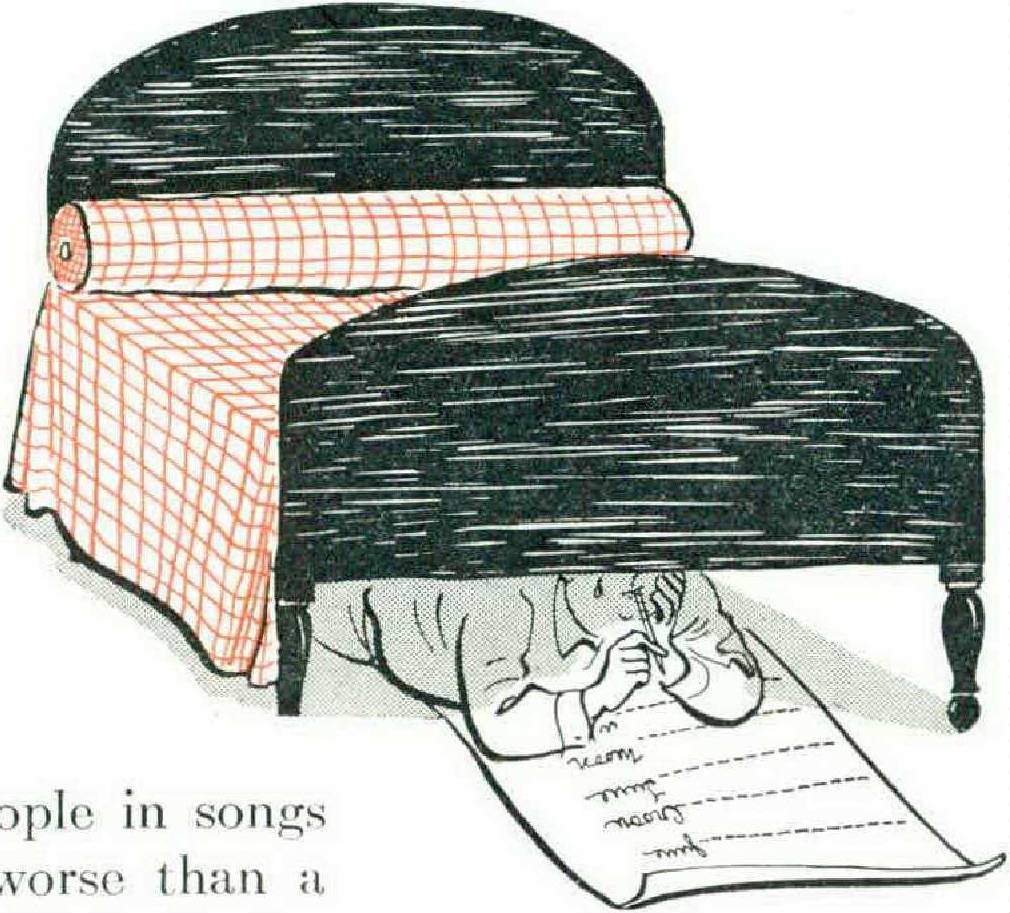
Song writers are prosperous fellows without a care in the world, and yet if they are to stay prosperous they have to keep on writing sad songs. Every writer has his own way of inducing that necessary woebegone, below-par state of mind. I have found that lying under the bed for half an hour or so works as well as anything. It is dark, uncomfortable, drafty, and possibly dusty there, and before long you find your thoughts taking on a grayish tinge.
Pretty soon melancholy phrases begin to drift through your mind: “I haven’t got a real friend in the world” — “How am I ever going to pay all my bills?” “My wife and I are drifting apart,” and so on. This last dismal thought is good enough to serve as a jumping-off place for a song, except for the fact that people in songs are never quite married. Therefore we revise it to “We’re drifting apart.” That will be our title, and the first line of our lyric. Song writing isn’t too hard so far, is it?
If you just make your mind a blank, the rhymes will come readily: —
We’re drifting apart,
You’re breaking my heart . . .
Already we’re on firm ground. That “apart-heart” rhyme is solid stuff. Interestingly enough, we seem to have embarked on one of those slow, throbbing waltzes. There hasn’t been a waltz on the Hit Parade for quite a while, come to think of it, so we won’t bother to turn this waltz off; just let it drip for a while, and see what we get.
We’re drifting apart,
You’re breaking my heart,
Like I knew at the start
it would be . . .
Not only are people in waltzes unhappy, but they knew well in advance of the disaster that they were going to be unhappy.
Who put out the flame?
It isn’t the same;
There’s no one to blame,
dear, but me.
Another lovable characteristic of people in songs is that they’re always ready to confess themselves at fault. For purely technical reasons, we will takeout the second line, “It isn’t the same,” and make it “I needn’t explain.” Makes a better rhyme.
If love is blind. I’m in love, dear;
I hope you’ll find you’re in love, dear . . .
This is such a good rhyme that the public will no doubt overlook the fact that the couplet doesn’t mean anything. Also, we get a vague note of hope in the second line, which is not bad. We’re getting on for the end of the song, and we don’t want to end on too gloomy a note: —
With you for my mate,
I’d be willing to wait;
It’s never too late,
dear, for me.
End of song.
Now we go back and write the “ verse,” the introductory stuff that precedes the chorus. Nobody ever sings the verse of a popular song, but you have to have one. Let’s see, now: —
We was so happy formerly,
But I regret
You’ve not been acting normally;
I’m all upset.
The alert reader will no doubt, have spotted a grammatical error in the first line. Well, that’s deliberate. The “formerly-normally” rhyme is so high-powered that we want a folksy touch to take the curse off it.
“We was so happy . . does it nicely. Let’s finish our verse without any further dawdling: —
You’ve been acting so cold, dear,
I think it’s time you was told, dear:
We’re drifting apart,
You’re breaking . . .
which is where we started. We’ve written a whole waltz.
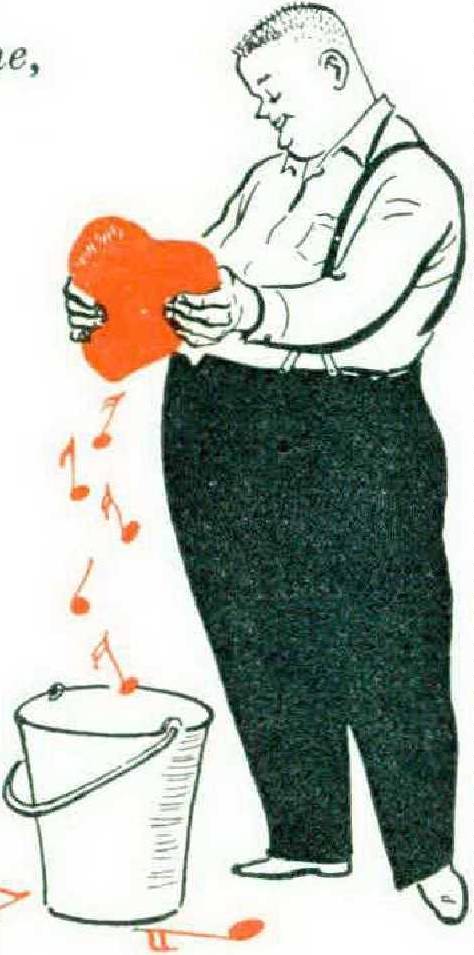
You can’t really call yourself a song writer until you’ve written a song about the moon, however. Moon songs are a little tricky, too, because there are certain obligatory rhymes like “June” and “spoon,” which are hard to use without stepping on another song writer’s toes. But for some reason the word “goon,” meaning an uncouth or stupid fellow, has never been used in a moon song. Let’s go: —
A guy and a gal was settin’
And pettin’
On a June night;
When the voice of a cop
Said, “Stop, stop, stop!
I can see you in the moonlight.”
There’s no hard-and-fast rule about doing the verse last, so this time we’re doing it first, just to get the drudgery over with. Also, we’re getting a little plot under way: guy, gal, June night, moonlight. Well, what does the guy say to the cop?
The fella shook his head.
And this is what he said:
The chorus, of course, is what the fella said. Neat, isn’t it?
Oh, the man in the moon is a goon,
goon, goon!
Why don’t he stay outta the park?
He knows I wanna spoon, spoon, spoon
With my sweetie in the dark.
Now here’s a place we have to be careful. Most songs sag in the middle, and we’re aiming at nothing short of perfection.
Now I’ve always left that guy alone,
Never even studied astronomy;
Why can’t he leave she and I alone
Instead of shining onna me?
Oh, Mr. Moon, you slob,
slob, slob,
Didn’t nobody never ex-
plain . . .
Lightin’ up Lover’s ———?
As the reader is now a graduate songsmith, I will leave him the job of filling in the last word.
Since his graduation from Harvard in 1934, Russell Maloney has been a member of the New Yorker staff. A collection of his writings will appear in book form later this year.