Cheese
FOOD
By CROSBY GAIGE
OUR cousins in England claim that the name “Cheddar” is theirs, and no one can dispute them. We have no Cheddar Gorge; we have no Mendip Hills; but we make enough Cheddar-type cheese every month to go far toward filling up Cheddar Gorge and to make a nice cheese spread for Somersetshire; — eighty million pounds.
The English, with understandable chauvinism, do not like us to call our Cheddar-type cheese by the name Cheddar, and they are just as right as the French vintners who object to our use of Burgundy or Bordeaux or Champagne to designate our native American vintages. Personally, I think so well of some of our American wines and cheeses that I am certain they should stand on their own feet and assume the names of the locality that produced them.
We Americans have become so embarrassed by the uncertainties of this situation that the average citizen who wants a pound of fine, aged Wisconsin or Herkimer County Cheddar asks for “store" cheese or “rat" cheese, or for “American" cheese, which it is by inheritance but is not by birth. Out in Oregon, however, in a high, rich, and rolling valley in Tillamook County, they make a Cheddar cheese as good as Britain ever dreamed of—and, unashamed, they call it “Tillamook.” One of our large dairy companies before the war produced a special Cheddar to which it gave the somewhat opprobrious title of “Coon,” in honor of the man who had a new and good notion about the preservation of a Cheddar. There was nothing opprobrious about the cheese, however, which belongs in the higher brackets of taste. I hope that it returns to our tables as soon as it can be ripened. In Sodus, New York, a small cheese-maker put out a fiveor six-pound loaf of well-ripened Cheddar under the name of “A Hell of a Good Cheese" — and it was.
I have stressed our ability to make good cheese from cow’s milk. We have made most acceptable Dutch, Swiss, and Italian type cheeses from the same fluid. We have never, to my knowledge, been able to produce anything remotely approaching Roquefort — that’s made from the milk of innumerable ewes who nibble the sturdy grass that carpets the pasturage in the Cévennes mountains in France. No one in the United States would have the patience to milk ewes for a living. The so-called bleu cheeses are pale, dry, chalky imitations. My good friend Sir John Squire, and other British savants like Morton Shand and Osbert Burdett, may lament American or Canadian Cheddar, but the English still have to their credit their superb Wensleydale and Stilton. We have tried in vain to reproduce their excellence.
Roquefort, Stilton, Wensleydale, and Gorgonzola are veined with the bluish green mold of the penicillium glaucum. Without realizing why they did so, knowing eaters have made a practice of taking a bit of one of these cheeses at the end of a meal to polish off the repast and to help digest their dinners. Undoubtedly there was good reason for this, for Fleming, an Englishman, discovered that penicillium notatum, a close relative of penicillium glaucum, had the divine eapacity to digest many things harmful to the human system. Another of the penicillium brothers, this one called album, is what gives Camembert its individuality, by ridding the curd of any lurking traces of lactic acid.
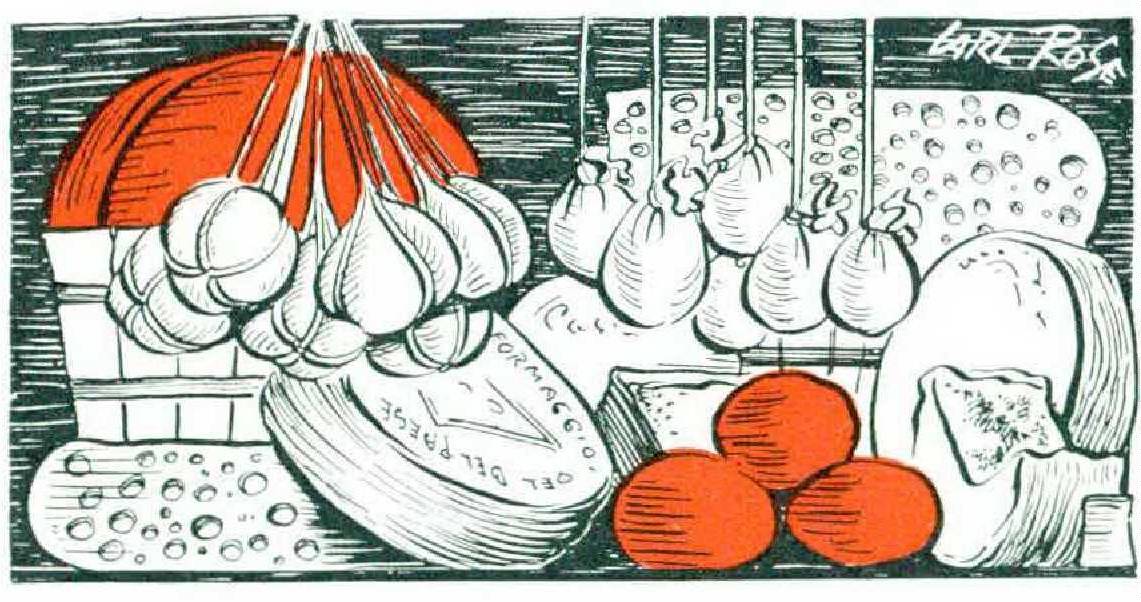

One sure way of making friends and of keeping them is to know your cheeses and to make a ceremony of their service. Some philosopher profoundly stated that cheese is milk grown up. And as milk is the universal pap of the young, cheese in its infinite variants offers the most complete variety show for the delectation and entertainment of mankind. There is a nice balance in the matter, for the riper and more mature the palate, the more it appreciates the maturer and more Sophisticated cheese.
I give thanks to the good God, who gave us cheese and many other great gifts as well, that I have arrived at a state of grace where I can enjoy the racy philosophy of a Limburger. Although the sense of smell and the sense of taste are supposed to be more or less one and indivisible, Limburger is a cheese to be eaten and not to be sniffed. Our own native Liederkranz has similar qualities and, spread generously on a slice of moist rye bread or pumpernickel, with a glass of cool beer in attendance, is a treat which any local Lucullus would enjoy if he happened to drop in unannounced for lunch.
There is, I fear, no short cut to an understanding of the finer shadings of cheese flavor, any more than there is to a full knowledge of the subtleties in wines. These difficulties, however, need not dismay the uninitiated. There are some five hundred varieties of cheese. Many of them, it is true, differ only in their names and their points of origin; in others, the margin of difference is too thin to be conveyed by the keenest sense of taste.
When all allowances are made, there are still perhaps fifty distinct types of cheese stemming from the milk of cows, goats, sheep, mares, camels, buffalo, reindeer; ranging in texture from the coziest ripeness to a hardness that yields only to the saw, the axe, and the grater; running in flavor from dewdrop mildness to the variety that can be eaten only with the aid of a gas mask. Anyone who pretends to know them all is imposing on our credulity and doesn’t deserve the blessings of cheese.
Much of the hocus-pocus about eating and drinking, I believe, is quite superfluous. It scares more potential worshipers away than it ever attracts. One may enjoy a Beethoven sonata without being a musical expert; a glass of sound wine without being an educated gourmet; and a choice of the best cheeses without being overlearned in the lore of cheesemongery. I shall have failed in my mission if I nip in the bud any incipient enthusiasm for cheese with a frost of exotic names and allusions. Some of the cheeses I have enjoyed most, in remote places, I never learned to identify by name and shall have to meet and salute all over again if and when I return to their habitats.
The housewife who knows or uses only two or three varieties of cheese is deliberately limiting herself and stunting the culinary education of her family. She is not unlike a painter who, with all the colors of the rainbow on his palette, would restrict himself to two or three and ignore the others. But if she can recognize and appreciate a first-rate cream cheese, the commoner hard cheeses of the Cheddar and Swiss types, a few soft varieties like Camembert, Brie, and Neufchâtel, and a sample or two of the intermediate varieties, let us say Münster and Limburger, she is well enough equipped to inject the stimulating values of cheese into her family’s diet.
The problem of influencing a rabbit is a simple one. It merely consists in teaching the rabbit to forget for the moment that it does not of necessity have to be Welsh — that it can be Swiss or French; that it can, under the name of fondue, a word which connotes the “melting pot,” become a charming social custom that is just in line with the low but pleasant American habit of dunking. Fondue is a national dish in Switzerland. It may, indeed, have kept that nation ou1 of the late unpleasantness, for a confirmed fondueist or dunker is never quarrelsome.
There are many ways of preparing a fondue, but the most famous one is the authentic Swiss. I cannot do better than to quote from Jeanne Owen’s highly useful Wine Lover’s CooK Book: —
½ pound Switzerland Swiss cheese, coarsely grated
1½ tablespoonfuls flour
1 clove garlic
1 cup of Neufchâtel wine, or any similar dry white wine
3 tablespoons of Kirsch
Salt, pepper, nutmeg to taste
A plate or small basket of French bread or hard rolls cubed into fairly large “bites”
Special equipment necessary: —
A small earthenware casserole.
An inexpensive, low electric plate, or an alcohol lamp.
Preparation: —
Dredge grated Switzerland Swiss cheese thoroughly with flour. Rub the casserole with the garlic, and bring the wine almost to the boiling point. Then add the cheese slowly, a handful at a time, and stir with a wooden spoon until thoroughly melted. Add salt, pepper, and nutmeg. When the fondue starts to boil add the Kirsch and serve at once, putting the lighted alcohol lamp or electric plate and its casserole on the dining table.
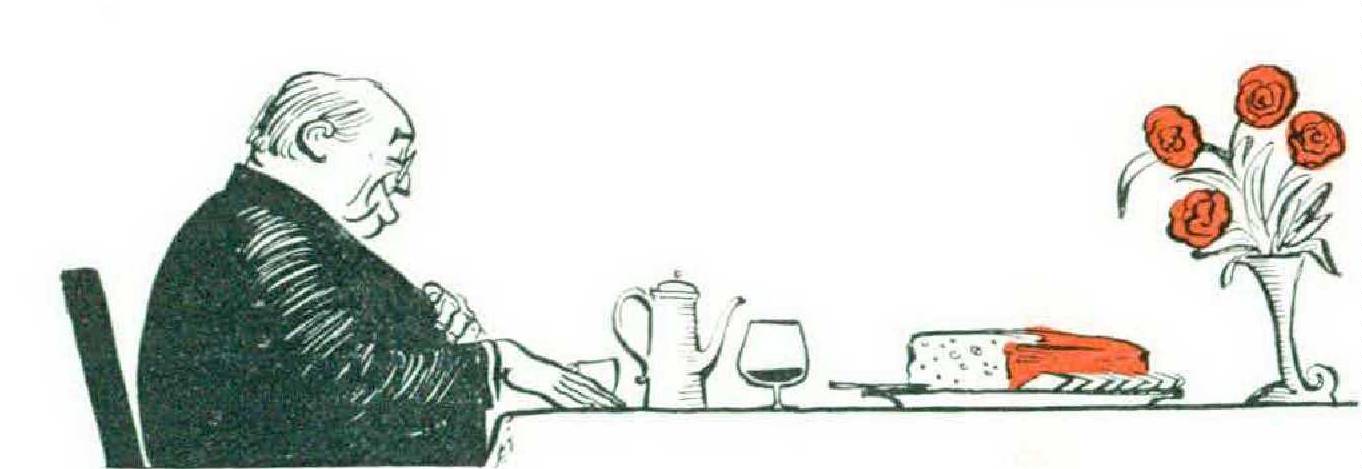
Do not let the fondue cook too much as the cheese is apt to become stringy. It must be kept bubbling lightly while the guests alternate in dunking a bread cube spiked on a fork. The momentary dunker keeps the fondue stirring until the next guest is ready to dunk.
This dish of course can be made from American Emmentaler or Gruyère, although a Swiss cook would have us believe otherwise. Incidentally, I learned from Lucien Prince, one of the really high priests of the fondue, that if the bubbling mass shows signs of stringiness, a little Kirsch, added from time to time, will act as a solvent.
Another of Mrs. Owen’s concoctions, which I have enjoyed at her home, is a Tomato Fondue, in which we can use American Cheddar. This method has a quieting effect upon our rabbit and makes it less restless in the stomach.
Here is a dish that can be made at the table for Sunday night supper with great success. Use a spirit lamp or an electric plate. Make the fondue in a small earthenware casserole, and use a wooden spoon for stirring.
Prepare the tray in the kitchen with the following ingredients: —
2 medium-sized tomatoes, skin and seeds removed, and the flesh finely chopped
½ teaspoonfid of dried sweet basil (or better still, six or eight fresh leaves)
1 clove of garlic
Paprika
2 ounces (half a bar) of fresh butter
1 cup of white wine
2 cupfuls freshly grated Cheddar cheese — American or Canadian — mixed with one tablespoonful of flour
Rub the casserole with the garlic. Put in the butter and heat. When the butter melts, add chopped tomatoes and simmer a few minutes to cook them. Add the basil and paprika to taste (no salt, the cheese will be sufficiently salty) and the wine; stir, and allow to come to a boil. Add the cheese, half a cup at a time, stirring constantly; and when the cheese is melted and all ingredients blended, pour over toast on individual hot plates.
Just for the record, I am now going to register a protest that marks the boiling point of personal vexations. I don’t like American processed cheese and I don’t care who knows it. Swiss Gruyère and Emmentaler are processed cheeses, but those are cows of a different color. I am willing to admit that processed cheese has a keeping quality that endears it to the pockets of processors, jobbers, brokers, wagon distributors, and finally to the retailer. It has nothing else to recommend it. Just nice slabs or bricks of chewy latex with a faint, far-off reminiscent touch of butyric acid. My children eat it. Your children eat it. Unless something is done to curb this sacrilegious practice, the present generation will grow to maturity as consumers of processed cheese without the remotest notion of the delightful civilization that dwells in a slice of well-ripened American Cheddar or almost any other cheese that has not been subjected to the present curse that bears the name of Pasteur.
Wise Spaniards had once the proverb: “Quien no llama, no mama-A quiet baby gets no milk.” And quiet papas of this day and generation will get no good cheese unless they raise their voices against the pest of process and insist upon age, sapience, and maturity from their cheesemongers.