Seats 3 Months in Advance..

By RUSSELL MALONEY
A GOOD exercise for the philosopher who has not yet given up the struggle to make some sense out of the contemporary commercial theater is to attend a performance of a hit show and, after inspecting the audience, ask himself the simple, literal question, “How do these particular people happen to be at this particular performance?”
The answer won’t be simple. The people are there because they want to see the play? Yes, in a general way, that’s true. But the nearest the potential members of an audience can come to controlling their destinies these days is to say that they’d like to see some play sometime. An appreciable percentage of the audience at any New York production are out-oftown visitors who must do their playgoing within a limited time and must go to whatever play has seats available. The rest are natives who have managed somehow to get hold of seats well in advance. Thus we have a mixed audience of drama-lovers who (a) didn’t especially want to see this play, or (b) didn’t especially want to see this play on this particular evening.
Now this may sound like a laborious analysis of a fairly obvious situation, but I’m making a point in just a minute. Theater people, in their sentimental moments, will tell you that the stage has one great advantage, from the actor’s point of view, over the movies and the radio; there’s a living audience right before him, and he can get an immediate reaction. Acting in a play is supposed to be better than participating in the making of a film, which will just be put into a can and shipped off to theaters all over the world. As for radio — nobody in the theater would touch it, except for the ten or fifteen thousand a year you can pick up by taking on a soap opera.
Well, at the risk of astonishing the entire membership of Actor’s Equity and throwing the luncheon crowd at Sardi’s Restaurant into a turmoil, I’m going to suggest that, in terms of warmth, immediacy, intimacy, or whatever else you want to call it, the present-day theater runs a poor third to the movies and the radio. By and large, the public thinks of movie-going in a relaxed and happy way. Somebody says, “Let’s go to the movies,” and that’s that; you go or you don’t go. As for the radio, the despised radio, you don’t have to listen if you don’t want to — a state of affairs which surely indicates some degree of cordiality on the part of the audience which is listening.
But now let us look at a theater-bound couple. Some months ago, these fortunate folk were allowed by a box-office man — a “treasurer,” as the theater program calls him — to purchase two seats, at a total cost of twelve dollars, to a reigning musical hit. All you can say about them is that they are people who once wanted to go to the theater. If, now that the night has finally come, they still want to go to the theater, that’s fortunate.
And here’s a slight aside on the matter of the cash purchase of seats in advance of the performance. A big musical show may gross forty thousand dollars a week — that is, the sale of seats for that week will be forty thousand, before deduction of expenses. Now the management’s expenses are met out of the week’s receipts, after the week is up. But with all the popular shows virtually selling out well in advance of the performance—three months in advance is by no means an inflated estimate — we get a curious financial setup, or at least a setup that would look curious to anybody but a theater man. The management is always twelve weeks ahead, with something just under half a million dollars in the till. To be sure, the management can’t touch it, but neither can anybody else; it represents a waste of six hundred dollars a week, at the current loan-shark rates of interest.
The current spate of long-run plays represents no terrific spirt of vitality in the theater. It represents all we have left from the utter and hopeless destruction of what was once the mainstay of the business: the “road,” the out-of-town engagements that followed the Broadway run. “Road company,”as it is now used, is a misnomer; it means only a second company which will play a few of the big cities outside New York for an indefinite time. The intricate schedule of weeks, split weeks, and one-night stands which brought every first-class play to every one of the big cities is forgotten. Katharine Cornell, to be sure, played Candida and The Barretts of Wimpole Street on an old-time road schedule, and Alexander Woollcott wrote a touching piece about an audience which waited until after midnight for a performance to start when the scenery was delayed by a blizzard.
Nevertheless, the majority of out-of-town playgoers prefer not to have to depend on such generous whims as Miss Cornell’s; and they like their plays to be performed on time, blizzard or no blizzard. This leads them to New York. I don’t know how many hotels there are in New York, or how many rooms each hotel has; but anybody who wants to do the arithmetic will know how many potential playgoers have been added to the normal New York audience. It seems safe to say that almost nobody comes to New York without trying to see a play, any play, because this is now an experience you can’t have anywhere but in New York.
Within the memory of relatively young New Yorkers, it was possible to buy seats for good plays as late as twenty-four hours in advance; indeed, the management considered it no serious disgrace if a few pair were available just before curtain time. The theater box offices simply weren’t designed to handle seats more than six or eight weeks in advance. Nowadays these offices often have to operate at double and triple their capacity; there are extra racks for the tickets, and still further tickets spread out in odd corners.
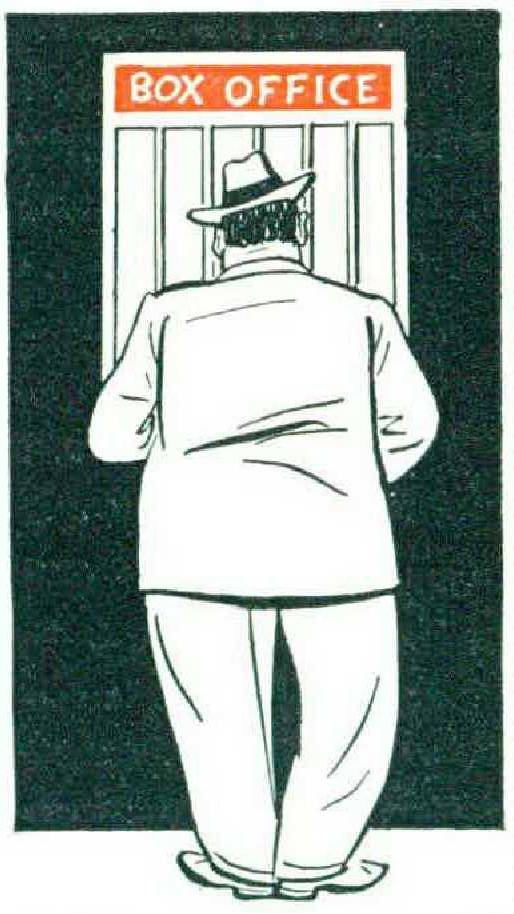
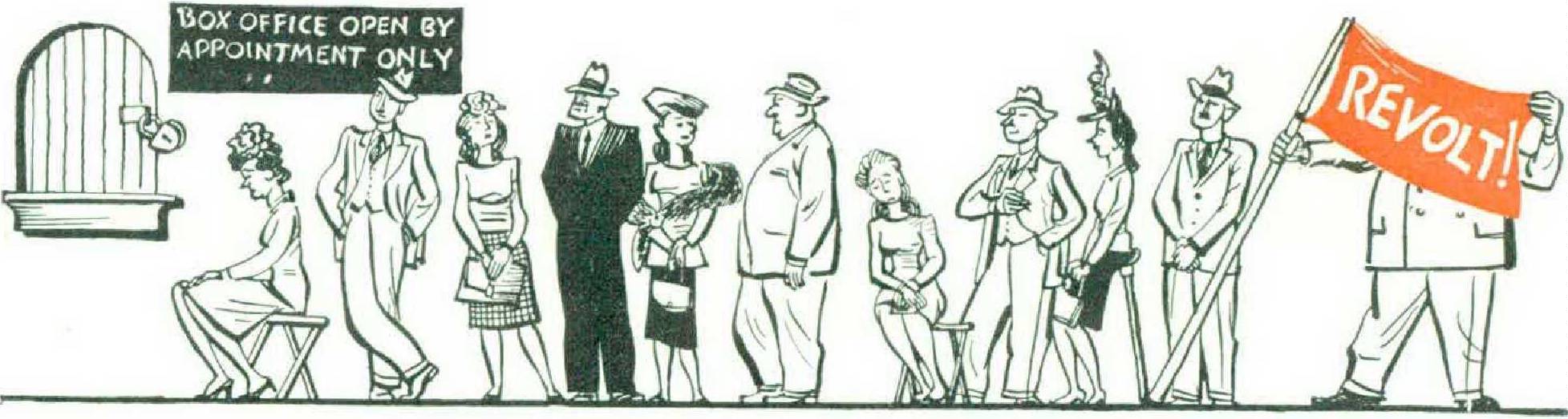
I was fortunate enough to be present when this whole system of advance selling broke down, not with a bang but a whimper. I was queued up in the lobby of the St. James Theatre, where the Theatre Guild was (and as we go to press still is) presenting “Oklahoma!” I was prepared to buy two seats for any evening performance in the future, be it two nights or two months in advance, or even four months. The fact was, though, that there were no seats for sale. No seats at all. They were sold out up to such-and-such a date, and for the succeeding performances there were as yet no tickets printed.
The box-office staff, obviously feeling itself under no obligation gratuitously to volunteer this information, merely told each applicant that the specific seats he asked for—and his second and third and fourth choices — weren’t available. No, nothing for the matinee four weeks from Wednesday. No, nothing eight weeks from Thursday night. “What it comes down to,”I said, when my turn came, “is that you haven’t any seats at all, then?” “That’s right,”the box-office man replied, plainly deciding that I was a bright young fellow. The psychology of the situation was plain enough. It is so silly to buy theater seats three or four months in advance — as silly, certainly, as buying a chocolate icecream soda under the same circumstances — it hardly matters whether or not there are really any seats to buy. Once down the rabbit hole, anything goes.
In The Voice of the Turtle, John Van Druten’s prim little effort to make sex respectable and popular, there is a grim passage about a theatrical institution called “house seats.” A soldier on leave wants to take a young actress he has just met to one of the hit plays, but he’s afraid he won’t be able to get seats on such short notice. So she tells him about the house scats; at every performance, no matter how fierce the demand for seats, four are reserved, right up to the rise of the curtain, in the name of the producer. If you know the right people, you can get into any play you want, any time you want. (This is really so.)
You would think that an audience composed of people who had bought their seats infinite weeks ago would, upon learning about the house seats, start thrashing about and muttering rebelliously; but they never do. They are, after all, the kind of people who are willing to buy theater tickets four months in advance. The other kind of people are not present.
If movies are canned entertainment, I say that theater audiences these days are canned audiences. They have been canned, weeks in advance, by the box-office staff. The composition of an audience is finally fixed, right up to the last row in the balcony, so far ahead that, on the night of the performance, they are stale and overtrained; they’ve worked too hard for what they’re going to get, and they’re bound to suffer a letdown.
Oh, yes, it would be perfectly practical for the producers to agree on a schedule by which seats could be released week by week, on a first-come-firstserved basis, with a few remaining for release on the day of the performance. But it would be a little trouble, and it wouldn’t mean any more money. And meanwhile the theater is losing the only superiority it has ever claimed over other forms of entertainment: the spontaneous and happy getting together of actor and audience.