Recollection
MUSIC
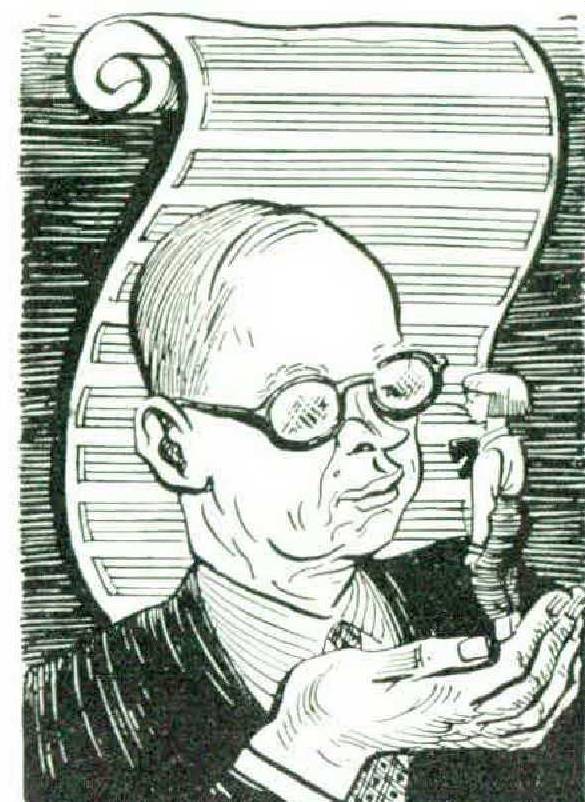
ONE of my earliest childhood recollections of music is an evening when I lay in bed, in a spacious village house, listening to the strains of a Beethoven sonata or a Chopin waltz. My mother was playing some four rooms away; I had already been put to bed, as it was eight o’clock in the evening, but I was not sleepy and I lay there listening. Mother played the piano quite well. She had no special pianistic talent and was rather shy of playing before strangers. But the important thing was that she really liked serious composers —Beethoven and Chopin above all so that from early childhood I was accustomed to hearing and loving good music. As a child of three or four I would often sit for hours in an armchair in Mother’s room listening to her playing. Sometimes Grandmother and I would argue as to what Mother was playing, and in these controversies it was nearly always I who was right.
In the daytime, while Mother was playing Hanori’s exercises, I would come up and ask to be allowed to play my own music on the two upper octaves. Mother would agree, not at all dismayed by the resulting cacophony. This increased my interest in the piano and soon I began to sit down at it myself, trying to pick out some tune. I played one of these several times. It caught my mother’s ear and she decided it might be set down. She set it down herself, not without painstaking effort, for she had never done this before. It is hard to invent a more absurd title than the one I gave this piece: “Indian Galop.” At that time there was a famine in India; grownups read about it in the newspapers and discussed it. I listened. I was just a few months over five. The curious thing was that I would pick out tunes at the piano which I could not set down on paper, and that sitting at the table I would draw notes which did not mean anything.
I just drew them for fun as children draw figures of men and trains, because I was always seeing notes on the music stand.
Once I came to Mother (so she related subsequently) with a sheet of paper covered with notes and declared, “Look, I have composed a Liszt Rhapsody.” I thought “Liszt Rhapsody” was a double title like “Sonata-Fantasia.” Mother had to explain to me that I could not compose a “Liszt Rhapsody” because a rhapsody was a form of musical composition, while Liszt was a composer who wrote it. In addition I learned that you cannot write music on nine lines without bars that it is written on five lines with bars.
Mother had a knack for teaching. Imperceptibly she tried to guide me and explain how to use an instrument. I was greatly impressed by Mother’s setting down of the notes of “Indian Galop and soon after, with her help, I learned to write notes with some success. My musical ideas did not always fit into ordered measures, but somehow I did manage to write down pieces that could be played. In the course of a year or two I wrote a whole notebook of pieces for the piano. Among them were waltzes, marches, rondos, and even one piece for four hands.
My mother watched my musical development carefully. In her opinion the main thing was to encourage a child’s interest in music and not repel him by making him do boring exercises. Hence: spend as little time as possible on exercises and as much as possible on acquaintance with musical literature. At first Mother taught me for twenty minutes a day, being careful never to exceed the allotted time. When I was almost nine, she gradually increased the lessons to one hour.
I read notes easily, and after playing a piece through several times, usually had it smooth. Anxious, above all else, to avoid having me learn things by rote, Mother gave me new pieces frequently, and thus the quantity of music I handled was enormous. Before giving each piece to me, Mother played it herself, and if she thought it uninteresting, discarded it. Alter playing pieces which she approved, we discussed them and I had to explain what I liked or disliked about them and why. Thanks to this requirement, I soon developed independent judgment, an ability to read notes freely, and an acquaintance with a large quantity of music, which helped me to analyze musical works easily.
However, this system also had its negative side: nothing was learned to perfection; my rendition was careless. My thoughts always ran ahead of my lagging fingers. This incompleteness of detail and my impure technique were a scourge all through my later years at the Conservatory, and I was over twenty before I began gradually to overcome these faults. On the other hand, at the age of ten I already had my own opinions about musical works and could defend them.
When I was nine my parents took me to Moscow, where I saw the opera Faust. Seated in a box liefore the performance began, Mother gave me certain preliminary explanations. You see, there once lived a learned man called Faust. He was already old but still spent all his time reading books. Once Satan came to him and said: Sell me your soul and 1 will make you young again.’ Well, Faust agreed, Satan made him young, and they began to lead a merry life.”
I pricked up my ears. We had come to the theater long before the opening of the performance, and I had felt bored waiting, not quite understanding where and why I had been brought and feeling rather skeptical about what I should see, but suddenly the prospect had proved interesting: They began to lead a merry life.”
The overture began and the curtain rose. Indeed there were books all over, and bearded Faust was reading a thick volume and singing something; then again reading and again singing. When would Satan come? How slow it all was. Ah, at last! But why was he in a red costume with a sword and altogether so elegant? I had thought Satan would be black like a Negro, half-naked and perhaps with hoofs. Later, when “they began to lead a merry life,” I immediately recognized a waltz and a march I had heard Mother play. I did not understand much of what went on, but the duel and Valentine’s death impressed me.
I came back to the village in the Ukraine with a rich store of impressions. I began to play theater with my village pals. We would get together and think out a play and then act it for our parents. The plots were simple and invariably included a duel — the result of Faust’s duel with Valentine. The plays we acted gradually acquired a large quantity of property effects. In a box in the storeroom we kept hats, old coats, all kinds of costumes, masks, swords, and toy pistols. A lamp shining behind a framed piece of gauze represented the moon; a camouflaged barrel from which water poured into another barrel represented a waterfall; boughs and twigs from the garden represented a forest. We had a mask and an old fur-lined coat turned inside out for the performer who played the role of the bear. Also burned-cork mustaches and beards.
One day I went to Mother and declared: “Mamma, I want to write my own opera.”
“How can you write an opera?" Mother protested. “ Why talk about things you cannot do?”
“You wait and see.”
We never said anything more about it, but I set to work. Where did I get a plot ? Evidently I invented it in the same way that I invented plots for our plays. The characters were village boys with whom I played then. This is approximately how I did it: —
“Stenya, you are sitting and reading a book. Suddenly a Giant passes by. You are frightened and ask: ‘Who goes there?’ and he answers: ‘I, it is I,’ after which he enters and tries to catch you. Just then Yegorka and I come up and hear you calling. Then Yegor asks: ‘Shall I shoot?’ and I answer: ‘No, wait, because the situation is not yet favorable.’
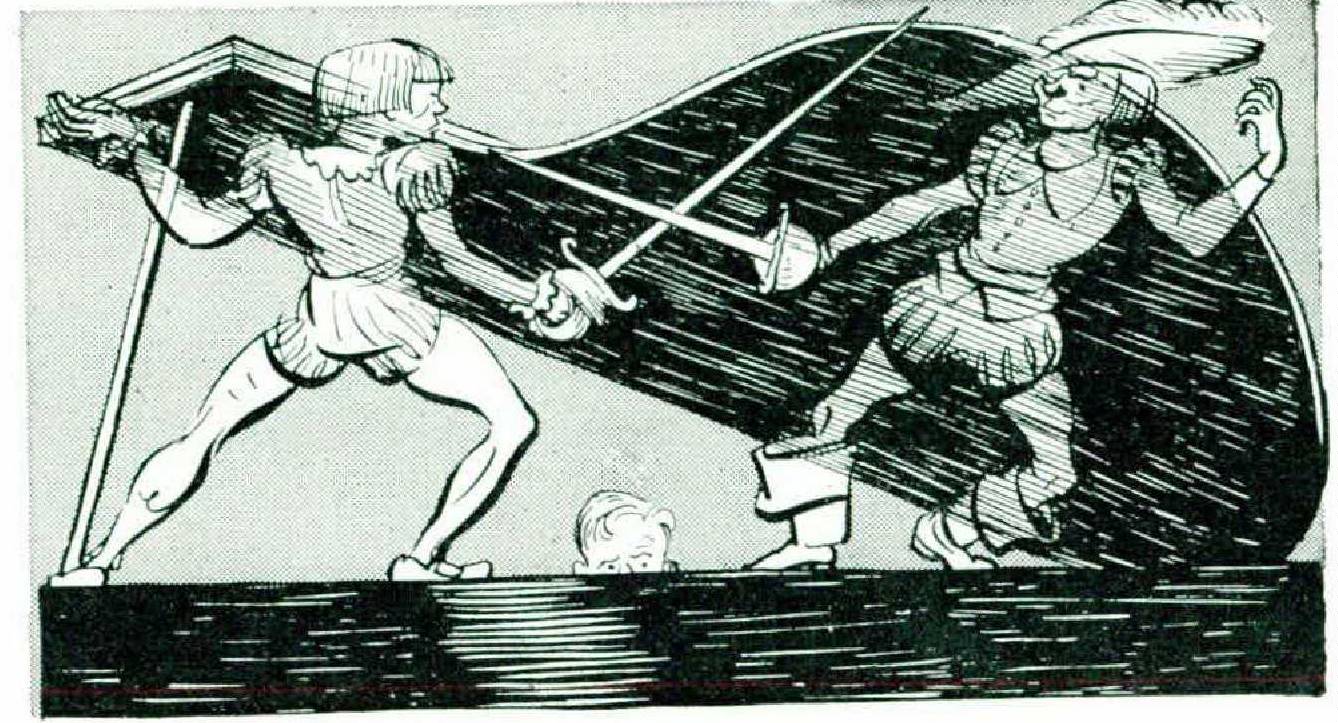
“Then Yegor asks again: ‘Shall we draw our daggers?’ but I say: ‘Now shoot!’ Just then the Giant sees us and runs away.”
“And I faint,” Stenya concludes.
“Well, after that we go away,” says Yegor.
“But how shall I know who rescued me?” asked Stenya.
A moment of deep thought and then I get a brilliant idea: as we go away we accidentally drop our visiting cards.
“At first, Stenya, you cry because you alone are so unfortunate, but then you find the cards and decide to write each of us a letter thanking us for our help.”Here the curtain comes down.
The second and third acts portray the fight against the Giant.
The opera, The Giant, was written in this manner, and a year later when I was staying at my uncle’s estate near Kaluga, my cousins, who were older than I, decided to produce it. My cousin Audrey, who was nineteen, played the piano quite well and undertook to represent the whole orchestra. Cousin Katya sang the role of Stenya. I naturally sang the part of myself—that is, Sergeyev—and my other cousin sang Yegorov. My aunt donned high hunting boots and played the Giant. The scores were studied under my direction and I felt extremely excited. Seeing this, Mother said to the others: “You had better perform what you have already learned, or he may get sick.”
Only the first act was ready. The audience — my mother, uncle, and a few guests — seated themselves in one room. Audrey began to play the overture, and instead of a curtain the door to the next room, which served as a stage, opened. I was so excited that when Yegorov and I came on the stage I sang out: “Well, shall we shoot?” although these were Yegorov’s words. But my cousin promptly caught up the cue and after that everything went smoothly. The Giant was very impressive in a cloak and high boots, and mv cousin sang Stenya’s aria charmingly, so my aunts thought, and they straightway decided that she ought to be taught singing.
The host, my uncle, was greatly pleased with our performance. “When your opera is staged in the Imperial Theater,” he told me, “remember that your very first opera was first performed here in my house.”
Since then, imperial theaters have disappeared and Uncle is long dead, but when my opera Love for Three Oranges was first produced in Chicago in 1921, I kept my word and remembered what my uncle had said.
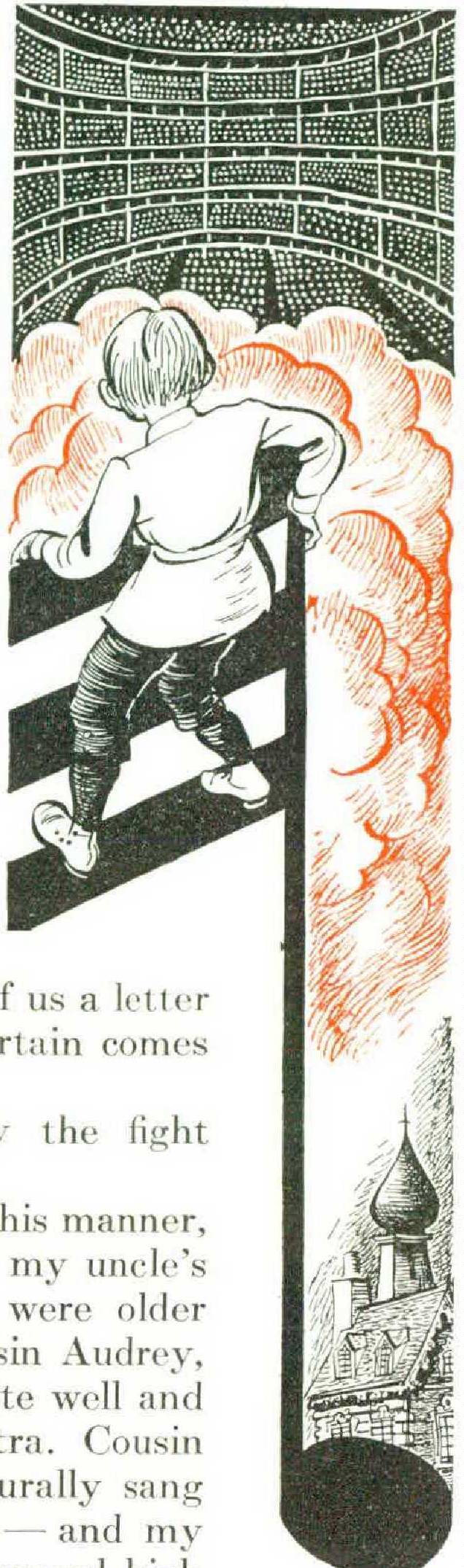
Upon returning home I began to compose another opera, called Desert Islands. In this opera a boat is wrecked against a rocky coast during a storm and the heroes arc stranded on desert islands. I could not think up anything else to do with my heroes, and therefore only a first act was ever written. True, this act was almost twice as long as the whole opera The Giant, and contained attempts at musical portraits of nature: rain with pattering notes and a storm during which a boat, is buffeted and wrecked.
When I was ten my parents again took me to Moscow, to see the celebrated composer and professor of music, Sergei Taneiey. The master was amiable and kindly. There was a bar of chocolate on his desk and he treated me to it at once.
I played a passage from The Giant and also the overture to Desert Islands for him.
“Despite the fact that the boy is only ten years old, said Taneiev, “correct instruction in the theory of music must be begun at once. Otherwise errors, which he will later find it very difficult to get rid of, will become habitual with the youthful composer.”
That was how I began to study under Reinhold Glière, whom Taneiev recommended to my mother. Now Glière is a noted composer and chairman of the Union of Soviet Composers, but then he was a young man of twentyseven, recently graduated from the Conservatory with a gold medal.
Gliere had a bent for teaching: he did not torture me with dry stuff when teaching harmony, but explained free composition, orchestration, and form at one and the same time. For the latter purpose he played Beethoven’s sonatas for me, explaining the peculiarities of the sonata form. Under his guidance I wrote a symphony, two sonatas, and an opera to Alexander Pushkin’s poem, “A Feast in the City of the Plague.”
Glière not only taught me music but understood my childish hobbies, attended our domestic performances, fought duels with popguns, and took long walks with me, thereby winning my heart completely.
When I was thirteen, acting on the advice of the composer Glazunov’, I entered a class in the theory of composition at the Petersburg Conservatory. My childhood may be said to have concluded with this event, and I therewith entered a new period in my life.