This Month
The ease against the horse (page 120) seems to have been worked out pretty solidly by Clyde Brion Davis, but we object to what he has to say about picket pins. His horses, you will find, are unintelligent in every respect except when picketed to graze; then they suddenly take on enough reasoning power to pull the pin and run away. We hasten to fortify an unnecessarily weak count in the general indictment, for the horses which we have staked out behaved quite differently, more consistently in the bonehead tradition of the species.
It must be assumed, first of all, that the person tethering a horse for the night has done all the horse’s thinking for it anyhow. Mindful not only of the aberrations of this horse but also of previous fiascoes with others, he takes great pains to pick out the perfect meadow, the richest feed, the gracious contours. He may, at the end of a hard day’s packing, spend an hour or more before finding a good enough meadow. Once located, the meadow
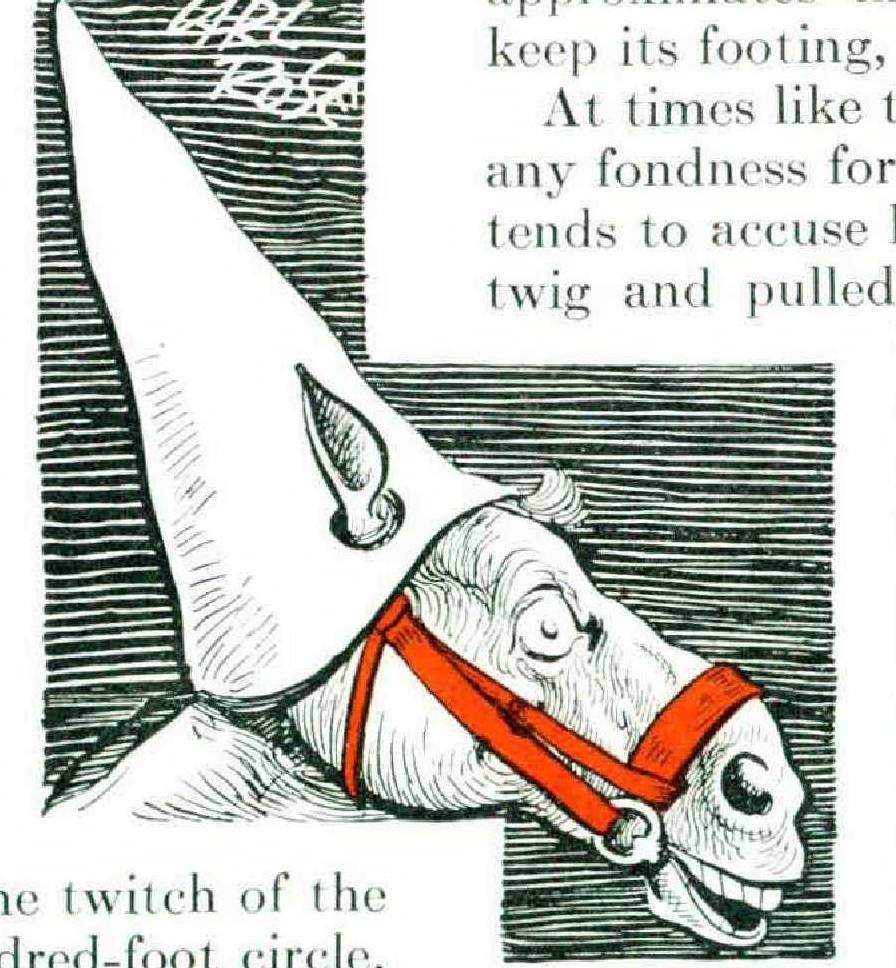
is searched for stumps, obstructions, anything that could impede the twitch of the picket line around its generous, hundred-foot circle. He ties a bowline to whichever hind foot the horse prefers (somehorses are very fussy about the choice), makes sure that the loop at the other end turns smoothly on the pin, drives the pin into place, and hides out for a few minutes to watch the result. The horse begins gobbling the grass; the picket line is in order; all is well. The camper goes back to start a fire and, at what, is now a late hour, the preparation of his own meal. He crawls out of his blankets the next morning and, without thought to his breakfast, although he is starving, rushes off to view the picket ground. It had been flawless, he recalls; the horse must have fed sumptuously. But no. By diligent search, the horse has found a twig, a weed, some frail growing thing around which it has wound and rewound the picket line. The snarl is such that the horse must have worked the greater part of the night on the entanglement, without time to seize a mouthful of grass. The camper estimates that it probably took the horse three or four hours of quick, inch-by-ineh hunting of the whole meadow to find the twig to wind up on, and another three or four hours to achieve the snarl. By a little extra effort the horse has managed to get one of its front feet involved; its stance as it confronts the camper approximates that of a hog-tied animal trying to keep its footing, ready to topple over at a touch. At times like this the camper, especially if he has any fondness for horses (i.e., if he is a green hand), tends to accuse himself: he should have spotted the twig and pulled it up; it was his fault, not the horse’s. He is likely to react thus through several such twig episodes, until he comes out one morning and finds that the horse has accomplished exactly the same bit of buffoonery on the completely twigless picket ground, the blameless meadow of lush grass where a horse could eat great quantities without moving five yards. But this time the horse has worked out an ingenious non-slip windup around the picket pin itself. It is practically standing on its head by sunup. If we grant Mr. Davis the horse that did pull its pin and run away, we suggest that the horse was not in search of better feed or pleasure. Failing to strangle itself or break a leg, masochist from nostril to fetlock, ii simply went looking for the right place to get wound up. We lack space to recount the inanities of other horses for which we have worked — the horse which would not step across a small mud puddle or soft spot but which insisted on leaping them as if they were three or four feet high; the horse that once stood on our foot for a half hour; the horse that ignored R.F.D. boxes on one day and boiled from each and every one of them on the next; the horse that would not tolerate our striking a match to light a cigarette; the horses that could distend themselves a foot or two at the sight of a cinch in the hope of dumping the entire pack and themselves off a precipice a half hour later. Disheartening indeed; yet we should be false to the heading Accent on Living were we to present more sanguine findings. Under other conditions, we should have been glad to travel, hunt, and argue in order to lay hands on an autobiographical listing by Sergei Prokofieff. Again, we should enjoy spinning an ornate tale of our editorial acumen, how perseverance and the will to win, Yankee ingenuity, infinite pains, brought us our heart’s desire. But “Recollection” (page 122) simply turned up in the mail from the composer’s agent, and was read, enjoyed, and accepted with the greatest of ease.
C.W.M