Doves in the Detonator
ByLOUIS N. RIDENOUR
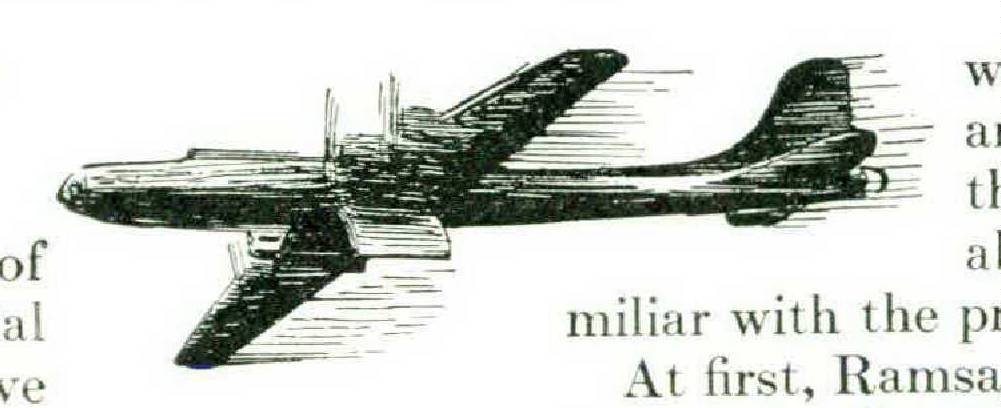
DURING the Second World War, a lot of people made the observation that aerial bombardment would be much more effective if the bombs could be made to hit the target. In spite of all the fancy talk about bombsights, good bombing is difficult. I know a professor of physics who, for a long time, was a pilot in a reserve bomber squadron that used to fly on week-ends. One Sunday afternoon he met the pastor of his church, who remarked that he hadn’t seen the professor at the services that morning.
“No,” said the professor. “I was out practicing bombing.” Well, this exercised the pastor a good deal. He made a little speech about the evil of desecrating the Sabbath by any such goings on. He wound up with a ringing denunciation of bombing, no matter what day of the week it was. “Imagine!” he said, with scorn in his voice. “ Riding in ease and comfort miles in the air while you rain destruction and bloody death on any chosen spot below.”
“Wait a minute,” the professor broke in. “About that chosen spot stuff. You have to allow for the ballistics of the bomb, for the speed, altitude, and crabbing angle of the plane, for the winds at all levels on the way down, and for the motion of the target. It’s not as easy as you think.”
That’s the way it is with bombing. It’s not as easy as you think. Because of the large national investment that every country was putting into bombing during the war, a great deal of thought and effort was expended on the problem of getting the bombs closer to their target.
If a pilot could ride along with the bomb and fly it into the target, the results ought to be better. We never tried this, but the Japanese did. The scheme worked pretty well when the pilot could keep himself brave and skillful all the way down. Our side used some electronically guided bombs you have read about in the papers. These could be steered a little during their flight by signals from the plane that had dropped them. Since, in wartime, no direction of attack on an important problem should be overlooked, there was also a proposal for a bomb flown by birds.
The fellow who dreamed this up will be called Ramsay. He reasoned that if he could train an animal to perform some simple operation which would give information on the line of sight between bomb and target, the flight controls of a steerable bomb could be hooked up with the animal, and the bomb would be caused to home on the target. As the animal, he chose the homing pigeon; I suppose he wanted a bird because birds are accustomed to viewing the ground from a considerable altitude, and arc familiar with the problems of flight.
At first, Ramsay tried to train the pigeons to look fixedly at the “target.”(He used for targets photographs of such objects as ships on the sea.) He arranged a little cap for the bird to wear, so that when the bird turned its head to keep its eye trained on the target, the flight controls would respond in the proper way to bring the bomb back onto its collision course with the target.
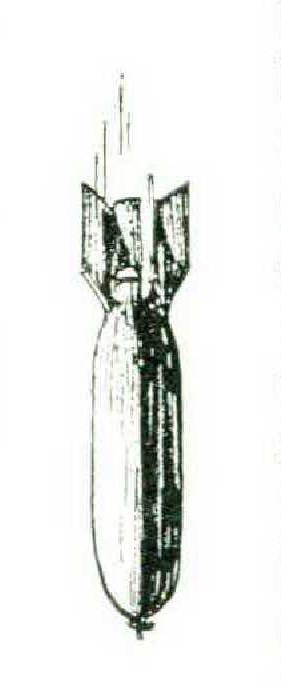
The bug in this scheme, as it turned out, was that a bird does not have binocular vision. Its eyes look out in independent directions on opposite sides of its head. One of Ramsay’s pigeons could be trained to fix its attention on the battleship, all right. But, about halfway through the twenty or thirty seconds that represent the time of fall of a bomb from high altitude, the eye the pigeon was using would get tired. The bird would then turn its head and shift to the other eye, thus moving the flight controls all the way over and putting the bomb into a wild swoop in entirely the wrong direction.
Ramsay went back to the drawing board, and in no time at all he had his next idea. He was looking for some function that the bird could perform to specify the target location in a unique way. At the same time, this function had to be one that was reasonably natural to the bird. Ramsay thought of pecking.
He made a little optical system which could be put into the nose of a bomb. It threw an image of what was in front of the bomb onto a screen in front of the bird. The bird was trained to peck at the image of the battleship or other target. The screen at which the bird was pecking had four electrical contacts, one at each corner. One pairworked the rudder of the bomb, to steer it right or left; the other pair worked the elevator, and steered the missile up or down. As long as the bird was pecking exactly at the center of the screen, each of the four contacts was closed for about the same time as were the others, and the bomb stayed on course. If the image moved away from the center of the screen, the bird’s pecking would close one set of contacts more than the other set, and this moved the flight controls in the proper direction to bring the bomb back on such a course that the target was in the center of the screen.
I should have explained earlier that Ramsay is a very thorough fellow. He worked out all the details of the project, even quite small ones like that of a standard container for the pigeons. A bird has a very complicated shape, with legs and wings and feathers sticking out all over it. If a bird is to be fitted into a mechanism, it should desirably be done up into a neat package, with only the head, which is used for pecking, sticking out. Ramsay found that if he cut off the toe of a man’s sock and put the bird into the top of the sock, head first, he had just the sort of package he wanted.
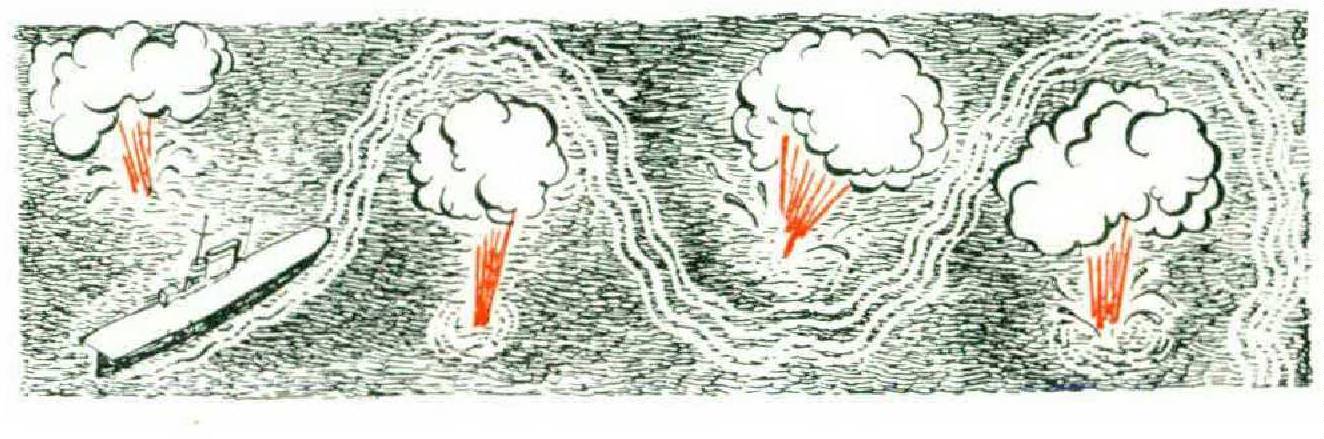
Another thing that Ramsay wondered about was the effect on his pigeons of the low air pressure at high altitude. He put some birds into an altitude chamber and “sent them up” to 30,000 feet by pumping the air out of the chamber. Then he let the air back in at a rate that simulated the fall of a bomb from that altitude. All the time the birds went on pecking as reliably as ever.
He worried about the effect on pecking that might occur because of the sidewise accelerations experienced by a bomb in flight. To study the effect of acceleration, he whirled some birds in a centrifuge almost to the point where they were “blacked out.” They went right on pecking.
Ramsay found that he could train birds on almost any type of target that was optically distinguishable. He got aerial photographs of typical cities, and he found that he could train the pigeons even to peck at a particular street intersection or prominent building in the city, ignoring all other details. I don’t know whether he ever tried an aerial photograph of a pickle barrel. In order to avoid confusing the birds, he would train each individual bird only on one class of target. Thus he had not just Tokyo pigeons; he had Emperor’s-palace pigeons, and Mitsubishifactory pigeons, and so on. He had battleship pigeons and destroyer pigeons and pigeons trained to peck at aircraft carriers, which no doubt is material for a pun about carrier carrier pigeons. The inflexibility thus introduced into the bomb load of any given airplane worried him somewhat, but he figured that bombing missions are carefully prepared in advance, and not many bombs are expended on targets of opportunity.
As we have seen, most of the basic problems were now licked, but there still remained one serious technical difficulty. The steering information applied to the bomb flowed around a closed loop, from pigeon to flight controls to bomb position, and thus back to the pigeon, since a change in bomb position moved the little target image that the pigeon was pecking at. Most automatic control systems are of this closed sort, and engineers refer to such a system as a “servo” system. Now one of the biggest problems in designing a servo system is to make sure that it does not oscillate violently, or “hunt,” about the position to which the control mechanism is trying to bring it.
I apologize for mentioning these intricacies, but it is necessary to explain why Ramsay found that his pigeons weren’t pecking fast enough to keep the bomb from hunting. He simply needed control signals, or pecks, with a frequency greater than the two per second at which his pigeons pecked.
Being a resourceful man, he first tried doping the birds with a little marihuana. This looked very promising at the beginning; when a bird got “high” on the stuff, it would peck at a greatly increased rate of speed, and the control system was stable. But the emotional reactions of the birds were unpredictable in the doped state. Often, before half the bomb’s time of fall had elapsed, a pigeon full of hashish would quit pecking entirely, lean its head over on its shoulder, and abandon itself to its dreams.
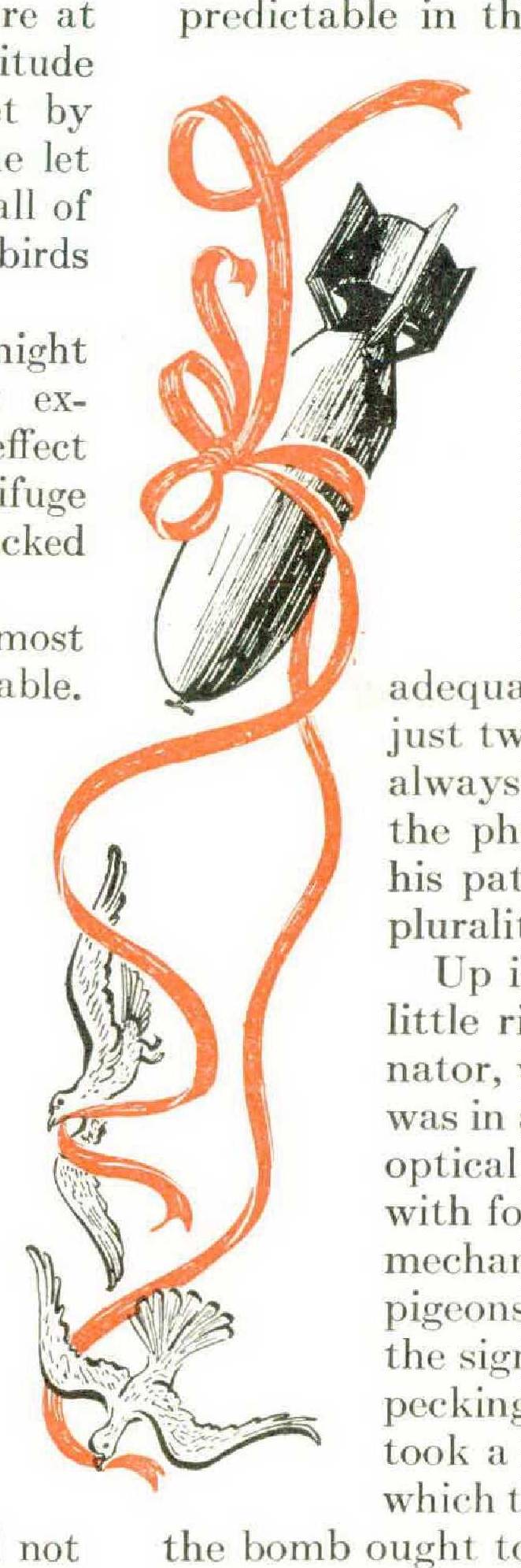
When this happened, there was nothing left to do but to use the brute-force method of solving the problem. If one pigeon would not peck with sufficient frequency to work the flight controls stably, more pigeons would. To be sure that he got his control signals with adequate frequency, Ramsay put in not just two or three but ten pigeons. I have always been enchanted by the music of the phrase that must have been used in his patent to describe this technique: “a plurality of pigeons.”
Up in the nose of the bomb, then, in a little ring around the fuze and the detonator, was this plurality of pigeons. Each was in a toeless sock, and each had its own optical system, ending in a little screen with four electrical contacts. The control mechanism received signals from all the pigeons and made use of them just as if the signals were coming from a single bird pecking at a faster rate. The mechanism took a sort of consensus as to the way in which the pigeons thought, on the average, the bomb ought to go, and acted on it.
Well, this is about the stage the project had reached when I left the country and lost sight of it. The technical problems seemed to be pretty well in hand. Of course, there remained the operational problems. Things like adding a Signal Corps Pigeon Company to the T/0 of a heavy bomb group, and putting pigeon lofts and birdseed in the T/E. The Standard Operating Procedure would have to be changed, too, by including such items as the list furnished each bombardier, at the briefing, of the target on which the pigeons in each of his bombs for that mission had been trained. Maybe the aggregate of these operational problems loomed so large that the Air Forces decided they’d rather wait for the atomic bomb, which you don’t have to be very accurate with. I just don’t know.