Absolute Pitch
MUSIC
By CARL ANTHON
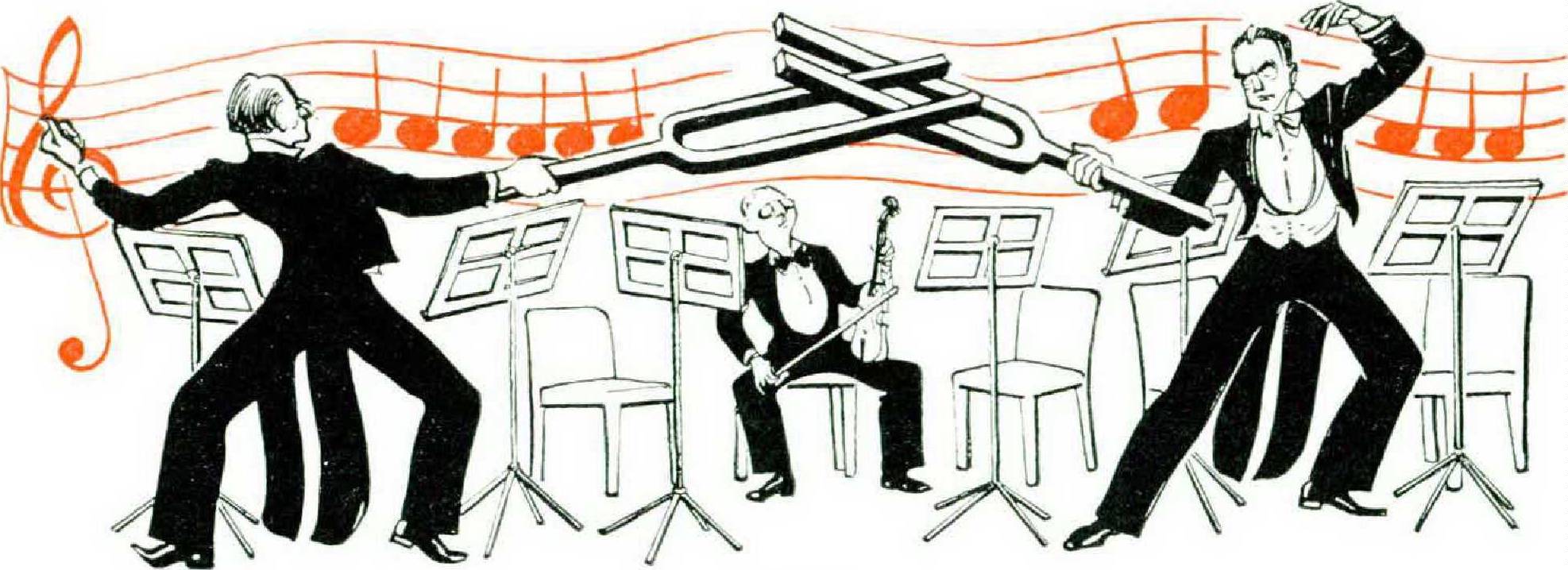
SOME time ago there appeared in the newspapers a story that brought an old problem into new focus. According to that story, French musicians were making an organized appeal to the world to stop the inflation of the musical pitch. It was a brave plea, but a voice in the dark, I fear, and the inflation will probably run its course.
What is this inflation of pitch that is already driving some musicians mad?
During the eighteenth century and before, the pitch of a musical note, say A, varied a great deal from place to place, thus causing considerable confusion. An A might be of one pitch in one organ, and perhaps half a tone lower in another, while still different A’s were used by orchestras and bands. This variation naturally resulted in a great deal of inconvenience to musicians and composers. Bach might compose a Mass in B Minor to fit the organ of St. Thomas’s in Leipzig, but when it was performed in a church where the organ was tuned half a tone higher, he would have to transpose several orchestral parts to lit the new organ.
To overcome these difficulties, a uniform standard of pitch was highly desirable. When weights and measures, coinages, and laws were undergoing a process of leveling and standardization during the nineteenth century, musical pitch, too, gradually came to be standardized. In 1858 the Paris Academy fixed the pitch of middle A at 435 double vibrations per second, and this became international pitch after its adoption by an international music congress that met in Vienna in 1889.
This international standard pitch was fully a half tone higher than the instrumental pitch of the eighteenth century. For that reason, works composed previous to the adoption of this international pitch all sound a half tone higher than the composer intended. Beethoven’s Fifth Symphony, which to us seems so inlimately associated with the key of C Minor, would actually sound to Beethoven, if he were back on earth, as a symphony in C sharp Minor, and he would probably have a fit over it. The associations we have with the key of G Major or C Major — joy, childlike simplicity — were felt by Bach, Haydn, and Mozart in keys that sound to us like F sharp Major or B Major, which for us have totally different associations.
The present international pitch, then, already represents a certain inflation compared to the earlier pilch. But inflation is still continuing. In America, international concert pitch was fixed at 440 v ibrations for A and is therefore considerably sharper than the European A. But even within the Lnited Slates there are deviations, The Boston Symphony Orchestra, for example, without wishing to make it official, uses a still sharper A, somewhere between 444 and 445 vibrations.
Why this steady rise? The theory underlying the sharper A is that it is more brilliant, and that is why Dr. Koussevitzky believes in an A of 444 vibrations. But more brilliant than what? The A of 440? According to that theory, the A of 440 must be more brilliant than that of 436, the latter more brilliant than that of 432, and so on. Going in the other direction, it follows that an A of 448 would be even more brilliant than the brilliant A of the Boston Symphony Orchestra. To follow this theory to its logical conclusion, one should keep pushing the pitch higher and higher to achieve greater brilliance. Where is the ceiling?
The implication of this pitch inflation for musicians is that they cannot always adjust their instruments to a higher pitch. A French flute or oboe, based on an A of 435, cannot play with flutes and oboes based on an A of 444. An organ’s pitch is relatively fixed; it cannot be changed at will as can that of the st ringed instruments. Musicians who are used to one kind of pitch arc upset when confronted with a higher pitch, for it blurs their sense of proper pitch.
This is the reason the French musicians voiced a frantic plea for the return to the international standard agreed upon in 1880. But modern conductors and virtuosi arc adamant in their belief that a sharper pitch means more brilliance. And more brilliance they must have at all cost, for that is presumably in harmony with twentieth-century tastes.
Is pitch absolute or relative? Don’t some people have absolute pitch? If so, what is this thing called absolute pitch? When we hear that someone has absolute pitch, don’t we mean that he can tell us exactly what A — that is, absolute A — should sound like? He should be able to sing for us instantly, without reference to any other sound, the correct pitch of any note. But what he will actually produce is not an absolute A; it is the A that he is accustomed to hearing and which his tonal memory now reproduces.
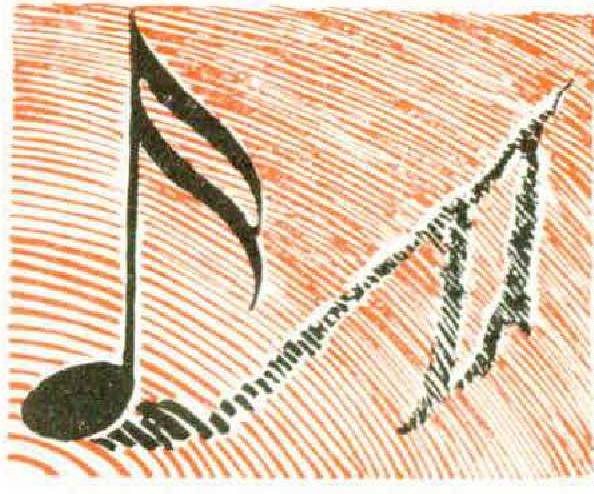
The reason for this, of course, is that there is no such thing as an absolute A, or any absolute pitch whatsoever. Pitch is relative, and wo can call A any tone we like. The rest of the musical scale is then built up in mathematical relation to it. Any associations with a sharper pitch — brilliance and so forth — seem purely psychological.
Some persons are born with this faculty called absolute pitch, this ability to tell an A or any other tone when one hears it. Others acquire absopitch through practice. In any case, it is a matter of tonal memory — the memory of that tonal system most frequently, or possibly most recently, heard and used by that particular person.
If, however, the pitch varies from one orchestra to another, what chance has the musician or the layman to develop an ear for proper pitch? The number of persons possessing so-called absolute pitch will decrease
in proportion to the varieties of pitch that are cropping up. It seems sensible to return to an international standard pitch and stop the inflation of the A.