Vermont Maple
FACTS
By LEE ANDERSON
THE production of maple sugar and syrup is a major industry of Vermont.
According to official estimates, in a normal sugar year it amounts to nearly 20 per cent of the total agricultural products of the Green Mountain State. In some sectionsions it represents 40 per cent of the value of all agricultural output.
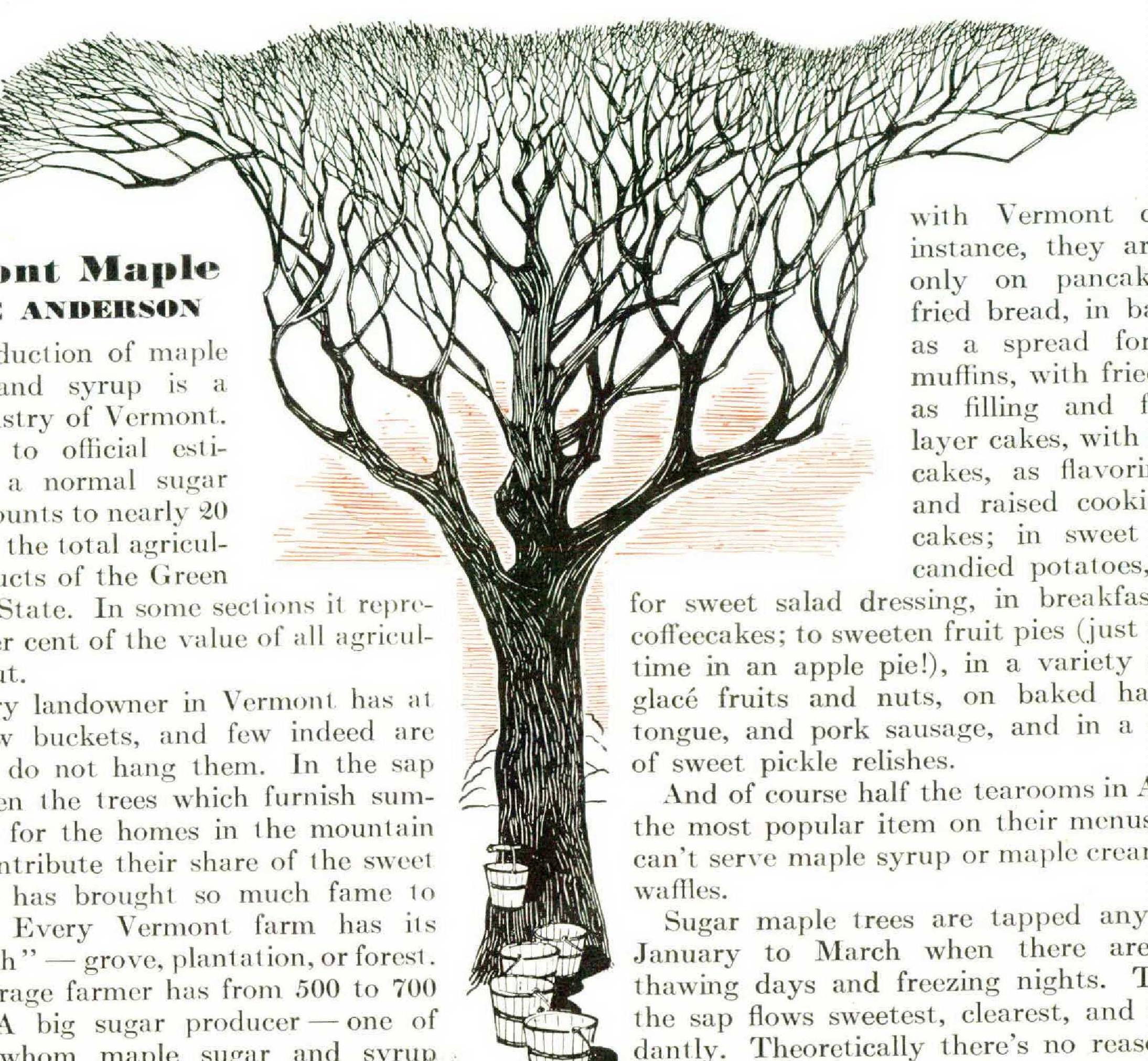
For every landowner in Vermont has at least a few buckets, and few indeed are those who do not hang them. In the sap season, even the trees which furnish summer shade for the homes in ihe mountain villages contribute their share of ihe sweet sap which has brought so much fame to Vermont. Every Vermont farm has its “sugar bush” — grove, plantation, or forest.
The average farmer has from 500 to 700 buckets. A big sugar producer — one of those to whom maple sugar and syrup amount to 40 per cent, of their farm income — will have from 2500 to 3500 buckets. Some have as many as 10,000.
When cane and even beet sugar became scarce during the war, there was no immediate ceiling price on maple sugar. Until a ceiling was established the “Pure Vermont” soared to 90 cents and $1.00 a pound. In a good production year most Vermont sugar producers can make a profit selling maple sugar at the price of cane sugar.
But Vermont maple sugar has become a confection: it is no longer regarded as merely sugar, except in the remote hill districts of the state. Pressed into four-leaf clover, rosette, arrow, crown, rose, and a dozen other patterns — all originally made with farm-kitchen cookie cutters — it now sells, boxed, for $1.50 a pound.
The Vermonter uses maple syrup and sugar in his home in a score of ways more or less exclusive with Vermont cooks. For instance, they are used not only on pancakes but on fried bread, in baked beans, as a spread for blueberry muffins, with fried salt pork, as filling and frosting for layer cakes, with nuts in loaf cakes, as flavoring in hard and raised cookies, in cupcakes; in sweet bread, for candied potatoes, in pickles, for sweet salad dressing, in breakfast rolls and coffeecakes; to sweeten fruit pies (just try it sometime in an apple pie!), in a variety of tarts, to glace fruits and nuts, on baked ham, smoked tongue, and pork sausage, and in a dozen sorts of sweet pickle relishes.
And of course half the tearooms in America lose the most popular item on their menus when they can’t serve maple syrup or maple cream with their waffles.
Sugar maple trees are tapped any time from January to March when there are successive thawing days and freezing nights. That’s when the sap flows sweetest, clearest, and most abundantly. Theoretically there’s no reason why the sweet sap could not he harvested in November or December, except that the weather in those months almost never produces warm days and freezing nights in alternation.
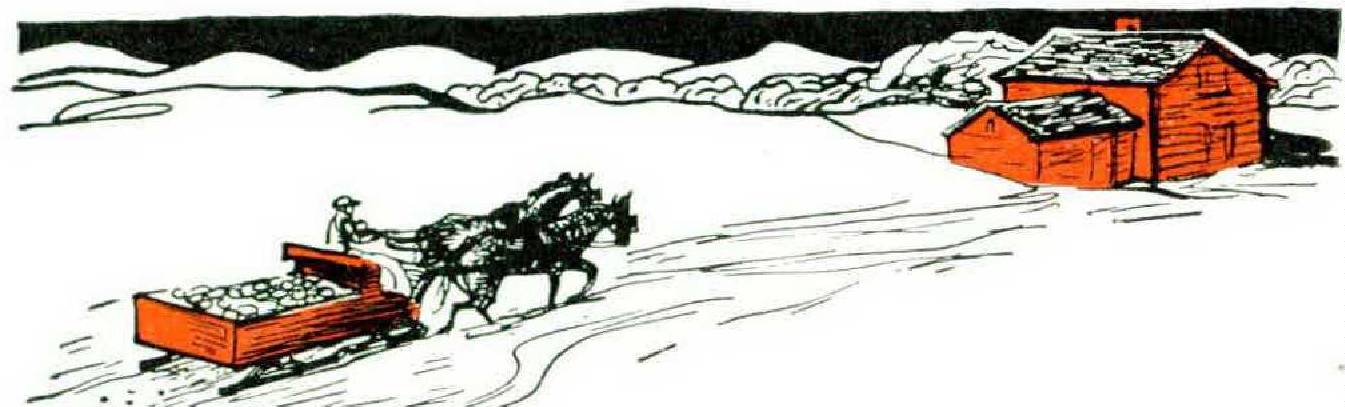
The best season in Vermont is when the winter is beginning to break: daytime thaws on the south slopes, a sharp freeze each night, and plenty of snow for sledging out the barrels of sap from the bush to the sugarhouse, where it is cooked down and sugared off.” Broadly that good season is around the first, of March, though it may vary from early January to mid-April.
Sometimes the Vermont winter breaks with a bang, the period of thawing days and freezing nights is short, and the trees come rapidly into bud with unseasonable warm weather. That’s what happened in 1946. The long warm spell in March practically killed the Vermont sugar crop. Many farmers didn t even get a chance to tap their trees before the soft mud season was upon them. The trees came into leaf so quickly that the scanty sap — from a quarter to a third of normal output — was dark and had a strong “bud taste.”
The year before, there was a short spell of thawing days and freezing nights, followed by a protracted period of day-and-night freezing, with virtually no snow. Sugar farmers, unless they are among the big, mechanically equipped producers with permanent conduits from the sugar bushes to the cooking houses, need snow to get out the sap that drips into their buckets. In 1945 the Vermont syrup output was about one third of normal.
“Sugar snow” is a fall of wet snow, preferably three to five inches, which blankets the sugar maple country on one of those thawing days, and then freezes solid in a deep crust during the night. With a good sugar snow, the farmers can pick up and sledge out of the bush about twice as many buckets as they can in deep, soft snow, and three or four times as many as they can handle in the Vermont mud.
Even if the sap is running abundantly, it never becomes maple syrup or sugar unless the buckets can be collected for the cooking. A Vermont farmer will tell you that maple sap is more sensitive, more delicate to handle than milk; and many of them are big dairy producers. Bacteria are plentiful in maple sap. it must be collected promptly, got quickly to the sugarhouse, and cooked without prolonged storing. Otherwise it deteriorates even if it doesn’t become rancid and worthless. That’s why a good sugar snow is so important; that’s why a steady unseasonable hot spell is disastrous to maple syrup product ion.
Of course, in an industry so closely allied with the weather, there are a lot of traditional, and sometimes strange, beliefs as to what helps or hurls a sugar crop. One farmer with a sugar bush of 2000 buckets once told me that a prevailing easterly wind during the season of tapping always reduces the sap flow and produces watery syrup; in his belief, west and southwest winds alone assure an abundance of the sweetest sap. Several have told me that trees deep in the forest, where there is a thick, warm bed of dead leaves, yield more and better sap than trees in the open or trees at the edge of a forest. There seems to be no proof that this is so.
The average hired hand will collect between 200 and 300 buckets a day. The proprietor who works, and worries about, his own bush can collect about 500 buckets a day.
If the sap is flowing abundantly, such collections frequently mean the whole night is spent in cooking. Undercooking means watery syrup; overcooking
produces granulation. The perfect, undiluted Pure Vermont maple syrup weighs 11 pounds to the gallon.
The proprietor of a fine sugar bush at the northern end of Isle La Motte died at a ripe old age, and the farm was not actively worked for several years. Under the leadership of his guide Benjy, a New Yorker named Shaw had shot duck from the shores of the farm for years. He liked the place, and when the family of the deceased owner let it lie fallow, he decided to buy it.
He had been told how the owner harvested from 3000 to 3500 gallons of syrup from his sugar bush, and he resolved that he would make that sugar crop if nothing else. His major problem was labor. Knowing not hing about sugaring himself, he gave the job of superintendent to the man who talked the most knowingly. Thousands of taps were made, buckets were hung, sledges were readied, and the sugarhouse waited. But each day the buckets were empty, or at best their bottoms wore moderately moist. The new owner was frantic.
Then he thought of Benjy. Benjy had a big bush of his own, was a good sugar man. That evening he got Benjy on the phone.
“Benjy,” he said, ‘Tin having trouble with my sugar. Buckets are all hung, but we’re noi getting any sap. Can you take time to come up here? I’d like you to find out what’s wrong.”
Benjy said he’d be up, and the following morning he arrived at Shaw’s farm about daybreak. He made a thorough inspection of the New Worker’s sugar bush, then ret timed to his own job.
“Benjy was here,” said Shaw’s superintendent when the owner appeared for breakfast.
“What did he sav?”
“ Nothin’.”
After trying all day to reach Benjy by phone, that evening Shaw drove to Benjy’s farm. After more than an hour’s ride in the fiftcen-below-zero air, he found that his consultant had gone to town.
Benjy was spending the evening in the village blacksmith shop, gassing and spitting tobacco juice into I ho forge.
“Go up to Shaw’s place 'bout Ids sugarin’?” asked one of the villagers.
“ Yup.”
“Kind what’s wrong?”
“ Yup.”
“What’d y’ tell him t’ do?”
“Nothin’.”
”’F y’ found what’s wrong, why didn’ y’ tell him?” demanded the blacksmith.
“Hr didn’ ask me,”said Benjy.
Well, that’s Vermont. What was wrong with Shaw’s sugaring? His unskilled help had driven his taps into the heart wood, and sap is procured only from the rings immediately beneath the bark of the sugar maple.