Spoon Bread and Moonlight
FOOD
By M. F. K. FISHER
IN 1880, when Mark Twain wrote nostalgically from Italy of the American food he missed so sorely, the list of dishes to be waiting for him in New York when his ship docked included at least nine that were Southern. So was he, of course.
But it is probable that almost any of us would have chosen much as he did, so strong is the influence of Southern cooking on our national gastronomy.
Whether the influence is justified has often been questioned, bitterly, dyspeptically, by natives of every state in the Union, but our romantic minds still curtsey to the mumbo-jumbo of “ante-bellum days” and “the old South,” even in the face of such a present monstrosity as the average restaurant’s Southern Fried Chicken. Moonlight -and-magnolias cover a multitude of dietetic sins, thanks to our innate sentimentality, and we gladly pay triple to have fobbed off on us a mediocre plum cake baked bv the delicate hands of a decayed Kentucky gentlewoman whose shrewd publicity describes her as unwillingly sacrificing her family’s most treasured recipe, in order to save the old plantation from seizure by the damyankees.
Expensive tearooms, whether in Louisville or Los Angeles, serve incredible masterpieces of pecan nuts, gelatine, and whipped cream with impunity and the promise that they are “adapted” from another secret Confederate recipe; and cookery books “translated from Southern lore” sell like hot cakes (or should I say canebrake biscuits?) in stores frequented by large soft ladies with inherited or acquired drawls.
“My old mammy told me this,” they say gently, cutting into a Dixie Sunshine or a Prince of Wales. “It never was written, to keep it secret of course. But if you take thirteen eggs instead of eleven, honey — ”
And the cake is delicious, and rich, and the fact that it has moved gradually from the plantation to the bridge club cannot dim its delicate splendor— as long as some people still have dozens of eggs and quarts of thick cream and, preferably, ihe strong, unquestioning black arm of a slave woman to beat them all together. The recipes are whispered, even on paper, and no bilious cynic from Detroit or Sioux City can deny that they deserve to survive as long as anyone can make them.
It is the commoner foods, the breads, the daily belly-fillers, that are mistreated from one end of America to the other because of the hypnosis of the adjective “Southern.” That is wrong, because food that can be made by poor and rich, old and young, should always be worth the swallowing. And good corn pone, for instance, is indeed just that. Mark Twain was right when he put it, and hoecake too, on that list of dishes that made him long for home.
One thing that makes good corn bread difficult to get is regional prejudice: a man from Arkansas blanches, for example, at the thought of putting molasses on his dodger like a Missourian, and instead wants it buttered, or plain with a dish of black-eyed peas and sowbelly. And he wants it made of white meal, never yellow.
Another difficulty is that recipes for corn bread are seldom written, not because they must be kept as hallowed family secrets, like Aunt Chloe’s Teacake or Belle of New Orleans Pie, but because they are made as automatically as breathing, and as often — a handful of meal, a pinch of salt, a couple of eggs, some sweet milk, and there you are!
Or rather, there you are if you have been doing it all your life. If not, you probably buy something in a box and try to convince yourself that it is just as good.
I tried, a long lime ago, to learn how our cook Bea made biscuits. She could not write or read, and smiled mockingly when I confessed that I had to copy down a recipe in order to remember it, but she let me stand beside her many times in the kitchen while her slender blue-black hands tossed together the biscuit-mix. She always did it at the last minute, when several other things for the meal had reached their climaxes of preparation, so that it was hard for me to separate them from the bowl I was watching. Every time, the ingredients were the same but in maddeningly different proportions; and every time, the biscuits were the same too; light, flaky but not crumbly, moist in the middle — as a cloud is moist, not a sponge.
I never learned, and flea told my mother that I was not as bright as I looked to be.
Now I have a friend from Arkansas, and she makes corn bread the same way. It is truly impossible for her to tell me how, and one reason I am sorry is that she makes the most delicious dressing in the world, and it takes corn bread to do it. I watch her, and she tries hard to tell me, and every time, as with flea and the biscuits, the ingredients are every which way and the bread is exactly the same delicious thing.
If you can make corn bread that is respectable, though, whether it be with white or yellow meal, here is how to make the dressing, to serve with chicken or turkey (“But you haven’t eaten turkey, my friend says, “so long as you haven’t eaten wild-turkey steaks, cut thick from the raw breasts and fried in butter.” I agree sadly, and think with amazement that the great wild birds Brillat-Savarin wrote about so tenderly are still flying over the pine woods, good! exceedingly good! oh! dear sir, what a glorious bit! ” his guests cried out as they ate the last morsel of his game, more than a hundred years ago — and I would do the same today, could I but taste a sliver from the breast. Meanwhile I comfort myself with this recipe, so much better than any I have ever found in a book) : —
Take fresh corn bread, about what would be in an 8-inch square pan, and crumble it lightly with 4 or 5 leftover biscuits or slices of stale white bread. Add eggs, and finely chopped celery and onions to taste. Season simply: salt, pepper, perhaps a little sage. Baste the roasting bird generously and often, and put all the drippings from it into the bowl of dressing, which must be moist but not sodden. Add good rich stock if it seems dry. When the bird is a scant hour from being done, stuff it lightly with the dressing, and put what is left under and around it in the pan.
(Some people like fresh peanuts or pecans chopped coarsely into this dressing, but not my friend — and therefore not I.)
The same impossibility of getting a good corn bread or biscuit recipe holds for spoon bread. Bea used to make that, literally, with one hand. I tried reading recipes to her, and although she pretended to find all of them ridiculous, the following one produces the nearest copy of her infinitely better dish: —
2 cups milk
1 scant cup sifted corn meal 1 tablespoon brown sugar ½ teaspoon salt
1 cup butter, melted or in tiny pieces 6 egg yolks, beaten 6 egg whites, beaten
Heat milk to scalding point, then very slowly stir in the corn meal, sugar, and salt. Add the butter gradually, stirring the mixture up from the bottom of the pan. Cool, and add the beaten yolks slowly, stirring hard the while. Fold in the stiffly beaten whites. Turn into a well-buttered casserole or souffle dish and bake about 25 minutes in a 425° oven (hot), until the bread is set in the middle and lightly crusted. Serve very hot, always from a large spoon.
Most places specializing in “real Southern cooking” serve spoon bread with chicken or ham. Usually, even in the South, it is a hot fuzzy mush, neither pudding nor porridge but possessing most of the disagreeable attributes of both.
“ But,” said my mother reasonably when we talked of such things, “that’s the way it is, down there. I never knew restaurants, of course, but I went to school there for several years, and spent all my vacations with friends on what was left of their plantations — that was in the nineties. They were still fighting the War Between the States, and I don’t yet see why they were so kind to a Yankee girl—and it seems to me that we lived on hot-breads and cakes and pies and fried chicken.”
“That sounds good,” I said greedily.
“It was — but only because l was young and ravenous,” Mother said. “We ate four or five kinds of soggy rich hot-breads every day for breakfast, besides corncakes and beaten biscuits always. And big bowls of jam, as if it were fresh fruit. We all had headaches all the time, and took pills. And,” she lowered her voice politely, “everyone was constipated.”
She looked slightly embarrassed at her unaccustomed boldness, and then went on energetically to camouflage it, “ Fry, fry, FRY ! Everything was fried. I do believe those cooks could dip old corncobs in batter and serve them up as crisp hot fritters.”
“That, sounds good too,”
I said, being even hungrier by now.
“It gets tiresome after live years or so,” my mother said.
“It’s why Southern belles are so languorous, probably — they all have indigestion, although usually it’s called love in one form or another.”
Mot her snorted. “And I don’t want to see another Southern fried chicken as long as I live!”
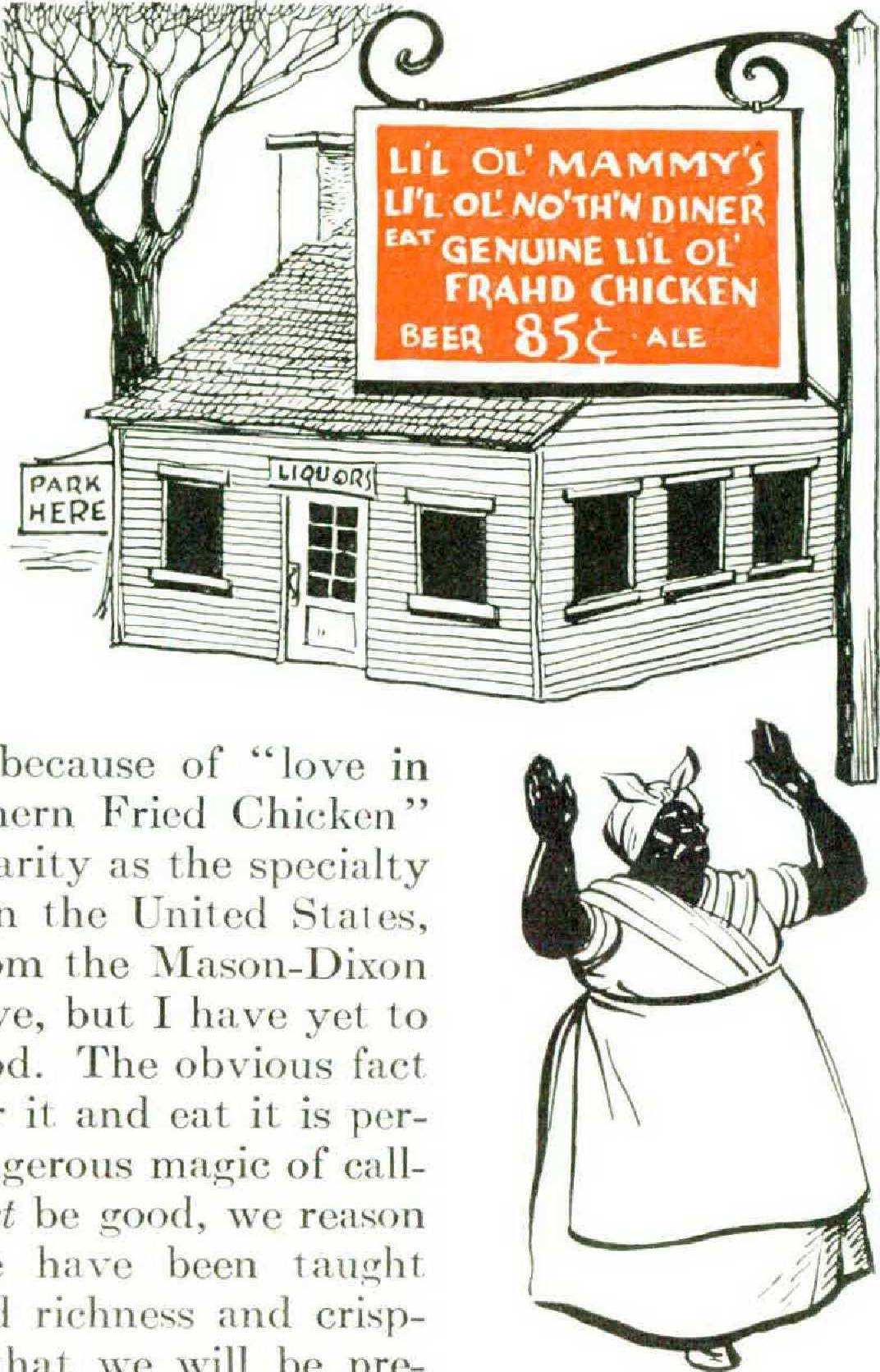
A great many people feel the same way, although not because of “love in one form or another.” “Southern Fried Chicken” is advertised with callous regularity as the specialty of most of the eating houses in the United States, no matter how far they are from the Mason-Dixon Line or what clientele they serve, but I have yet to hear of any that is notably good. The obvious fact that a great many people order it and eat it is perhaps one more proof of the dangerous magic of calling a thing “Southern": it must be good, we reason unconsciously, evoking all we have been taught about ante-bellum delicacy and richness and crispness, and knowing very well that we will be presented with one more mistreated, steam-heated carcass, parboiled before it was fried, to ensure a kind of tenderness, no matter what its age and antecedents.
The worst I ever ate, I am almost sure, was in a lakeside tavern in northern Minnesota. People whose gnstronomical judgment I respected, largely because they had tipped me off to the local caviar, assured me that no drive was too long if at the end of it there waited a platter of superlative Southern fried chicken prepared by the tavern s master cook.
I telephoned ahead, as they told me to, and mentioned their names, and then drove a very long drive indeed through spicy woods that made me hungry in an almost violent way. And the platter that was set before me was reward enough, heaped with erisp sizzling half-fryers, piled extravagantly high, sending off a visible perfume of brown, savory delight. Southern fried chicken, I told myself — at last I would taste it as it should be, as it never was.
The outer skin, dripping with rancid grease that soon overpowered the first fine aroma, was a thick half-done batter which slipped off in a horrid way, entire, and was inwardly pale and pasty. The flesh was grayish, boiled to death and dead to look at. Worst of all was the way it cut, like putty or suet, and then the fact that a half-inch from the surface it was cold — cold from the icebox where it had lain cooked for days before it was dipped quickly into a ready-mix batter and then into ancient fat, for my arrival.
It was a bad thing to meet, in northern Minnesota or southern California or in the Deep South itself—and the sad part of the story is that the same thing will happen again, in any of those places, to anyone fool enough to ask for it.
Me, I am cured — except spiritually of course. And I think this recipe, the nearest I can come to my dream of what Southern fried chicken should be, helps soothe my good American sentimentality about Confederate gastronomy, and may even lay Mark Twain’s outraged ghost as it hovers over the pier in New York, waiting for the Southern fried chicken that he so hungered for in Italy in 1880: —
Cut up a young chicken and soak the pieces in sweet cream overnight. Drain them, saving the cream for the gravy. Pat each piece partly dry with a cloth, and salt and pepper amply. Dredge in a mixture of half bread flour and half corn meal. Mix one part butter with two parts lard, and have just hot enough to hiss when a crust is dropped in. Fit the chicken carefully into the skillet, and cover closely for about fifteen minutes. Then turn frequently to make the chicken brown and crisp, taking care not to let the fat become too hot.
For the gravy, pour off most of the fat from the skillet, add the chopped giblets and a little flour, brown, and then add seasoning and lastly the cream.