Break the Heart
RADIO
ByR. J. HICKS
A POPULAR radio program entitled “Break the Bank” is to be heard over a nation-wide network each Friday night. Its sponsorship a happy marriage between a laxative and a deodorant, this offering is ostensibly one of the big, brassy, goodnatured “give it away” shows, in which, instead of refrigerators, washing machines, and nylons, large quantities of hard cash are handed to members of the public who answer questions correctly.
A procession of men and women steps to the microphone, all pitifully eager to lift some of the money which the announcer keeps referring to droolingly (“There’s four thousand, eight hundred and twenty good United States dollars in the Bank now, folks”). In the background a studio audience whistles, roars, and applauds with vicarious cupidity.
Are the questions difficult? No. Is the announcer on the side of the questionees? He could not be more so. There is never a trick question. He is friendly and helpful — often answering questions outright on behalf of a particularly ungifted contestant, and always in the best humor when he can give away some of the sponsor’s money. But it is not easy for him to do so. This is the sort of thing that happens (I won’t use real names, in order not to hurt feelings, but the dialogue is virtually word for word as heard and noted down): —
The announcer, happy as a sandboy, calls out, “All right, folks, now we have three thousand, six hundred dollars in the Bank; and here come—” (they come mostly in twos, for some reason: mother and son, husband and wife) “— here come Mr. and Mrs. Jay Flannap, of Charleston, South Carolina.” Applause. The announcer jests for a moment, speaking in what he believes to be a Southern accent. “How long youall been married?” he drawls humorously. “Five years,” responds Mrs. Flannap. “Five years! And how many children you got, honey chile?” “None,” says Mrs. F. “None, hunh? I see — well, let’s get on to the first question,” says the announcer, dropping the drawl hastily. “Now what theme have you two chosen from off of the giant blackboard?”
The “giant blackboard” is a further staggering feature of the program. Displayed on it, one infers, are a dozen or more themes. Contestants can choose beforehand their own subject. If they achieve meager results with the subject on which they fancy themselves, a gamble with one that struck them as difficult would no doubt find the desperate announcer paying out little or nothing week after week.
Anyway, the Flannaps have chosen “Queens.” “All right,” cries the announcer, “here we go — reaching for ten dollars — and no prompting, please. How would you address a queen if you were presented to one?” Mr. Flannap says with hopeful facetiousness, “I wouldn’t say, ‘Hi-ya, toots!’”
The audience roars at this sally and so does the announcer. “Good for you, Mr. Flannap, we’ll allow that one. Well, now, you’ve got ten dollars and you ‘re reaching for twenty. All right — who’s the present Queen of England?” Dead silence. “England — the present Queen of England. What’s her name?” The announcer pauses, then whispers as though to himself “Liz — oh, Liz—” “Elizabeth!” gasps Mrs. Flannap amid thunders of applause. “Elizabeth is — right!” shrieks the announcer. “Now, you’ve got twenty dollars and you’re reaching for fifty. What was the name of the queen who was King Solomon’s girl friend?” Silence. The Flannaps, in fine form hitherto, appear stumped. The announcer takes a hand again. “She sure was cute,” he says. “How cute she was. She-she-she-” “Sheba!” cries Mr. Flannap. A big hand greets this almost fey sensitiveness. “All right, good for you. Now you’ve got fifty dollars and you’re reaching for a hundred. Sure you wanna go on?” (archly, this). A nervous giggle and an “Oo, yes,” is the response. “What queen is the ruler of the Netherlands?” Silence. “ Very popular, well-loved, was in Canada during the war. Mother of Princess Juliana.” Silence. “Queen of the Netherlands — been on throne a long time?” Mrs. Flannap: “Oh, of course — Queen Mary!” “No. Sorry, folks, that answer is wrong. Well, now you’re back to twenty and trying for fifty again. What was the name of England’s queen who married a cousin, the German Prince Albert, in 1840?” Silence from the queen experts. “Oh, a very famousqueen, folks — no prompting, please — why, she was on the throne for years and years, and gave her name to an entire epoch or period.” Prolonged silence. “Sorry, folks. Well, there’s twenty dollars waiting for you, right over there, and thanks for joining us tonight.”
What caprice induced the Flannaps to pick queens for their subject? Could they have shone any less brilliantly with one of the others?
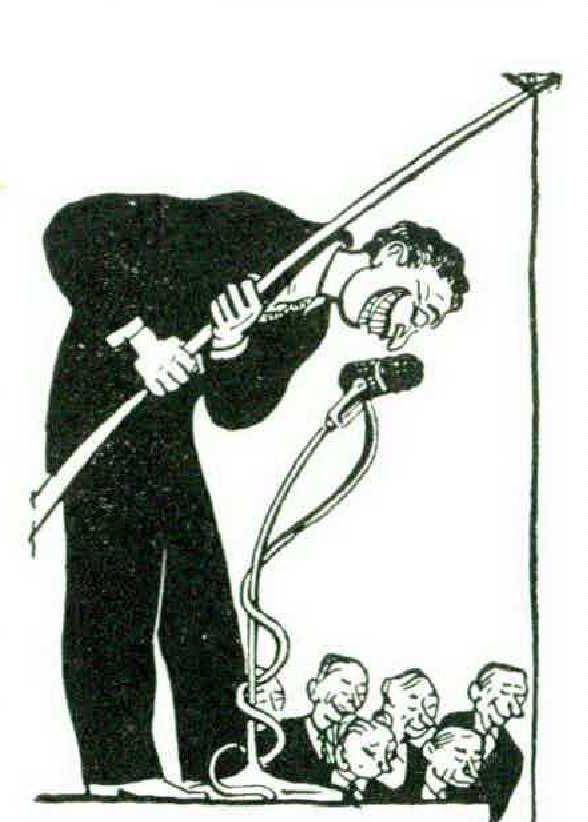
Next comes Mrs. Maria Borker, of Independence, Missouri, a farmer’s wife. Having endured a barrage of inevitable pleasantries about President Truman from the delighted announcer— no man to pass up an opening — Mrs. Borker started to attack her chosen subject, which turned out, sensibly enough, to be farming.
Her first twenty dollars was earned by doing barnyard effects to the words of “Old MacDonald Had a Farm,” sung by the announcer. Next she was asked to guess the name of a tune played on the piano. It was “Turkey in the Straw.”“Hmm,”said Mrs. Borker uncertainly. “Seems like I heard that some place before.”“Come now, Mrs. Borker,”said the announcer. “Someone’s in the straw — who is it?" “Chickun? ” queried Mrs. Borker sharply, “No, no.” “Turkey?" “Turkey is right!“ Applause. She got by all right on a question about “What contrivance keeps chickens warm?" (a brooder), and “If you were talking about Holsteins and Aberdeen Anguses, what animals would you be discussing?" but encountered a setback when the announcer said, “Miss Betty MacDonald has written a famous best-seller - and a very amusing one — all about life on a chicken farm. What is the title of the book?” After agonized pondering Mrs. Borker gave up, but when the announcer sorrowfully reminded her (the timelimit gong having sounded), she ejaculated, “Oh, and I read that book too—just last week.”
Next question: “Which of the children of Adam and Eve is spoken of in the Book of Books as a quotes tiller of the ground unquotes?" Answer: “Cain.” “Cain is right!” shouted the announcer — and rarely, I feel, can Cain’s name have been greeted with such unfeigned and exuberant pleasure and applause.
Mrs. Borker’s Waterloo came when she answered “Colorado” to a question on which state contained the Grand Coulee Dam, but she retired amid general approval to collect one hundred dollars.
A high spot of the program for at least one listener was when a man and woman from somewhere called Granite Ledge Homes, New York, were tackling the self-selected problem of “ Islands.”They were about up to average - average for “Break the Bank,” that is—being right on “What is the Pacific island paradise where they present wreaths known as leis when the visitor leaves?"; “What is the name of the island-continent where our tennis team won back the Davis Cup?”: “What is the name of the animal from a large island which carries its young in a pouch?”; and “Lots of circuses and sideshows have featured an attraction called ‘The Wild Man of -.’ What island?" But they fluffed “What group of islands is Guadalcanal in?” (“The Philippines,”they said). Then came this memorable interchange:
“All right, Mr. and Mrs. Brind. You’ve got one hundred dollars and now you’re reaching for two hundred. Off the shores of what Pacific island were the recent atom bomb tests held?" Silence. “Oh, think hard now, folks. It was in all the papers — on the radio too.”Mr. Brind: “It was Atoll Island!”
Another man (accompanied by two small sons), when asked which state had three sets of double letters in its name, responded without an instant’s hesitation, “Alabama”; and when asked to say what states’ names were brought to mind by various tunes, listened to a spirited rendering of “Sweet Georgia Brown" and then, mistaking the well-meant promptings of the announcer for sabotage, remarked testily, “Oh, please don’t do that while I’m trying to concentrate.”
As will be seen, few contestants pose a serious threat to the accumulated largesse, though none leaves empty-handed. But a few weeks ago a mother and son had somehow forged their way correctly through the seven or eight questions which put competitors in a position — with a final one to come — to lift the entire bank, at that time standing at a rich five thousand, six hundred dollars. The announcer made the most of the unhappy woman’s tension. He did a cat and mouse act, asking her if she was nervous, and what she would do with the money if she won it. Rather appealingly, she eschewed attempts at humor, and after a pause for thought, said soberly that she would like to devote it to her son’s education. This produced applause which sounded for once timely and appropriate. I think we were all rooting for her. But alas — “All right, now: the question which will bring you five thousand, six hundred dollars — you hope. We all know and enjoy the adventures of that lovable character of fiction, Don Quixote. What was the name of his horse?”
It was instantly apparent that the woman did not know. I got the impression that no one in the audience knew either. The gong sounded. “Well, I’m sorry, Mrs. Jasmine — it was, of course, Rosinante.” Whereupon Mrs. Jasmine, a woman who had sounded pleasant and moderately intelligent, made in her moment of disappointment a significant remark. “Don Quixote,” she murmured. “Oh, dear, that’s one of the books one ought to have read, isn’t it ?”
There has been a good deal of discussion recently concerning the hard lot of schoolteachers, and of how defeated they feel about it all. I hope that none of them listens to “Break the Bank.”