Through the Looking Glass

TRAVEL
ByBERGEN EVANS
THE chief advantage of travel is that it gets us out of ourselves, and the chief advantage of getting out of ourselves is that we can then see ourselves.
Perhaps the most interesting thing that a citizen of the United States sees in Mexico is the United States and its citizens, including himself.
I am not referring to his dysenteric, gawking fellow tourists, nor to the childish Uncle Gringo of Rivera’s murals, but to those incidents and situations which bring us face to face with our own antipathies, prejudices, and circumstances. Every man considers himself reasonable and tolerant, and therefore anything strange seems unreasonable and intolerable to him. But an honest man, recollecting in tranquillity, often has doubts, and doubt is the beginning if not, indeed, the end of wisdom. Thus the motorist who on his first night out of Laredo south puts up at a “native” hotel or tourist camp will probably reject with disgust the fried bean mush, goat meat, and grilled worms which his host, most eager to please, may offer him for breakfast. Yet when he is safely back home, cured of colitis and wanderlust, placidly munching his morning cellulose, he may wonder if, in the matter of food, he is not perhaps a little provincial. For, despite the advertisements, there is little doubt that the majority of mankind would unhesitatingly choose the Mexican’s breakfast in preference to his, and from the aspect of nutrition would choose wisely.
And so with the exasperating mañana. Are the Mexicans as slow and remiss as they seem, or are we overexacting and full of inefficient bustle? It’s all a matter of values, of course. But the traveler who does not become aware that there are different values in the world had better have stayed home and looked at pictures.
Still, each time it comes as a shock. In the almost geologic era that elapsed between ordering and receiving breakfast in our hotel in Mexico City, I once amused myself by checking the prices of the special breakfasts against the à la carte list printed on the opposite page of the menu, and found, in every case, that the special breakfast cost more than its individual items added up to. When I called this to the attention of the manageress, she was not in the least embarrassed — unless, maybe, at my stupidity. “Why, of course, Señor,” she said, with a smile of forgiveness; “it is surely worth something to make the combinations for you.”
While visiting a lady at Coyoacán I happened to comment on the industriousness of one of her servants. She laughed. “That’s not one of my servants,” she said. “My servants wouldn’t work that hard. That’s the servant my servants hire to do their work for them. It’s a useful custom, too,” she added, “because everything that goes wrong can be blamed on her. If I am angry enough they offer to discharge her, but the preposterousness of the whole thing makes it impossible to stay angry.”
An American visitor who had hired a special car to take him from Oaxaca to Mitla had an astonishing introduction to this custom. They had gone some distance over the exceedingly rough road when he became aware that a small boy was cramped in the luggage compartment. Fearing for the stowaway’s safety, and touched by what he assumed to be his pathetic desire to get home, he had him taken into the car. On the return journey, to his amazement, he discovered the same child again locked in the luggage compartment. This time the chauffeur explained: it was the boy he always took along in case he might have to have a tire changed!
The most familiar custom can be concealed by very slight changes in circumstance. One evening I drove into a filling station in Ciudad Victoria to have a tire fixed. At least I thought I drove into a filling station, but it turned out that I didn’t. Just as I was about to run alongside the pumps a boy of about seventeen, in an official-looking visored cap, motioned me to turn and park parallel to the station in an alley. My Spanish is not good. His gesture was commanding and I obeyed. I said that I had a tire that needed repairing and that I would leave the car with him until after supper. He said that his dearest friend repaired tires and that he would be happy to speak to him in my behalf, a statement which I innocently mistook for rhetoric.
After supper I found that the tire had been mended and that the car was being thoroughly scratched by two small boys who were washing it vigorously with gritty water and who received my protests with polite smiles and increased abrasion.
The young man with the visor assured me that the tire had been repaired with exceptional skill. He had noticed, however, — he was desolate to have to say — that one of my lights was defective. With my permission, he would fix it. I said no, emphatically. I knew all too well that that light was defective. I had taken it to six garages between Chicago and Laredo and had paid six times to have it corrected. But it remained defective, and having to choose between apoplexy and a dim light, I had resolved to leave it alone. But he was insistent and eloquent, it would require but the slightest effort, the merest momentito.
At my groan of consent he dove into the car’s vitals. His protruding posteriors waggled busily. Mysterious thumps and tappings were heard, and lo, in the merest momentito indeed, the light shone in full splendor! Some way, without training or even, one would think, opportunity of observing, he had known the wiring system of one of the latest models and had done with ease what had apparently been too much for half a dozen American mechanics.
But my biggest surprise came when I asked him to fill the tank and found that he couldn’t because he wasn’t connected with the filling station. He was a broker. His whole stock in trade consisted of his wits and an imperious gesture. If with these he could persuade turistas to pull into the alley instead of into the station, they would then become his clients and he would enter into negotiations with the station for their needs.

And when I gave the little boys fifty centavos for removing the finish from the car, I found that they merely operated a concession in his territory.
“How typically Mexican,” we said. But it wasn’t Mexican; it was American. The boy’s poverty, his lack of equipment, were Mexican, but his enterprise was the trait we most pride ourselves on. Had he been sitting at a glass-topped desk in a paneled office, with three telephones, a receptionist, and “Broker” in gilt letters on the door, he would not have seemed absurd at all. Nor, of course, would he have seemed admirable either.
Normal is that to which we are accustomed. But we may be accustomed to the abnormal. The very suspicion of such a possibility is an education.
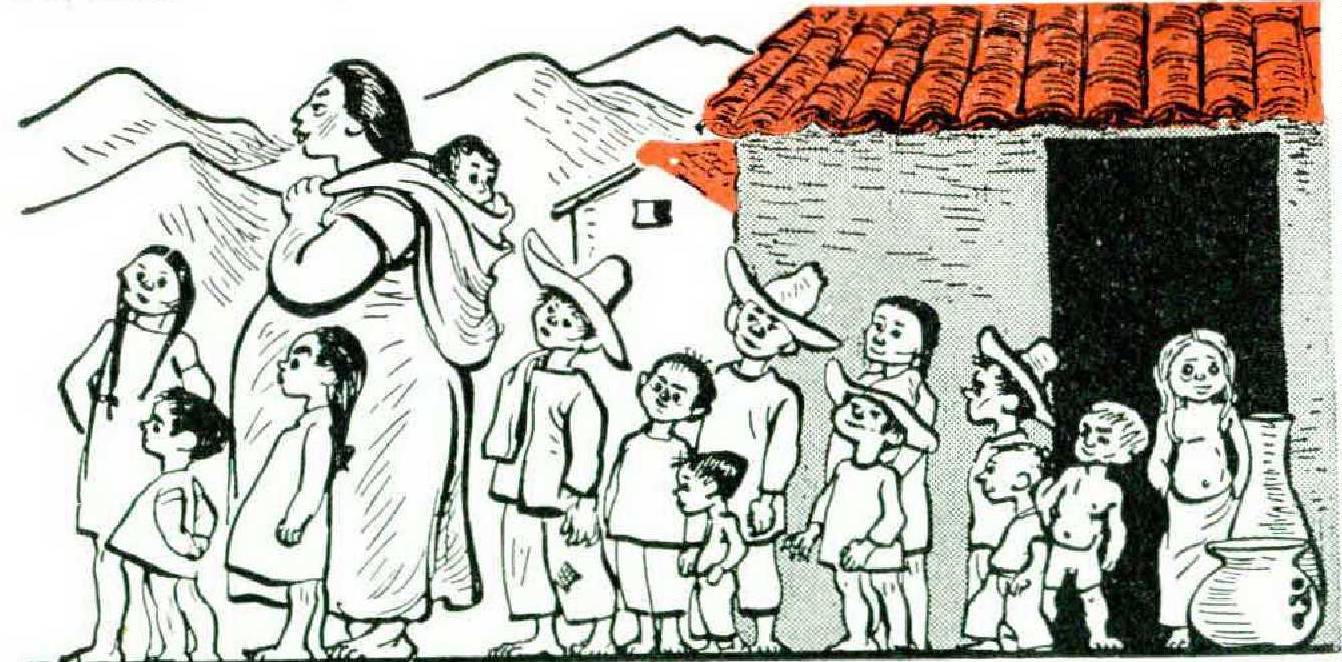
Take one of the most striking features of the Mexican scene, the exasperating profusion of children. Slow down as you enter a town, and little boys swarm over your car, offering to be your guide. Step from your hotel, and giggling little girls, carrying solemn littler girls in their rebozos, pester you with postcards. Turn a corner, and a shrieking phalanx of juvenile lottery-sellers is upon you. Rest on a bench, and half a dozen competing bootblacks scuffle between your legs. Pause to admire a view, and a score of urchins assist you with voluble descriptions. They are attractive children, bright and comic, ingenious to glean a centavo; but there are moments when every American in Mexico perceives Herod’s true greatness.
But the “strange” thing about the situation is not that Mexican brats are unusually annoying, but that most Americans are no longer used to children. The little Mexicans behave, one gathers, as children do and have done everywhere. But in the United States, at least in those segregated communities from which the majority of well-to-do tourists come, there are relatively few children. And that is strange. A biologically healthy species must have more young than mature members. A human society in which children do not outnumber adults three or four to one is something wholly new in the history of the race. Mexico is living; we are dying. Mexico is normal; we are abnormal.
A peon set down in Suburbia would be more astonished at the absence of children than the turista is at their omnipresence. And in cosmic values his astonishment would be the justified one. Our lawns, to be sure, are untrampled, our cars are unscratched, and our life expectancy is 63.5. But when we have joined the pterodactyl and the ichthyosaurus, ragged little Indian boys will probably be infuriating Russian tourists by offering to watch their helicopters or to guide them through the quaint ruins of our rest homes.