My Barbecue Pit
By HERBERT COGGINS
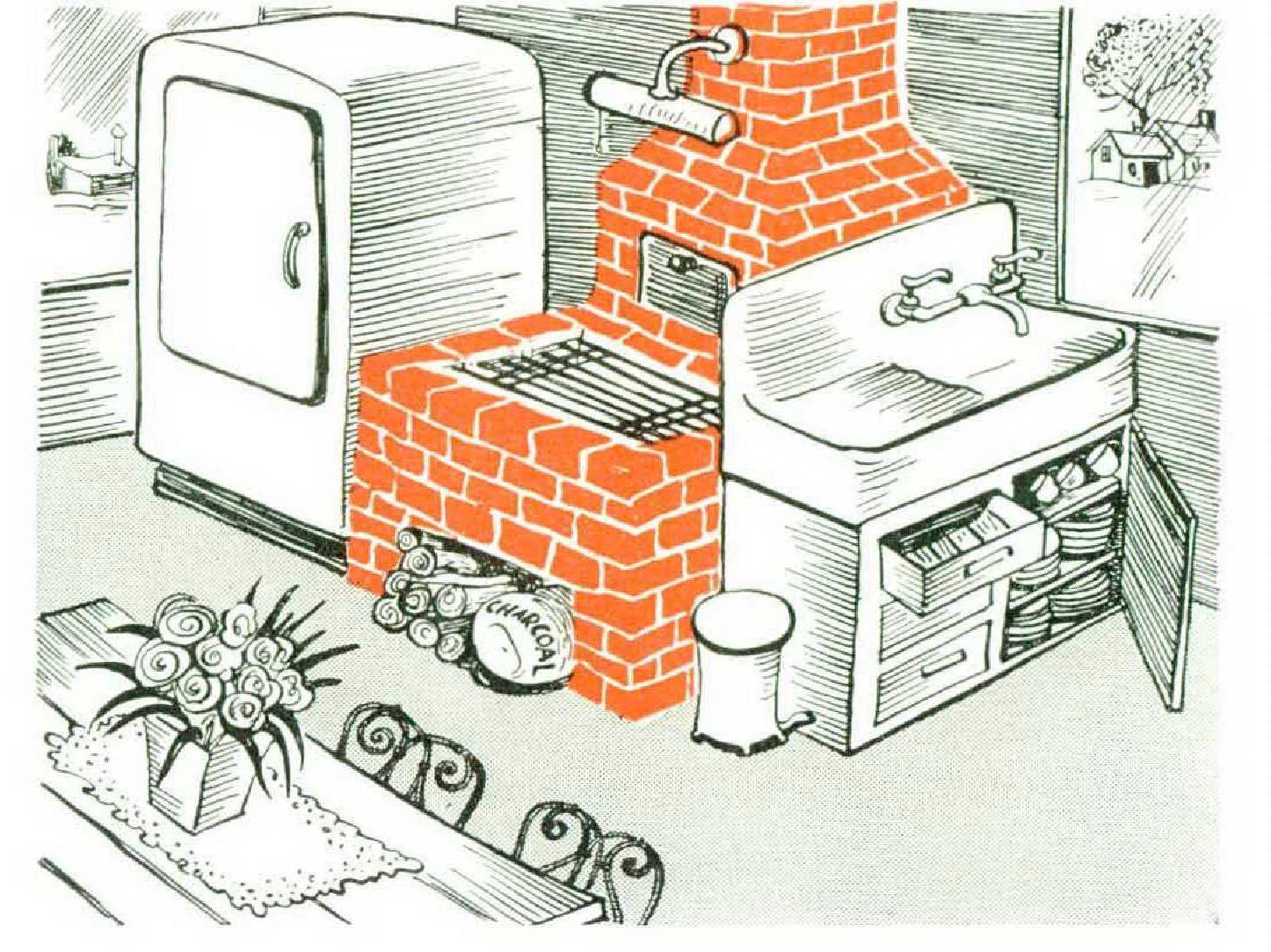
WHEN I built my barbecue pit I was fortunate in hiring a man who knew his business. His experience and my originality made it an outstanding success. Our minds stimulated each other. Whenever he completed a firebox, he explained, he usually extended the brickwork to one side to make an oven for such things as roast corn, baked beans, and potatoes. This gave me the idea of making the other side into a closet, for dishes and utensils — saving untold steps to the kitchen and dining room. Then when the bricklayer carried the back wall up high enough for a shelf over the fireplace — a spot to keep things warm — I recognized it as a place for a lighting fixture. I had the local electrician wire it so that we could use the fireplace day or night.
While the workman was finishing up, I observed that the walled-in space below the firebox was hollow and would make a convenient bin for wood and charcoal. It was nothing to tear out the front wall while the mortar was green. The slight expense of a new facing to cover up the broken bricks was money well spent.
A fortunate circumstance — a leaky faucet — brought a plumber to the house. He naturally thought of something I hadn’t running water as a convenience and a fire precaution. But it was my idea to put a sink on top of the dish closet. It was an outstanding timesaver. While the plumber was setting the sink, he showed me how easily he could bend a coil of pipe around the interior of the fireplace to furnish a welcome supply of hot water independent of the house plumbing.
Department store windows at this time were showing interesting rustic tables, and chairs to match, designed especially for barbecues. A fair amateur carpenter, I had planned making such things myself. But the sturdy-Iooking store models convinced me that real economy lay in buying trained skill. The set was expensive, but, after all, it was a permanent investment and should be written off over a period of years. In that light it was cheap.
By this time the family had come to look upon the barbecue as finished and perfect; that is, until a friend described an attachment he had on his fireplace. It was a roasting spit that revolved over the fire, propelled by a small motor. His description of a roast or a couple of fowls revolving over the fire was irresistible. Furthermore he offered to send over a man who would install a spit within a few minutes. The first time we gathered around the fireplace and sniffed our dinner rotating savorily above the coals we were again convinced that we had added the last possible improvement.
And so it was, until autumn, when the air grew a little chilly. We moved the table closer to the fire, but it seemed that someone was always getting up and running into the house for a wrap or a coat. We liked our new outdoor life and we resented the change of weather.
The answer was obvious, although it did seem inconsistent to enclose an outdoor fireplace. My carpenter friend, however, understood both the job and the psychological aspect involved. He built a strong but light and scarcely noticeable frame around and above the whole pit. He glazed it with exceptionally clear, glass windows.
Even on the coolest evenings we could now use the pit in comfort and the outdoor feeling was perfect. The illusion had been generously climaxed by a friend who, on my birthday, presented me with an artificial green-grass mat that covered the entire floor of the pit and looked like a lawn. It was better than a lawn; it didn’t wear out in spots to show the bare earth with its dust and dirt.
My own pleasure in the barbecue was ruffled a trifle when I figured its cost —about three times my expectation. Business sense came to the rescue. After all, the barbecue, while expensive, was not an expense. I had improved my property.
The improvement brought a problem. The barbecue pit was so complete that our kitchen, although modern and a model in every respect, was now practically useless. My instinct for economy stirred uncomfortably. A talk with the carpenter pointed the right way out. I had him tear out the outer kitchen wall and a certain amount of the obstructing plumbing. In its place he set three large French windows, making it possible to open the entire side of the room.
With little more than a gesture the well-nigh useless kitchen had been transformed into an attractive and commodious sunroom. We moved the diningroom table into it and on pleasant summer evenings found it an ideal spot to which to bring our food from the fireplace, so that we could eat in relative cool and comfort. On such days the barbecue pit was terribly stuffy.