Trial by House Party
FACTS
By ELIABETH OGG

IN the beautiful old Manor House at Stoke d’Abernon, Surrey, a novel experiment has been going on since the end of the European war. Here, in groups of twenty-four, come young men and women, aged twenty-one to thirty, who aspire to be permanent administrators in the British civil service. They are the guests of the British government at a two-day house party.
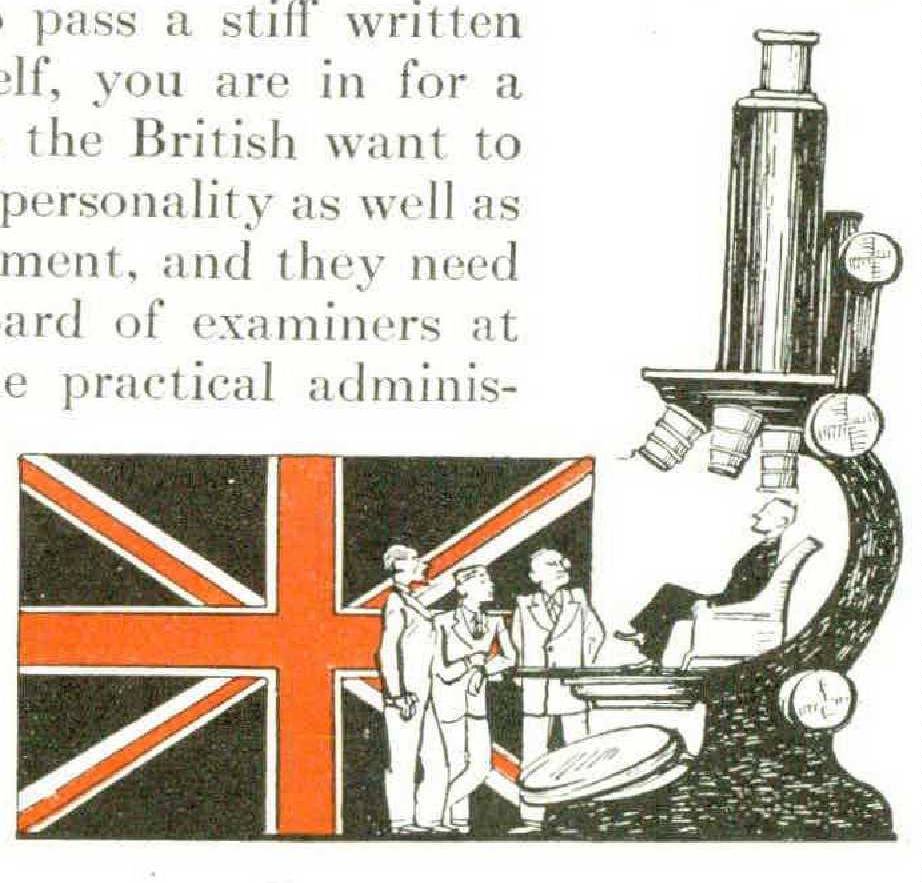
But this is a house party with a difference. To get an invitation, you have to pass a stiff written exam. Then, at the party itself, you are in for a grueling inspection. Nowadays the British want to recruit people who are fitted by personality as well as academic knowledge for government, and they need such people in a hurry. A board of examiners at the Manor House throws some practical administrative problems at you and watches you at work. They write a detailed report of their findings. This goes to a final selection board, which, after an interview, decides your fate. On arrival in midmorning, everybody becomes anonymous.
You receive two placards hearing your number, which you pin on back and front. Thereafter you’re addressed by number, not by name. Candidates are then photographed for identification and divided into groups of eight — two or three women usually in each group. To each group are assigned three examiners— a chairman, an observer, and a psychologist. The grouping remains constant throughout the party.
The opening session in the paneled dining room is to let you know what it’s all about. You’re bluntly told that the examiners are not interested in whether you eat peas with a knife or have a fund of small talk. The purpose of the house party is to accumulate as much information as possible about you as a human being, much as a court of inquiry accumulates evidence. The more evidence, the more likelihood of a just decision.
You’re told also when you’ll be on parade and when off. Meals are off parade. At first examiners and examinees lunched and dined together, and the fine-toothed appraisal continued without let-up uniil the candidates fell exhausted into bed at night. The trouble was it wore the examiners out too, so now they relax at meals and mingle with their victims only over midmorning coffee.
Background information is supplied by personal-history blanks which candidates are asked to fill out. Aside from the usual data, here are some sample items: Write two brief critiques of yourself, one by a penetrating critic, the other by an appreciative friend. List your leisure activities during the last twelve months; indicate six in which you have been especially interested, and others in which you would be interested if you had the opportunity. Name three or four serious subjects and two lighter topics, such as travel or sport, on which you could give a ten-minute talk on twenty minutes’ notice, Give two propositions you are prepared to defend in debate. Have you ever published anything? If not, and if you did write, on what subjects would you write? List the books you have read during the past five years. (This one is tough on ex-servicemen, for obvious reasons, but it’s almost as hard for well-read civilians.)
A two-hour session after lunch concentrates on your psychological make-up. General knowledge, intelligence, aptitude, and word-association tests of the type now familiar to every American draftee are clocked in rapid succession. In the last test, five lantern slides of simple scenes are shown for thirty seconds apiece, and you have two and one-half minutes to write a story framework for each.
Born and educated in England, ELIZABETH is now an American citizen. She was formerly an editor on the staff of the Foreign Policy Association, and during the war worked for the Office of War Information.
After a break for tea comes the group work — the main feature of the house party. Each group of eight has its own meeting room. They sit around in easy chairs, while the three examiners try to look unobtrusive at a table in the background. To break the ice a general topic is thrown out for discussion. Sample topics: The effect of the trend of present-day legislation on the national character. The pros and cons of compulsory military training. The requisites for post-war prosperity in Britain.
As the young people go to bat, unprepared and unrehearsed, the observers watch closely to see who’s shy or overargumentative, who starts well but loses his head when opposed, who commands the attention of the others, who has good ideas, and who is just hot air.
After this limbering up, the group is introduced to its major assignment the so-called “island story. You are allowed about an hour to glance through a fat dossier giving the main facts about a hypothetical British colony, Dolphin Island — its population, area, climate, resources, history, and so on. There isn’t time to read every word, but that’s part of the test. Then a problem is posed. Nine thousand inhabitants of Dolphin Island want to emigrate to Western Australia, and the British government has decided to offer the island to the UN as a haven for displaced persons. By what method would you select the first thousand emigrants for Western Australia? You have half an hour to offer a written solution before you adjourn for dinner.
Governing Dolphin Island takes up most of second day. Each group becomes a committee which, first of all, is required in half an hour to arrive at a common policy on the emigrant question. (Committees in real life, please take note!) Then, with each member representing a government department such as Agriculture or Education, the group must work out a plan for adjusting the is land’s economy and constitution to take in the refugees from Europe. You receive a brief stating the problems for which answers are needed.
In thirty minutes, before the committee as a whole meets again, you must prepare a scheme for dealing with the problems affecting your department. When these come up in committee, you take the chair. You must then present your scheme, get the committee’s views, and arrive at an agreed solution, all in fifteen minutes.
The nature and problems of Dolphin Island vary with each house party. A candidate who has tackled them once can’t coach another who hasn’t. Sometimes, after that first glance at the island file, you are required, as a government official, to write a tactful letter to a private individual, asking for special concessions which the island government needs. Or, when you represent a department, you may have an axe to grind. A girl representing the Department of Education, for example, had to argue for bigger educational grants for both natives and whites. The Labor Department opposed, on the ground that there were not yet enough professional jobs available for natives to justify extending their school facilities.
At first, when the house party was a three-day affair and there was more time, a practical organization problem was also set. The committees were told, for example, that a cloudburst had wiped out three native villages which were traditionally at enmity with one another. The refugees from the floods would arrive at the Manor House in two hours. Each committee had forty minutes to view the terrain and report what arrangements they would make in the remaining eighty minutes for the reception, feeding, housing, and medical care of the refugees over a twenty-four-hour period.
Sometime during the second afternoon, you have to make a speech lasting exactly ten minutes, on a subject assigned two hours earlier. Subjects vary as between home service and foreign service candidates, but are usually suggested by your “interests” list. You may name your own imaginary audience, from an informal discussion group in a community center to the Senate of the United States. You are then judged on the appropriateness of your remarks to the audience chosen.
Before the house party ends, you have a personal interview with each of the examiners observing your group. The chairman goes over your record and achievements with you, asks why you want to enter the civil service, what department you’d prefer to join, what you propose to do if you aren’t accepted, and so on. An hour with the psychologist is devoted to your past history from a personal viewpoint — your family, your childhood, how you got on with your parents and brothers and sisters, your likes
and dislikes. The observer’s questions deal with your cultural background.
As a parting exercise, you are asked to rank your fellow committee members in order of preference, first, as fellow civil servants, and second, as holiday companions. Your answer not only helps to show the examiners how candidates stack up with their colleagues, but also gives them a line on what your judgment is worth.
As one examiner said, “The scheme may not be perfect, but it’s the best I know for selecting junior civil servants. We’re doing our best to follow up those we select. Whether they’ll make good senior civil servants, we shan’t know for twenty years.”