My Interplanetary Teens
By FRANK K. KELLY
CERTAIN peculiar experiences I suffered at the age of sixteen, when I was under contract to deal with death rays and rocket ships for several pulp magazines, have pared me for the day of the robot plane and the flying bomb and other things of the future which burst a little too suddenly on the minds of my friends. Many of them have struggled bitterly to adjust themselves to the possibility of personal disintegration in the atomic age. My mind must have been softened when I was a boy, for my main feeling recently has been a sense of wonder that it took the future so long to arrive.
At eleven I had begun to read the fantastic magazines, fascinated first by a cover picture of Martians riding on tripods across London, which illustrated The War of the Worlds by H. G. Wells. I brought their issues home and hid them under my mattress, because I knew my father wanted me to read the adventures of Tom Swift, and my grandfather urged me to study the life of Buffalo Bill, who ranked in his affections next to William S. Hart. I stubbornly preferred flights to Mars or trips in time machines.
When I reached fifteen I felt a compulsion to write a strange tale in secret, and I did. I slipped it into a mailbox on my way home from school one day and it was published soon afterward in one of the magazines. I was lost then — words poured out of me by thousands and tens of thousands. A few months later, when I was sixteen, a contract arrived in the mail. My poor mother opened the envelope, and a faraway look came into her eyes. Peering over her shoulder, I saw a magical sentence typed in blue ink on buff-colored paper: —
“Agreement is made on this 3rd day of October, 1931, between the Stellar Publishing Corporation of New York City, hereinafter designated as the Publisher, and Frank K. Kelly, hereinafter designated as the Author. . . .”
My mother turned to me. “Oh, Frank! What have you been doing?”
“I couldn’t help it, Mother,” I said. “I just started writing.”
I thought I had climbed the peak of happiness, but my subsequent responsibilities became rather severe. My editors turned out to be extremely critical men. My readers complained that 1 would not give them joyful endings even on Jupiter or Saturn. My family showed serious doubts about my sanity.
Fighting forward, I sold my dreams of interplanetary war and love among the asteroids month after month — for half a cent per word. But the hardheaded editors were more at home on the airless plains of Mars or in the riotous life of steaming Venus than l could ever be, and they savagely criticized me when I made what seemed to them an obvious error in describing conditions under Saturn’s rings or on the moons of Jupiter.
The first letter I received after I signed the contract was dated October 29, 1931, and the editors wrote: “We are accepting your story ‘The Man from Earth.’ We think it is quite well done, although it contains some scientific errors such as the pool of liquid radium and the fact that water will be transported from Earth to Mars. Your story did have a tendency toward the weird which it might be advisable to avoid in the future.”
After these rebukes, they concluded on an encouraging note: “We are looking forward with excited interest to your next contribution.”
Their excitement evidently died down rapidly when my contribution landed on their desks. The next letter began plaintively: “We are accepting your story ‘On the Mars Run,’as it is substantially better than some of your earlier ones, but why, oh why, did you use such a theme as the invisibility cloak in this story? If such a cloak were known and in use, it could have changed entirely the aspect of the story, for then everybody would be prying into everybody else’s affairs with impunity.”
The letter continued sternly: “For no reason at all, you drag such a device into your narrative, with an offhand, unconvincing explanation, and thereby give your story an aspect of a bedtime tale. Not that invisibility is impossible. But the point is, you drag it in so purposelessly.”
In attempting to edge away from the weird and to avoid the “aspect of a bedtime tale,” I packed my pages with scientific terms, creating many of the words myself. I was given a brisk rap on the knuckles for this activity: —
“We are accepting your story, ‘Exiles of Saturn,’ in its revised form. We were not entirely pleased with the revision, since you still keep all of your queer scientific jargon without explaining the terms that you use. You are not fooling the reader by making up new words to indicate scientific apparatus that you do not explain. We wish, in your future stories, that you would keep a little closer to your readers, who do not know just what those terms mean.”
I gave the best years of my adolescence, from sixteen to twenty, to the creation of fables of the future. But I never succeeded in giving complete satisfaction to the editors.
While I was struggling to supply the magazines with chronicles of the wanderings of Earth Men through space and time, 1 tried to creep closer to my readers. They would not take me into their hearts. My vision of the future was too bleak.
In the Reader Speaks departments, I achieved an odd form of fame, if you can call it fame. People wrote in from Australia to suggest that 1 might choose happier subjects than planetary famines and interplanetary feuds. “Perhaps a happy ending is not possible on this Earth,” wrote one philosophical fan of mine, “but how do we know that it is not possible on Saturn or Jupiter?”
The worst blow came from a man in Los Angeles. “Kelly’s stories leave me feeling cold and comfortless,” he declared from the golden comfort of Southern California. “Is there no hope?”
I kept on writing, because I had compensations for these criticisms — a steady flow of checks, and a few letters praising my work. And one night while I stood on the front porch of my home in Kansas City, a boy rode up on a bicycle. He looked at the iron numbers on one of the porch pillars, and asked me: —
“Could you tell me where I could find Frank K. Kelly, the writer?”
“Right here,” I said. “What can I do for you?” “Would you shake hands?" he said. I was eighteen then, and he was fifteen or sixteen. He seemed to be serious. “I just read ‘Evil on Saturn,’ and I found out where you live. I’ve read every story you’ve ever written, from the first one they printed.” “What was the name of the first one?" I said. “‘The Light Bender,’” he said. “That was the one where you made the Woolworth Building disappear , and nobody knew what had happened to it, but it was there all the time. The scientist had just bent the light around it, so nobody could see it.
He was right. We shook hands. That was the high point of my experience with readers.
My family difficulties increased through the years as my stories grew wilder. I wrote about explorers in glass-topped cities on the moon, duels in ihe fourth dimension, terrifying studies of scientists who developed living cells in their lonely laboratories and then couldn’t stop the multiplication of these cells, which swarmed at last in shapeless masses over the entire Earth.
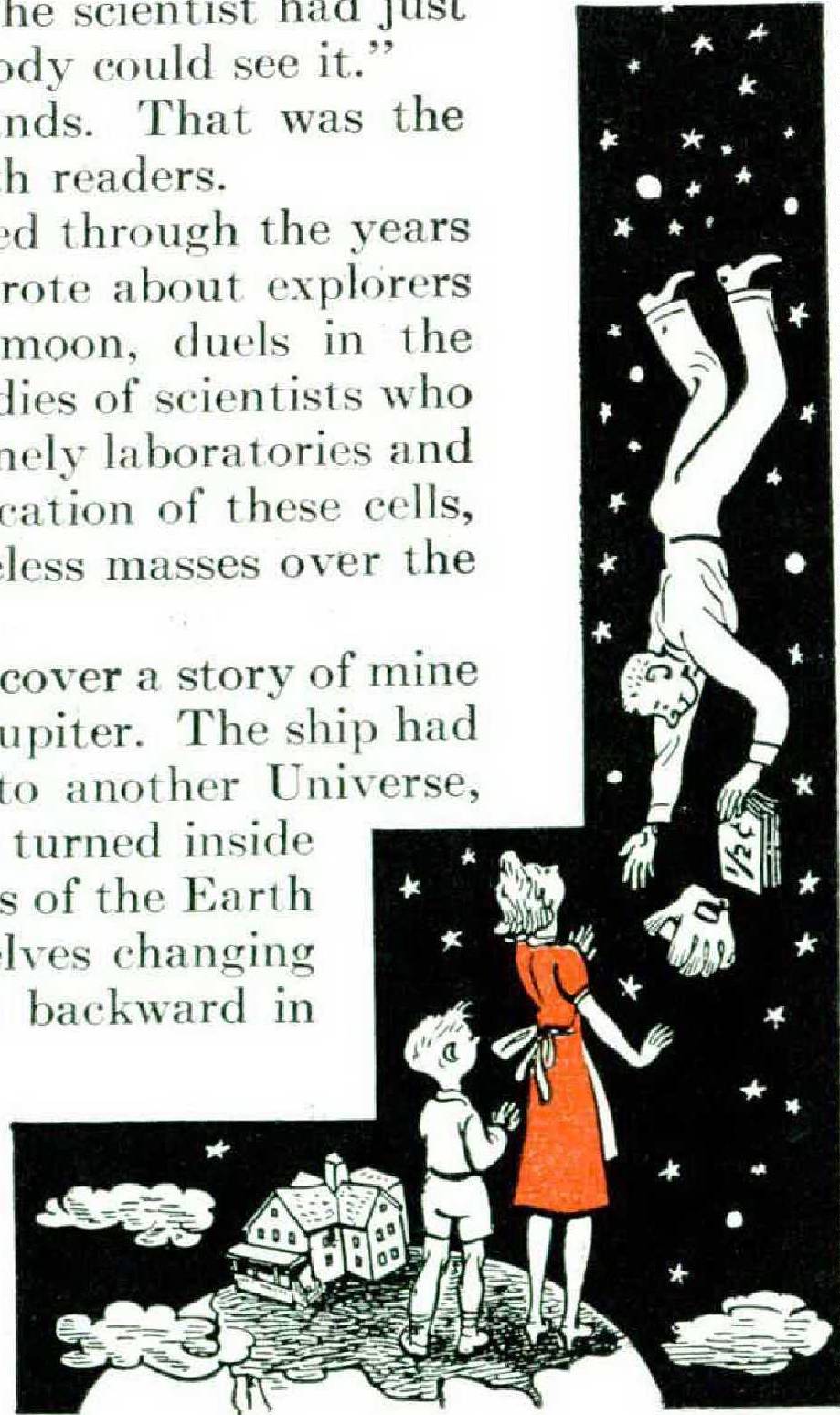
One magazine featured on its cover a story of mine about a rocket ship bound for Jupiter. The ship had been hurled by cosmic rays into another Universe,
where everything seemed to be turned inside out and upside down, in the eyes of the Earth crew. Then they found themselves changing shape, and their thoughts ran backward in their brains.
A few of my finest tales I showed to my grandfather — a tall, straight, pink-nosed Irishman of eighty — and he read them through, his sharp blue eyes frowning. He must have spoken to my father afterward, because I remember my father urged me about that time to take up handball or tennis.
Once when I came home my mother told me she had found my sister crying in the kitchen. “I asked her what could be the trouble,” my mother said. “She answered, it was the strange things in your stories.”
My mother engaged in months of internal argument before she permitted the neighbors to know that I was a writer. She seldom read any of my stories, and she was a little doubtful about my themes. When I prevailed upon her to glance through several of them and she found that the characters from Earth were of noble mind and had the highest motives, — the evil people were usually from Saturn or Jupiter, — she was completely converted.
Her early misgivings surged back later, I think. We sat in the kitchen one summer afternoon, having tea together before I attacked my typewriter to finish a serial. My young brother Vincent raced through the back door to join his baseball team. My mother touched my hand, and said finally: “Vincent is worried about you. He was reading one of your stories.”
“It’s about time he did,” I said defensively:
“And he told me, ‘Mother, there’s something wrong with Frank. In this story I just put down, there’s a part where a guy steps out of bed in green pajamas and explodes.'”
Her teacup trembled when she lifted it. “Did you write that, Frank?”
“The fellow had an electronic beam trained on him, that’s all,” I said. “He was disintegrated by an enemy because he had the plans for a radium plant in his head. I explained the whole thing.”
She took a long sip of tea. “Perhaps you shouldn’t write any more of those stories.”
I couldn’t stop. I kept, on dreaming of rockets in the night, and sleek, shining ships hurtling through space. Stretched full-length in a soft suspended hammock which relieved my body of the tremendous pressure created by a speed of ten thousand miles an hour, I listened to the drumming of star fragments on the rocket ship’s outer shell and I smiled sometimes at the luminous face of Zeletta, the phosphorescent girl who often lay beside me.
My dreams were big and sprawling, and ran to twenty thousand words, including three or four thousand adjectives. With adjectives I bought my brother a baseball glove, and silenced his criticism. My sister got a new hat, my mother got a waffle iron, and I took my grandmother to a Uhinese restaurant. She could never get enough of chicken chow mein.