This Month
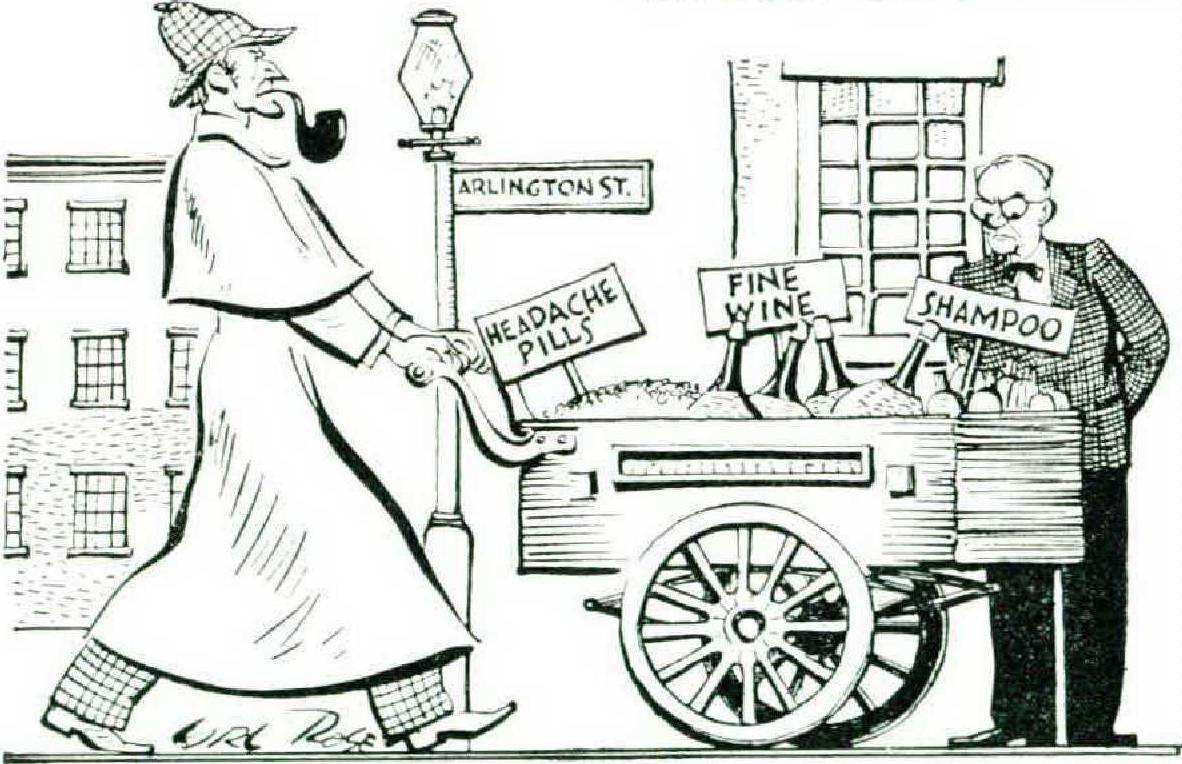
My final memory of Sherlock Holmes is aural, as the smarter of two characters plugging a soluble coffee on the radio. I am not sure that Holmes himself drank the coffee, but Dr. Watson was fairly awash with it as he unfolded his tales. Since then, I gather, Holmes has continued his “adventures”— for a time in the field of headache pills, again under the aegis of a wine company, and at present as one who wrested a hair tonic account from a news commentator even after the latter had ridden it to victory five nights a week throughout World War II. But other matters claimed my ear and I lack direct knowledge of whether Holmes is getting a bit thin on top, suffering from a serious scalp disorder, or merely discovering that it pays to have that well-groomed look. (The tonic is just as good for one condition as for another.)
My final memory of Holmes is via radio because a five-pound omnibus edition of Doyle destroyed my ability to read him further, and my only view of Holmes on the screen was back in the days of Roscoe Arbuckle and William Gillette. Thus, on how a Hollywood producer would have “angled” Holmes for the films, I hasten to defer to Erle Stanley Gardner (page 102).
A recent bibliographer credits Mr. Gardner with fifty-three titles of book-length mysteries. He is king of the quarter books, with annual sales of anywhere from four to six million copies. His American and Canadian editions alone have passed 27,873,401. Like Holmes, Mr. Gardner’s Perry Mason ekes out his career as a criminologist nowadays by considerable radio work. While Holmes is toning up scalps, Lawyer Mason is adventuring in soap. Both boys are making good on the networks, but neither one has connected with as many screen triumphs as both would seem to deserve. I believe Mr. Gardner’s little treatise will throw some light on the cleavage between Hollywood and the two master minds.
What separates Hollywood melodrama from British melodrama is a basic difference in purpose. The British film is out, unabashedly, for the gasps. The Hollywood effort is to show how many changes of Adrian ensembles the female star can make in a given sequence. Vaudeville, years ago, always gestured to the higher arts by sandwiching in an artiste between the Australian Woodchoppors and the skit.
The artiste was a vocalizer who first appeared armored in sequins and rhinestone tiara, a truly blinding spectacle in the spotlight. After an aria or two, she would modestly withdraw to the wings, only to reappear almost instantly in a new but equally formidable gown, ostrich feathers and pearls. Without benefit of a slide fastener, it was all hook-and-eye coupling and the audience knew it. The artiste always deigned to construe their tributes as intended not for her fast transfers but for her upper register, and she would even cut in the accompanist on the ovation given her aigrettes and corseting. So, in Hollywood melodrama, the clothes are spectacular even though the action never honestly reaches high C. But while all this is going on in California, the British melodrama’s hero is hanging by his teeth from a middle-span girder of the Firth of Forth bridge.
One vote, then, for the British.
C. W. M.