My First Alarm
By WALTER M. KISH
I AM all aglow about my first discovery of a fire, but there are moments when I wish that the blaze had been discovered by someone else. I imagine the fire department feels a little that way about it too, but just doesn’t want to make a scene.
I came upon this fire indirectly, by way of our back porch. There was a worn step in our porch stair that had bothered me for upwards of two years. Saturday seemed like a good time to replace it. So I measured the thing and started up York Road in search of a step store or its equivalent.
I was very happy then, even making a song of sorts out of the step’s dimensions: “O ho for a board that is thirty-two, by nine and three-quarters, by one or two, O ho, yoo hoo” — that kind of thing.
Finally, after many choruses, I came upon a place that advertised woodworking. The door was locked, however, and peering through the window I could see nothing but an uninteresting display of house paint. Still O-hoing and yoo-hooing, I walked around the side on the chance the fellow might have a workshop in the rear, perhaps even a lumberyard with my board and himself in it.
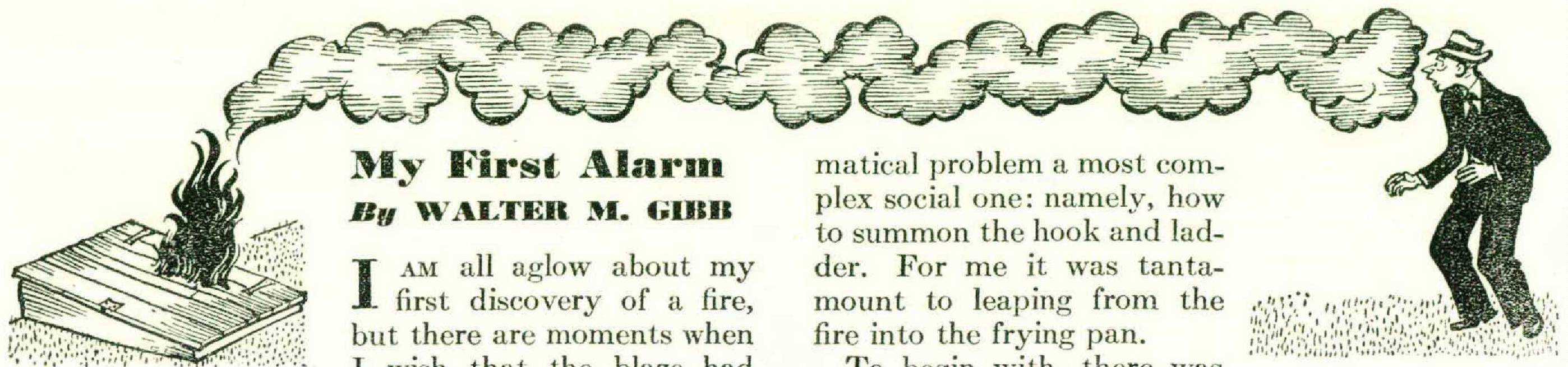
And there I saw it — my first fire! Mine, that is, by cognition rather than ignition. The actual blaze, I assumed, belonged to the proprietor of that little establishment, and I only wondered, as I watched it, why he had chosen to build it on top of his cellar door.
I wondered too why he wasn’t there to enjoy it; it was lively and pretty and had a nostalgic campfire fragrance. It did not impress me offhand as the variety of fire that needs putting out, but that may have been because no firemen were present. Just a pleasant crackle and dance of flames along a sloping cellar door.
The flames hadn’t quite reached the clapboard building wall. I was idly wondering how long that would take, when it, occurred to me that here was a problem which should not be allowed to reach a solution.
Alas, that was substituting for a simple mathematical problem a most complex social one: namely, how to summon the hook and ladder. For me it was tantamount to leaping from the fire into the frying pan.
To begin with, there was no alarm equipment. That struck me as paradoxical, for I recalled the case not long ago of a man who failed to turn in a fire alarm because he could not read the instructions on the box; here was I with a fire and a college education, and there wasn’t so much as a participle dangling from a hatchet anywhere. You know the type of literature I mean — the framed directions on display in depots, hotel lobbies, and doctors’ waiting rooms, reading: —
Break glass to get axe, use axe to open fire alarm box, lift receiver from hook, pull lever down, and invert can. Violators will be punished by a fine of not less than $1000 and imprisonment up to and including ten years, or both.
But if there was no alarm box, at least there was a fire station itself less than two blocks away, and I set off for this at a dogtrot.
It was a calm, sunny afternoon, quiet even on York Road. Fluffy, white non-smoke clouds floated overhead, and in the whole world not another soul seemed hurried or anxious. In the still, peaceful air I could hear, as I trotted along, a small voice saying, “Look here, Gibb, they aren’t going to believe you. Nobody goes to the fire station to report a fire. Pull yourself together.”
Need I say that by the time I reached the station I was scarcely of a mind to report anything? But one does not walk into a place of that nature to say, “How do you do?” or “What’s cooking?” So I did what the little voice had suggested. I pulled myself together first, then made my entry as dignified and businesslike as befitted the seriousness of my mission.
It was less of an ordeal than I had anticipated. Half a dozen relaxed fire-fighters were discussing baseball and they made no great to-do over my arrival. A seventh was seated at a desk in one corner apparently making out a report, and he paid no special attention to me either.
The man at the desk was the only one wearing a hat, and although it was a sorry excuse for the peaked fire helmet I had been brought up to expect, it was nonetheless official-looking and decided me in his favor as the one who should hear my report. Moreover, the desk itself contained a fascinating array of clockwork and telegraph equipment, and this I had the opportunity to examine at close quarters while awaiting an acknowledgment of my presence.
Finally, however, I felt obliged to attract attention by clearing my throat and saying, “Pardon me.”The man in the hat looked up then, asked me what was on my mind, and promptly resumed his paper work without waiting for an answer or offering me a seat. _
I suppose that in the course of his career as liaison man between a disaster organization and a distressed public he has learned that dispensing with the customary formalities goes a long way to relieve embarrassment. Some persons are painfully shy. In my own case, although I am more accustomed to the amenities than otherwise, I must confess I found that his nonchalance made my chore easier.
Without so much as introducing myself, therefore, I began at once to tell him about having to replace a worn step in our porch stair, and how in my search for a place to buy the required board I had discovered a likely establishment, just a couple of blocks away on York Road, advertising woodworking, only to find that the door was locked, so that—
But there he interrupted me by pointing to one of the other men (his superior, I imagine) and saying,
“Tell it to him!” . .
“The gentleman with the white hair?” I inquired.
“That’s right.”
The individual indicated was easy to pick out, not only by his hair but also because at that moment he was being the life of the firehouse. Judging from the attentiveness of his audience, whatever anecdote he was telling must have been unusually good, and of course I permitted him to finish it. He in his turn was equally polite to me as I told him about the step that had needed replacing for a couple of years, my decision to do the job today, it being Saturday, and so on.
He did not once interrupt me and even nodded sympathetically now and again. But at the very end when I said, “And the whole cellar door was on fire,” he jumped almost straight up in the air and called upon God.
For the next few seconds I was like a safety island in a busy intersection. But for seconds only. It seemed like no time at all before I became a forlorn buoy in a deserted sea.
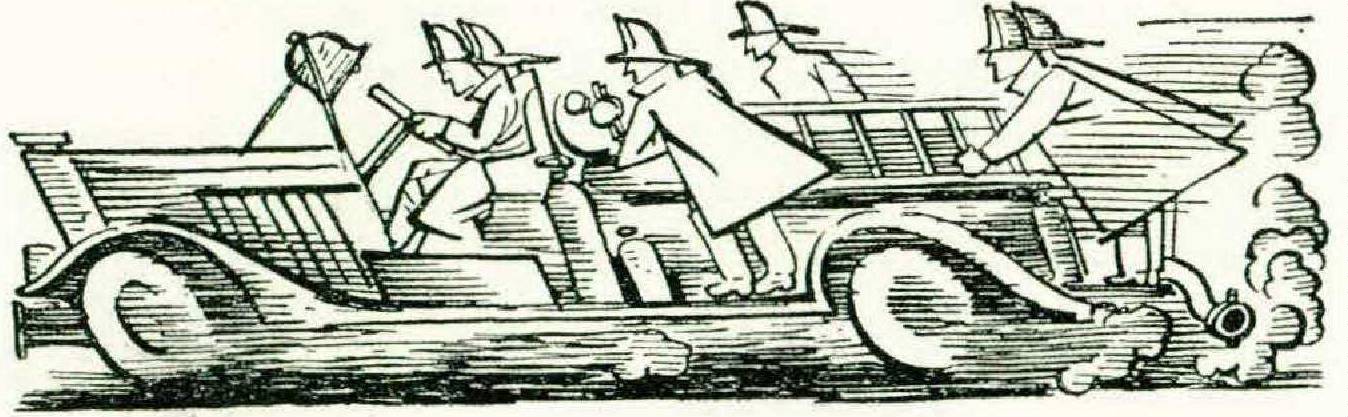
The room emptied faster than if someone had shouted, “Fire!” Through a door I caught a glimpse of men pulling on rubber boots, and the next instant the station itself moved backward like a wharf at shipside. The huge red and white truck had begun to roll.
Riding the rear step was my man in the hat.
“Could I be of any further assistance by going along?” I started to ask.
“Write down your name and address! ” he shouted, pointing back to his desk, which was now ringing and rattling throughout its clockwork. And before I could ask why, he was gone.
I did as he had suggested, however, and then went back to my fire. This time it looked like the real thing, with hose lines, a crowd, and all. But now I could not see the nice old blaze itself because the firemen wouldn’t allow anyone to go around back.
So I just stood in the fringe of the crowd out front. In a moment of excusable pride I mentioned to one of the other onlookers that this fire was my discovery. He nodded and walked away.