Green Thumb in Your Eye
GORDON KAHN is a frequent contributor, from Hollywood, to the Atlantic.
HOLLYWOOD
by GORDON KAHN
AFTER five years of banishment the Japanese gardeners have come back to California. Sprinkler jets again flash miniature rainbows in daily hydrotechnic displays, healing scabrous patches of lawn to viridian and emerald. And throughout the Greater Los Angeles Co-prosperity Sphere there is afoot what our Mr. Furusaki calls a great “pranting” of “viorets, phrox, and rirries.”
The reoccidented Mr. Furusaki comes three times a week — Monday, Wednesday, and Friday — just in time to nail me, soaped and silly in the shower without an ounce of pressure in the water pipes. He coasts up in a trim new one-ton truck freighted with the most modern gardening tackle and fathoms of plastic hose that is as limber as a shoelace.
Both man and equipment are a remarkable change from Mr. Kikimoto, who chuffed up in a spavined Model T, or Banzai cart as it was known, to scrabble among the sneeze-weed of my compound before the war. I had always suspected that Kikimoto was playing a double game — that he was planning to add California to the shogunate whilst doodling with the saxifrage on my little savanna. On the last day of his service, I was certain of it. ... I came to the screen door at his knock.
“I hope,” he began, “you are not seriousry ararmed. Your famiry is safe. You may berieve Mr. Upton Crose.”
“This time I’ll berieve Mr. von Kartenborn,” I answered. “And there’ll be no more bottles of beer at this house for you, Admiral Kikimoto!”
Some of the bushido went out of him. He backed away three paces, bowing; then advanced three paces to collect his check. I saw him last taking off, wide open and under full flaps in the Model T, later designated as the Land Zero, the first Japanese secret weapon. In this machine a simple maneuver, failing to signal a left turn, accounted for a staggering toll of civilian motor equipment.
The only memento I had of him was a decrepit rubber hose with tourniquets every few feet and not enough pressure to put out the fire on a crepe suzette. Later, in trying to coil it for the scrap collection it gave me no more trouble than a basket of cobras de capello.
In the arid years between Kikimoto and Furusaki, I would have been content to let plant life fight it out for survival just as the human family was doing. It was fascinating to watch the first tendrils of Johnson grass lance out at the delicate and doomed lucerne. Then, one evening, a month after Kikimoto’s departure, I brought a mournful bulletin to my wife. “La Flamme,” I said, “those posies of yours have shed their chlorophyll in the War to End Wars.”
“You mean my Whispering Bells are dead?” She caught on quick.
“Yes. And your Farewell to Spring, Cream Cups, Baby Blue Eyes, and Miner’s Lettuce have given up their whimsical little ghosts. You will receive a gold star from the Department of Agriculture.”
It didn’t end there. The women of my household had picked up some phrase about the “encroaching jungle” and drove me out to look for a gardener.
In five years, out of an estimated hundred that I had buttonholed, nine consented to accept employment at, naturally, unconscionable subsidies. They remained on the job anywhere from a week to three months. Altogether, the work they did could have been duplicated by an intelligent orang-outang with a water pistol and an oyster fork.
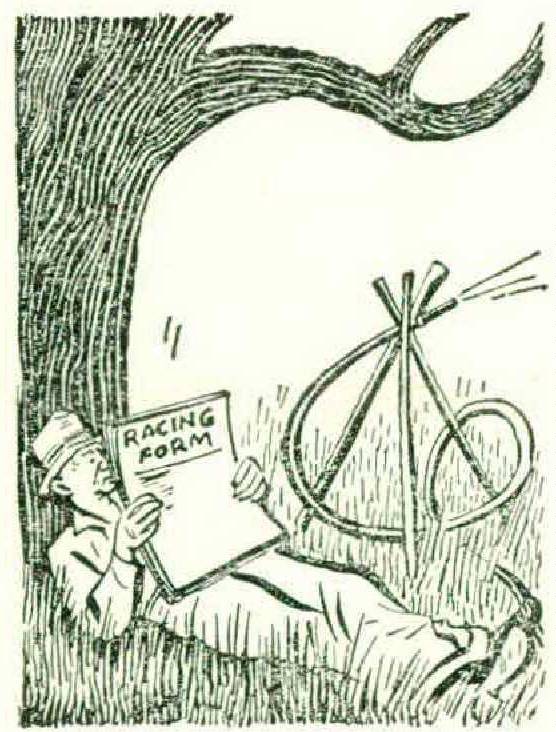
However princely Kikimoto’s remittances were from the Yokohama Specie Bank, he seemed glad to accept $9.25 every first and fifteenth of the month. The salary demanded by his successor, a Welshman, was $40 a month, which broke down to $5 for each of his eight monthly visits. Taffy’s specialty was watering. He would fit a hose nozzle on a tripod, aim it anywhere, and for the balance of his visit sit in the shade with a Racing Form. In a few weeks he had turned the place into a scale model of the Everglades.
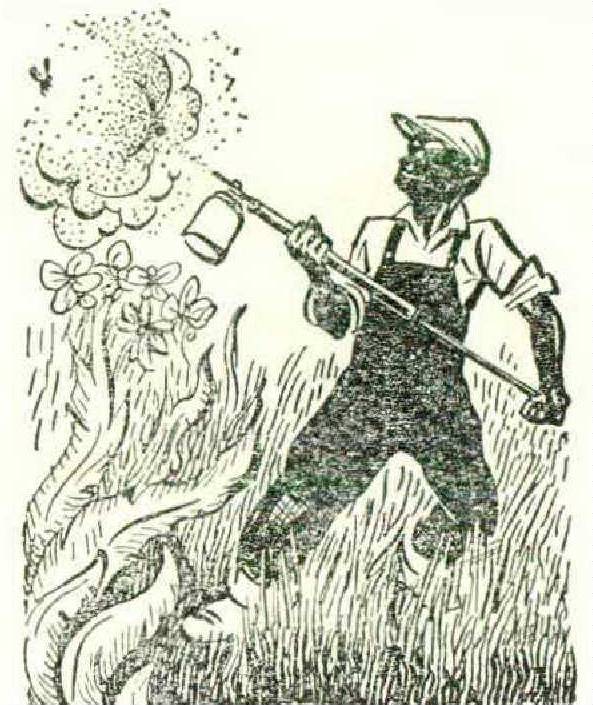
Leroy and Milton, two Negro botanists who came next, worked as a team and let me off easy for $45. They didn’t hold with too much water. They held with no water at all. Instead they worked with a power spray and some chemical which smelled like cleaning fluid which they said was sure death to the red spider. I had never seen a red spider and inquired if their atomizer was effective also against the Black Widow.
“Black Widow,” said Milton, “that’s a bad bug.”
“A biter,” Leroy agreed solemnly. “The best way to deal with him—”
“Her, isn’t it?” I suggested.
“Yes, sir,” Leroy continued. “Got to crush him out.”
Neither Milton nor Leroy could charge any offense against the red spider on whom they conducted gas warfare, except that he was always spinnin’, spinnin’, and spinnin’.
In the summer of 1944 the tribute for part-time gardeners went up to $60 a month and there it remained for more than a year. Anybody with a minimum of equipment and not too muscle-bound to prod at some furze could net $5 an hour or $240 for a 48-hour week. This bonanza was evidently not juicy enough. When they were getting a mere $40 a month per client they would turn down anybody whose garden was situated on a hillside. But at the peak period they were as haughty as black-market butchers.
While the householder was still on his knees they would snap at him, “How much are you willing to pay?”
“I can’t go higher than a hundred and seventyfive a month,” I told one of them to see how he would react. He twitched with avarice, yet he cocked his head and drawled, “Well — if your place ain’t too far—”
“It’s just around the corner. But I guess you’re too busy.” And off I drove.
Sometimes in the mind’s ear I recall how he bellowed, “Hey, mister, wait! I’ll take it!”
Of the nine wartime gardeners, Number Six happened to be on the job when I had the tree trouble. I’ll never know what kind of tree it was, but if anybody then had told me it was a hemlock, I would have brewed an infusion of its bark and drunk deeply.
It started when a policeman, for lack of anything better to do, I am sure, hove up and pointed to the tree. “That’ll have to go,” he said.
“Why? Is it bothering anybody?”
“For the present, just me,” he said. “Later on it’ll bother people in cars by blocking off visibility on this curve.”
“All right, I’m sold,” I told him. “Have it chopped down any time you like.”
“That’s your job, mister. And I’m giving you a week to do it in.”
I informed my gardener that we were harboring an illegal conifer and would he please bring an axe on his next visit so that we could make the fir fly.
“Brother,” he said. “I ain’t licensed for that kind of work. I’ll bring the axe, but you’ll swing it.”
He was right in the matter of licensing. Not just anybody, not even the owner has the right to hack down a tree. The first certified woodsman I called said he would send a man around to check on the job and give me an estimate. The man came, measured the height and girth of the tree, and allowed as how this was one of the most firmly rooted junipers he’d ever seen. Yup, getting this baby out of the ground would come to a little expense.
“You’ll make a pretty penny selling the wood. It could be worked up into useful and artistic objects of furniture,” I said. “I’d only want a few stove lengths for whittling.”
“You can have it all,” he told me. “Every sliver. And the best price I can make you is a hundred and twenty-five dollars.”
“I’ll take it,” I said eagerly, whereupon he informed me with great clarity that I would have to pay him, and not the other way around.
The second expert called my tree an acacia and wanted $120. The third and lowest bid, in writing, was $95 for “removeing and hauling from premasiss one (1) Cyprus.”
In the fall of 1945 there was a rebellion under my own roof. The ultimatum was that unless I sold Tanglewild and moved somewhere else, I could spend the rest of my days there alone. There was more talk about the “encroaching jungle” and that it was impossible to move around in the yard for the cactus.
“The cactus,” I explained, “is the philosopher of plants. It is important in the economy of our southern neighbor, Mexico. Entire regions subsist on its deciduous flesh, clothe themselves in its fibers, and it may be distilled into a potable beverage alcohol.”
“All we need now is a cactus-whiskey still,” they scolded. “You hear that howling? The gophers are tormenting the cat again.”
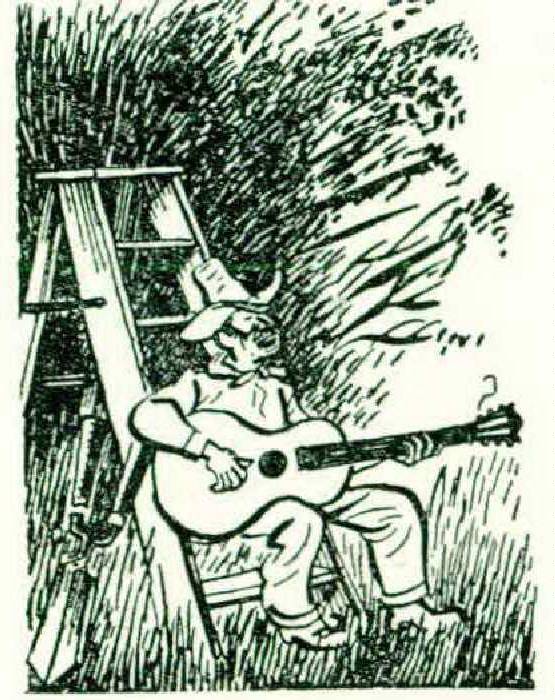
Ten days later I acquired another estancia. Its former owner had been taking care of the herbage on it himself after a fashion. He had spent most of his gardening hours on the hedge which bordered the property and grew to a height of seven feet. It was a ragged and blooming ten feet when I found Julio, pronounced Hoolio, a sterling Mexican. He consented to give me Tuesdays and Fridays and declined to discuss reparations until the day he brought up his rig to begin work. His fee was moderate and he seemed to enjoy himself. I kept the windows open so that on Tuesdays and Fridays he could enjoy a matinata of Mexican selections on the phonograph. Julio himself sang well, but as a gardener he was considerably less than efficient. I bought a stepladder as a hint that he ought to cut the hedge, but he explained that climbing it made him dizzy and offered to hold it for me. He knew of only two flowers, the aster and the marigold.
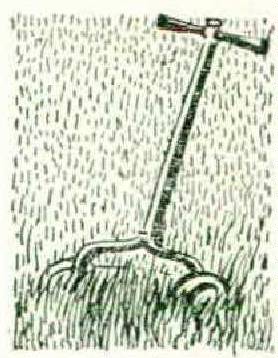
Then, one day, Julio left us to return to his old job as section hand on the Southern Pacific. So, now we have the fine Mr. Kenjiro Furusaki, who is making two blades of timothy grow where only a stinkbush flourished. He has resurrected the nightblooming jasmine so that it reeks again like an explosion at the perfume counter of a dime store. There are Michaelmas daisies and two varieties of roses, the Mrs. Herbert Stevens and the Frau Karl Druschki, and flowers which require aspirin tablets after they are cut.
Mr. Furusaki suspects that I am not much interested in flowers. Had Tojo been as accurate, our children would now be wearing bangs and calling us Papa-san and Manra-san.
As for me, all I know about botany is that a mandrake is supposed to scream when you pull it out of the ground, unless, of course, you’re wearing a foxglove. And I’d still rather have a salami hanging in the pantry than a liverwort on the garden wall.