The Love Letters of Mark Twain
DIXON WECTER has recently been appointed Literary Editor of the Mark Twain estate. Last August he made the trip by riverboat down the Mississippi with Mark’s pilot book to guide him to the old landmarks. Now at the Huntington Library, as Chairman of the Research Group, he is editing the unpublished letters of Mark Twain, of which the most endearing are these to his fiancée, Olivia Langdon. A first selection appeared in November.
Edited by Dixon Wecter
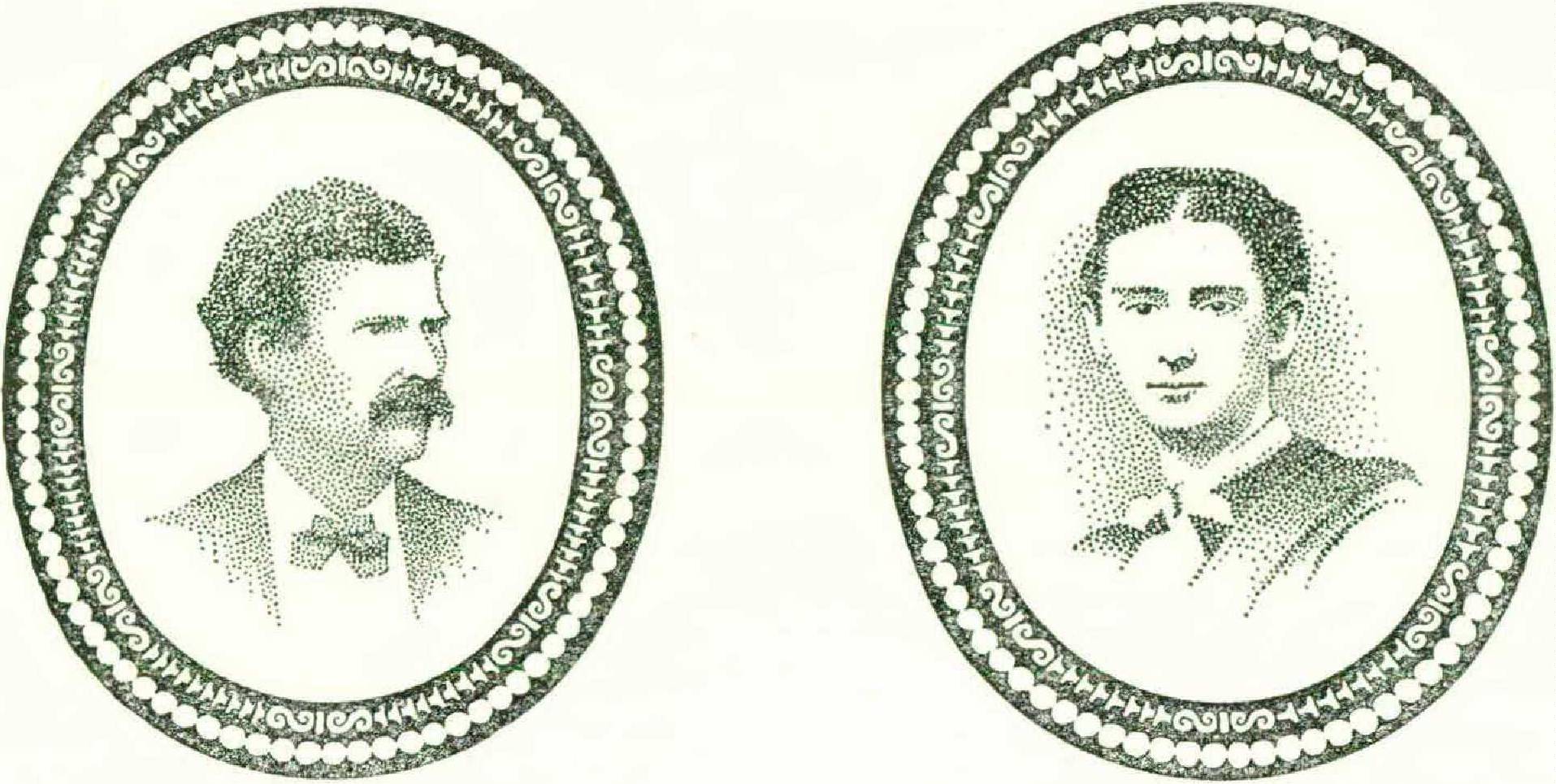
SAMUEL L. CLEMENS, known by the most famous pen name of modern times as Mark Twain, at the age of thirty-two fell in love with Olivia (“Livy”) Langdon. Ten years his junior, this Elmira girl had long lived a sheltered, semi-invalid life not unlike that of Elizabeth Barrett. The incursion of her wild-haired suitor — Missouri printer, Mississippi pilot, Nevada miner, California journalist, world traveler, and rising young lecturer — swept all before him. He conquered the reluctance of her affluent father as well as the doubts of Livy herself. After a trial engagement begun in late November, 1868, their betrothal was announced on February 4, 1869, after Mark found time in the midst of a strenuous lecture schedule to make another whirlwind descent upon Elmira.
Romantic by nature and ardently in love, he discovered in Livy the physical beauty, charm, purity, and intense Victorian femininity which he craved. Yet from the start he realized the temperamental differences which lay between them. For example, the trade by which he earned his bread was at first blush almost incomprehensible to her. “Poor girl, anybody who could convince her that I was not a humorist would secure her eternal gratitude!” he wrote to his elder friend Mrs. Fairbanks early in his engagement. “She thinks a humorist is something perfectly awful. I never put a joke in a letter to her without a pang. Best girl in the world.” Nevertheless the playfulness of his courtship letters — ranging from drollery to mock ferocity and the teasing of passages deliberately inked out, interspersed by sallies of fun over her gravity and bizarre spelling — seldom went amiss. In time, as if to prove her powers of accommodation, Livy began to repay him in his own coin, in what he delightedly called “a burst of humor worthy of your affianced husband.”
These letters, penned daily by Mark Twain in hotel rooms or on the railway cars, often at late hours when he was struggling against fatigue of mind and body, as well as the vexations of a public performer constantly on edge, are still probably the best he ever wrote. “Mamma says she thinks they are the loveliest love letters that ever were written,” reported their first-born daughter Susie, in a precocious biography she once attempted of her famous father. “She says that Hawthorne’s love letters to Mrs. Hawthorne are far inferior to these.” Besides the endless variations on “I love” which Latins call conjugating the verb, these missives are filled with equally indispensable talk about photographs (porcelaintypes being the latest fashion), rings, volumes which they read as courting books while underscoring significant passages, and of course the unfolding of plans for their life together. “What we want is a home,” wrote the Missourian who had wandered over the continent and the earth since he left Hannibal in 1853. “ We are done with the shows and vanities of life and are ready to enter upon its realities — we are tired of chasing its phantoms and shadows, and are ready to grasp its substance. At least I am — and ’I’ means both of us, and ‘both of us’ means I of course — for are not we Twain one flesh?”
With the lecture season over, late spring of 1869 saw him at Hartford, home of the American Publishing Company, whose owners, the Blisses, were rushing through the press his first full-length book, The Innocents Abroad. Livy had helped him read proof on the early chapters during one of his frequent Elmira visits. Now, having to carry on alone, he professed to grumble at the drudgery and the absence of his dutiful little critic — with no prevision of the rather silly Freudian controversy which would break out, some years after his death, about this same censorship, the ordeal which was supposed to have made him into a kind of henpecked Rabelais. Urging the Langdons to bring Livy to see him, he wrote provocatively: “There are awful things in the proofs which she needs to scratch out, and I am putting in more awful ones every day.”
Meanwhile he found Hartford in the spring “the pleasantest city, to the eye, that America can show,” and first entertained notions of bringing Livy some day to settle there. Just now his yearning for her left him constantly restless in the intervals between spells of hard work. “How could I walk these sombre avenues at night without thinking of you?” he wrote. “Every flagstone for many a mile is overlaid thick with an invisible fabric of thoughts of you.” But for all his pining he made new friends in this town — like the Reverend Joseph Twichell, Yale College athlete and Civil War veteran, whose hearty, simple, kindly ways endeared him to Mark Twain for life; the savant James Hammond Trumbull and his younger brother Henry Clay, the Sunday-school missionary; and John Hooker, who with his eccentric wife Isabella Beecher had come to Hartford some fifteen years before and bought a tract of land which became Nook Farm, where in later times lived Harriet Beecher Stowe, the Charles Dudley Warners, and the Clemenses. The Hookers he took mostly on faith, because Livy liked them. His struggle to mail a previous letter, telling her about these new acquaintances, forms the starting point for the first letter here selected.
HARTFORD, Saturday Night, [May 15, 1809]
Livy dear, only let me say Good-night — that is all. Just as I expected, and just as I said in your mother’s letter, Mr. Bliss forgot to mail that letter to you, and I discovered the fact an hour after supper and took it and cleared out for the post office — it was raining like sixty. I grabbed a seedy old umbrella in the hall and hurried. But that umbrella appeared to go up too much and sloped the wrong way — it was like a funnel — and Livy, would you believe it, before I had walked three blocks it had conveyed more than eighteen tons of rain-water down the back of my neck. Why, I was ringing wet. And I had my thin shoes on, and I began to soak up, you know. Barrels and barrels I soaked up — and that water rose in me, and rose in me, higher and higher, till it issued from my mouth, and then from my nose, and presently I began to cry — part from grief and part from overflow — because I thought I was going to be drowned, you know — and I said I was a fool to go out without a lifepreserver, which Livy always told me never to do it, and now what would become of her?
Well, you know I live half way from Hooker’s to the post office, and it is six miles by the watch, and I only got there just in the nick of time to mail my letter three hours and a half before the mail closed, and I tell you I was glad, and felt smart — and then I bought 4 new numbers of Appleton’s Journal and went up town and called on Billy Gross a minute, and went away from there and left my Appleton’s, — and went down to the photographers and ordered a lot of pictures from the negative of the porcelain I gave you, and came away from there and forgot my umbrella — and then rushed back to Gross’s and got my Appleton’s — and crossed over and started home and got about 3 miles and a half and recollected the umbrella, and said “All right, never had a seeming misfortune yet that wasn’t a blessing in disguise,” and so, turned and tramped back again, damp but cheerful — twice three and a half is nine miles — and got my umbrella, and started out and a fellow said, “Oh, good, it’s you, is it? — you’ve got my umbrella — funny I should find you here.” And it was funny. We had unconsciously swapped umbrellas at the post office, or up a tree, or somewhere, and here, ever so long afterward and ever so far away, I find him standing unwittingly by his own umbrella looking at those pictures, with my old funnel in his hand. But the moment I picked his property up he recognized it — splendid umbrella, magic case, chronometer balance — he paid a thousand dollars for it in Paris — and it was unquestionably my umbrella that he had, because what was left of his paper collar was washed down around the small of his back and he had come just in an ace of being drowned before he noticed the little peculiarity of my property — and you know he had made a pass at that daguerrean shop and climbed in there just in time to save his life, — and he was wet, Livy, you better believe. He was very glad to see me. And I went away cheerful, and said “I never had a seeming misfortune yet that wasn’t a blessing in disguise — and it holds good yet, and it was a blessing this time, too — for that other fellow.” And then I came home, you know. And since then I have written a beautiful little romance about a nigger which was stolen out of Africa which was a prince — and sold into American slavery, and discovered, 30 years afterward and purchased of his master by the American public and sent home to Timbuctoo — and it is a true story, too, and Rev. Trumbull told me all about it — and his father had seen this poor devil with his own eyes — and T. showed me his majesty’s portrait (original) painted by Inman, And if you were here you could read this stirring romance, darling, and make out all the marginal poetry — and mark out all the jokes you didn’t understand — and all the — well every thing — you should mark it all out, if you wanted to, for if Livy didn’t like it nobody else should have a chance to like it — and since then — it is just “midnight — and All’s well!”
A thousand blessings on your honored head and kisses on your precious lips, my own darling.
Good-night.
SAM
His soaking left Mark Twain with a miserable cold; the following letter was written in bed. His discomfort led him perhaps to seek relief in badinage, at the expense of a sentimental scheme undertaken by “Mrs. Sue.” She was Livy’s adopted sister, Susan Langdon Crane, who with her husband Theodore lived at Quarry Farm, up the hill from Elmira, where in future years Mark would do some of his best writing. Susan Crane early became one of Mark Twain’s great favorites; to her bestowal of the sobriquet “the Holy Samuel” he replied by calling her “Sinful Susan.” Just now, it appears, she was planning a little memoir or literary tribute to a son of their neighbor, Henry Babcock Noyes of Big Flats. This youth, William Lord by name, had died in 1866 at the age of twenty. Mark Twain could not have known him. But (as any reader of the Emmeline Grangerford passages in Huckleberry Finn will remember) Mark was a derisive foe of the saccharine obituary muse, and so set forth his idea of a suitable elegy.
HARTFORD, Monday Night, [May 17, 1869]
I can’t resist the temptation to write you a line or two even though I sneeze myself to death before I get through with it. — What a bewitching little darling you are, Livy. You were going to come. It seems almost a misfortune that I wasn’t dangerously sick, so that I might see the dear face again. — I used to think of sickness with dread — for I always had visions of dreary hospitals — solit ude — shut out from friends and the great world — dragging, uneventful minutes, hours, weeks — hated faces of hired nurses and harsh physicians — and then an unmoumed death, a dog’s burial, and — dissection by the doctors! But with you at the bedside — it seems to me that sickness would be luxury! You are a noble, true-hearted little darling, Livy. And I love you. . . .
You little rascal, you slurred over Noyes’s name, because you knew very well you didn’t know how to spell it! Never mind, Livy darling, you know your spelling is perfectly safe in my “deluded” eyes, because I love everything you do, whether it be good, bad, or indifferent. Let Mrs. Sue be troubled no more about her memoir. I will write it — (with pleasure, I came near saying, but it seems like rather a doubtful compliment, and so I withhold the words). I will write it, and I will do it with such grace and such felicity that the ghost of the late William Lord Noyes shall tear its filmy garments with envy and chagrin. I will put in tasty congratulations from each member of the family, and from all the admirals and brigadier generals, and even from the President, the Emperor of the French and Queen Victoria — for both of you — both of you in the same volume — and I will write all these felicitations myself—every one of them — so that I shall know that they are just exactly as they ought to be. And I’ll have some poetry in — some of those sublime conundrums from Young’s Night Thoughts which only Livy can cipher out the meaning of, and some dark and bloody mystery out of the Widow Browning — and also some poetry of my own construction — and between the three I guess we’ll “hive” the gentle reader. And I shall have in a lot of smart remarks made by both of you when you were teething (after the “load of hay” pattern) and I shall get up these remarks myself, so as to be sure that they are not insipid like the late Wm. L.’s (which I regard as altogether “too thin”). And I will put speeches into your maturer mouths which shall astonish the nations — profound remarks upon agriculture, commerce, diplomacy, war, chemistry, afghans for babies at $15 a day, geology, theology, cut-throat, painting, sculpture, niggers, poetry, politics, — every thing that erudition loves and intellectuality revels in. And there shall be a picture of you two and Jim for a frontispiece, with your autographs underneath, which I will write myself, so that people can read them. And I will have pictures of the Spaulding girls (together with their regrets), and pictures of Mr. and Mrs. Langdon and Hattie and the mocking-bird in a group, and a portrait of the late Jep engaged in his favorite study (landscape gardening,) — and toward the end a handsome likeness of your grandmother, along with her letter announcing her exasperation at the sad news. And away over at the extreme back-end of the book I shall wind up with a weeping and disconsolate picture of Theodore’s friend with a basket, going for flying arbutus — and “hoofing it,” as Charley says.
There you are. I’m no compiler of Wm. Lord Noyes bosh. When I get up memoirs I make the deceased get up too — at least turn over. How many copies do you want issued, young women? . . .
“Lovingly your Livy” — the very dearest words to me that ever illuminated paper and gave it a glory as of a vision. How the words seem to nestle up to me! — and put arms about me, and a loved head upon my shoulder, and the hymning of the angels in my heart! You are my Livy — and I am grateful that it is so, beyond all power of speech to express — and I pray God you may remain my Livy always. . . .
SAM’L
The Innocents Abroad appeared in midsummer, 1869, and rocketed to immediate success. A few weeks later, in August, with some financial help from his future father-in-law, Mark Twain bought an interest in the Buffalo Express — as evidence of his determination to settle down and follow a steady calling. He also prepared to resume lecturing on the Redpath circuit. Meanwhile the wedding date had been tentatively set as February 4, 1870, exactly a year after announcement of the betrothal, although this was later advanced by two days. Already a family adviser, he offered his fiancée some comforting advice about her brother; Charlie was regarded as a little wild, in the classic tradition of the young Victorian buck. Eventually, after his trip to the Holy Land and a later round-the-world cruise with a Professor Ford had failed quite to settle his restiveness, Charlie was permitted to marry the girl of his choice, and thereafter became a model citizen.
BUFFALO, Sept. 8, 1861)1
... I have written to Redpath that my lectures must come to a permanent close a week or ten days before the end of January, and when I hear from him, if he has made no appointments after Jan. 15, I will not let him make any. I ought to have the whole month, if I can get it. I am booked for Newark, N.J., Dec. 29.
It seems a dreadfully long time till Feb. 4, dearie, but I am glad we are to have that day, for it will always be pleasant to keep our engagement and wedding anniversaries together. I would rather have that day than any in the whole 365, for it will be doubly dear to me, and be always looked forward to as one peculiarly and sacredly blessed — the day about which the most precious memories of my life have been concentrated. We can always prepare for it weeks ahead and keep it in state. . . .
Don’t be sad, dearie, Charlie will come out all right, yet. It would be an unnatural marvel if Charlie were a better boy than he is. Let us not expect extravagant things of the fellow. He is another sort better and manlier than ninety-nine out of a hundred boys in his situation in life. Now if you knew boys as well as I do, sweetheart, you would know that as well as I do. Let us do the rascal justice, Livy. I suppose I was a better boy at his age, but then you know I — well I was an exception, you understand — my kind don’t turn up every day. We are very rare. We are a sort of human century plant, and we don’t blossom in everybody’s front yard.
Since I wrote that last line I have read column after column of proof, and now it is so late that I must stop talking with Livy and go home to bed. It has rained all day and I suppose is raining yet, and I told Jo. Larned to stay at home after supper and be a comfort to his wife and I would sit up and do the work for both — though there wasn’t a great deal to do, for that fellow works straight along all day, day in and day out, like an honest old treadmill horse. I tell him I wish I had his industry and he had my sense.
Good-night my darling little wife, idol of my homage and my worship, and the peace of the innocent abide with you.
SAM
Mark’s lecture tour this autumn took him into Pennsylvania, Ohio, and New England, with much planning ahead to contrive the prompt receipt of Livy’s letters. “No matter how dreary and wretched I may feel when I enter one of these sad, homelesslooking towns,” he once wrote her, “I soon retreat to the shelter of your love, Livy, and all is bright and cheerful again.” Without the stimulant of a letter, he protested, a good lecture at night was impossible. At one of his major stands, Pittsburgh, he met William B. Dean, cousin and boyhood playmate of William Dean Howells — for whose Atlantic Monthly Mark now aspired to write. (Later this season, when Clemens met Howells, he told the editor what relief had come to him from Howells’s good words about the Innocents: “When I read that review of yours I felt like the woman who said that she was so glad that her baby had come white.”)
Mark’s growth as a professional lecturer and writer, and his dependence for livelihood upon tongue and pen, early stirred his interest in the problem of literary property rights, as the following letter reveals, foreshadowing the main share which he later took in copyright agitation. Whatever his conviction about the sacredness of brain children, toward more corporeal progeny his attitude was apt to be fickle. Adoring well-behaved children all his life, and in the years ahead the devoted father of three little girls, Mark Twain from youth to age was subject to outbursts of extreme violence under the goad of noisy, spoiled, affected juveniles. When, in Pittsburgh, his old Nevada acquaintance Asa L. Wangaman turned up with one such domestic aflliction, Mark uncorked his savagery in private.
PITTSBURGH, Oct. 31, [1869]
I walked all around town this morning with a young Mr. Dean, a cousin of Wm. D. Howells, editor of the Atlantic Monthly. He kindly offered to give me a letter of introduction to Mr. Howells, but I thanked him sincerely and declined, saying I had a sort of delicacy about using letters of introduction, simply because they place the other party in the position of being obliged to take the stranger by the hand whether or not and show him civilities which he may not feel like showing him, or at least may not feel like it at that particular time. He may have engagements — business — the headache twenty circumstances may conspire to make the entertainment of a guest a hardship. I prefer to be casually introduced, or to call ceremoniously with a friend — then the afflicted party is perfectly free to treat me precisely as he chooses, and no harm done. ...
Wangaman made me go to his house to see his wife. I knew her in Nevada, too. I staid 15 minutes, and would have remained to supper, for the table looked tempting, but their young boy of 7 is one of your petted smarties whose entire mind is given to climbing around and getting where he can intercept your vision and attract your attention — industriously watching your eye and changing position so as to intercept it again if you change the direction of your glance — a child with a feverish desire to do something surprising and win the notice of the stranger— a creature that parades its toys and asks its mother questions concerning them which it is plain are merely asked to compel the stranger’s attention to them and gouge a remark out of him — a soiled and nasty imp that sings nursery stuff in a loud and still louder and louder key as the conversation rises to meet the emergency, and does it all to win coveted admiration — a small whelp that says those ineffably flat things which mothers treasure up and repeat and regard as smart things, purring and smiling blandly the while — a little pugnosed, mop-headed, sore-toed, candy-smeared beast that paws after things at table, and spills its coffee, and eats mashed potatoes with its fingers, and points and clamors for “some of that” — a sinful, tiresome, homely, hateful, execrable nuisance at all times and in all places whatsoever!
I may be a brute. Doubtless I am. But such is my opinion of this breed of children, nevertheless. The “four-year-old” department at Harper’s Monthly is written in vain for me.
Well, Livy dear, I was afraid that brat would be at supper — Mothers who rear such prodigies always like to have them on exhibition — and so I first started to ask, and then, recognizing that that would not be strictly polite, I simply declined supper and returned to the hotel.
One of the newspaper gentlemen who called today was Mr. Bennett of the Commercial, a good fellow modest and pleasant. He wants to make a synopsis of my lecture tomorrow night, or report it in full. I told him a synopsis of a humorous lecture holds up all the jokes, in a crippled condition for the world to remember and so remembering them hate them if ever they hear that lecturer repeat them in solemn and excruciating succession one after the other.
And I said to take the points out of a humorous lecture was the same as taking the raisins out of a fruit cake — it left it but a pretense of a something it was not, for such as came after.
And further, the charm of a humorous remark or still more, an elaborate succession of humorous remarks, cannot be put upon paper — and whosoever reports a humorous lecture verbatim, necessarily leaves the soul out of it, and no more presents that lecture to the reader than a person presents a man to you when he ships you a corpse.
I said synopses injure — they do harm, because they travel ahead of the lecturer and give people a despicable opinion of him and his production.
I said my lecture was my property, and no man had a right to take it from me and print it, any more than he would have a right to take away any other property of mine. I said “I showed you what time it was by my watch a while ago, and it never occurred to me that you might pull the hands off it so that it would be only a stupid blank to the next man that wanted the time — but yet I see you meditate pulling the hands off my lecture with your synopsis and making it a blank to future audiences. You see me sitting here perfectly serene although I know you could walk off with my valise while I am talking with these other gentlemen — but don’t steal my valise because it is property — my property. Now do take the valise and let the lecture alone. I own both of them — I alone. Take the valise — it is only worth a hundred dollars — the lecture is worth ten thousand.”
This was all perfectly friendly and good-natured, of course. I was trying to show him how in the wrong he was — I had no desire to offend him, and I didn’t.
But Livy, if his chief orders him to report the lecture he can’t help himself— for although the law protects rigidly the property a shoe maker contrives with his hands, it will not protect the property I create with my brain.
I went to church and heard a man from a distance preach a sermon without notes — which was well — but in a frozen, monotonous, precise and inflectionless way that showed that his discourse was a carefully memorized production. There was something exceedingly funny about this bald pretense of delivering an off-hand speech — and something exceedingly funny, too in a full grown man “speaking a piece” after the manner of a little schoolboy. His gestures were timid — never could finish one — always got scared and left it half made. He evidently had the places marked, and knew how he wanted to make them but he didn’t dare.
Oh, the music was royal! . . .
My! What a soprano singer! When I thought the very hair would stand up straight with delight, and looked again and wondered if that grand flood of mellow sound did issue from so small a constitution — and how it could come with such utter absence of effort. . . .
And do you know there are some people whose complacency nothing can subdue. In the midst of the beautiful music a skinny old cat sitting next to me tuned her pipe and began to yowl. Well I came as near as anything to banging her over the head with a pew. Now was there ever such effrontery as that woman’s?
The second tune was a little too complicated for her and I had a rest. On the third, I waited in pure torture all through the first verse, and felt happy, satisfied, safe — but on the second the venerable screech-owl came to the rescue and again filed her saw all through the hymn.
The young man who went with me got tired of the sermon early. He evidently was not used to going to church, though he talked as if he was. Toward the last he got himself down till he was resting on the end of his backbone; and then he propped his 2 knees high against the pew in front of him; he stroked his thighs reflectively with his palms; he yawned; he started twice to stretch, but cut it short and looked dejected and regretful; he looked at his watch 3 times; and at last he got to belching.* I then threw him out of the window. (1 P.M. Good night and God bless and preserve you, my own darling.)
SAM
2 — ‘Tisn’t elegant, but there isn’t any other, Livy.
Mark Twain in later days rated the distinction of having a cigar named for him. An inveterate smoker, he liked to say that he never indulged to excess, since he made it a rule never to smoke more than one cigar at a time. Following the skirmish with Livy here revealed, and during the first months of their wedded life, at home he restricted his smoking to “two hours on Sunday,” solely to humor her, as he told Twichell in December, 1870. But before long he seems to have gone back to the old regime.
CAMBRIDGE, [NEW YORK], Jan. 13, [1870]
No, Livy dear, I shall treat smoking just exactly as I would treat the forefinger of my left hand: If you asked me in all seriousness to cut that finger off, and I saw that you really meant it, and believed that the finger marred my well-being in some mysterious way, and it was plain to me that you could not be entirely satisfied and happy while it remained, I give you my word that I would cut it off. — I might think what I pleased about it, and the world might say what it pleased — it should come off. There would be nothing foolish in the act — and all wordy arguments against it would sink to t heir proper insignificance in presence of the one unanswerable argument that you desired it and our married life could not be completely in unison while that bar remained.
Now there are no arguments that can convince me that moderate smoking is deleterious to me. I cannot attach any weight to either the arguments or the evidence of those who know nothing about the matter personally and so must simply theorize. — Theorizing has no effect on me. I have smoked habitually for 26 of my 34 years, and I am the only healthy member our family has. (What do mere theories amount to in the face of a fact like that.) My health is wholly faultless — and has been ever since I was 8 years old. My physical structure — lungs, kidneys, heart, brain — is without blemish. The Life insurance doctor pronounced me free from all disease and remarkably sound. Yet I am the victim of this fearfully destructive habit of smoking. My brother’s health has gradually run down instead of up — yet he is a model of propriety, and has no bad habits. My mother smoked for 30 years, and yet has lived to the age of 67.
Livy dear, make no argument of the fact that you have seen me “nervous, irritable,” etc., etc., for it happens to be no argument. — You can see your father nervous, worn, restless — you can see any anti-smoker affected just as you have seen me. It is not a condition confined to smokers — as you possibly know in your own experience.
There is no argument that can have even a feather’s weight with me against smoking (in my case, at least), for I know, and others merely suppose.
But there is one thing that will make me quit smoking, and only one. I will lay down this habit which is so filled with harmless pleasure, just as soon as you write me or say to me that you desire it. It shall be a sacrifice — just the same as if I simply asked you to give up going to church, knowing that no arguments I offered could convince you that I was right. It will not be hard for me to do it. I stopped chewing tobacco because it was a mean habit, partly, and partly because my mother desired it. I ceased from profanity because Mrs. Fairbanks desired it. I stopped drinking strong liquors because you desired it. I stopped drinking all other liquors because it seemed plain that you desired it. I did what I could to learn to leave my hands out of my pantaloon pockets and quit lolling at full length in easy chairs, because you desired it. There was no sacrifice about any of these things. Discarding these habits curtailed none of my liberties — on the contrary the doing it released me from various forms of slavery. With smoking it is different. No argument against it is valid — and so to quit it I must do without other reason than that you desire it. The desires of others have weight with me, but are not strong enough quite.
But even if you never said the words, if I saw that my smoking was a bar to our perfect wedded unity and happiness, it should go by the board — and pitilessly.
You seem to think it will be a Herculean task for me to suddenly cast out a loved habit of 26 years, Livy dear. Either you do not know me, or I do not know myself. I think differently about it. — Speak the words, Livy dear — unaccompanied by any of the hated arguments or theories — and you shall see that I love you well enough to follow your desires, even in this matter. Nothing shall stand in the way of our perfect accord, if I can help it.
If you had ever harried me, or persecuted me about this thing, I could not speak as I do — for persecution only hardens one in evil courses. But it is you, darling, that have suffered the persecution (and yet, being you, it has seemed to be me, and so I have resisted all along). You have had to listen to it all, and it grieves my heart to think of it. It has had its necessary effect in making me more loth to yield up this habit than I would have been otherwise. We do hate to be driven.
Ah, Livy, if the whole matter had been left solely in your hands, I would have been quit of the habit of smoking, long ago, and without a pang or a struggle. It was bad judgment to attack so strong a vice save through you. There could be little prospect that other means would succeed if your gentle ministrations failed.
It is about supper time, and some new friends are to come in after supper and sit with me till lecture time. Just as usual, I am in splendid trim for this little country town — and just as usual I must get up at 6 in the morning and be in a lifeless lethargy for the next large city — Utica, and so make a botch of it. . .
SAM
The final courtship letter speaks for itself. Mark’s favorable impression of Fredonia, New York, bore a very practical result. He started almost immediately to plan for his mother and his widowed sister and her young daughter — who were all coming East for the wedding — to settle in Fredonia. There they lived for many years, and there the niece met and married Charles L. Webster, a young surveyor who presently gave up his practice and embarked upon the management of Mark Twain’s precarious, and indeed delirious, business affairs.
HORNELISVILLE, [NEW YORK], 20th [January, 1870]
My child, I am within sixty miles of you, and so I do feel that your unseen presence is stronger about me than when you are away at the other side of a State — but further than this, your proximity does not benefit me, little one, but on the contrary is rather a matter to growl at. Because it only makes me Want the more to see you, without giving me the opportunity. . . .
We did have a most delightful audience at Fredonia, and I was just as happy as a lord from the first word of the lecture to the last. I thought it was about as good a lecture as I ever listened to — but some of the serious passages were impromptu — never been written.
This, my precious Livy, is the last letter of a correspondence that has lasted seventeen months — the pleasantest correspondence I ever had a share in. For over two months of the time, we wrote every other day. During the succeeding twelve months we have written every day that we have been parted from each other. And no man ever did have a dearer, more faithful little correspondent than you have been to me, my heart ‘s darling. — Your letters have made one ray of sunlight and created a thrill of pleasure in every one of these long-drawn days, howsoever dreary the day was otherwise. And so I thank you and bless you now, once more, as I have thanked you and blessed you all these days. And I pray for you, even as I have done with the closing in of each night, ever since you moved my spirit to prayer seventeen months ago. This is the last long correspondence we ever shall have, my Livy — and now on this day it passes forever from its honored place among our daily occupations, and becomes a memory, A memory to be laid reverently away in the holy of holies of our hearts and cherished as a sacred thing. A memory whose mementoes will be precious while we live, and sacred when either one shall die.
They have come for me, my sweet Livy.
Good-bye and God bless you,
SAM
(To be concluded)