A Cook Is Born
GILES PLAYFAIR is the Accent on Living author who likes singing commercials but who is never quite able to catch the name of the product they advertise (December Atlantic). A former London barrister, he is now living in New Canaan, Connecticut.
FOOD
by GILES PLAYFAIR
As an Englishman resident in this country, I have been conducting a one-man crusade to explode the popular American myth that the British can’t cook. For weapons I have used my own culinary efforts plus two cookbooks and a few private recipes imported from my native land.
Chance adversity set me on this course. My wife had to spend several weeks in hospital, and I was left alone in the house. I had long had the urge to cook, but on the first and only occasion my wife had permitted me an opportunity to gratify it, the stove had unaccountably burst into flames.
My initial effort was a stew made out of leftovers I discovered in the icebox. When I first tasted it, I exclaimed gallantly to myself, “It’s out of this world!” But somehow my appetite for it was obstinately small. Three times I had it warmed up for dinner, and then, despite my determination to be a thrifty housekeeper, I deposited it in the garbage can.
At last an eternal truth dawned on me. Most women, I reflected, may be born to be ordinary cooks, but most men are born either to be extraordinary cooks, or not to be cooks at all. Clearly, if I had talent, I had as yet given it no chance to reveal itself. For what was there extraordinary about that stew — with the minor and insufficient exception that instead of water I had poured half a bottle of red wine into the pot? I faced a choice: either to admit failure or to fly high. I decided to fly high.
I remembered a dish that I had once had at the Midland Hotel, Manchester. This was breast of chicken, brought to the table in a silver chafing dish, simmered for several minutes in cream flavored with Worcestershire sauce and assorted condiments, and flambe a I’eau de vie. I thought I could handle the last stages from memory, but my trouble was I had no idea what should be done to the chicken before it reached the chafing dish.
Eventually I took into consultation a young housewife who was, as I knew, a fairly ambitious and adventurous cook herself. She suggested that the chicken should be parboiled; furthermore, food prices being what they were, that the legs and wings should be used as well as the breast. She agreed to give a small dinner party that very night, at which I might make my debut. She would see to the parboiling; the rest would be up to me.
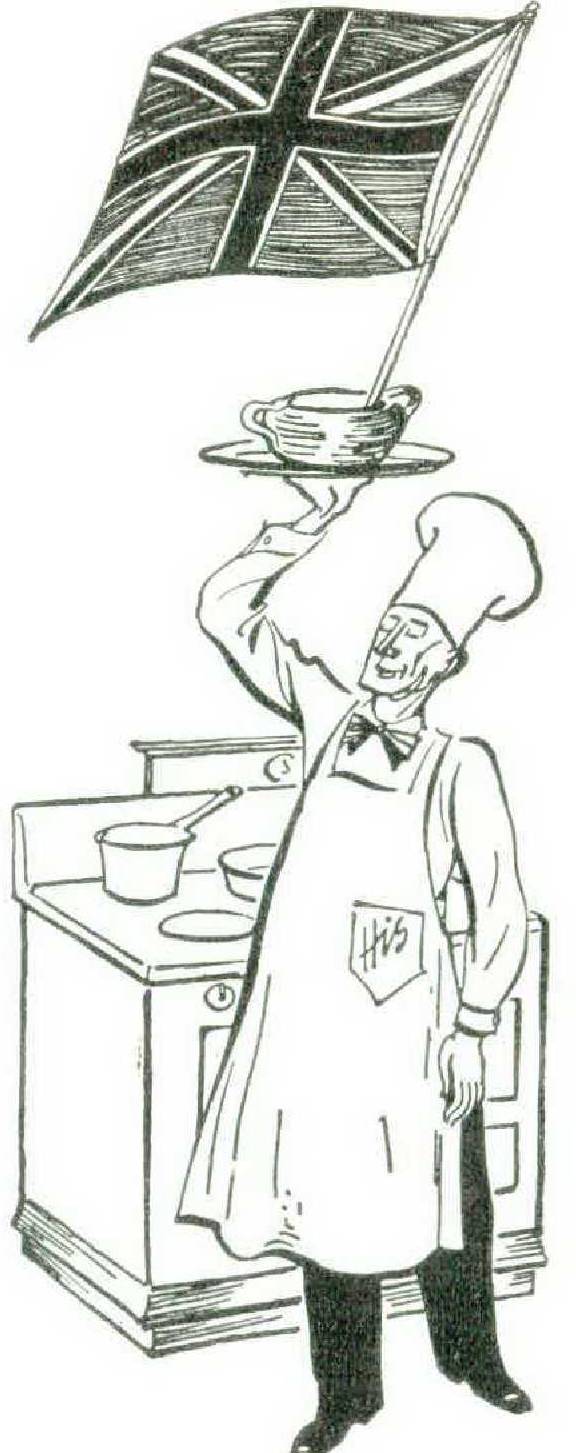
To guard against any possibility of mishap, I spent most of the afternoon experimenting with makeshift implements and ingredients: namely, a frying pan instead of a chafing dish; milk instead of cream; blended whiskey instead of brandy; and a slice of bacon instead of chicken.
These precautions paid off. The final result, though far removed from its original inspiration, proved a sensational success. I suppose, considering that the housewife is an American and that she helped, I cannot claim the dish exclusively for England. But I can call it an AngloAmerican dish, with emphasis on the Anglo. Here is the recipe: —
Parboil a chicken, and cut into appropriate helpings. Pour I pint cream into a chafing dish. To this add 2 teaspoons Worcestershire sauce, ^ teaspoon salt, ^ teaspoon paprika, and a few grains cayenne. Allow to warm over flame, and when dangerously near the boil add the chicken. Simmer for as long as may be thought, safe, desirable, and interesting. Then dash in 1/2 cup brandy, strike a match, and set alight. Serve — not boastfully, exactly, but ceremoniously.
My confidence from then on knew no bounds. Soon I was giving little dinner parties at which I presented my boldest culinary efforts: for example, a roast duck, stuffed with oysters, wild rice, and esoteric spices, served with a sauce made from orange juice, vinegar, brown sugar, and port wine. Admittedly this did not taste quite so delicious as it should have, for something went wrong with the oven. When, a half hour or so before midnight, I eventually felt obliged to remove the duck, it was still notably close to its natural state.
If my guests asserted that clearly l had secret methods of my own invention, I would smile agreement with a modest yet appropriately mysterious air. But the truth was I could not so much as scramble an egg without a recipe to guide me.
Yet my ignorance, I realized, was my strength. If the rule was to beat for ten minutes, I beat for ten minutes — by the clock. And it the rule was to add sugar half a teaspoonful at a time, I did exactly that, braving the mental and physical strain in the cause of Art.
By the time my wife returned from the hospital. I had already imported several recipes from England and determined to sell the virtues of English cooking to the neighborhood. My wife is American, and although she has endorsed my campaign in principle by permitting me to cook when guests are bidden to a meal, she has effectively slowed it down by bidding guests to a meal with less and less frequency. She complains that I cannot cook without (a) using her as a kitchen maid, (b) losing my temper, (c) eventually causing her to lose her temper, (d) besmearing the floor and walls of the kitchen with flour, egg white, egg yellow, and other perhaps stickier ingredients, (e) bespattering the ceiling of the kitchen with the same, (f) bedizening my clothes irretrievably with the same, (g) besmirching every available bowl, dish, saucepan, and kitchen utensils of other description almost unwashably with the same, (h) taking a whole day to accomplish what she could do in an hour; and so on, and so on.
I have made some progress nevertheless. With two recipes, in particular, I have had impressive successes, and both of these, 1 guarantee, come from an English cook extraordinary. The first is as follows: —
CHOCOLATE PUDDING À LA HELEN ANGLAISE
Place a double boiler on the fire. Into this break directly 2 eggs. Beat in 4 tablespoons sugar and 1 glass pale sherry. Continue to beat diligently, and never mind the heat, until the mixture is of the same consistency as whipped cream. Have prepared an ordinary steamed chocolate pudding. Bury this in the sauce, and thus transform it into a rare gastronomic delight. Serve it as such.
And here is the other: —
LITTLE DEVILS
Line patty tins with short pastry (or piecrust. — to use the Americanism). Fill each three-quarters full with mashed sardines (imported, of course). Prepare 2 cups thick white sauce. Wait patiently until this is cool, then stir in 2 eggs (unbeaten) and 2 tablespoons grated cheese. Fill up the patty tins with this mixture, and bake for 15 minutes in a moderate oven (3831°). Remove the pastries or pies from the patty tins and serve — fairly casually, but with inner confidence — as a light luncheon entree. When complimented, reveal to guests’ amazement that dish is English.
My crowning achievement so far is to have induced a party of seven Americans to eat heavily, and with unconcealed delectation, of steak and kidney pudding — a dish that is apt to be regarded on this side of the Atlantic as at once the most characteristic and terrifying example of English gastronomic taste. A standard recipe lor steak and kidney pudding (four modest servings) is roughly as follows: —
Mix I pound flour, 1/2 pound shredded suet, 1 teaspoon baking powder, and 2 pinches salt; add sufficient water to transform into a stiff dough, and roll out as you would piecrust (or pastry — to use the Anglicism). Grease a pudding basin, and line this with some of the suet crust. Fill up with a mixture made from 1/2 pound steak cut into 1/2-inch cubes, 1 sheep’s kidney chopped small, 1/2 teaspoon salt, 1/8 teaspoon pepper, 1 teaspoon minced parsley, 1 dessertspoon flour. Add 1/2 cup water. Cover the top with remainder of the suet crust, and in turn bind with a pudding cloth or other waterproof covering. Then plunge (but do not submerge) basin into a saucepan of boiling water, cover and steam for 2 hours. Get someone else — since this is a tiresome and possibly dangerous business, requiring no culinary skill — to remove basin from saucepan. Encircle it with a large Irish linen napkin. Serve triumphantly.
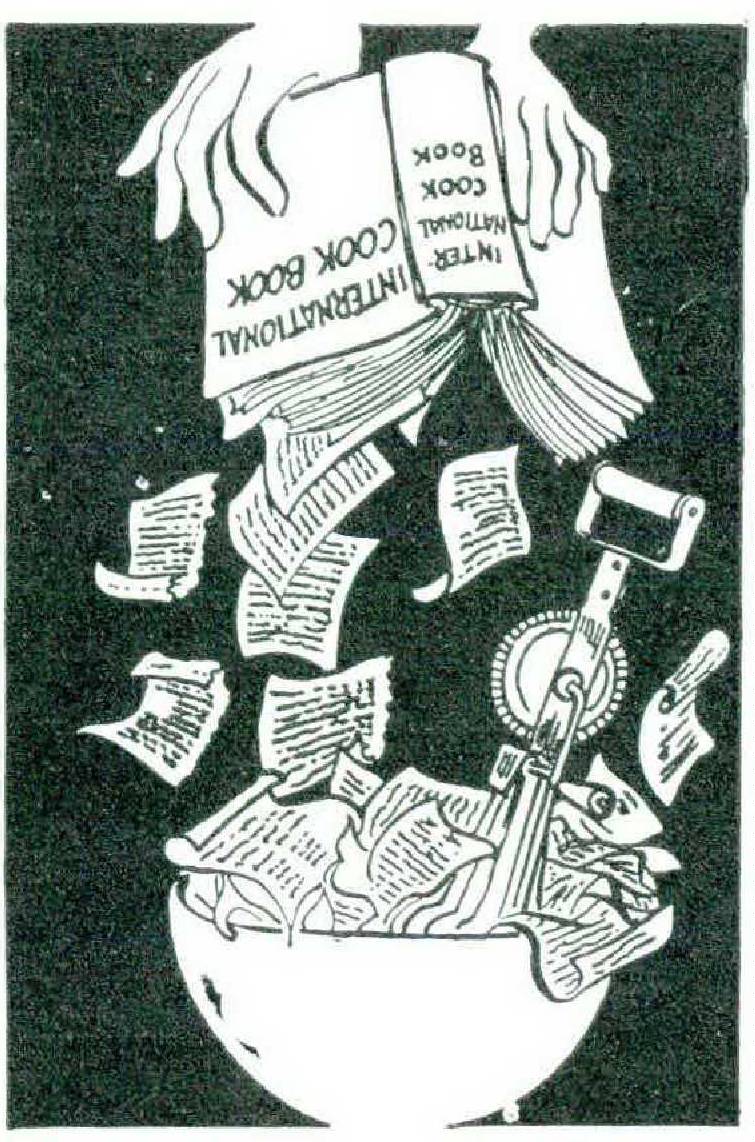
I must confess that I cheated a little. I added a quantity of onions and mushrooms to the meal mixture, and made the suet crust far thinner than strict Ye Olde English style permits. But those seven Americans want more; and I intend, each time I serve it in the future, to include fewer and fewer vegetables in the meat mixture and to make the suet crust thicker and thicker. The day must come, therefore, when I shall have persuaded them to enjoy the real thing in all its awful traditional glory. That — unless my wife’s attitude hardens meanwhile — should be about twenty years from now.