Hither and Fro
by ALAN DEYOE
IN the December Atlantic I told how my mind had been nearly addled by an idea for a story. It would be a story employing the positive forms of those numerous words which are commonly used only in the negative. It would tell about a man who was a speakable cad who lived in a pregnable fortress, the roof of this peculiar dwelling being pervious. And so on. I wanted to write it down, I said, in the hope of getting rid of it forever.
For several weeks after publication, it looked as if I had succeeded. Readers from coast to coast obligingly supplied me with just about every rare positive remaining in the unabridged dictionaries. The one perfect adjective for the story’s hero was turned up. It was, of course, couth. There was supplied the term to sum up all his tendency to weakness and wavering. The fellow was obviously trepid.
I even got it worked out, at last, why my struggle with the story of the speakable cad had proved so exhausting. It was evident that I must be a defatigable writer. On this happy note of conclusion I dismissed the whole thing from mind.
It was a lovely lull, while it lasted. But it is over. I am in an awful mess again.
It began a couple of weeks ago. I was writing to thank a reader who had suggested that the hero of my idiot story ought surely to have a name, so that, when traveling, he could travel eognito.
“I agree,” I wrote blithely. “We oughtn’t just to leave the fellow walking to and fro forever on that kempt lawn of his without a name.”
The instant I had written this sentence, I knew that 1 was Off Again.
The reader to whom I was writing when the blow fell can rest happy. The man in the new story that is making my life a torment has a name. He is eognito, all right. His name is Edward Halfway. He is nothing so harmless as a mere anonymous speakable cad, peccably dressed. He is something much more hideous. Edward Halfway is the man who doesn’t walk to and fro, but. only fro. Why does he walk fro? Because he wants to get yon. Can he face any eventuality with perfect calm? No. He will remain calm only weal.
I have been living with Edward Halfway now for two weeks, day and night. I am about at the end of my endurance.
Halfway, you see, lives in a dingy old house which I take to be located (why, I cannot imagine) somewhere in London. It is a cobwebby, dusty, grimy old wreck of a house. People wonder why he lives there. They think perhaps he is compelled, willy-nilly, to inhabit such a dismal place. But no. I know better. I know that EdAvard Halfway actually likes it there. I know that he lives there willy.
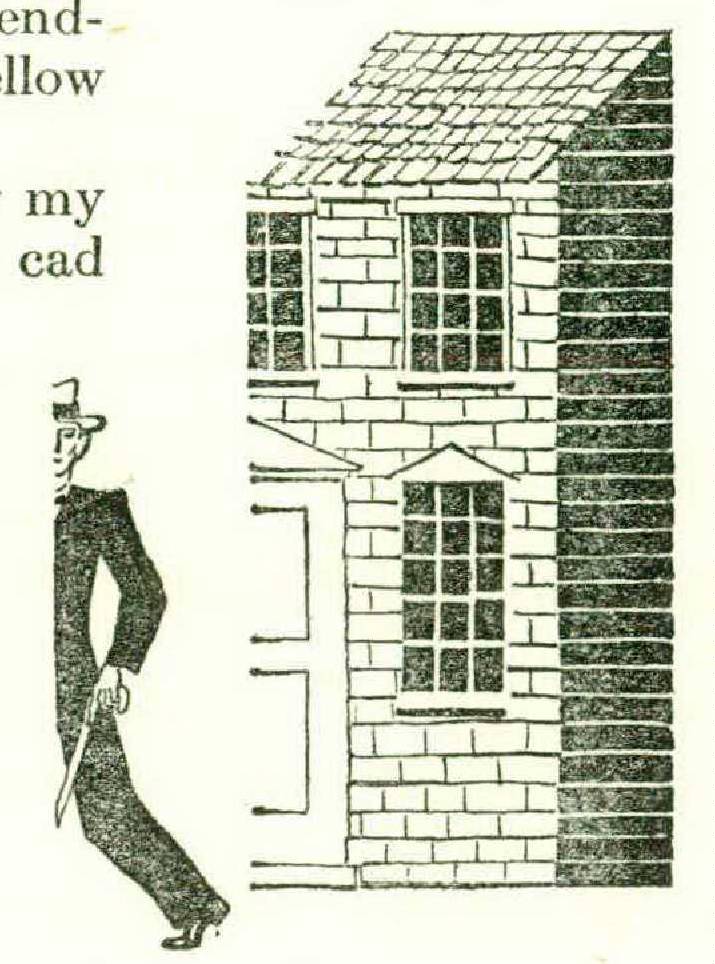
I see him, in the dim light of a London morning, opening his dingy door and walking fro. How bravely he squares his thin shoulders and goes hurrying diagonally across the street, zig. But I feel a mistiness in my eyes, and a pang of compassion for Edward Halfway. For 1 know he is a lonely man. He does not have, as most men do, a plenty of kith and kin. All he has got (somewhere up in North Wales, I think) is a couple of kith.
As Halfway now returns diagonally across the street, zag, I see how firmly his lips are set. I know that he is making a great effort to marshal and order his thoughts. Edward Halfway, inhabiter of that shabby old house, is a believer in mental discipline. He hates to have anything like a topsy-turvy jumble in his thoughts. It is his pride always to keep his thoughts topsy. Would that his kith up there in Wales had as much self-control.
Halfway is about to re-enter his shabby door when I see a policeman come heavily along the street and accost him. The policeman is suspicious of this seedy figure, on the understandable grounds that for days he has been seeing him walk fro and yon without seeing him walk hither and to. The officer says firmly: “’Ere, ‘ere, now. Wot’s up?” Such a question might set any other householder to hemming and hawing. But not my Edward Halfway. Halfway, never a man to do things by wholes, just looks the officer in the eye and haws.
This is too much for the policeman. He steps menacingly toward Halfway. Halfway hesitates for only an instant. Then he turns on his heels and goes running away down the street, mell.
(As a result of my frenzied plungings about in the dictionary during the past couple of weeks, I am perhaps the only living man outside the directorate of a Philological Society who knows that pell-mell comes from Old French and means “stirred up with a shovel.” Poor old Halfway is stirred up, all right, but I can’t for the life of me see that there is any shovel — pesle, Old Fr. — involved in the business; so, as I say, he just goes running away down the street very fast, mell).
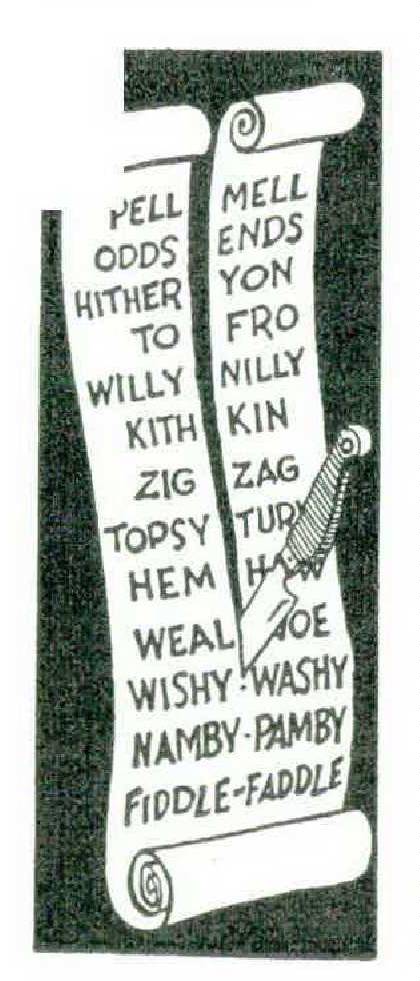
He has sprinted only about a block when he trips and breaks his neck and that’s the end of the story. Well, no, not quite the end. I usually see a final scene in which the police converge on his miserable old house, to see what clues to his enigmatic personality they can find among his odds and ends. I see the Scotland Yard men staring at one another with white, baffled faces. Because poor old Halfway, naturally, hasn’t left a collection of odds and ends. All he has left is some odds.