Moby Dick
“It is because Herman Melville created him that, notwithstanding the reservations one may make, Moby Dick is a great, a very great book.”
1
I HAVE read Raymond Weaver’s Herman Melville Mariner and Mystic, Lewis Mumford’s Herman Melville, Charles Roberts Anderson’s Melville in the South Seas, and William Ellery Sedgwick’s Herman Melville: The Tragedy of Mind. I don’t believe that I know much more about Herman Melville than I knew before.
According to Raymond Weaver an “uncircumspect critic at the time of Melville’s centenary in 1919” wrote: “Owing to some odd psychological experience, that has never been definitely explained, his style of writing, his view of life underwent a complete change.” I don’t quite know why this unnamed critic should be described as uncircumspect. He hit upon the problem which must puzzle everyone who is interested in Melville. It is on this account that one scrutinizes every known detail of his life and reads his letters and books, books some of which can only be read by a determined effort of will, to discover some hint that may help to elucidate the mystery.
But first let us take the facts so far as they are made known to us by the biographers. On the face of it, but only on the face of it, they are simple enough.
Herman Melville was born in 1819. His father Allan Melville and his mother Maria Gansevoort were gentlefolk. Allan was a cultivated, traveled man and Maria an elegant, well-bred and pious woman. For the first five years of their marriage they lived at Albany and after that settled in New York where Allan’s business — he was an importer of French dry goods — for a time prospered, and where Herman was born. He was the third of their eight children. But by 1880 Allan Melville had fallen on evil days and moved back to Albany, where two years later he died bankrupt and, it was said, insane. He left his family penniless.
Herman went to the Albany Classical Institute for boys and on leaving school in 1834 was employed as a clerk in the New York State Bank; in 1835 he worked in his brother Gansevoort’s fur store and the following year on his uncle’s farm at Pittsfield, Massachusetts. For a term he was a teacher at the common school in the Sykes district. At seventeen he went to sea.
Much has been written to account for this, but I cannot see why any further reason need be sought than the one he gives himself: “Sad disappointments in several plans which I had sketched out for my future life; the necessity of doing something for myself, united to a naturally roving disposition, had now conspired within me, to send me to sea as a sailor.” He had tried his hand without success at various occupations, and from what we know of his mother we may surmise that she did not hesitate to express her displeasure. He went to sea, as many a boy before and after has done, because he was unhappy at home. Melville was a very strange man, but it is unnecessary to look for strangeness in a perfectly natural proceeding.
He arrived in New York wet through, in patched trousers and a hunting jacket, without a penny in his pocket, but with a fowling piece his brother Gansevoort had given him to sell; walked across town to the house of a friend of his brother’s, where he spent the night; and next day with this friend went down to the waterfront. After some search they came across a ship that was sailing for Liverpool, and Melville was signed on as a “boy” at three dollars a month. Twelve years later he wrote an account of the voyage there and back, and of his stay in Liverpool, in Redburn. He looked upon it with some contempt as hack work; but it is vivid and interesting, and it is written in an English that is simple, straightforward, easy, and unaffected. It is one of the most readable of his works.
Nothing much is known about how he spent the next three years. According to the accepted accounts he taught school in various places—at one, Greenbush, New York, he received six dollars a quarter and board; and he wrote a number of articles for provincial papers. One or two of them have been discovered. They are without interest, but give signs that he had done a lot of desultory reading; and they have a mannerism of which to the end of his life he could never rid himself, namely that of bringing in without rhyme or reason allusions to mythological gods, to historical and romantic characters, and to all kinds of authors.
2
MELVILLE had an adventurous spirit, and it may be supposed that in the end he could no longer endure the tameness of life to which it seemed circumstances had condemned him. Though he had disliked life before the mast, he made up his mind to go to sea again; and in 1841 he sailed from New Bedford in the whaler Acushnet bound for the Pacific.
With one exception the men in the forecastle were coarse, brutal, and uneducated; the exception was a boy of seventeen called Richard Tobias Greene. This is how Melville describes him; “Toby was endowed with a remarkably prepossessing exterior. Arrayed in his blue frock and duck trousers, he was as smart a looking sailor as ever stepped upon a deck; he was singularly small and slightly made, with great flexibility of limb. His naturally dark complexion had been deepened by exposure to the tropical sun, and a mass of jetty locks clustered about his temples, and threw a darker shade into his large black eyes.”
After fifteen months of cruising the Acushnet put in at Nukahiva, an island of the Marquesas. The two lads, disgusted with the hardship of life aboard the whaler and the brutality of the captain, decided to desert. They stowed away as much tobacco, ship’s biscuit, and calico (to give the natives) as they could get into the front of their frocks and made off for the interior of the island.
After several days, during which they had sundry adventures, they reached the valley inhabited by the Typees, and were by them hospitably received. Shortly after their arrival Toby was sent away on the pretext of getting medical help, for Melville on the way had hurt his leg so badly that he could only walk with pain, but in fact to arrange their escape. The Typees were reputed to be cannibals, and prudence suggested that it would be unwise to trespass on their kindness too long. Toby never returned, and it was discovered much later that on arriving at the harbor he had been kidnaped onto a whaler.
Melville, according to his own account, spent four months in the valley. He was well treated. He made friends with a girl called Fayaway, swam and boated with her, and except for his fear of being eaten was happy enough. Then it happened that the captain of a whaler, putting in at the harbor of Nukahiva, heard that there was a sailor in the hands of the Typees. Many of his own crew having deserted, he sent a boatload of taboo natives to secure the man’s release. Melville, again according to his own account, persuaded the natives to let him go down to the beach and, after a skirmish in which he killed a man with a boat hook, effected his escape.
Life in the ship he now boarded, the Julia, was even worse than in the Acushnet, and on reaching Papeete the crew mutinied. They were held in chains for five days in a French naval vessel and after trial by a tribunal at Papeete consigned to the local jail. The Julia, having signed on a new crew, sailed, and the prisoners were in a short, time released. With another member of the old crew, a medical man who had come down in the world and whom he calls Doctor Long Ghost, Melville sailed to the neighboring island of Eimeo, and there the pair hired themselves out to two planters to hoe potatoes.
Melville hadn’t liked farming when he worked for his uncle in Massachusetts, and he liked it still less under the tropical sun of Polynesia. Math Doctor Long Ghost he wandered off, living on the natives, and eventually, leaving the doctor behind, persuaded the captain of a whaler which he calls the Leviathan to sign him on. In this ship he reached Honolulu. What he did there is uncertain. It is supposed that he found employment as a clerk. Then he shipped as an ordinary seaman in an American frigate, the United States, and after a year, upon the ship’s arrival home, was discharged from the service.
We have now reached the year 1844. Melville was twenty-five. No portrait of him in youth exists, bill from those taken of him in middle age we can picture him in his twenties as a tall, well set-up man, strong and active, with rather small eyes, but with a straight nose, a fresh color, and a fine head of waving hair.
He came home to find his mother and sisters settled at Lansingburg, a suburb of Albany. His elder brother Gansevoort had given up his fur shop and was become a lawyer and a politician; his second brother Allan, a lawyer too, had settled in New York; and his youngest, Tom, soon to go to sea like Herman, was still in his teens. Herman found himself the center of interest as “the man who had lived among cannibals,” and he told the story of his adventures to eager listeners; they urged him to write them in a book, and this he set out to do. He had tried his hand at writing before, though with little success, but he had to earn money.
When Typee, the book in which he described his sojourn on the island of Nukahiva, was finished, Gansevoort Melville, who had gone to London as secretary to the American Minister, submitted it to John Murray, who accepted it, and some time later Wiley and Putnam published it in America. It was well received, and Melville, encouraged, wrote the continuation of his adventures in the South Pacific in a book which he called Omoo.
It appeared in 1847, and in this year Melville married Elizabeth, the only daughter of Chief Justice Lemuel Shaw, whose family had long been known to the Melvillcs. The young couple moved to New York where they lived in Allan Melville’s house at 103 Fourth Avenue together with Herman’s and Allan’s sisters Augusta, Fanny, and Helen. We are not told why the three young women left their mother and Lansingburg.
Herman settled down to write. In 1849, two years after his marriage, and a few months after the birth of his first child, a boy named Malcolm, he crossed the Atlantic again, this time as a passenger, to see publishers and arrange for the publication of White-Jacket, the book in which he describes his experiences in the frigate United States.
From London he went to Paris, Brussels, and up the Rhine. His wife wrote as follows in her dry account of his life: “Summer of 1849 we remained in New York. He wrote Redburn and White-Jacket. Same fall went to England and published the above. Took little satisfaction in it from mere home sickness, and hurried home, leaving attractive invitations to visit distinguished people—one from the Duke of Rutland to pass a week at Belvoir Castle — see his journal. We went to Pittsfield and boarded in the summer of 1850. Moved to Arrowhead in fall — October 1850.”
Arrowhead was the name Melville gave to a farm at Pittsfield which he bought on money advanced by the Chief Justice and here he settled with his wife, child, and sisters. Mrs. Melville in her matter-of-fact way says in her journal: “Wrote White Whale or Moby Dick under unfavourable circumstances — would sit at his desk all day not writing anything till four or five o’clock — then ride to the village after dark — would be up early and out walking before breakfast — sometimes splitting wood for exercise. We all felt anxious about the strain on his health in the spring of 1853.”
When Melville established himself at Arrowhead he found Hawthorne living not far away in the Red House at Lenox. He took something that very much resembles a schoolgirl crush for the older writer, a crush which may have somewhat disconcerted that reserved, self-centered, and undemonstrative man. The letters he wrote to him were impassioned: “I shall leave the world, I feel, with more satisfaction for having come to know you,” he said in one of them. “Knowing you persuades me more than the Bible of our immortality.” Of an evening he would often ride over to the Red House to talk — a little, it appears, to his host’s weariness — of “Providence and futurity and of everything else that lies beyond human ken.”
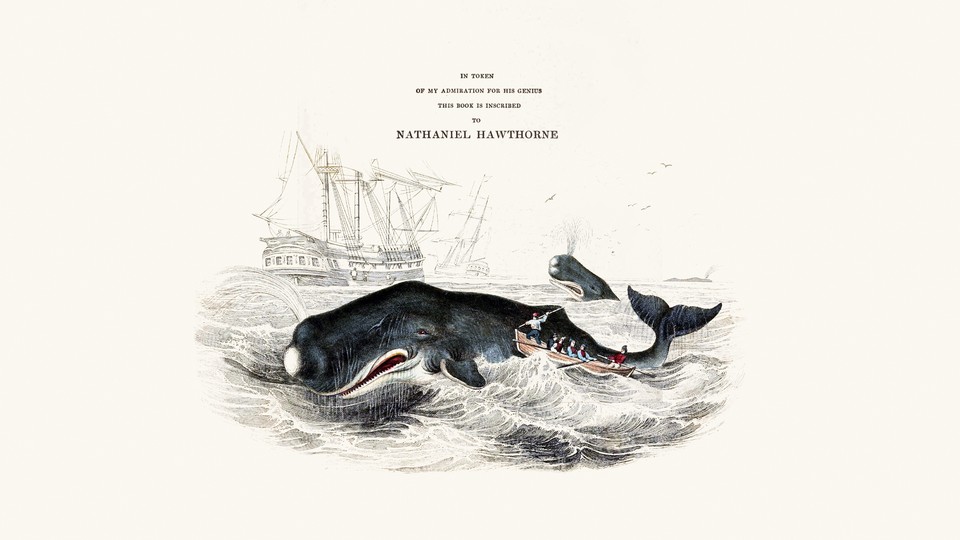
The Hawthornes left Lenox, and the friendship, eager and deep-felt, on Melville’s side and on Hawthorne’s sedate, and perhaps embarrassed, came to an end. Melville dedicated Moby Dick to him. The letter he wrote after reading the book no longer exists, but. from Melville’s reply it looks as though he guessed that Hawthorne did not like it. Nor did the public, nor did the critics; and Pierre, with which he followed it, fared even worse. It was received with contemptuous abuse.
He made very little money from his writings, and besides his wife he had by now two sons and two daughters, and presumably three sisters, to support. Melville, judging from his letters, found farming his own land as little to his taste as when he had been occupied cutting his uncle’s hay at Pittsfield or digging potatoes in Eimeo. The fact is he had never cared for manual labor: “See my hand! — four blisters on this palm, made by hoes and hammers within the last few days. It is a rainy morning, so I am indoors, and all work suspended. I feel cheerfully disposed. . . .” A farmer with hands as soft as that is unlikely to have found his farm a source of profit.
His father-in-law, the Chief Justice, seems periodically to have come to the financial assistance of the family, and as he was a sensible man, besides being evidently a very kind one, it may be supposed that it was he who suggested to Melville that he should look for some other way of earning his living. Various strings were pulled to obtain a consulship for him, but without success, and he was obliged to go on writing. His health failed, and the Chief Justice once more came to the rescue: in 1856 Melville went abroad again, this time to Constantinople, Palestine, Greece, and Italy. When he came back he managed to earn a little money by lecturing.
In 1860 he made his last journey: his brother Tom commanded a clipper in the China trade, the Meteor, and in this Melville sailed to San Francisco. One would have expected him to have still enough of the spirit of adventure to seize the opportunity to go to the Far East, but for some unknown reason, either because he was bored with his brother or his brother had grown impatient of him, he left, the ship at San Francisco and went home. The Chief Justice died. For some years after this the Melvilles lived in great poverty, and in 1863 they decided to leave Arrowhead. They bought a house in New York from Allan, Herman’s prosperous brother, and in part payment turned Arrowhead over to him. The remainder of the purchase money was raised on mortgage. In this house, 104 East Twenty-sixth Street, Melville lived for the rest of his life. At this time, according to Raymond Weaver, it was a good year for him if he earned a hundred dollars in royalties on his books.
In 1866 he was appointed Inspector of Customs, and the circumstances of the family grew brighter. In the following year Malcolm, his eldest son, shot himself in his room, but whether by design or accident is not clear; his second son, Stanwick, ran away from home, and of him nothing more is heard. Melville held his position for twenty years; then his wife inherited money from her brother Samuel, and he resigned. In 1878 he published in two volumes at the expense of his Uncle Gansevoort a poem of twenty thousand lines called Clarel. Shortly before his death he wrote a novelette called Billy Budd. He died, forgotten, in 1891. He was seventy two.
Such in brief is the story of Melville’s life as it is told by his biographers, but it is evident that there is much that they have not told. They pass over Malcolm’s death and Stanwick’s flight from home as though they were matters of no consequence. Surely letters must have passed between Mrs. Melville and her brothers when the boy, he was only eighteen, shot himself; one can only suppose that they have been suppressed; it is true that by 1867 Melville s fame had dwindled, but one would expect that such an event would have reminded the press of his existence and some mention would have been made of it in the newspapers.
The records show that in his old age Melville was fond of his grandchildren, but his feeling for his own children is ambiguous. Lewis Mumford, whose biography of Melville is sensible, and to all appearance trustworthy, gives a somewhat grim picture of his relations with them. He seems to have been a harsh, impatient father and to have teased his children unkindly: “One of his daughters could not recur to the image of her father without a certain painful revulsion. . . . When he purchased a work of art, a print or a statue for ten dollars, when there was scarcely bread to go round who can wonder at their black memories?” He had, it appears, a jocularity which was little to their taste, and if you read between the lines, you can hardly escape the suspicion that he sometimes came home the worse for liquor. For this, I hasten to add, there is no direct evidence. But there is little evidence for anything to confirm any view one may take of his character; and one does no more than surmise when one decides that he was selfish, work-shy, and shiftless. Already at Pittsfield, according to a certain Titus Munson Goan, the neighbors looked upon him as no better than a bum.
3
WHAT occasioned the change from the man who wrote Typee and Omoo to the man who wrote Moby Dick and Pierre and who, when barely more than thirty, was written out? I have found Omoo more readable than Typee. It is a straightforward narrative of Melville’s experiences on the island of Eimeo, and on the whole may be accepted as true; Typee, on the other hand, seems to be a hotchpotch of fact and fancy. But Melville should not. be blamed for this; we know that he repeatedly gave an account of his adventures to willing listeners, and everyone knows how hard it is to resist the temptation of making a story a little better and a little more exciting each time you tell it. It would have been embarrassing for him when he came to write it to state the sober and not peculiarly thrilling facts, when in numberless talks he had freely embroidered upon them.
Typee, in fact, appears to be a compilation of matter which Melville found in contemporary travel books combined with a highly colored version of his own experiences. Charles Roberts Anderson has shown that he not only on occasion repeated the errors these travel books contained, but in various instances used the very words of their authors. I think this accounts for a certain heaviness the reader may find in it. But both Typee and Omoo are well enough written in the idiom of the period. Melville was already inclined to use the literary word rather than the plain one: so, for example, he prefers to call a building an edifice; one hut isn’t, near another or even in its neighborhood, but in the vicinity; he is more apt to be fatigued than like most people, tired; and he prefers to evince rather than to show feeling.
But the portrait of the author of both these books emerges clearly and you need make no imaginative effort to see that he was a hardy, brave, and determined young man, high-spirited and fond of fun, work-shy, but not lazy; gay, amiable, friendly, and carefree. He was charmed with the prettiness of the Polynesian girls, as any young fellow of his age would be, and it would be strange if he did not accept the favors they were certainly willing to grant him.
If there was anything unusual in him it was that he took a keen delight in beauty, something to which youth is apt to be indifferent, and there is some intensity in his admiring description of the sea and the sky and the green mountains. Perhaps the only indication there is that there was more in him than in any other sailorman of three and twenty is that he was of a pondering turn and conscious of it. “I am of a meditative humour,” he wrote much later, “and at sea used often to mount aloft at night, and, seating myself in one of the upper yards, tuck my jacket about me and give loose to reflection.”
How is one to account for the transformation of this apparently normal young man into the savage pessimist who wrote Pierre? What turned the commonplace, undistinguished writer of Typee into the darkly imaginative, powerful, inspired, and eloquent author of Moby Dick? Well, in these days of sex-consciousness it is natural to look for some sexual cause to explain so strange a circumstance.
Typee and Omoo were written before Melville married Elizabeth Shaw. During the first year of their union he wrote Mardi. It begins as a straightforward continuation of his adventures before the mast, but then it becomes wildly fanciful. It is long-winded and to my mind tedious. I cannot put its theme better than has been done by Raymond Weaver: “Mardi is a quest after some total and undivided possession of that holy and mysterious joy that touched Melville during the period of his courtship: a joy he had felt in the crucifixion of his love for his mother; a joy that had dazzled him in his love for Elizabeth Shaw. . . . And Mardi is a pilgrimage for a lost glamour. . . . It is a quest after Yillah, a maiden from Oroolia, the Island of Delight. A voyage is made through the civilised world for her: and though they (the persons of the novel) find occasion for much discourse on international politics, and an array of other topics, Yillah is not found.”
If one wants to indulge in fancy one may take this strange story as the first sign of his disappointment with the married state. One has to guess what Elizabeth Shaw, Mrs. Melville, was like from the few letters of hers that remain. She was not a good letter-writer, and it may be that there was more in her than they reveal; but they show at least that she was in love with her husband and that she was a sensible, kindly, practical, though perhaps narrow and conventional, woman. She bore poverty without complaint. She was doubtless puzzled by her husband’s development and perhaps regretful that he seemed bent on throwing away the reputation and popularity Typee and Omoo had won him, but she continued to believe in him and to admire him to the end. She was not a woman of intellect, but she was a good, tolerant, and affectionate wife.
Did he love her? No letters that he may have written during his courtship remain. He married her. But men don’t only marry for love. It may be that he had had enough of a wandering life and wanted to settle down: one of the strange things about this strange man is that though, as he says himself, of “a naturally roving disposition,” after his first journey as a boy to Liverpool and his three years in the South Seas his thirst for adventure was quenched. Such journeys as he took later were mere tourist trips.
It may be that Melville married because his family and friends thought it was high time he did, or it may be that he married in order to combat inclinations that dismayed him. Who can tell? Lewis Mumford says that “he was never quite happy in Elizabeth’s company, nor was he quite happy away from it,” and suggests that he felt not merely affection for her, but “on these long absences, passion would gather within him,” only to be followed by quick satiety. He would not have been the first man to find that he loves his wife more when he is parted from her than when he is with her, and that the expectation of sexual intercourse is more exciting than the realization. I think it: is probable that Melville was impatient with the marriage tie; it may be that his wife gave him less than he had hoped, but he continued to have marital relations long enough for her to bear him four children. He remained, so far as anyone knows, faithful to her.
4
MELVILLE had an eye for masculine beauty. I have already described the impression made on him by Toby, the boy in whose company he deserted the Acushnet, and in Typee he remarks more than once on the physical perfection of the young men with whom he consorted. It will be remembered that at the age of seventeen he sailed in a ship bound for Liverpool. There he made friends with a boy whom he calls Harry Bolton. This is how he describes him in Redburn: “He was one of those small, but perfectly formed beings with curling hair, and silken muscles, who seem to have been born in cocoons. His complexion was a mantling brunette, feminine as a girl’s; his feet were small, his hands very white; and his eyes were large, black and womanly; and, poetry aside, his voice was as the sound of a harp.”
Doubt has been thrown on the hurried jaunt the two boys made to London, which certainly reads very unconvincingly, and even on the existence of such a person as Harry Bolton; but if Melville invented him to add an interesting episode to his book, it is odd that so manly a fellow as he should have invented a character who was so obviously homosexual.
In the frigate United States, Melville’s great friend was an English sailor, Jack Chase, “tall and well-knit, with a clear open eye, a fine broad brow, and an abounding nut-brown beard.” “There was such an abounding air of good sense and good feeling about the man,” he wrote in White-Jacket, “that he who could not love him, would thereby pronounce himself a knave”; and further: “Wherever you may be now rolling over the blue billows, dear Jack, take my best love with you, and God bless you, wherever you go.” A touch of tenderness which is rare in Melville! So deep an impression did this sailor make on Melville that he dedicated to him the novelette Billy Budd, which he wrote nearly fifty years later and only finished three months before his death. The story hangs on the hero’s amazing beauty. It is this that causes everyone in the ship to love him and it is this that indirectly brings about his tragic end.
I have dwelt on this trait in Melville’s character because it is just possible that it may account for his dissatisfaction with married life, and it may be that a sexual frustration occasioned the change in him which has puzzled all who have interested themselves in him. I think the probabilities are that he was a very moral man, but who can tell what instincts, perhaps even unrecognized, and if recognized angrily repressed and never, except perhaps in imagination indulged in — who can tell, I say, what instincts may dwell in a man’s being which, though never yielded to, may vet have an overwhelming effect on his disposition?
It has been suggested that the peculiar transformation in Melville’s character which turned the author of Types into the author of Moby Dick was occasioned by an attack of insanity. But that he was ever out of his mind has been as hotly denied by his admirers as if it were something disgraceful; it is of course no more disgraceful than to have an attack of jaundice. In any case, if there is any evidence of it, it has not, so far as I know, been produced.
It has been suggested also that Melville was so profoundly affected as to become a different man by the intensive reading he undertook when he moved from Lansingburg to New York; the notion that he was crazed by Sir Thomas Browne as Don Quixote was crazed by romances of chivalry carries no conviction. It is too naive. It may be that the mystery will be cleared up if ever research uncovers further documents, but at present it must remain unexplained. In some unknown way the commonplace writer became a writer of something very like genius.
Melville’s reading, though desultory, had always been wide. It is plain that he was chiefly attracted by the poets and prose writers of the seventeenth century, and one must presume that he found in them something that peculiarly accorded with his own confused proclivities. Whether their influence was harmful to him or beneficial is a matter of personal opinion. His early education was slight and, as often happens in such cases, he did not quite assimilate the culture he acquired in later years. Culture is not something you put on like a readymade suit of clothes, but a nourishment you absorb to build up your personality just as food builds up the body of the growing boy. It is not an ornament used to decorate a phrase, still less to show off your knowledge, but a means, painfully acquired, to enrich the soul.
Robert Louis Stevenson claimed that Melville had no ear: I should have said on the contrary that his ear was very sensitive. Though he spelled erratically and his grammar was sometimes faulty, he had a wonderful sense of rhythm, and the balance of his sentences, however long, is excellent.
He liked the high-sounding phrase, and the stately vocabulary he employed enabled him frequently to get effects of great beauty. Sometimes this inclination led him to tautology, as when he speaks of the “umbrageous shade,” which only means the shady shade; but one can scarcely deny that the sound is fine. Sometimes one is pulled up by such a tautology as “hasty precipitancy,” only to discover with some awe that Milton wrote: “I hither they hasted with glad precipitance.”
Sometimes Melville uses common words in an unexpected way and often obtains by this means a pleasant novelty of effect ; and even when it seems to you that he has used them in a meaning they cannot bear, it is rash to blame him “with hasty precipitancy,” for he may well have authority to go on. When he speaks of “redundant hair,” it may occur to you that hair may be redundant on a maiden’s lip, but hardly on a young man’s head; but if you look it up in the dictionary you will find that the second sense of redundant is copious, and Milton (Milton again!) wrote of “redundant locks.”
I sympathize less with Melville’s liking for archaic words and words only in poetic usage; o’er for over, nigh for near, ere for before, anon and eftsoons give a fusty, meretricious air to prose that is solid and virile. I think there is greater excuse for his partiality for the second person singular. It is an awkward mode of speech and presumably for that reason has fallen into disuse, but I can well believe that Melville employed it to achieve the deliberate purpose he had in view. He may have felt that it gave something of a hieratic turn to the conversations he reported and a poetic flavor to the words used.
But these are trifles. Whatever reservations one may make, Melville wrote English uncommonly well. His style reached its perfection in Moby Dick. Sometimes, of course, the manner he had acquired led him to rhetorical extravagance, but at its best il has a copious magnificence, a sonority, a grandeur, an eloquence that no modern writer, so far as I know, has achieved. It does indeed often recall the majestic phrase of Sir Thomas Browne and the stately period of Milton. I cannot leave this side of my subject without calling the reader’s attention to the ingenuity with which Melville wove into the elaborate pattern of his prose the ordinary nautical terms used by sailormen in the course of their daily work. The effect is to bring a note of realism, the savor of the fresh salt of the sea, to the somber symphony which is the unique novel of Moby Dick.
5
SINCE some very intelligent persons have taken Moby Dick for an allegory it is proper that I should deal with the matter. They have regarded as ironical Melville’s own remark; he feared, he wrote, that his work might be looked upon “as a monstrous fable, or still worse and more detestable, a hideous and intolerable allegory.” Is it rash to assume that when a practiced writer says a thing he is more likely to mean what he says than what his commentators think he means? It is true that in a letter to Mrs. Hawthorne he remarked that he had, while writing, “some vague idea that the whole book was susceptible of an allegorical construction”; but that is slender evidence that he had the intention of writing an allegory.
May it not be possible that if it is indeed susceptible to such an interpretation, it is something that came about by accident and, as his words to Mrs. Hawthorne suggest, not a little to his surprise? I don’t know how critics write novels, but I have some not ion how novelists write them. They do not lake a general proposition such as Honesty is the Best Policy or All is not Gold that Glitters; and say: Let’s write an allegory about that. A group of characters, generally suggested by persons they have known, excites their imagination, and sometimes simultaneously, sometimes after a time, an incident or a string of incidents experienced, heard, or invented appears out of the blue to enable them to make suitable use of them in the development of the theme that has arisen in their minds by a sort of collaboration between the characters and the incidents.
Melville was not fanciful, or at least when he attempted the fanciful, as in Mardi, he came a cropper. To imagine, and his imagination was powerful, he needed a solid basis of fact. When, as in Pierre, he gave it a free rein without, this basis he wrote absurdly. It is true that he was of a “pondering” turn, and as he grew older he became absorbed in metaphysics, which Raymond Weaver states is “but misery dissolved in thought.” That is a narrow way of putting it: there is no subject to which man can more fitly give his attention, for it deals with the greatest problems that confront his soul: value, God, immortality, and the meaning of life.
Melville’s approach to these questions was not intellectual, but emotional: he thought as he did because he felt as he did; but this does not prevent many of his reflections from being profound. “Le coeur a ses raisons que la raison ne connait ’point.” I should have thought that deliberately to write an allegory required an intellectual detachment of which Melville was incapable.
Fortunately Moby Dick may be read, and read with passionate interest, without a thought of what allegorical significance it may or may not have. I cannot repeat too often that a novel is to be read not for instruction or edification but for intelligent enjoyment, and if you find you cannot get this from it you had far better not read it at all. But it must be admitted that Melville seems to have done his best to hinder his reader’s enjoyment. “What I feel more moved to write,” he said in one of his letters, “that is banned — it will not pay. Yet, altogether write the other way I cannot.” He was of an obstinate temper, and it may be that the neglect of the public, the savage onslaughts of the critics, and the lack of understanding in those nearest to him only confirmed him in his determination to write exactly as he chose.
Montgomery Belgion in a sensible introduction to a recent edition of Moby Dick has suggested that since it is a tale of pursuit and the end of the pursuit must be perpetually delayed, Melville wrote the chapters dealing with the natural history of the whale, its size, skeleton, and what not, to do this. I don’t believe it. If he had any such purpose, during the three years he spent in the Pacific he must surely have witnessed incidents or been told tales that he could have used more fitly to effect it. I should have said that Melville wrote these particular chapters for the simple reason that he could not resist bringing into the work he was writing any piece of information that interested him. For my part I can read all but one, that which deals with the whiteness of the whale, with interest; but it cannot be denied that they are digressions which impede the narrative.
There is one other point which may cause the reader a sensation of disappointment and this is Melville’s way of describing a character at length and then dropping him: you have been fascinated by him, you want to know more about him, and you are left at a loose end. The fact is that Melville hadn’t what the French call Vesprit de suite, and it would be stupid to assert that his novel is well constructed.
If he composed Moby Dick in the way he did, it is because that is how he wanted it. You must take it or leave it. He would not be the first novelist to say: “Well, I might write a more satisfactory book if I did this, that, or the other as you suggest. I daresay you’re perfectly right, but this is how I like it and this is how I’m going to do it, and if other people don’t like it I can’t help it, and what’s more, I don’t care.”
Some critics have accused Melville of lacking invention, but I think without reason. It is true that he invented more convincingly when he had a substratum of experience to sustain him; but then so do most novelists, and when he had this his imagination worked freely and with power. I have little more to say. It is hardly worth while to point out, for it cannot escape the most careless reader’s attention, that when Melville has action to describe he does it magnificently, with great force, and his somewhat formal manner of writing finely enhances the thrilling effect. The early chapters, when the scene is laid in New Bedford, are intensely real and at the same time enchantingly romantic. They beautifully prepare the mind for what is to come after.
But of course it is the sinister and gigantic figure of Captain Ahab that pervades the book and gives it its emotional quality. I can think of no creation of fiction that approaches his stature. You must go to the Greek dramatists for anything like that sense of doom with which everything that you are told about him fills you, and to Shakespeare to find beings of such terrible power. It is because Herman Melville created him that, notwithstanding the reservations one may make, Moby Dick is a great, a very great book.