Plumbing in Portuguese
After teaching in aircraft training schools during the war, PENELOPE CRANE spent a year in Brazil teaching Brazilian Air Force mechanics. She is now a case worker with the Erie County Department of Social Welfare, and lives in Buffalo, New York.
by PENELOPE CRANE
My pensão was on a pleasant street in one of São Paulo’s older residential sections. Little by little the well-to-do Brazilians had moved further out, leaving their homes to humbler people and boardinghouses, till only the very rich on the hill above us remained in their huge houses, each an island in a green block of tended grounds.
The house was nineteenth-century French in style, with big rooms opening through double doors from a central hall, and a stairway leading to more rooms and a bathroom upstairs, all with ceilings fifteen or sixteen feet high and marquetry floors polished till they shone like deep, brown pools. Every day Angelina, the tired, toothless little maid, waxed the floors, padding about in her bare feet; and every day she scrubbed the front marble steps with soap and water and washed down the front court and sidewalk with a hose. Brazilians are not apt to pay so much attention to things North Americans care about more, such as the bathroom.
Sometimes the plumber came to see about the plumbing and to dig up the pipes under the concrete of the back court with a pickaxe. He was a pleasant, friendly man, intensely curious about life in the United States and Hollywood. And after he left, things were always quite different from the way they had been before. Once he fixed it so that upstairs the water ran in but not out, downstairs out but not in, so later he came again and asked more questions as I washed my clothes in the big stone tub in the basement.
The laundry tub had a cold-water tap over it, and a beveled, corrugated side to scrub clothes on. I used the American system of soaping, scrubbing, rinsing, and hanging out to dry, and was frowned on by the landlady, who rightly felt that my clothes were not getting very clean. According to Brazilian custom, clothes should be soaped, laid out with their suds on the stones of the back yard, and doused with water from time to time as the sun starts to dry them. They get very white that way and undoubtedly very clean. Everything gets white — white clothes, blue clothes, pink clothes, or yellow clothes.
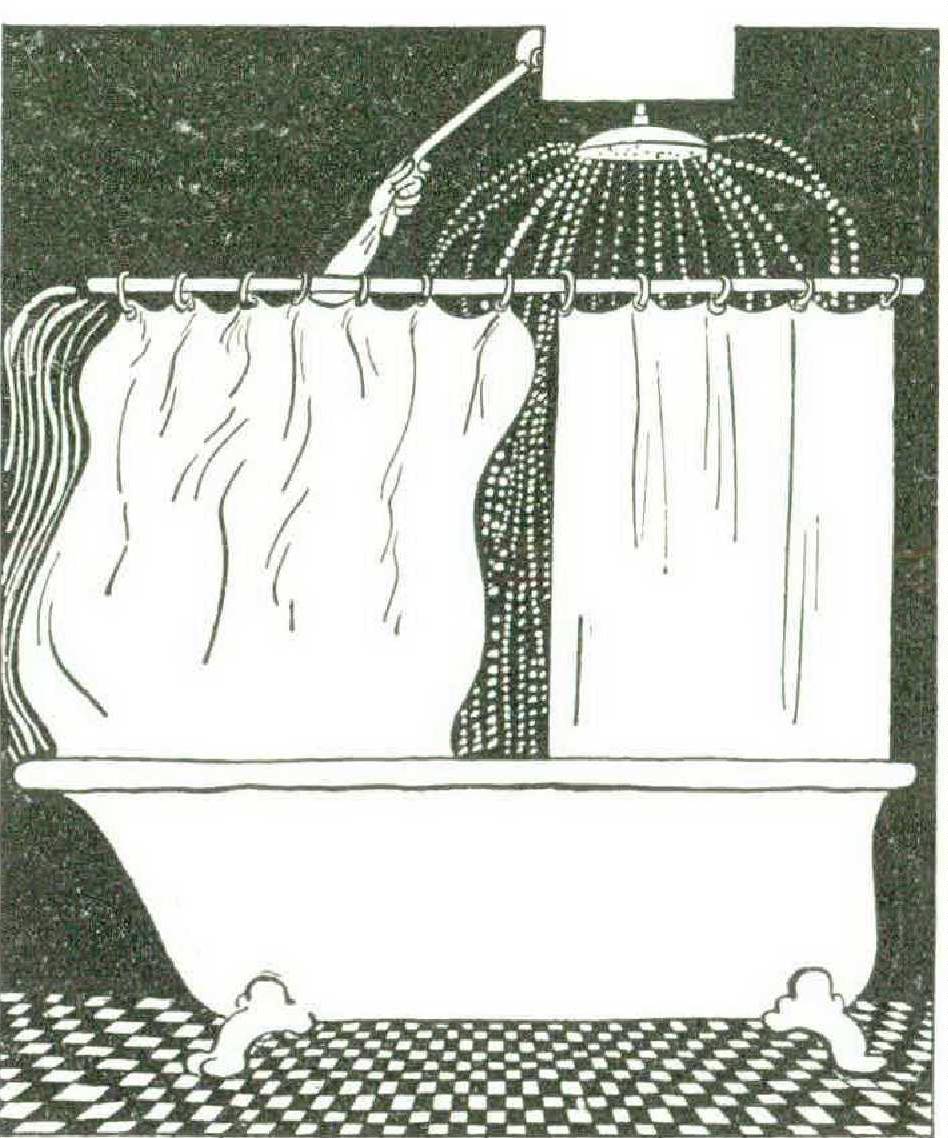
I never saw Angelina clean our bathroom, but it kept spotless, possibly because so many people in the house took showers, flooding the room each time. To my foreign eye the electric shower looked like sure electrocution, but since it was the only source of warm water in the house, there was little to do but brave it, saying to oneself each night, “I shall live through this shower si Dens quiser — God being willing.”
A bath would have been safer, of course, but neither tub nor washbasins had plugs. To take a shower one stood in the tub, avoiding, if possible, a ten-inch length of pipe sticking out from a broken gas heater at one end, and pulled a lever overhead to turn on the water. The movement of the lever threw a switch to turn on an apparatus in the shower-head which heated the water a little or a lot, depending on the amount of water passing through it. If one moved the lever just a little way, a lot of water came down from a box in the attic, quite a bit warmer than the cold water from the tub’s various taps; and moving the lever further suddenly cut off the supply, so that there was just a dribble of scalding drops. My head seemed to me uncomfortably near the sparks and flickering up above; but I never heard of anyone’s dying in a Brazilian tub. It was less alarming to take a shower in the afternoon rather than at night, for one couldn’t see the flashes so well by daylight, and at night the bathroom light kept going off. No one ever fixed the light but it didn’t really matter since a person got just as clean in the dark. And it could almost always be made to work again for a little while by standing on a stool and swatting at it with a towel.