This Month
Contributor Alan Devoe is out to simplify the language. He got rid of the negative prefix with “The Speakable Cad” (December Atlantic). Now he is chopping away at duality with “Hither and Fro” (page 88). It’s a worthy cause.
But while Mr. Devoe is simplifying, the entire fraternity of sociologists is complicating. One has only to read a few of their books and pamphlets to realize that the English language, as we have known it, is giving way to intricate gabble all along the line. It fills me, as Durkheim put it, with anomie.
Anomie is a sociologist’s word, not in the dictionaries. It is one of those fiat words which spring, in full working order, from the forehead of a sociologist.
Sociology is a science. Every science must have its own words. Thus far, the sociologist hasn’t quite enough science under his belt to match terminology with a mathematician or with an M.D. Any psychiatrist can lord it over him. In the presence of a physicist he feels positively wordless and unarmed. A late starter in the Comte Handicap, he needs a vocabulary in a hurry. Thus we find Fuddleton, sociologist, scheming his new word.
On Wednesday afternoon, there is no such word, anywhere. On Thursday morning, Fuddleton is chattering it to his seminars. By the end of the week he has tucked it into “An Inquiry into Some of the Causes of Egestricism among European Positivists,” and it’s on the way to its first printer. (There is no such word as egestricism — yet.)
For a time, nothing happens. No one goes up to Fuddleton and says, “Just what is this new word you’ve been throwing about, and what does it mean?” The only people who have encountered the word are students and teachers, and none of these could afford the loss of face implicit in the question. Not to know the cabalistic jargon of the specialty is disgraceful in educational circles. The innovator, with a few unintelligible, private words on which to trade, can intimidate even his fellow lodge members.
If the new word seems to catch on, if it evokes knowing nods from those who never heard it before, the sociologist will try formally to market it. Like a new gargle or washing powder, the word has to be promoted, so the sociologist begins by plugging it. He reiterates it in the journals, at conventions and summer encampments of the lodge, meanwhile confiding to a few trusted juniors the meaning of the term. Sworn not to divulge it, the younger men get behind the word. The phrase, “egestricism, as Fuddleton puts it,” creeps into the lodge literature. At this stage, it could just as well be asterisked and marked “patent pending”; notice is being served that from here on, egestricism is Fuddleton’s Word.
The news gets around that Fuddleton has thrown down the gauntlet, and the rest of the lodge settles back to watch his campaign. Fuddleton was a useful party whip in earlier days. He was floor leader for Himmelfarber at the convention in ‘38, when eldoralgia was accepted as a definition of a tendency on the part of middle-aged people to look back somewhat wistfully on the days of the Gold Standard. His grandfather, traveling on the Continent, helped Durkheim himself launch anomie: roughly, a sense of insecurity arising from institutional instability. It was Fuddleton who gave further ton to anomie by accenting equally its three syllables, to the embarrassment of the Middle Westerners who had innocently been accenting the second syllable. Some looked for a grudge fight against egestricism on this account, but Fuddleton’s field organization and a masterly direct mail approach made him an easy winner. At the next meeting of the Grand Lodge, it was Fuddleton who was invited to read his paper defining egestricism as, roughly, a state of unwarranted preoccupation, bordering on fear, with the Eastern part of a land mass and an ostrichlike tendency to ignore its Western potential. “Patents Pending” was replaced by “Reg. U.S. Trademark,” and all that night there was jollity up and down the corridors of Fuddleton’s hotel.
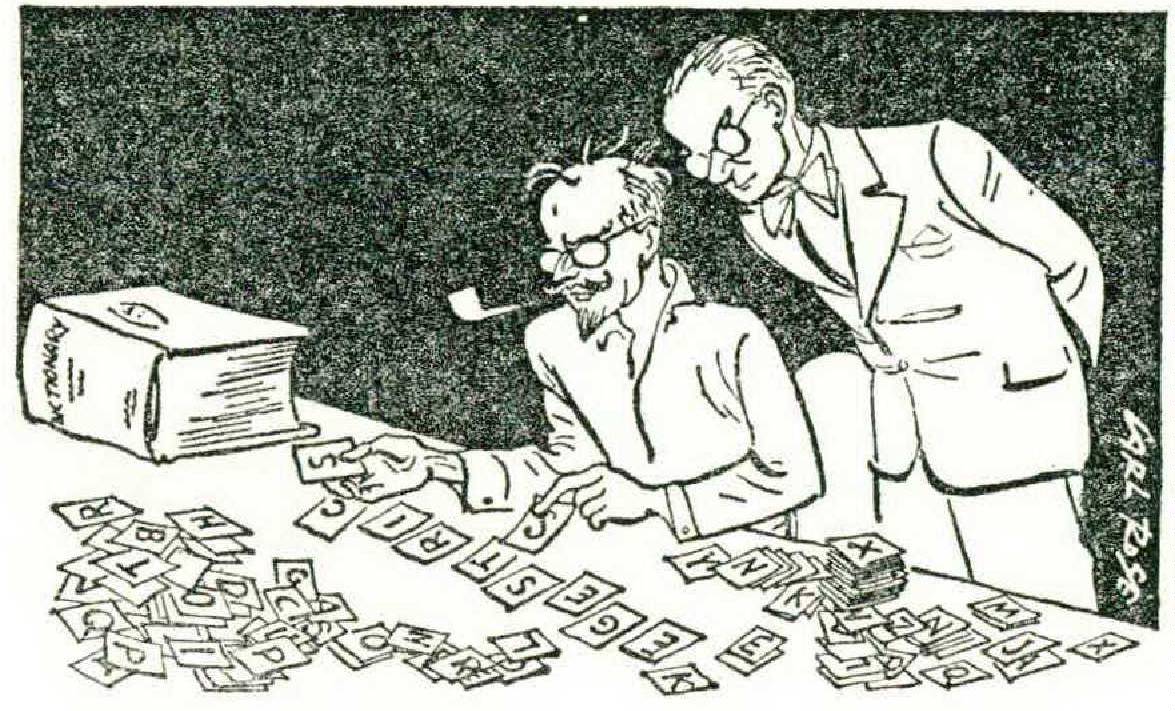
Time was when Fuddleton’s coup with egestricism would have sufficed for the rest of his career. Promotions would have followed and Fuddlelon would have picked up various editorships, lecture invitations, and advisory board berths, perhaps a few honorary degrees. He could, eventually, have wound up as a regional Grand Old Man, content with his word and asking only to be allowed every so often to recount the stirring tale of its invention.
But the days when a one-word man like Fuddleton could look forward thereby to the good things of life are gone. In the fast tempo of modern sociology, three, four, a half-dozen words are expected before a man can look for his first Sc.D. (Hon.) even from one of the smaller schools.
A still more grueling pace is set by a radical element which, instead of thinking up new words, is taking old words and investing them with peculiar new meanings. The professional is no better off than the layman when he first picks up a booklength job of this kind. If he reads the sentence, “A sign is a useful thing,” he has no way of telling which word hides the stinger. Ought he to hunt the big meaning in sign, or is that tricky little word thing the key to it? What about useful? Is there an outside chance that the sentence really means what it seems to say? Any right-thinking sociologist knows that it does not. He must tour the glossary, swearing under his breath, to see what new deviltry is afoot.
Here is a verbatim definition from the glossary of a recent book by a University of Chicago sharp: “Ambiguous sign. . . . A sign-vehicle that is nor unambiguous.”
On reading that one, Fuddleton is understood to have resigned and left town. He is now living quietly in Petaluma, California, as a chicken raiser and orchardist.
C. W. M.