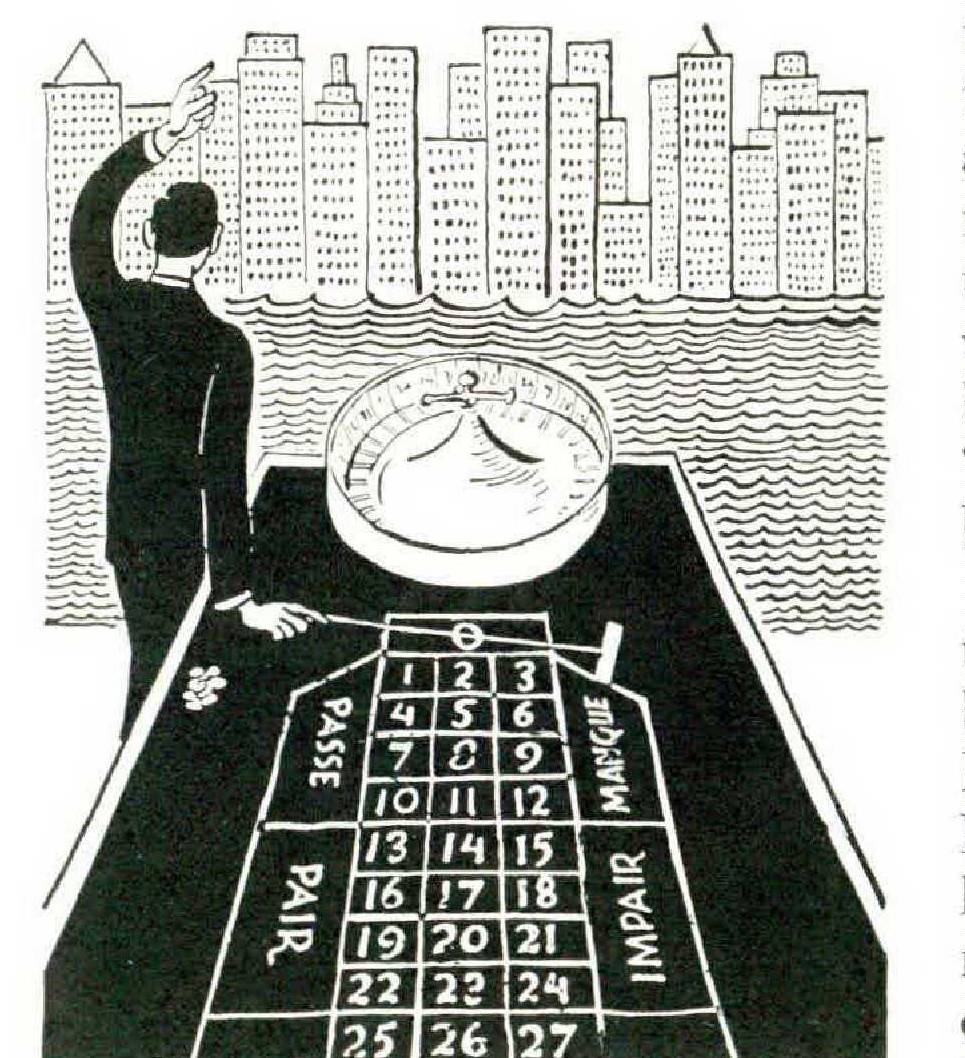
Monaco
This is one of several travel articles which JOSEPH WECHSBERG has provided for Atlantic readers from a recent leisurely tour of Europe.
TRAEL
by JOSEPH WECHSBERG
ACCORDING to the three most widely circulated opinions about Monaco, the miniature principality on the azure coast of the Mediterranean nine miles east of Nice, its inhabitants pay no taxes, all are croupiers or carabiniers, and the governmental expenses arc balanced by revenue from the Monte Carlo Casino. None of these notions is correct. It is true that the Monégasques, as the citizens of Monaco are called, pay no income tax, but they shell out their dues by way of sales taxes on matches, cigarettes, tobacco, and fees for the privilege of owning a radio. Of the 24,000 inhabitants of Monaco, only 600 were croupiers in the best years between the two wars. Today their number is hardly 300, and there are just a few dozen local police. The days are gone when the Casino’s prolils paid for the principality’s entire budget. In 1947 the Casino was 136 million francs in the red, owing to rising costs and dwindling receipts.
But there are cheerful facts about Monaco’s yearly budget, which is now about 300 million francs. About 20 million comes from the Casino and twice as much from postage stamp revenue. Whenever the Minister for Finances and Economics discovers a slight deficit in the principality’s treasury, a new set of postage stamps is brought out and snapped up prestissimo by philatelists the world over. Some of Monaco’s new stamp editions hardly ever appear on letters but go straight to stamp dealers. Which proves that the Monégasques, after almost a hundred years’ experience with gamblers, know a sucker when t hey see one. Should the stamp business once gel into trouble as did the tourist and roulette business in the past decade, the Monégasques will come up with something new, you may be sure.
Monaco’s measly 370 acres are divided into Old Monaco, capital of the state, the terraced Condamine between the water front and Mont Agel, and Monte Carlo. It takes only fifteen minutes by car to cross the country, but four generations to become its citizen. In defense of this snobbish attitude it should be said, however, that four generations mean little in the history of Monaco, which goes back some three thousand years. The Phoenicians were here and the Greeks, and five hundred years before the first Christians were thrown to the lions, fashionable Roman ladies liked to be seen around the Herculis Monoeci Portus, as the Rock of Monaco was called, “Monoikos” being the Greek surname of mythology’s Strong Man number one, who gave the principality its name.
Today Monaco is the last absolute monarchy in Europe. Prince Louis II, the country’s ailing 78-year-old sovereign, whose family has occupied the throne of Monaco since the tenth century, combines all executive and legislative power, decrees laws and ordonriartcet?, and, if he pleases, can abolish the Constitution of 1911 with a stroke of his pen without so much as committing an unconstitutional act, because the Constitution was given to Monaco as a sort of favor by his father, Prince Albert 1.
There are three government bodies: ihe Crown Council, the Government Council, and the National Council. The last, a kind of local parliament, consists of twenty-one members elected for a period of four years by all Monegasque males of pure blood. (There are only some 2000 full-fledged citizens in the country, 8 per cent of the total population; ihe rest are Frenchmen, Italians, Corsicans, British, and others, who get along together splendidly.) The parliament is limited to giving its vote of approval to the benevolent decisions of His Most Serene Highness. The Crown Council is a group of advisers to the Prince; the Government Council consists of his three ministers (for Interior, Finances and Economics, Public Works and Various Affairs), under the Prime Minister, M. de Witasse. Anything they may do is subject to the Prince’s veto — a power that makes Gromyko a mere amateur. Incidentally, Monaco is not a member of the Fnited Nations, because, as a high official put it, “there would be too many jokes if we asked for admission.” But Monaco takes part in UNESCO work and other internal ional conferences. In its external affairs it is represented by France.
There are diplomatic representatives of the principality in Paris, Brussels, Rome, and at the Vatican. But the country’s most important civil servants are the people in charge of tourisme, which is the main source of revenue. (Monaco’s two factories produce beer and chocolate and can hardly be counted upon to pay for the upkeep of schools, hospitals, police, parks, palm trees, tennis courts, and golf courses.) Right now the tourist people are up against a tough situation. Ever since the ingenious M. Francois Blanc set up the Monte Carlo Casino in 1861, Monaco has been a favorite playground for authentic princes and dispossessed dukes, American oilmen and British aristocrats, gigolos and demimondaines, and, above all, for that ever patient, always suffering, and never rebelling species of our time, the tourist-at-large. Over one and a half million of them used to come here every year, delighted to lose their money, paying their tax de séjour, and enjoying every minute of their visit. Five dozen hotels, ranging from the palatial Hotel tie Paris and the Hermitage to modest boardinghouses, would cater to their variegated tastes. The Casino is still open from 10 A.M. to 2 A.M., its roulette, trente et guarante, and baccarat tables always waiting for optimists. Those who don’t gamble (and you would be surprised how many there are of them) can spend their money at the International Sporting Club, the Opera, concerts, the Beach, at automobile races, gala nights, flower shows, dog shows, tennis tournaments, and whatnot.
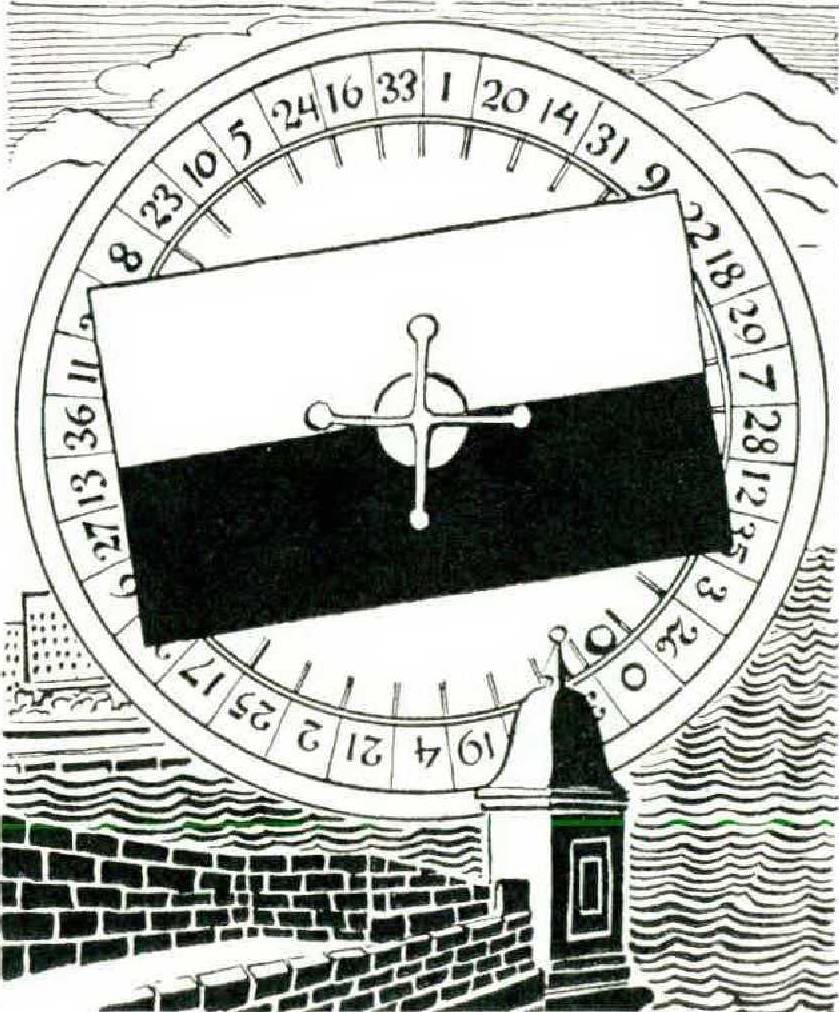
Unfortunately the trend of the times is against Monaco. Frivolity, be it roulette, postage stamps, or flower parades, is slightly frowned upon nowadays. The pleasures of the well-to-do in Europe have become more strenuous. In the winter they go skiing in Switzerland; during the summer they travel all over the Continent. Everybody, it seems, wants to have a last good look at what is left of Europe before it will be atomized into final chaos. “Monaco? Monte Carlo? Only old people go there now.”
I think a lot of not so old people make a mistake in skipping Monaco. If you like genuine charm and nostalgia, Monaco is your best bet. After looking at the physical and human ruins of Europe it is pleasant to find a vacuum where tomorrow’s weather is more important than yesterday’s headlines; where the armed forces of a hundred-odd comic-opera characters wear technicolor uniforms and no one is called up to serve; where the old bronze cannons are lined up once a year for the annual review of the carabiniere; where the Prince had the good sense to change his fortified castle into a palatial home furnished with rare art treasures and fine tapestries; where three local parlies — Socialists, Democrats, and Liberals — campaign against each oilier in small bistros filled with the scents of onion soup and wine rather than an air of depression; where strikes and customs guards are unknown and the Communist Party has tried, unsuccessfully, to raise its membership from 300; where, during the last war, French citizens didn’t have to go into labor service and anti-Jewish decrees were never put in force; where, even in the worst months of the Italian and German occupation, everybody got six packages of cigarettes per week and no one’s property was requisitioned; where no one seems overworried about the atomic bomb because, as the Monégasques say, “We aren’t important enough to be noticed.”
True, the Casino looks a bit the worse for wear, and the gamblers are princes of the black market rather than of noble blood. But the sun hasn’t changed, nor have the deep-blue skies, the mood of the place, the horsedrawn vehicles, and the old RollsRoyces converted into taxicabs. At the Hermitage you can get a majestic suite for 1200 francs a day, and a room for less than half of that.
In the neighboring French commune of Beausolcil, the Bee Rouge, one of the best restaurants on the Continent, specializes in friands, ravioli, veal with champignons, and charlotte russes, which would make the fancy “French” restaurants in New York look poor by comparison. (Lunch for two at the Bee Rouge, with wine, runs to about 2000 francs, and what a lunch it is!) The ballets of Monte Carlo have left for hardcr-currcncy shores, but the opera is still there, with occasional good performances; and there arc concerts and movie houses, English tearooms, French patisseries, native fish restaurants, the Oceanographic Museum, the Museum of Prehistoric Anthropology, the exotic gardens, and the Romanesque cathedral. And there are rows of slot machines in the Renaissance atrium of the Casino, just in case you should get homesick all of a sudden for the pleasures of Las Vegas, Nevada.