Christmas Cookies
VIRGINIA PASLEY is a former Chicagoan and news reporter who now lives in New York. This article was taken from The Christmas Cookie Book by Mrs. Pasley, which has just been published by Atlantic Monthly Press-Little, Brown.

by VIRGINIA PASLEY
CHRISTMAS came to our big oldfashioned kitchen on Chicago’s north side long before the holly wreaths went up in the front windows or the Christmas bell was hung on the door.
Christmas came to our kitchen on the wings of a frosting-painted cookie angel, in the hundreds — no, thousands— of cookies spicy and sweet, crispy and chewy, that were baked and decorated there — cookies to be packed lovingly into baskets or boxes and carried to friends or served in our own house throughout the holiday season.
During the Christmas baking, our kitchen, always the focal point of the household, took on exciting new values with a succession of tantalizing aromas. The essences of honey and cardamom, cinnamon and cloves, molasses and ginger, mingled with the heady ambrosia of rum and apricot brandy, and the fragrance of anise, the dark pungency of black walnuts, the almost cloying sweetness of almonds pounded with powdered sugar and egg white. Finally, as the magic day approached, the kitchen was redolent with the gentler scents of melting butter and carameling sugar, with now and then a whiff of nutmeg or mace or chocolate and vanilla.
Cookies were everywhere — cookies in the batter stage, cookies being rolled out on the big breadboard, cookies being cut out on the table, cookies just fresh from the oven and impossible to resist even if they burned your fingers, cookies cooling on the marble shelves in the pantry, cookies being decorated and frosted, and cookie jars and tins stacked high in all available corners.
There were golden macaroons with curlycues of orange peel, frosty white kisses topped with savory minikins of nuts or cherries, sugar cookies, butter crisps, and sugar-frosted black-walnut squares. There were the old-country cookies, the dainty spongelike Springerle and the dark brown spiciness of Lebkuchen and Pfeffernüsse. And there were the special cookies for the children, the cookies to hang on the Christmas tree, in the shapes of stars and bells, white-winged angels with golden halos and blue gowns, the snowmen with frosted buttons, the elves and Santa Clauses.
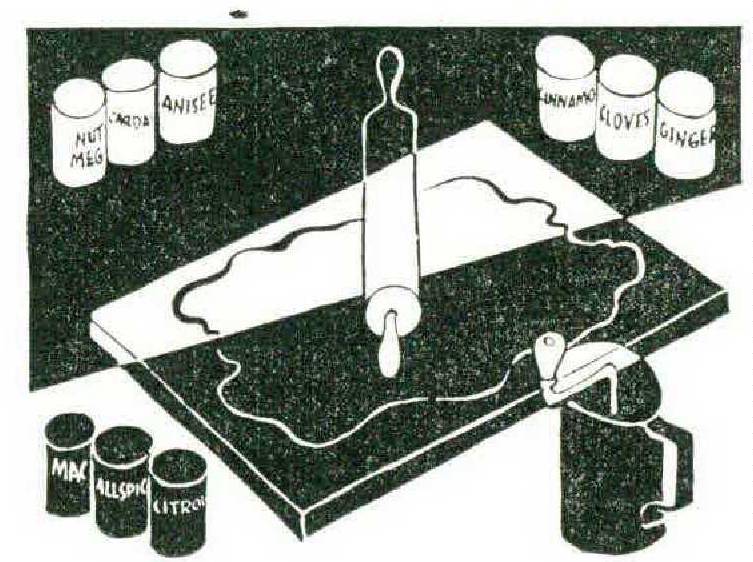
Mother laid in an ample supply of cookie essentials before starting her Christmas baking. The only items she bought on a day-today basis were such perishables as butter, eggs, cream, and so on. The spices and cookie decorations were easy to obtain in all grocery stores.
Today, although ordinary food seasonings can be found in any delicatessen or supermarket, the rarer ingredients of cookie making are sometimes hard to find. Unless you live in a community large enough to support a shop specializing in all varieties of spices, sweet herbs, rare teas, and exotic food oddities from around the world, you will have to ask your druggist, or grocer to order them. However, you might first tour the various neighborhood stores, trying the Scandinavians, for instance, for cardamom, the Czechs or Germans for aniseed, the French or Italians for decorations and candied peels.
Our Christmas baking invariably seemed to start unexpectedly, to happen overnight. One snowy brisk day in November we three girls would race in from school rosy-cheeked and cold-nosed, and go wild with excitement at the sight of the big cookie sheets that had burgeoned during our absence, the Springerle board spread out on the kitchen table, and Mama checking her handwritten recipes.
My mother always saw to it that no one, not even the youngest, was made a drudge in the Christmas cookie making. If you shelled nuts, you were allowed to put them on the tops of the cookies. If you measured the flour out and sifted it with the spices, you could hold the spoon and stir for a minute or two. And you were never too young to be given a scrap or two to cut out a cookie of your very own.
We began our Christmas cookie baking with Lebkuchen. Lebkuchen is one of the very oldest of the Christmas cookies — so old, in fact, that there are literally hundreds of different recipes for it. Even the exact meaning of its name is lost. You could translate the word as “ lively cookies” or “long-lived cookies” or “life-giving cookies,” I suppose. They are lively with spices, and the ones made from honey have a life span (if they get a chance) of from twelve to eighteen months.
Lebkuchen cooks argue endlessly as to which recipe is the best, or the most authentic, or the oldest. Mama’s problem, however, was different but possibly more difficult. She had to try to make Lebkuchen the way Grandma Schmitz — Papa’s mother — used to make it. Grandma cooked by the touch system and made the Christmas Lebkuchen herself as long as she lived. She left no recipe for Mama’s guidance.
Mama tried recipe after recipe in her attempt to find Lebkuchen “like Mother used to make,” and in the meantime perfected her skill with other varieties until she was baking cookies so good everyone was begging for them. That was when Papa suggested she give them to friends on Christmas, and that was how the Schmitz Christmas cookie tradition got underway.
About that same time Mrs. Schmidt next door — no relation to the Schmitz clan — produced a recipe for Lebkuchen that Papa finally approved. Mama took it over and Lebkuchen became the one cookie she insisted on making all by herself, allowing us children only the privilege of slivering the almonds or cutting up the citron.
Mrs. Schmidt’s Lebkuchen is probably closer to the time-honored traditional Lebkuchen than the other recipes which we used. In a European farm home where honey could be produced by the inexpensive processes of nature, and where refined sugar was imported and thus prohibitively high, Lebkuchen was the cheapest of all cookies, calling for no eggs, no butter, and only a minimum of lard. Its principal extravagance was in the chopped citron and orange rind and the almonds.
Lebkuchen is one of those cookies that you either like or you don’t. The honey gives it an elastic texture — those who don’t like it call it rubbery — and it does have a clinging taste that not everyone enjoys.
Lebkuchen, incidentally, is not likely to be a favorite with the children, especially as made from Mrs. Schmidt’s recipe; but it is greatly liked by those persons who, with advancing maturity and the acquiring of sophisticated, if not effete, palates, have lost their taste for the simple sugar cookies. Lebkuchen is a good cookie to serve with after-dinner wines of the heavier type such as port and sweet sherry.
MRS. SCHMIDT’S LEBKUCHEN
4 cups honey (3 pounds)
1 teaspoon soda
3 tablespoons lard
1 cup brown sugar
1/2 teaspoon cloves
1/2 teaspoon ginger
1 teaspoon cinnamon
1/2 teaspoon cardamom (crushed)
2 cups slivered blanched almonds
1 1/2 cups chopped citron, candied orange and lemon peel
9 cups all-purpose flour (about)
Bring the honey to a boil, add the soda, brown sugar, and lard, and stir until dissolved. Allow to cool somewhat before adding flour sifted with spices and chopped nuts and fruits. Add flour by cupfuls to make a very stiff dough. Perhaps not all the 9 cups will be needed, since the consistency will vary, depending on the honey and the flour. Spread the dough in flat buttered tins about, one half inch deep. Bake in a slow oven — between 300° and 325° — about 15 minutes.
The cake may be frosted with an icing made of confectioners’ sugar, lemon juice, and water mixed to the consistency of thin cream and spread on while the cake is hot. Cut the cakes while warm into sticks about five inches long and one inch wide and store tightly in a tin box. These cakes improve with age. They do not get the right texture until they are aged. They may be cut and stored unfrosted, and frosted just before using with the above icing, or with an apricot glaze, or with a heavier icing of confectioners’ sugar and cream. With the latter icing, they are usually decorated with blanched almonds, candied cherries, and angelica.