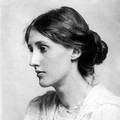
My Father: Leslie Stephen
“To read what one liked because one liked it, never to pretend to admire what one did not — that was his only lesson in the art of reading.”
BY the time that his children were growing up, the great days of my father’s life were over. His feats on the river and on the mountains had been won before they were born. Relics of them were to be found lying about the house — the silver cup on the study mantelpiece; the rusty alpen-stocks that leant against the bookcase in the corner; and to the end of his days he would speak of great climbers and explorers with a peculiar mixture of admiration and envy. But his own years of activity were over, and my father had to content himself with pottering about the Swiss valleys or taking a stroll across the Cornish moors.
That to potter and to stroll meant more on his lips than on other people’s is becoming obvious now that some of his friends have given their own version of those expeditions. He would start off after breakfast alone, or with one companion. Shortly before dinner he would return. If the walk had been successful, he would have out his great map and commemorate a new short cut in red ink. And he was quite capable, it appears, of striding all day across the moors without speaking more than a word or two to his companion. By that time, too, he had written the History of English Thought in the Eighteenth Century, which is said by some to be his masterpiece; and the Science of Ethics —the book which interested him most; and The Playground of Europe, in which is to be found “The Sunset on Mont Blanc” — in his opinion the best thing he ever wrote.
He still wrote daily and methodically, though never for long at a time. In London he wrote in the large room with three long windows at the top of the house. He wrote lying almost recumbent in a low rocking chair which he tipped to and fro as he wrote, like a cradle, and as he wrote he smoked a short clay pipe, and he scattered books round him in a circle. The thud of a book dropped on the floor could be heard in the room beneath. And often as he mounted the stairs to his study with his firm, regular tread he would burst, not into song, for he was entirely unmusical, but into a strange rhythmical chant, for verse of all kinds, both “utter trash,” as he called it, and the most sublime words of Milton and Wordsworth, stuck in his memory, and the act of walking or climbing seemed to inspire him to recite whichever it was that came uppermost or suited his mood.
But it was his dexterity with his fingers that delighted his children before they could potter along the lanes at his heels or read his books. He would twist a sheet of paper beneath a pair of scissors and out would drop an elephant, a stag, or a monkey with trunks, horns, and tails delicately and exactly formed. Or, taking a pencil, he would draw beast after beast — an art that he practised almost unconsciously as he read, so that the fly-leaves of his books swarm with owls and donkeys as if to illustrate the “Oh, you ass!” or “Conceited dunce” that he was wont to scribble impatiently in the margin. Such brief comments, in which one may find the germ of the more temperate statements of his essays, recall some of the characteristics of his talk. He could be very silent, as his friends have testified. But his remarks, made suddenly in a low voice between the puffs of his pipe, were extremely effective. Sometimes with one word — but his one word was accompanied by a gesture of the hand — he would dispose of the tissue of exaggerations which his own sobriety seemed to provoke. “There are 40,000,000 unmarried women in London alone!” Lady Ritchie once informed him. “Oh, Annie, Annie!” my father exclaimed in tones of horrified but affectionate rebuke. But Lady Ritchie, as if she enjoyed being rebuked, would pile it up even higher next time she came.
The stories he told to amuse his children of adventures in the Alps — but accidents only happened, he would explain, if you were so foolish as to disobey your guides — or of those long walks, after one of which, from Cambridge to London on a hot day, “I drank, I am sorry to say, rather more than was good for me.”were told very briefly, but with a curious power to impress the scene. The things that he did not say were always there in the background. So, too, though he seldom told anecdotes, and his memory for facts was bad, when he described a person — and he had known many people, both famous and obscure — he would convey exactly what he thought of him in two or three words. And what he thought might be the opposite of what Other people thought. He had a way of upsetting established reputations and disregarding conventional values that could be disconcerting, and sometimes perhaps wounding, though no one was more respectful of any feeling that seemed to him genuine. But when, suddenly opening his bright blue eyes, and rousing himself from what had seemed complete abstraction, he gave his opinion, it was difficult to disregard it. It was a habit, especially when deafness made him unaware that this opinion could be heard, that had its inconveniences.
“I am the most easily bored of men,” he wrote, truthfully as usual: and when, as was inevitable in a large family, some visitor threatened to stay not merely for tea but also for dinner, my father would express his anguish at first by twisting and untwisting a certain lock of hair. Then he would burst out, half to himself, half to the powers above, but quite audibly, “Why can’t he go? Why can’t he go?” Yet such is the charm of simplicity — and did he not say, also truthfully, that “bores are the salt of the earth"?— that the bores seldom went, or, if they did, forgave him and came again.
Too much, perhaps, has been said of his silence; too much stress has been laid upon his reserve. He loved clear thinking; he hated sentimentality and gush; but this by no means meant that he was cold and unemotional, perpetually critical and condemnatory in daily life. On the contrary, it was his power of feeling strongly and of expressing his feeling with vigour that made him sometimes so alarming as a companion. A lady, for instance, complained of the wet summer that was spoiling her tour in Cornwall. But to my father, though he never called himself a democrat, the rain meant that the corn was being laid; some poor man was being ruined; and the energy with which he expressed his sympathy — not with the lady — left her discomfited. He had something of the same respect for farmers and fishermen that he had for climbers and explorers. So, too, he talked little of patriotism, but during the South African War — and all wars were hateful to him — he lay awake thinking that he heard the guns on the battlefield. Again, neither his reason nor his cold common sense helped to convince him that a child could be late for dinner without having been maimed or killed in an accident. And not all his mathematics together with a bank balance which he insisted must be ample in the extreme could persuade him, when it came to signing a cheque, that the whole family was not “shooting Niagara to ruin,”as he put it. The pictures that he would draw of old age and the bankruptcy court, of ruined men of letters who have to support large families in small houses at Wimbledon (he owned a very small house at Wimbledon), might have convinced those who complain of his understatements that hyperbole was well within his reach had he chosen.
Yet the unreasonable mood was superficial, as the rapidity with which it vanished would prove. The cheque-book was shut; Wimbledon and the workhouse were forgotten. Some thought of a humorous kind made him chuckle. Taking his hat and his stick, calling for his dog and his daughter, he would stride off into Kensington Gardens, where he had walked as a little boy, where his brother Fitzjames and he had made beautiful bows to young Queen Victoria and she had swept them a curtsey, and so, round the Serpentine, to Hyde Park Corner, where he had once saluted the great Duke himself; and so home. He was not then in the least “alarming”; he was very simple, very confiding; and his silence, though one might last unbroken from the Round Pond to the Marble Arch, was curiously full of meaning, as if he were thinking half aloud, about poetry and philosophy and people he had known.
He himself was the most abstemious of men. He smoked a pipe perpetually, but never a cigar. He wore his clothes until they were too shabby to be tolerable; and he held old-fashioned and rather puritanical views as to the vice of luxury and the sin of idleness. The relations between parents and children to-day have a freedom that would have been impossible with my father. He expected a certain standard of behaviour, even of ceremony, in family life. Yet if freedom means the right to think one’s own thoughts and to follow one’s own pursuits, then no one respected and indeed insisted upon freedom more completely than he did. His sons, with the exception of the Army and Navy, should follow whatever professions they chose; his daughters, though he cared little enough for the higher education of women, should have the same liberty. If at one moment he rebuked a daughter sharply for smoking a cigarette — smoking was not in his opinion a nice habit in the other sex—she had only to ask him if she might become a painter, and he assured her that so long as she took her work seriously he would give her all the help he could. He had no special love for painting; but he kept his word. Freedom of that sort was worth thousands of cigarettes.
It was the same with the perhaps more difficult problem of literature. Even to-day there may be parents who would doubt the wisdom of allowing a girl of fifteen the free run of a large and quite unexpurgated library. But my father allowed it. There were certain facts — very briefly, very shyly he referred to them. Yet “Read what you like,” he said, and all his books, “mangy and worthless,” as he called them, but certainly they were many and various, were to be had without asking. To read what one liked because one liked it, never to pretend to admire what one did not — that was his only lesson in the art of reading. To write in the fewest possible words, as clearly as possible, exactly what one meant that — was his only lesson in the art of writing. All the rest must be learnt for oneself. Yet a child must have been childish in the extreme not to feel that such was the teaching of a man of great learning and wide experience, though lie would never impose his own views or parade his own knowledge. For, as his tailor remarked when he saw my father walk past his shop up Bond Street, “There goes a gentleman that wears good clothes without knowing it.”
In those last years, grown solitary and very deaf, he would sometimes call himself a failure as a writer; he had been “jack of all trades, and master of none.” But whether he failed or succeeded as a writer, it is permissible to believe that he left a distinct impression of himself on the minds of his friends. Meredith saw him as “Phoebus Apollo turned fasting friar" in his earlier days; Thomas Hardy, years later, looked at the “spare and desolate figure” of the Schreckhorn and thought of
him,
Who scaled its horn with ventured life and limb.
Drawn on by vague imaginings, maybe,
Of semblance to his personality
In its quaint glooms, keen lights, and rugged trim.
But the praise he would have valued most, for though he was an agnostic nobody believed more profoundly in the worth of human relationships, was Meredith’s tribute after his death: “He was the one man to my knowledge worthy to have married your mother.” And Lowell, when he called him “ L.S., the most lovable of men,” has best described the quality that makes him, after all these years, unforgettable.