The Three-Dime Dollar
EDVIN BATEMAN MORRIS was formerly assodated with the office of the Supervising Architect in the Federal government.
by EDWIN BATEMAN MORRIS
THE low-cost house, as we laughingly call it, is of course controlled by dollar value. The reference is not to the old brownstone-front dollar, but to the modern form-fitting one. You may gloomily think that there is not much left of it except a good portrait and a nice crackle; but it actually does have a firm purchasing power, equal to three— perhaps four — of the potent dimes of yesteryear.
In building our dream houses, we must give consideration to our dream currency, carefully remembering that any resemblance to the former dollar is purely coincidental. We must build houses which, condensed like the dollar, also retain the same subtle glamour that lingers on in the dollar’s pleasant rustle and the value-reminiscent color.
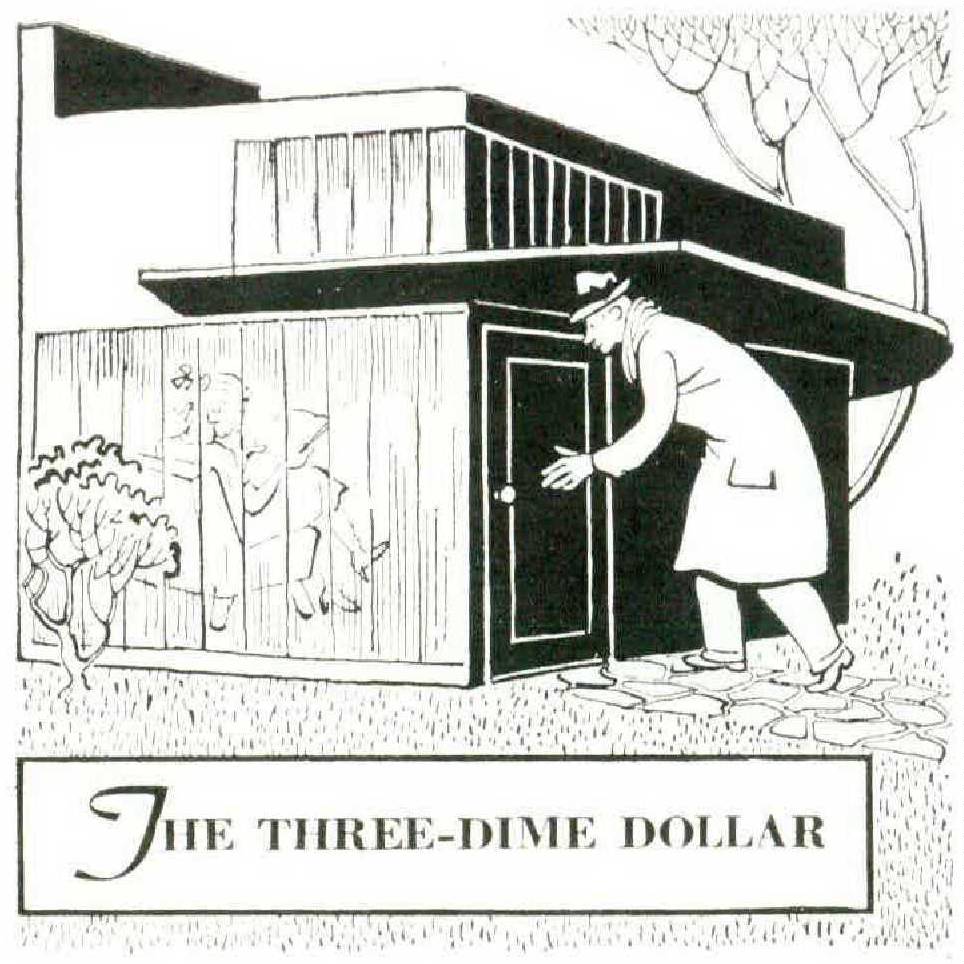
For instance, they used to build columned porticoes — with our more anemic dollar, now too expensive. Resourcefully, we use instead at doorways a few projecting overhead twoby-sixes with one across the end, giving a fetching shadow at small cost. And when it rains we wear a raincoat.
The same smart principle applies to the matter of room size. Dependence is placed on visual appeal. That is, it does not have to be a room, so long as it looks like a room. A ten-bytwelve space which has been tinted with a keen shade of rose-glow or a clever pink will look — approximately’ of course — eleven by thirteen-six. And a so-called budgetheight room can be made to look less low and breathless, in fact almost premeditated, if a gay hand is inspirationally painted near tile ceiling.
Kitchens, by use of the beautician technique, can be made very small. The housewife is lured on by sweet talk of saving of steps; which is convincing, since, in the beautiful condensed tidiness of the room, if she took a step she would be in the refrigerator or outside by the garbage container.
Therefore a charmingly designed picture window is placed in some convenient spot so that she can look out and see that there still is space. When she has done a dozen difficult pushups getting pans and skillets from intricate hiding places at instep level, she can see, though sandwiched in between sanitary tile and metal surroundings, that others in the world move about freely; and new hope is kindled within her.
The kitchen counter, by smart designing, is extended to form a quaint mirage of a dining room, without any striving for false elegance. Backless stools offer uncomfortable perches which encourage diners to hurry — thus giving the housewife more time for relaxation, if she can find a place for it.
The living room will suggest such relaxation even though, because of costs, there will be little space. Its decor (to give illusion of size, if not actual size) will be mostly shelves and closets, the higher levels, useless for anything else, being cleverly reserved for such little-used things as books. At lower levels will be ingenious condensed accommodations for phonograph, radio, television. A panel amusingly lowers to disclose writing desk and telephone, for simultaneous use. Wedged into the frugal space in the middle of the room is an up-todate decorative chair.
A new type of American living is brought into being by these modern close-fitting houses, so round, so firm, so fully packed. But now and then their inhabitants feel the need of going to a night game or a widespaces movie where they can enjoy the feeling of being able to stoop without sticking.
This decompression has providentially been made possible by the rise of baby-sitters. These technicians can be hired to huddle in the decorative chair beside the dim decorative lamp which lights your table, perhaps beautifully made from an old sewing machine or a churn, accepting money in return for confinement. The tenants can thus squeeze out into the open, leaving the sitter in their lovely carefully congested dream house, while they plunge deep into Elbow Room.