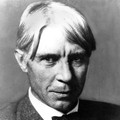
Trying to Write
“All my life‚” says CARL SANDBURG, ”I have been trying to learn to read, to see and hear, and to write. . . . At fifty, there was puzzlement as to whether I was a poet, a biographer, a wandering troubadour with a guitar, a Midwest Hans Christian Andersen, or a historian of current events.”Now, at seventy-two, Mr. Sandburg’s Complete Poems are to be published by Harcourt‚ Brace‚ and as he looked back over the long, dear toil of those poems, he wrote this essay as the preface for his new book.

by CARL SANDBURG
THE inexplicable is all around us. So is the incomprehensible. So is the unintelligible. Interviewing Babe Ruth in 1928 for the Chicago Daily News, I put it to him, “People come and ask what’s your system for hitting home runs — I hat so?” “Yes,” said the Babe, “and all I can tell ‘em is I pick a good one and sock it. I get back to the dugout and they ask me what it was I hit and I tell ‘em I don’t know except it looked good.”
Tyrus Raymond Cobb, who in twenty-four seasons played more games (3033), made more hits (4191), scored more runs (2244), and stole more bases (892) than any other player who ever wore spiked shoes— Ty Cobb at the end of one season got the quest ion from sports writers, “ We′ve watched you close this season and we find you’ve got eleven different ways of sliding to second. At what point between first and second do you decide which of those eleven ways you′ll use? Ty flashed, “I never think about it I just slide!”
All around us the imponderable and the unfathomed— at these targets many a poet has shot his bullets of silver and scored a bull′s-eye, or missed with dull pellels of paper.
Will Rogers, twirling his cowhand rope, insisted. “We are all ignorant but on different subjects. Picasso gives his slant as to his own ignorance related to that of others, “Why should I blame anybody else but myself if I cannot understand what I know nothing about?” And in Chicago we heard William Butler Yeats quote his father, ‟What can be explained is not poetry.”
I have known newspaper stalls where a saying ran, “The way to be a Star Reporter is to break all the rules.” I heard Steinbeck say regarding Of Mice and Men, “I began with an equation and after that the story wrote itself.” Paganini had a formula: toil, solitude, prayer. Steichen after World War I put in a year making a thousand photographs of a white cup and saucer, a quest in light and shadow. Maugham crosses up Forster on how to write a novel and both heave Walter Scott into the ash can. Shakespeare wrote a certain amount of trash — because his theater had to have a new play next Tuesday.
Readers of poetry — and writers of it — can harken to Thomas Babington Macaulay in 1825: “Perhaps no person can be a poet, or even can enjoy poetry, without a certain unsoundness of mind.” Does he say that if you are perfectly sane, a respectable citizen with a well-ordered mind, you shouldn’t try writing poetry or reading it? And if you are a little “off the beam” mentally you will get along better in the poetry world? Some would decide it is well he used the word “perhaps,” which leaves it open to debate along with the American proverb, “Every family tree has its nut.”
There are poets of the cloister and the quiet corner, of green fields and the earth serene in its changes. There are poets of streets and struggles, of dust and combat, of violence wanton or justified, of plain folk living close to a hard earth as in the great though neglected poem Piers Plowman. There have been poets whose themes wove through both of the foregoing approaches. John M. Synge presented a viewpoint in this era ever worth care and thought: “When men lose their poetic feeling for ordinary life, and cannot write poetry of ordinary things, their exalted poetry is likely to lose its strength of exaltation, in the way men cease to build beautiful churches when they have lost happiness in building shops. Many of the older poets, such as Villon and Herrick and Burns, used the whole of their personal life as their material, and the verse written in this way was read by strong men, and thieves, and deacons, not by little cliques only.”
Poetry and politics, the relation of the poets to society, to democracy, to monarchy, to dictatorships— we have here a theme whose classic is yet to be written. Some of its implications I tried for in my dedication of a book to the poet Stephen Vincent lionet: —
He knew the distinction between pure art and propaganda in the written or spoken word. He could sing to give men music, consolation, pleasure. He could intone chant or prayer pointing the need for men to act. He illustrated the code and creed of those writers who seek to widen the areas of freedom for all men, knowing that men of ideas vanish first when freedom vanishes. He saw that a writer′s silence on living issues can in itself constitute a propaganda of conduct leading toward the deterioration or death of freedom. He wrote often hoping that men would act because of his words. He could have been Olympian, whimsical, seeking to be timeless amid bells of doom not to be put off.
Oliver Wendell Holmes, skilled rhymester, told a young poet: “When you write in prose you sav what you mean. When you write in verse you say what you must.” Having said this to the young man, Holmes bethought himself and then wrote, “I was thinking more especially of rhymed verse. Rhythm alone is a tether, and not a very long one. But rhymes are iron fetters; it is dragging a chain and ball to march under their incumbrance; it is a clog-dance you are figuring in when you execute your metrical pas seul. . . . You want to say something about the heavenly bodies, and you have a beautiful line ending with the word stars. . . . You cannot make any use of cars, I will suppose; you have no occasion to talk about scars; ‘the red planet Mars’ has been used already; Dibdin has said enough about the gallant tars; what is there left for you but bars? So you give up your trains of thought, capitulate to necessity, and manage to lug in some kind ol allusion, in place or out of place, which will allow you to make use of bars. Can there be imagined a more certain process for breaking up all continuity of thought, than this miserable subjugation of intellect to the clink of well or ill matched syllables?”
The fact is ironic. A proficient and sometimes exquisite performer in rhymed verse goes out of his way to regisier the point that the more rhyme there is in poetry the more danger of its tricking the writer into something other than the urge in t he beginning.
A well-done world history of poetry would tell us of the beginnings and the continuing tradition of blank verse, rhymed verse, ballads, ballades, sonnets, triolets, rondeaus, villanelles, the sestina, the pantoum, the hokku; also odes, elegiacs, idylls, lyrics, hymns, quatrains, couplets, ditties, limericks, and all the other forms. These are fixed, frozen, immutable; in a Japanese hokku you are allowed exactlv seventeen syllables and if you try to make it in sixteen or eighteen you’re out of luck. Such a history of poetry, however, might go a long way in research, chronicle, and discussion of a vital body of ancient and modern poems under the following (and more) heads: —
1. Chants.
2. Psalms.
3. Gnomics.
4. Contemplations.
5. Proverbs.
6. Epitaphs.
7. Litanies.
8. Incidents of intensely concentrated action or utterance.
Under each of the above heads could be gathered a multitude of instances. There are “strict formalists in soup-and-fish” who would deny such instances being valid poetry. They can be confronted with a superb and passionate verse from the mouth of Oliver Cromwell: “My brethren, by the bowels of Christ I beseech you, bethink you that you may be mistaken.” (Do we have here the cadenced utterance of passion?) Or we could cite the Union General in April of 1864‚ bemoaning blunders and corruption, “May God save my country — if there is a God — and if I have a country.” Or a Michelangelo saying in 1509, “I have no friends of any kind and I do not want any,” and forty years later writing, “I am always alone and I speak to no one.”
We could add the Irish toast: “May the road to hell grow green waiting for you.” We could copy from Olive Schreiner’s diary: “I have such a longing for friendship, someone to talk to really. I wonder if it is all a delusion. Even any kind of love I want. Death is so near and I have lined so little.” We could offer an epitaph from the novel Remembrance Rock: —
who lived dreamless.
Now he sleeps here
as he lived— dreamless.
Or we could draw from Justice Holmes: “I have always sought to guide the future— but it is very lonely sometimes trying to play God.”
No two persons register precisely the same to a work of art. Mark Twain tells, as one version has it, of two men who for the lirst lime laid eyes on the tumultuous and majestic Grand Canyon of Arizona. One cried out, “I′11 be God damned!” The other fell to his knees in prayer. Mark contended their religious feelings were the same though the ritual was different.
Of Turner’s painting, The Slave Ship, Ruskin wrote it was “perfect and immortal.” The painter Inness declared, “It’s claptrap.” Thackeray was puzzled and neutral: “I don’t know whether it’s sublime or ridiculous.”
Lincoln rated the Declaration of Independence an “immortal emblem,” though Rufus Choate earlier held it to be a string of “glittering generalities.” Choate it was who listened to Italian grand opera, hearing the words but not knowing what they were saying, and asking his daughter, “Interpret for me the libretto lest I dilate with the wrong cmotion.”
What is instinct? What is thought? Where is the absolute line between these two? Nobody knows — as yet. What is an Emotion as apart from an Idea? When are a Concept and a Feeling identical? Nobody knows — exactly — as yet. What is an ideational state of mind as set off from a reverie? When do the foregoing seemingly contrasted urges of blood and brain move into a confluence with an end result of Creative Art? They’re working on it. If or when they filch this secret from the broad bosom of Mother Nature they will have solved the mystery of what for long has been termed Genius.
What is this borderland of dream and logic, of fantasy and reason, where the roots and tentacles of mind and personality float and drift into the sudden shaping of a flash resulting in a scheme, a form, a design, an invention, a machine, an image, a song, a symphony, a drama, a poem? There are those who believe they know — and those who hope they may yet know.
As years pass and experience writes new records in our mind life, we go back to some works of art we rejected in the early days and find values we missed. Work, love, laughter, pain, death, put impressions on us as time passes, and we brood over what has happened, praying it may be an “exalted brooding.” Out of songs and scars and the mystery of personal development, we may get eyes that pick out intentions we had not seen before in people, in art, in books and poetry.
Naturally, too, I lie reverse happens. What we find full of fine nourishment at one time, we may find later has lost interest for us. A few masterpieces last across the years. We usually discard some. A few masterpieces are enough. Why this is so we do not know. For each individual his new acquisitions and old discards are different.
Perhaps no wrong is done and no temple of human justice violated in pointing out that each authentic poet makes a style of his own. Sometimes this style is so clearly the poet’s own that when he is imitated it. is known who is imitated. Shakespeare, Villon, Li Po, Whitman — each sent forth his language and impress of thought and feeling from a different style of gargoyle spout. In the spacious highways of books major or minor, each poet is allowed the stride that will get him where he wants to go if, God help him, he can hit that stride and keep if.
At the age of six, as my fingers first found how to shape the alphabet, I decided to become a person of letters. At the age of ten I had scrawled letters on slates, on paper, on boxes and walls, and I formed an ambition to become a sign-painter. At twenty I was an American soldier in Puerto Rico writing letters printed in the hometown paper. At twentyone I went to West Point, being a classmate of Douglas MacArthur and Ulysses S. Grant III — for two weeks — returning home after passing in spelling, geography, history, failing in arithmetic and grammar. At twenty-three I edited a college paper and wrote many a paragraph that after a lapse of fifty years still seems funny, the same applying to the college yearbook I edited the following year. Across several years I wrote many odd pieces — two slim books — not worth later reprint. In a six-year period came four books of poetry having a variety of faults, no other person more keenly aware of their accomplishments and shortcomings than myself. In the two books for children, in this period, are a few cornland tales that go on traveling, one about “The Two Skyscrapers Who Decided to Have a Child.”
At fifty I had published a two-volume biography and The American Songbag, and there was puzzlement as to whether I was a poet, a biographer, a wandering troubadour vviih a guitar, a Midwest Hans Christian Andersen, or a historian of current events whose newspaper reporting was gathered into a book, The Chicago Race Riots. At fifty-one I wrote America’s first biography of a photographer.
At sixty-one came a four-volume biography, bringing doctoral degrees at Harvard, Yale, New York University, Wesleyan, Lafayette, Lincoln Memorial, Syracuse, Rollins, Dartmouth, Augustana, and Upsala. I am still studying verbs and the mystery of how they connect nouns, I am more suspicious of adjectives than at any other time in all my born days. I have forgotten the meaning of twenty or thirty of my poems written thirty or forty years ago. I still favor several simple poems published long ago which continue to have an appeal for simple people. I have written by different methods and in a wide miscellany of moods and have seldom been afraid to travel in lands and seas where I met fresh scenes and new songs. All my life I have been trying to learn to read, to see and hear, and to write.
At sixty-five I began my first novel, and the five years lacking a month I took to finish it, I was still traveling, still a seeker. I should like to think that as I go on writing there will be sentences truly alive, with verbs quivering, with nouns giving color and echoes. It could be, in the grace of God, I shall live to be eighty-nine, as did Hokusai, and speaking my farewell to earthly scenes, I might paraphrase: “If God had let me live five years longer I should have been u writer.”