Duffer's Defi
Readers trill remember RIXFORD KNIGHT, who has appeared, in the Atlantic on several occasions. He is a resident of Jamaica, Vermont.
by RIXFORD KNIGHT
FOR a long time I had known I was falling behind on recent developments in science and philosophy, and in order to catch up on them I went to the public library and drew from there a book by Mr. Eddington called The Nature of the Physical World. There were things in this book that I did not understand, exactly, so I took it back and exchanged it for one by Mr. Whitehead. This too I returned to the library and drew in its place Science and Sanity by Mr. Korzybski. After a decent interval I also handed this back to the librarian.
By this time I was beginning to see how things stood with me. Milton has been called a poets’ poet. Morgan was known as a bankers’ banker. I myself once underwent, a financial experience with a doctors’ doctor and I have suffered humiliation at the hand of a checker players’ checker player. I saw now that what I had done was to get myself tangled up with a scientists’ scientist and a philosophers’ philosopher. In the case of Mr. Korzybski I felt he might be even a degree or two higher than that.
But although it was probably a good thing to know where I stood with respect to these three eminent thinkers, my experience with them was disillusioning just the same. I had always considered myself an intellectual. Now it seemed that recent developments in intellectual fields were getting out of my range.
But this was not all. I have also considered myself a devotee of the finer, the richer, the nobler things of life. Things like poetry, music, and art. Yet here too I have had chastening experiences.
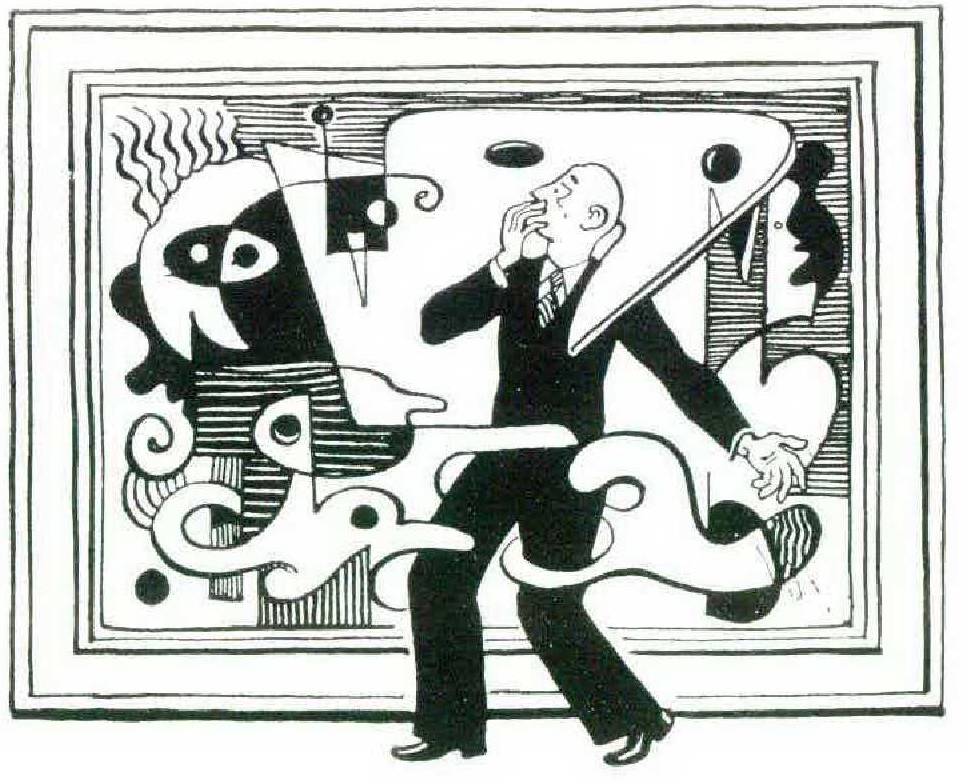
I have always appreciated art. That is, I appreciated that art was something to be appreciated and I was glad that it was. My status was that of an appreciators’ appreciator. But recent developments in art are baffling to me.
I am aware that real art does not lie in photographic depict ion of a subject or model. The artist must put something of himself into his work, and whenever I appreciate art I always make allowances for this. But lately it has seemed to me that the more of himself the artist puts into his work the less room there is left for his subject. As a result I have great difficulty in telling what his subject is. In an effort to help myself in this difficulty I have devised certain methods of appreciating art.
One of these I call my transubstantiation method. I stand before the painting or sculpture with my eyes half closed, my mouth half open, and my mind as void as I can make it. I have concluded that the mind has very little to do with what goes to make up modern art. It is the soul of the artist I must commune with if I am to discover what it is that the artist does when he puts himself into his work. So I try to do with my own soul what a ventriloquist docs with his voice: to put it into the body of another, the creator of the work of art. I try to see what the artist sees through the artist’s eyes.
I cannot say definitely that this method has ever brought me truly en rapport with any great master. Sometimes I think it does. Other times I am sure it does not. If I sustain my position long enough I get a peculiar feeling. But I am never certain that this peculiar feeling is what constitutes a real appreciation of art. Consequently I often resort to my second met hod.
This is my will-power method. Here I tense my muscles, firm my jaw, and cause my eyes to scan rapidly but sharply the details of the work of art — not searching for hidden faces, as in a child’s picture puzzle, hut hoping just the same that something will turn up if I try hard enough. I nearly always get results from this method. But I know very well that the results I get are not those the creator of the work of art intended I should get. I generally give it up and try my third method.
This is my Coué method. I do not like it very well. But it is the method used by many connoisseurs of the finer t hings of life and I must perforce, and by definition, have confidence in it. In my Cone method I stand before the work of art with my head slightly tilted. Then I say, “Ah, yes.’ After this I pause for a time, tilt my head to the other side, and say, “Remarkable composition.” When this has soaked in well I add, “Exquisite portrayal of the emotions.” Strangers, observing me in the throes of this melhod, have commented on my appreciation of art. But I myself am skeptical. I have begun to suspect t hat in order to appreciate the modern forms of art one has to he an artist himself. It seems a big price.
Poetry is something of which I also have considerable appreciation. I may not care to appreciate all poems, particularly the longer ones; but a short poem with a good swing to it I am always glad to appreciate. If occasion required I would be able to make long and short dashes under the syllables of it showing I understand such things as iambic pentameter.
But in recent years a great change has come over poetry. Alodcrn poets have dropped the pentameter and use only vertical columns of iambics. You have to be a poet to fill in the other four bars. The new poetry seems to be written by poets’ poets.
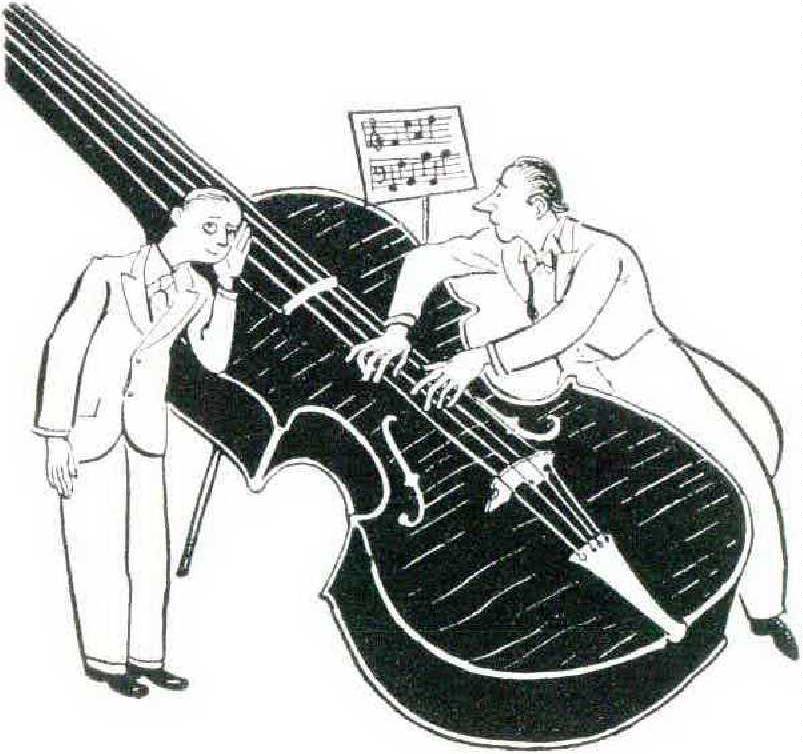
When it comes to music my situation ought to be better. I play the piano myself. There is one lively piece in particular t hat my friends are always enthusiastically urging me to play. But when I try to appreciate the work of a master I find myself in trouble. If I know that the name of the piece being played is “Wind Amongst the Trees,” I can hear the wind and I can see the trees. But if I hear the piece first and learn its name afterward, it always happens that the things I heard and saw are not the same as those heard and seen by the piece’s composer. There has been no meeting of minds. Musicians’ musicians have pre-empted the field.
It is quite a comedown for one of my intellectual and cultural pretensions to have to admit that the things that make life worth while are over his head. But even that is not all.
I have always prided myself on being a practical man. Whenever anything about the place got out of order and the family was huddled in consultation about whom to call up to get it fixed, I would enter and say, “Wait, I will fix it. There is no need to pay someone to take care of this.” But now the experts’ experts have taken even this satisfaction away from me. They have dogged me right into my driveway.
It used to be, if the car acted up, that I would raise the hood and ground each of the four plugs with a wooden-handled screwdriver. I usually found out the trouble. Of late years, however, the experts have engineered me into such a state that I would as soon lift the lid off Pandora’s box as raise the hood of a modern car. The designers’ designers have got me where I can do very little but pay for repairs.
I spend my life pushing buttons designed by experts, buying things prepared by experts, and voting for programs offered by experts. I don’t even have a specialty of my own I can hide behind. I don’t know what goes on anywhere any more. About all I am, it turns out, is a duffers’ duffer.