October 1951
In This Issue
Explore the October 1951 print edition below. Or to discover more writing from the pages of The Atlantic, browse the full archive.
Articles
Berlin
The Atlantic Report on the World Today: Washington
Too Much Football
Apart from the moral breakdown at West Point and the taint of professionalism in one college after another, what has big-time football been doing to the player who has gone to college in honest search of an education?ALLEN JACKSONwas a first-string guard at the University of Michigan, from which he was graduated this year. He won his letter on three consecutive championship teams and played in the Rose Bowl. Here is his account of his own experiences at a university where the slogan is: “when Michigan loses, someone has to pay.'
European Steel: Monopoly in the Making
President of Inland Steel since 1949, CLARENCE B. RANDALLwas invited by Paul G. Hoffman to be his steel consultant in the first summer of ECA. As such, Mr. Randall enjoyed close associations with the steel masters on the Continent and in Britain — associations which he renewed when the Schuman Plan was first announced and again this summer when he studied the fifty-year pact now ready for ratification by the member nations.
Within the Wave
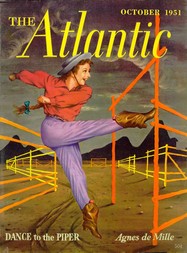
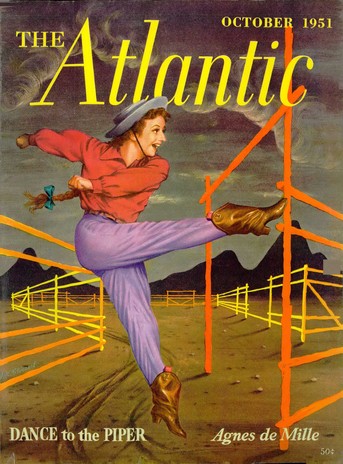
Dance to the Piper
A choreographer and dancer whose ballets in Oklahoma!, Bloomer Girl, Brigadoon, and Allegro have brought a new quality to the American stage, AGNES DE MILLEhad a long row to hoe before she could establish herself as a dancer, and a still harder struggle before she could break through the callous resistance of Broadway. Like Martha Graham, her mentor and friend, she believed that the ballet could draw fresh vitality from American themes. She had some initial success in New York, but it was in the London theater of Marie Rambert that she began enjoying sustained recognition before a critical British public. The art and the discipline of a choreographer came later, and again it was in a foreign company, the Ballet Rasse, that she projected her first great ballet, Rodeo, dancing the lead in it at the Metropolitan on the opening night. This is the first of four installments which the Atlantic is privileged to print from her warm, spirited book, Dance to the Piper.
Why Boys Steal
A graduate of Yale College and Medical School, J. ROSWELL GALLAGHER has been specializing in the care and “doctoring” of boys since 1932. He has served as the School Physician at the Hill School and at Phillips Academy, Andover; as Consultant-in-Medicine at the Children’s Medical Center in Boston; and is today Head of the Health Department at Wesleyan College. His earlier articles in the Atlantic, “Can’t Spell, Read” (June, 1948) and “There Is No Average Boy” (March, 1949), and the paper which follows have been drawn from his new book, Understanding Your Son’s Adolescence, an Atlantic-Little, Brown publication.
Hong Kong
Also Northern Novelists
William Faulkner
A young writer with a talent for biography and criticism, HARVEY BREITis the Assistant Editor of the New York Times Book Review. We invited his appraisal of William Faulkner’s novels and short stories with the realization that our latest Nobel Prize winner has never received the thorough reading he deserved from his own countrymen. This essay will make Mr. Faulkner’s work more meaningful for those who wish to make up for lost time.
Claudie's Cosmic Vibrations
A native Texan, DILLON ANDERSON established himself as one of the ablest young lawyers in Houston before he took time off for his fiction. This September has seen the publication of his first book, I and Claudie, a salty Texas narrative of two happy hobos who fortunately do not take themselves or their victims too seriously. Clint Hightower and his oxlike companion, Claudie, have adventured their way in and out of the oil country, Texas politics, hurricanes, revivals, and state fairs — and we hope there is no stopping them for some time to come.
High-Pressure Lobbying
Two Congressional committees inquiring into lobbying activities have recently turned their searchlights upon the lobbies registered under the Lobby Act of 1946 and those indirect lobbies known as “educational foundations.” KARL SCHRIFTGIESSER, who reviews the findings thus far, is a journalist and biographer who has served on the editorial staffs of the Washington Post, the New York Times, and Newsweek and is note devoting full time to his writing. His biography of Henry Cabot Lodge. The Gentleman from Massachusetts, appeared under the Atlantic — Litte, Brown imprint, as does his latest volume, The Lobbyists: The Art and Business of Influencing Lawmakers, which appeared in early September.
Old Crow
Full Circle: Stevenson and His Critics
Authors who have enjoyed enormous popularity in their day are eery likelyto be neglected for some time after their death. Then comes reassessment, which in the exceptional case is accompanied by a revival of interest. This has happened recently in the case of F. Scott Fitzgeral and if J. C. FURNAS is right, an even greater retribution is due to Robert Louis Stevenson. For ten years Mr. Furnas has been following Stevenson’s trail in Oceania, in the Uniled States, and in Scotland, and from his glowing appreciative biography, Voyage to Windward (Sloane), the Atlantic has been privileged to draw two sections.
The Peripatetic Reviewer
Books: The Editors Like
Reader's Choice
Shadows Move Among Them
White Man Returns
Party Going
Accent on Living
Great to Be Home
WILLIAM EDMAN MASSEE was engaged in editorial work and writing before spending a year in France. He is now editor of the Red Cross Magazine. This is his first appearance in the Atlantic.
The Amah Problem
NANCY PENCE BRITTON was born in Madison, Wisconsin, and is a graduate of Northwestern University. She is the wife of an RAF officer,who has been stationed for the past year in Singapore.
Duffer's Defi
Readers trill remember RIXFORD KNIGHT, who has appeared, in the Atlantic on several occasions. He is a resident of Jamaica, Vermont.
A Hollywood Child Star's Garden of Verses. Iv: (Apologies to Robert Louis Stevenson)
Chinchillas
ALEX FAULKNER is the Sew York correspondent of the London Daily Telegraph. This is his second, appearance in the Atlantic.
Triste
Luchow's