Words Without Music
EDWIN O’CONNAR has written sereral articles of unit radio for these pages. He is the author of a recently published book, The Oracle,the central character of which is an omniscient and thoroughly fraudulent network commentator.
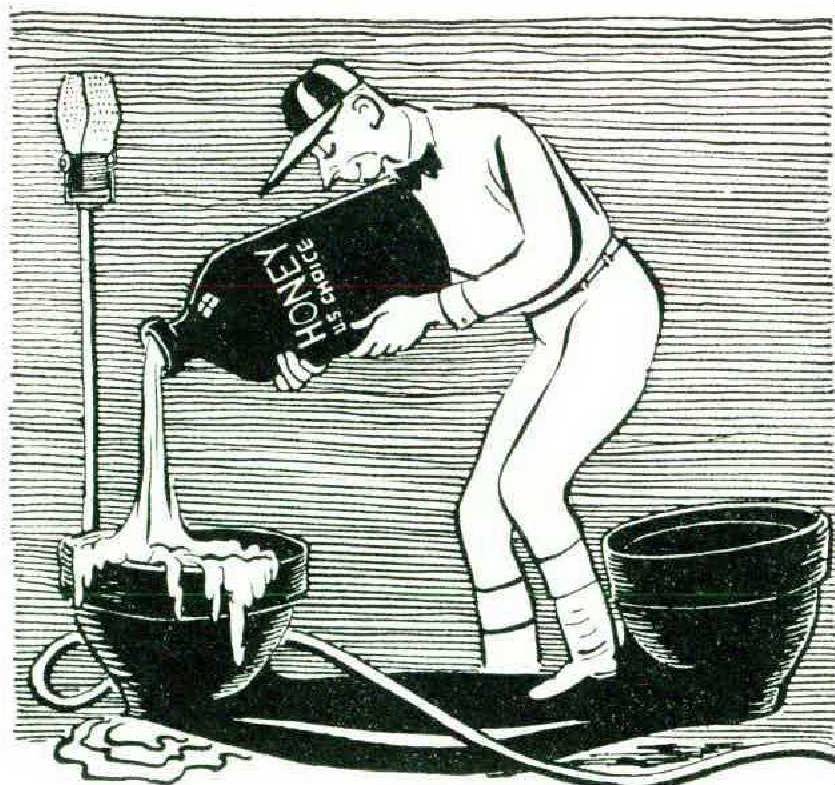
GENETICALLY speaking, the disc jockey, or chatter-platter man, who may be heard on virtually every radio station in the country as he spins his records and gabbles away, is a comparatively recent breed of cat. He came into existence little more than twenty years ago, and at that time it would not have been inaccurate to define him as one of radio’s humblest toilers: a durable, often anonymous creature, given to few illusions about his status in life, and fully aware that he had been born, not of art, but of thrift.
To his employers, the early disc jockey had but a single positive merit: he represented the cheapest possible way of filling time on the air. The disc jockey knew this; quite naturally, it helped to keep him meek. His one function was to break up, at regular intervals, the flow of recorded music which he played. This was in accordance with the established radio tradition that music, if uninterrupted by human speech, is somehow distasteful and really not entertainment at all.
In the pursuit of his simple, punctuative duties, the primitive disc jockey evolved a kind of universal patter, which was used by all of his kind, and which, as a mark of professional identification, was as unmistakable as the cauliflower ear:
1. “A change of mood, a change of tempo, and it’s Guy Lombardo and the Royal Canadians with The Sweetest Music This Side of Heaven. . . .” 2. “Comes now travel time on our Magic Ballroom as Glen Gray and the Casa Loma band take us on a musical journey to Hindustan. . . .”
3. “And now a lovely girl, a lovely song — yes, it‘s Sandra Gable and [pause] Smoke Gets in Your Eyes. . .
As radio entertainment has the advantage of being audible rather than visible, it was considered both safe and standard to dress up the show by referring to all feminine vocalists as “lovely” or “bewitching.”
Lifeblood of the early disc-jockey program was the “request,” particularly if the program were aired late at night. Letters, postcards, telegrams, and telephone calls poured in front the more sentimental inhabitants of firehouses and lunch carts, asking that certain songs — “Our Song”— be played on the air and dedicated to their various inamoratas. Thus: “And now for Gussie at The Jolly Pharmacy, for celia on the night shift at Waterman’s Foundry, for Mildred at Harvey’s Bar and Grille, from Fdward, Frank, and Danny-boy, it’s the Duke’s version of that perennial favorite, Sophisticated Lady. . . .”
The occasional visits of flesh-andblood celebrities to the disc-jockey program were great events, for it was by association with the famous that the show acquired something of the flavor of the main tent. Touring band leaders were especially in demand; they usually responded, not unwilling to publicize their one-night stand in the disc jockey ‘s territory. Disc jockeys sit uated on the main lines of travel could expect periodic visitations from Tommy Dorsey, Benny Goodman, Artie Shaw; those geographically less fortunate were forced to content themselves with infrequent consultations with Husk O’Hare and his Genial Gentlemen of the Air.
For such an interview the disc jockey boned up by reading Variety or Billboard; the real aficionado might bo found with a copy of Downbeat on his person. It was bonanza for the band leader: he had only to remember lo pepper the interview with bis host’s Chrislian name (to indicate palship), and to supply the automatic answers to the automatic questions. He was delighted to be back in Wichita (Dallas, Providence, Dos Moines); yes, he looked forward to seeing all his old friends that night at the Palais Royale Ballroom (dancing nine to one); yes,
there were some really great new tunes coming along ihese day’s, and by a stroke of singular good fortune, he happened to have made records ol same, which shortly would be available for public purchase.
This was all innocent, if relatively mindless, endeavor, and — perhaps unfortunately — it is all in the past. The disc jockey of today is the highcompression type, geared to his times, profoundly aware of himself: he is light-years removed from his professional ancestor. While at least equally gabby, today’s product lacks the humble, obliging core natural to a man who night after night spent his hours spinning a succession of acetate discs for the lovesick many. Today’s disc jockey disavows the request. He willingly accepts letters, telegrams, and particularly telephone calls from the world outside, but they are given short shrift until they touch upon a favorite topic: —
Hello, I’M ON THE PHONE! . . . What? . . . Yes, honey, this is Sidney La Grange. . . . You want to hear what? . . . I’m sorry, we don’t play requests on this program — no — no —no. . . . W IIAT WAS THAT? . . . You say you’d know me anywhere on account of my voice? . . . You say you think it has a great deal of charm? . . . Well, thank you, doll, you’re very sweet to say so. . . . What? . . . You say you listen to me every night and you really should go to sleep but you’re so interested you just can’t turn me off?
. . . That’s very wonderful of you to say that, honey, and I appreciate it, I really do. . . . What’s that? . . . You say I’m funnier than Milton Berle? . . . I see. Well, look, doll, no one admires Milton any more than I do. I’ve known him for years and lie’s a Great American, but the point is you just can’t compare us. I mean, our styles- are entirely different. . . .”
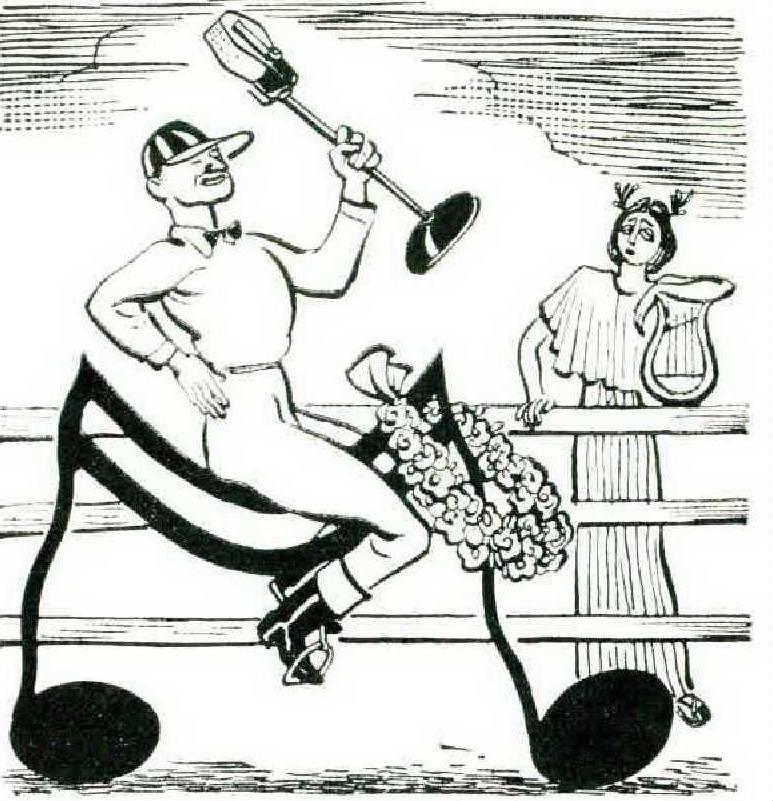
A telephone conversation of this kind, provided il sticks to the proper subject, is subject to indefinite prolongation; over the years, the disc jockey has become a Personality,
wort In of sustained discussion. As such, lie is of course no longer confined to the realm of popular records in his talk; his range has grown with his stature. In answering the phone, he talks volubly and with confidence on any number of large matters. This sometimes disconcerts a good many people, including some of the guests who may drop in to appear on his program. The band leader of today is apt to have a hard time of it in his inierview : —
BAND LEADER: SO as I was saying, Sidney, we open tonight at the beautiful StarBright Ballroom for a short —
Disc JOCKEY: Excuse me just a minute, Al. Hello, I’M ON THE PHONE! . . . Yes. . . . What’s that ? . . . You say you want to know what I think of sending American troops to Europe? Well frankly, honey, 1 think I may go along with the President on that one. S es. yes — good night. Now, Al, what were we saying?
BAND LEADER: Well, I was just saying, Sidney, that tonight is the night we begin our three-day engagement at the beautiful —
Disc JOCKEY: Pardon me, Al. Hello, I’ M ON THE PHONE! . . . Yes. . . . Yes. . . . You say you listen to the program every night and you think I’m great? Thank you, honey. . . . W hat?
. . . What do I think about capital punishment? Tin very much against it, doll. You should know that by now if you listen to this program as regularly as you say you do. Good night. Now, Al, how long are you going to he around these parts? Always good to see you.
BAND LEADER: Thank you, Sidney, and I don’t need to tell you how much I always enjoy being on the air with you. Ah— the point is, Sidney, I was saying that the boys and I open tonight at the —
Drsc JOCKEY: Hold it just a second, Al. Hello, I’M ON THE PHONE! . . . Yes. . . . You want to know what?
. . . You say you want to know impersonal opinion of Stalin? . . . I don’t, think we need to go over that again, doll. I mean, I think that by this time Joe Stalin knows just exactly what I think of him. . . .
This is a far cry from the days of “a lovely girl, a lovely song,” yet it is a logical departure, for with the new disc jockey, songs and vocalists, whether lovely or unlovely, are conspicuous by their relative absence. As the disc jockey came to talk increasingly about himself and similar topics of global interest, something had to give; it was the music. The result has been that the average program of tins nature today is a great deal of jockey and very little disc. Music has come to be very nearly as foreign, on these programs, as solferiticism.

This is discouraging, not only for the itinerant band leaders, but also for those few remaining listeners naïve enough to believe that there should be some music on a recorded music program. And it still comes as something of a shock to many who, tuning in the radio late at night, happen by chance across rich, authoritative baritone pronouncements on everything from fiscal distribution to man’s final end, and discover that they issue, not from an archbishop or the head of the Securities and Exchange I Commission, but from the tireless larynx of Sidney La Grange or Crazy Chester McGee, the new-found shepherds of Lombardo-Land.