Progress and Prospects
THEY SHALL HAVE MUSIC
by JOHN M. CONLY
JOHN M. CONLY is a former New York and Washington newspaperman, now on the staff of High Fidelity Magazine. “They Shall Have Music" is a quarterly feature in the Atlantic.
DOWN a quiet metropolitan byway, on a midsummer day, came questing a music lover of formidable aspect. He was a nationally known magazine writer, a massive, slouching man with a bearlike gait and a purposeful glint in his spectacles. He also had $600 in his pocket and a consuming yen for a high-grade high-fidelity radio phonograph system.
Reaching his goal, the leading local custom home-music shop, he mounted therein, flagged a few timorous fellow customers out of his path, and planted himself in front of the proprietor.
To the latter, a shrewd, normally spruce young man, now somewhat wilted by the summer heat, he was by no means a stranger. In fact, he had constituted a minor traffic hazard around the showroom for a fortnight. He had compared amplifiers. He had compared loud-speakers and their enclosures. He had compared record players. He had compared phonopickup cartridges. He had also, willynilly, come to know the opening bars of Boccherini’s cello concerto (in the Westminster Janigro version, then much favored as a demonstration disk) almost as well as Boccherini did. But he had acquired the data he craved and now he was ready to buy.
He outlined his choices to the hi-fi man, and true connoisseur’s choices they were — taken item by item. Just the same, as the recital went on, the hi-fi man began to feel a slight chill of misgiving. Mustering all the unction at his command (for it is no light matter to cross a phonophile who has just worked himself up to buying pitch), he asked for a day’s grace.
Immediately the chill became mutual. The journalist’s friends, it came out, had been invited over to hear the new machine that very evening. There could be no backing down. So the equipment was loaded on the shop’s station wagon and rushed across town to the journalist’s apartment. Two moist and weary installation men hooked it up. The journalist plucked a record from an opera album, flipped switches, twisted the appropriate knobs, and retreated happily into a corner to listen.
The rest is almost too tragic to recount. After a few moments’ anguished listening, a few futile dabbles with tone controls, he managed a vast, dismal wave of his arm.
“Take it away!” he groaned. In suitably sepulchral silence, the installation men took it away.
As hasty epilogue to this mournful tale, it is perhaps well to add that after the initial agony had subsided the journalist made a couple of substitutions in his array, and at last report he was wishing phonograph records were a little better, to do justice to his machine. He was happy again — or, at least, as nearly happy as a real home-music enthusiast ever gets after his brief, bitter brush with progress.
For it was progress, of a kind, that had trapped him. This journalist, as it happens, was a second-degree high-fidelity addict. At about the time the Atlantic began this series, two years ago, he had bought and assembled a modest, compact set. (It had to be compact, since he was living on a cabin cruiser.) It consisted of a little Espey 10-watt tuner-amplifier, a Webster record changer with GE cartridges, and an 8-inch Jensen “Concert” speaker in a small box cabinet. It served him splendidly. The speaker, to be sure, rejected all deep bass tones; but, to offset this, the GE preamplifier tapered the extreme treble, leaving the result well balanced and fairly wide in tonal range. It sounded clear, if not big. The magazine writer began taking LP records aboard at a rate which, if continued, might soon have caused a minor marine disaster.
However, before watery doom overtook him, he moved ashore, acquired a huge studio apartment, and went shopping for “big” sound — with the results already recounted. As has been said, he chose wisely but too well. It will do no harm to identify the components he picked, since, paradoxical as it sounds, it was their very merit which made them interact badly.
His amplifier was an H. H. Scott 210-B, certainly one of the best made today. It has an enviable reputation for trouble-free operation and possesses one of the most versatile sets of tone controls devised. At its designing, H. H. Scott very properly made its last test, in his Cambridge laboratories, an ear test before a musical jury (because there are such things as amplifiers which “measure” well but “listen” badly). The test employed typical high-grade American loud-speakers, hard-coned lineal descendants of theater speakers, predisposed to favor treble over bass unless they are specially housed. The Scott amplifier emerged on the market, thereafter, with ample provision for the most generous possible bass response.
The journalist’s speaker was a Tannoy, a very fine new 15-inch British concentric double speaker, with a soft cone especially made to deliver full bass even from a compact box cabinet. Not that he had bought a compact box cabinet; indeed, he had chosen a large “folded horn” corner mounting, designed to beef up the low tones threefold or more.
Lastly, he had acquired an Audax Polyphase pickup, unexcelled for its compliance — meaning the freedom of its stylus to swing wide and free, bringing in every last vagrant bass note.
When the journalist turned on the power, this exotic array went faultlessly into action. The whole room shuddered to a great and glorious throb of bull fiddles. Only dimly, in the remote background, could be heard a faint soprano plaint — Tosca reviewing her numerous woes. Every item in his system was striving mightily to make up for the supposed bass deficiencies of the others. The likelihood of this had dawned on the equipment dealer just too late for him to do anything about it. Had he tested the assembly, be would never have let it out of the shop. A few changes (perhaps only the substitution of another speaker cabinet) might easily have remedied the trouble.
This somewhat wry anecdote may seem a strange way to sum up what has happened in two years to the phenomenon known as “high fidelity” — and it is. But it is always easier to prod than to praise. The fact is that both as an industry and as a cultural development “high fidelity” — the manufacture, sale, and use of widerange, precision-built equipment to reproduce music in the home — has made fantastic progress. Where once there were a bare dozen models of audio amplifiers available to the layman customer, I here are now probably ten times that many on the market. Loud-speakers have multiplied proportionately. Record players, phonopickup cartridges, and radio tuners have increased somewhat less wildly, but enough.
As for customers themselves, they now certainly number in the millions. Only a minority of them are hobbyists — “audiophiles.” Most are after what the equipment can deliver: music as they have never heard it in their homes before. Indeed, it is a fact too little noted that many have never heard first-class musical performances anywhere before. A whole new contingent of American music lovers actually is being created by this new equipment and the microgroove records which are its prime raison d’être. The sweetest of the muses owes a good deal, locally, to a few hundred boys who started out with nothing but soldering irons and an unaccountable desire to see if a 10-kilocycle note could be electronically reproduced at 10 watts power without harmonic distortion.
Furthermore, despite the sad experience of the journalist (who was a graduate student, so to speak), the beginning buyer in search of a modicum of hi-fi quality at a modest price is much better served now than ever before.
The minimum rig, so called, is pretty well standardized. He can get any of several good 10-watt amplifiers (Bell and Grommes being the most popular) for about $50. Three-speed record changers (paced by Garrard and Webster, the latter with a new, quiet model) cost about $40. GE cartridges (also in revision.) are still de rigueur for the new addict. As regards tuners, FM and AM-FM, it must be admitted, there is less ground for satisfaction; the cheaper are almost as dear as the more expensive, without being nearly as good. Possibly the low-price KM tuner was a mistake to start with.
Among loud-speakers, there is plenty of choice. Several low-priced 12-inch models have appeared, perhaps the outstanding one being the University “Diffusicone” at $27. To keep 8inchers in competition, there are at least three cabinets designed to give them adequate bass. These are the corner horns made by Electro-Voiee (the “Baronet”) and Permoflux and the bookshelf model (12” by 9” by 22”) made by the R-J Company. For the man with a few more dollars, there are a couple of astonishingly good loud-speakers: the University 6201, an excellent 12-inch coaxial ($45), and the Wharfedale Super-10 ($35), a beautifully responsive British reproducer.
This may be a good point at which to announce that the lazy buyer (the one who wants his rig already assembled) is now to be taken care of, too.
At about the time this article appears, a major record company will begin distributing a modicum-hunter’s set, a wide-range table-model record player, priced at less than $150 and very ingeniously put together by one of the nation’s topmost electronic engineers. And Stromberg-Carlson, one of the first radio manufacturers ever (to their sorrow, then) to try marketing high fidelity, also has a readyassembled, handsomely finished set on the market. This is no economy job: in its most modest version it boasts a 10-watt amplifier, AM-FM tuner, Garrard changer, GE cartridges, and coaxial speaker in a patented labyrinth cabinet. It costs over $700, but Stromberg will also sell the makings separately at much less. (Preassembly involves not only labor man-hours but an additional excise tax.)
Two other big radio-TV set manufacturers also have broken into the high-fidelity components market. Hallicrafters, long famous for its shortwave receiving equipment, is putting out a two-chassis AM-FM tuner and amplifier unit, to sell at about $220. The tuner, shown at the Chicago Audio Fair in May, is impressively smooth, precise and drift-free. The amplifier is a so-called Williamson type. The major importance of the move, however, lies in the fact that Hallicrafters has more than 600 sales and service agencies in 125 towns across the nation — staffed by men who are now going to have to learn how to service high-fidelity equipment. This should hearten many a hesitant buyer in the hinterlands. The third of the big companies newly in the field is Pilot Radio, with a tuner and amplifier still under wraps at press time.
The people hardest to hearten, however, are the likes of the journalist whose misadventure opened the narrative. These are the customers — the perfection seekers — who follow closest behind the advancing front line of the whole craft. Its problems are theirs, and vice versa. And some of the problems are not even properly theirs, although they are afflicted with them.
There is, for example, the problem of record equalization. This did not bother the journalist when he listened to his $160 set, but it bothers him now, when he sits down before $600 worth of equipment painstakingly contrived to reproduce faithfully every sound furnished its music source. The problem began in the early days of electrical recording.
For one thing, the makers of records and radio transcription disks found that they could not let a recording, or cutting, stylus have its own way with loud bass tones. If they did, it swept in such broad curves as to endanger grooves already cut — or, at least, to use up an inordinate amount of disk space. So they limited the amplitude of its swing with elastic chocks. It could still cut bass notes below this limiting point, but they were of subnormal volume. (This is called the “turnover” point, a term which has understandably confused record fanciers.) The idea was that the reproducing amplifier should be designed to build up again the bass tones that had been diminished.
Another thing they discovered was a handy way to reduce surface noise. Since most of this noise was highpitched, they boosted the treble volume while making their records and transcriptions. Again, the reproducing amplifier was given the dirty job. It was to lower the volume of the whole upper register, progressively, in such manner as to reduce the music’s treble portions to normal and, as part of the same process, push the surface noise down below audibility. This is known in the trade as “rolloff.”
The general theory here was excellent. And so far as broadcasters were concerned it worked. The National Association of Broadcasters soon settled upon a “curve,” including both turnover point and roll-off. This came to be known as the NAB curve. Unhappily, commercial record makers were more independent in spirit. Each adopted a different curve. The differences have not been reconciled. For instance, the turnover point of a British 78 rpm record is usually at about 250 cycles per second, that of an RCA Victor LP at approximately 800 — about an octave and a half apart. If the RCA record is played through an amplifier adjusted to the British record, all the tones within that octave and a half are going to be virtually lost, or severely cut in volume. Conversely, should the British record be played at RCA Victor settings, these same tones will be grossly magnified, lending the music an ungraceful tubbiness.
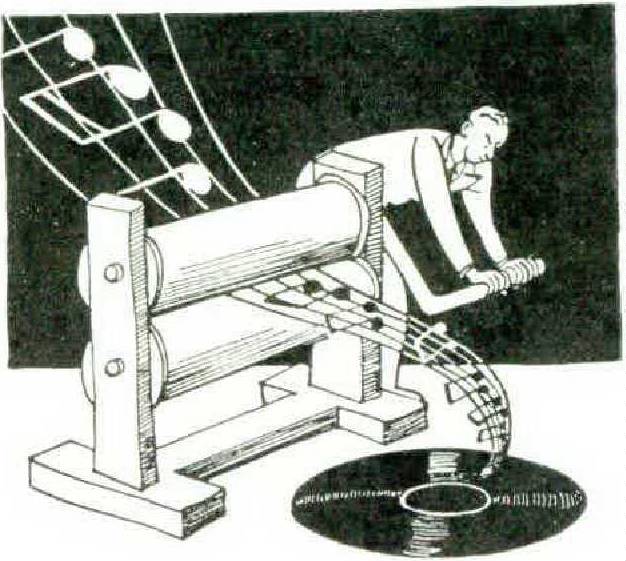
Most cases of cross-purposes between cutting stylus and reproducing stylus are not so extreme, but they don’t have to be. On a $250 rig, even a mild misequalization can be annoying. On a $1000 rig, it will be almost intolerable. Yet to correct it, with most current amplifiers’ controls, is hard work at best, at worst impossible. This is the next big job for the amplifier makers to beat.
There are, of course, stopgap remedies. Pickering & Company, makers of one of the most popular high-grade phono-pickup cartridges, also make an equalizer ($12) which has six settings, each to compensate, through an arrangement of resistors, for the preemphases (that’s the horrid word) of one particular make of record. The Radio Shack, in Boston, makes a similar device to service GE and Audak cartridges. Both help, though neither is perfect.
Two years ago the Audio Engineering Society worked out a curve ideal for modern microgroove records, and an encouraging number of record makers have begun using either it or the NAB curve. Some use both. Westminster Recording Company, a firm whose high standards and good taste have made it a favorite with exacting record fanciers, has its disks printed by both Columbia and RCA Victor. From the former it specifies compliance with the NAB curve, from the latter the AES. In fact, it goes one laudable step further: it now lists the proper equalization on each record label. May its competitors soon follow suit!
Of course, not all amplifier control panels — even some wry fancy ones — show markings for AES and NAB equalization, but most can achieve it. Best in this respect is a new separate preamplifier-equalizer made by Brociner ($50 wit h power supply, $38 without) which has individual settings for four turnover points and six stages of roll-off. It can be used together with other “front ends” or with a companion chassis by Brociner which furnishes bass, treble, and volume controls ($56). The Scott amplifier also comes with complete equalizationsetting instructions. Other makers probably can furnish guidance on request.
There are limits, of course, to what an array of control knobs can do. They cannot alter what may be called the basic personality of a $200 amplifier, as the journalist in the anecdote found out. These highly specialized, lovingly designed instruments, and their comparable companion components, really do have personalities — not one of them sounds or behaves exactly like another. They are prima donnas. If they are to perform well as parts of an ensemble, the ensemble must be warily chosen. The perfectionist shopper’s best, recourse is to a dealer of taste and discretion. Next best is to manufacturers, by letter. Each speaker manufacturer, for instance, knows which amplifier drives his product most sweetly.
Another matter which the control knobs cannot do much about is the strange musical judgment of certain record makers. If a recording director wants to make a soloist sound as if he were standing right beside the listener, while the accompanying orchestra plays out behind the building, he can do it, and no knob-twisting can repair the result. Or he can record a symphony from a spot 10 inches above the conductor’s right ear — a vantage point no concert-hall listener is ever likely to occupy. The disk thus produced, by the same token, will not sound much like a real concert performance. This is not to say that there won’t be listeners who’ll prefer it that way. To the real audio cultist, the creak of the clarinetist’s boiled shirt is just as important as the pace of Beethoven’s coda.
In some cases, to be sure, unreality is desirable. When Mary Marlin sings Johnny One-Note in a show album, it is more important that all the words be heard than that a proper balance be maintained between singer and band. But when Ezio Pinza sings an aria into a microphone equally close up, his voice, when reproduced through an efficient bass speaker, is going to sound as if it were coming down a stair-well or out of a rain barrel.
Fortunately, there is no need for the home-music enthusiast to suffer such afflictions. Great as has been the increase in the supply of high-fidelity gadgetry, the flood of LP records has surpassed it. And the new ones continue to come, 100 to 150 a month. Not all are good, but a surprising number are. And, of the rest, many purvey such musical rarities as to be worth while anyway.
In fact, there may never again be quite the varied array of recorded music and rcenrd-playing equipment that exists in 1952. Some of the smaller manufacturers in both fields probably will soon drop out of the race. Perhaps this is the year to buy.
Record Reviews
Beethoven : Sonatas, Op. 31, No. 1; Op. 54; Op. 90 (Hugo Steurer, piano; Urania: 12" LP). LP versions of the Beethoven sonatas must total almost a ton by now (see below), but this disk still deserves mention for its presentation of the lyrical Opus 90, a real love-at-first-hearing job.
Beethoven: Sonatas (Wilhelm Kempff, piano; Decca). In a final, six-album spurt, Decca has won the race to record all the Beethoven sonatas under one label. There are many moments, herein, of deep tenderness, and there is great delicacy, but little virility. The recording is all very low-level, too.
Beethoven: Trio in B Flat, “Archduke” (Jean Fournier, violin; Antonio Janigro, cello; Paul BaduraSkoda, piano; Westminster: 12" LP). These three young men have not quite the discipline of RCA Victor’s “million dollar trio” (Heifetz-Feuermunn-Rubinstein) but they have equal understanding and the benefit of far better engineering, of course, than the Victor reprint offers.
Debussy: Préludes, Books I and II (Walter Gieseking, piano: Columbia: two 12" LPs). Another fabulous pianistic treasure from Columbia (their first: the Casadesus Ravel disks), of which the Préludes are only the top layer. Issued simultaneously are superb Gieseking versions of Debussy’s Bergamesque and Childrens Corner suites; Brahms’s Intermezzi, Op. 117, and Schumann’s Kinderscenen; Franck’s Symphonic Variations; Mozart’s Concerto No. 23 and Beethoven’s No. 4, the last three with von Karajan and the Pbilharmonia Orchestra — all told, six musically exquisite, technically faultless records. For only (!) $29.10.
Handel: Concerti for Strings and Winds in F and B Flat (Lavard Friisholm conducting Collegium Musicum Orchestra of Copenhagen; Haydn Society: 12" LP). No doubt composed as Georgian garden party concert pieces, these concerti contain quotes from many a familiar Handel masterpiece (even The Messiah) and seem to go on pleasantly for hours. Good recording.
Haydn: Missa St. Joannis de Deo; Missa Brevis (Hans Gillesberger conducting soloists, Akademie Kammerchor, Vienna Symphony Chamber Orchestra; Lyrichord: 12" LP). These, written with a tiny choir-loft in mind, may well be the gayest masses ever scored. For contrast, try the Haydn Society’s Heiligmesse, a later, Beethovenesque work wit h Mogens Wöldike conducting fine Danish choristers, trumpeters, and drummers.
Haydn: Symphonies No. 92, “Oxford,” and No. 94, “Surprise” (Hermann Scherchen conducting Vienna State Opera Orchestra; Westminster: 12" LP). Again Scherchen’s large-scale treatment of Haydn yields startling depth and drama. Take special note of the second movement of the “Oxford.”
Margarete Klose Song Recital (contralto with Michael Raucheisen, piano; Urania: 12" LP). This is Urania’s second reprint of Klose in song, following Schubert, Handel, and Gluck with Grieg, Strauss, Cornelius, Pfitzner, and Jenson. Fine interpretations and almost incredible vocal ease and agility. Most highs filtered out in reprinting.
Mozart: Concerto No. 26 in D Major, “Coronation,” with Liszt: Rhapsodie Espagnole (Gina Bachauer, piano, with Alex Sherman conducting New Orchestra of London: RCA Victor: 12" LP or separate 45 albums). The Liszt is showy and attractive, the Mozart a real gem, full of vigor and grace. Recording: good.
Guiomar Novaes Encores (Vox: 12" LP). After handicapping this excitingly dexterous Brazilian pianist with miserable recording in a series of concerti, Vox finally has done right by her. There is not much important music in this Bach-Gluck-PurcellBrahms-Pinto-Philipp-Vuillement recital, but it is all beautiful and performed with thrilling skill.
Thomas, Dylan: Readings (Caedmon: 12" LP). One of today’s foremost young poets reads works of his own, which he says were written to be spoken, not read. His short impressionistic pieces bear up well enough, but are outshone by the long, narrative, extremely funny A Child’s Christmas in Wales. Another interesting Caedmon issue: Laurence Olivier’s eulogy of King George VI, on a 10inch disk, backed by the BBC description of the funeral.
Stravinsky: Suites No. 1 and No. 2 for Small Orchestra, toget her with Hindemith: Kammermusik No. 1 (Thomas Scherman conducting Little Orchestra Society; Decca: 10" LP). Every last bit of delightful waggishness in these fantastically clever and very appealing little works is beautifully exploited by Scherman. Good recording, too.
Vaughan Williams: Concerto in D Minor (Joseph Fuchs, violin; Zimbler String Sinfonietta) together with Tansman: Triptych (Zimbler Sinfonietta; Decca: 12" LP). To the neglected legion of Vaughan Williams admirers, it is a pleasure to report that the concerto is performed and recorded most handsomely. So is the Tansman trifle, which presumably was added to justify the 12-inch disk.