Too Late I Read
by SCOTT CORBETT
SCOTT CORBETT was the discoverer of “the large 8-ounce jar“ an contrasted with the normal 8ounce jar (December, 1950, Atlantic). A native of Misnonri, he now lives in East Dennis on Cape Cod. He is the author of two books, The Reluctant Landlord and Sauce for the Gander.
ANYONE who has toured the country must be familiar with the poetry of those sweet singers of the open road, the bards who write the BurmaShave jingles. As a rule, two lines of iambic tetrameter are offered the literate motorist on four small red signboards spaced apart for easy reading.
Nothing gave me more trouble on a recent motor trip.
The trouble came during the intervals when my wife was spelling me at the wheel. At such times I indulge my fondness for studying road maps, between that and counting red barns us. white barns in a game with my daughter. I kept landing in the middle of a jingle. I wouldn’t notice it was going by until it was half gone. Once, for instance, I glanced up just in time to read two boards with this on them: —
“Tee-hee!" said he.
“That’s mine you’re pattin’!”
“Who’s patting what?" I cried, turning to my wife.
“Who’s patting anything?" she countered.
“Didn’t you read the first part of that verse?”
“What verse?“
I was on my own. As for who was doing the patting, it was doubtless a she, but the secret of what she was patting was irretrievably lost to me, half a mile back.
“Puttin’. Pattin’. The rhyme was trobably ‘satin.‘" I multered, while imagination ran riot. How racy would our roadside Browning be likely to get? If only I hadn’t glanced up at all! If only I had continued to tot up the mileage between Indianapolis, Ind., and Hannibal, Mo.!
The next day it happened again. This time I saw only the final board:—
What had Ben Hur.
Quietly, in a controlled voice, I said to my wife, “I don’t suppose you read those Burmu-Shave signs just then.”
She hadn’t.
“How can you drive along and not read them?” I demanded.
“I was watching that car ahead of us, which is more important than reading jingles on signs,” she retorted. “You’d have been reading the signs instead of watching, which is why your driving makes me nervous.”
We won’t go into that here.
“‘What had Ben Hur.’ That’s all I saw of it,” I complained. “What had Ben Hur?”
It was pretty clear I was up against one of those bad puns for which our roadside poets have such a serious weakness. Something had “been her,” all right — but what?
Another fragment that spoiled at least the next twenty miles of my trip was: —
When Pa tried
What the signs discussed.
What did the signs discuss, and what happened when Pa tried something? I take it he tried to get funny, probably with Ma. I dare say that was it. But the whole secret is locked up in the lost opening line. I tested out all the rhymes I could think of for “discussed”: bust, bussed, crust, dust, fussed, gust, disgust, just, lust
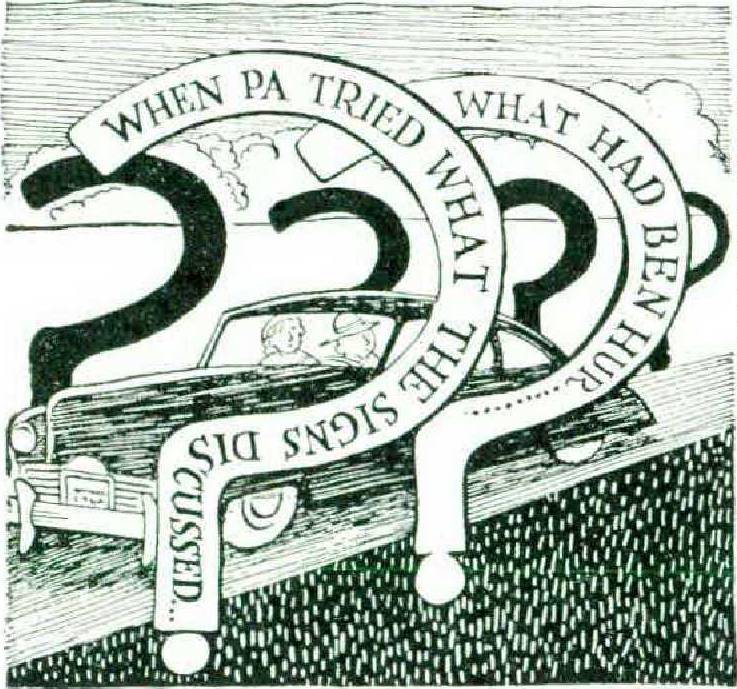
(which seems unlikely, when you consider the family type of audience they get on the average highway), must, rust, trust — the possibilities were too confusing.
On our way back across the country I attempted a coup. Noticing a series of the little red signs going past on the other side of the road, I suddenly realized that if I looked back quickly I could read the last two signs, which would actually be the the first two and might turn out to be one of those first lines I was missing.
I jerked my head around and read the two signs: —
He tried
“What do you think you’re doing?” cried my wife, who found my sudden action startling and annoying. The fact that I was driving at the time had a lot to do with this.
“I thought maybe that was one of the jingles I missed part of coming out, but it wasn’t. It was one I didn’t even see.” Now l was stuck with another fragment, this time a mere part of a first line read backwards.
The next time we take a trip I’m going to try to concentrate on the scenery. When I’m not reading my maps, that is.