Doctors Is in Surgery
DOROTHY BAKER, after an arduous career as novelist and faculty wife, now lives in comparative calm on a ranch in California with her husband and their two daughters.
by DOROTHY BAKER
I HAVE a healthy respect for the medical profession in general — and wilt’ll the chips are down, even in particular. For example, I never fail to seek the advice of a reputable physician, one Farnham k. Philbriek, M.D., whenever, as the French say, I have something. Like the pain in my elbow that I had for so long. This pain — I’d always notice it just before I went to sleep at night; and when I’d wake up in the morning it would be gone. 1 didn’t want to mention it to my family because they go to pieces when anything’s wrong with me, and yet I felt I shouldn’t let it just go on and on unnoticed by anyone but me. So I went to Dr. Philbrick finally, and he finally got on to what it was, or I assume he did, because it wont away.
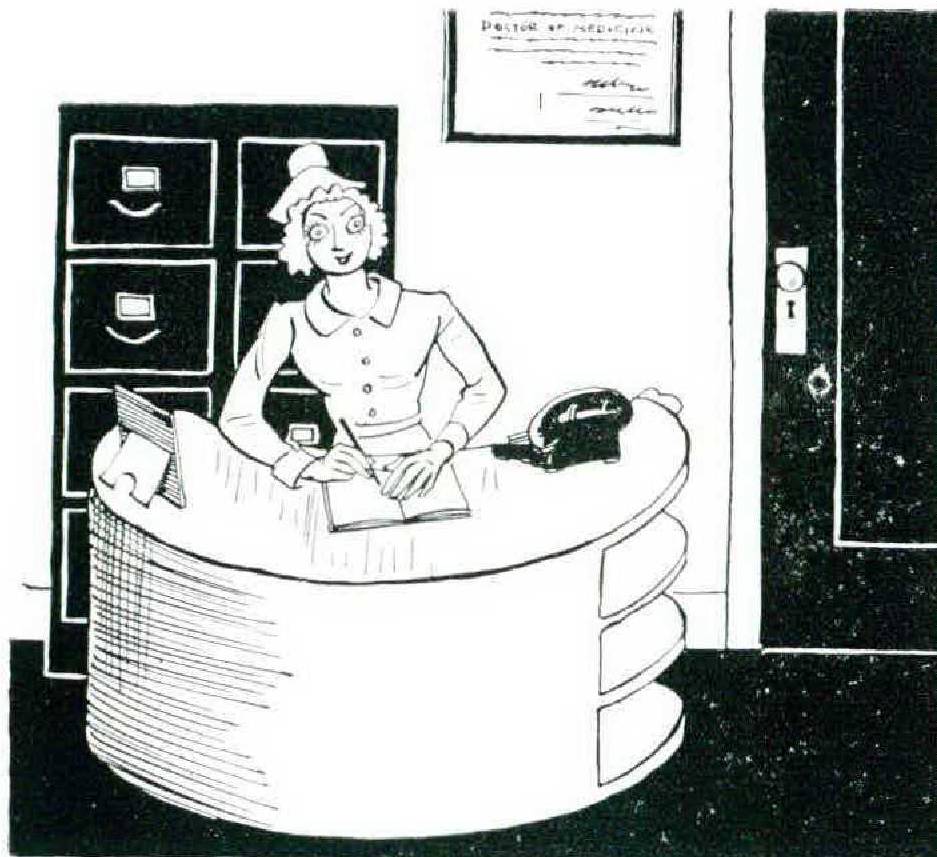
It may have been out of gratitude to him that I got the notion of reforming his receptionist for him. She was a pleasant girl, soft-spoken though redheaded, and she had come within a few courses of being a registered nurse, only something went wrong and she ended up as receptionist for Dr. Philbrick. She wore a nurse’s outfit, nevertheless, with a good deal of authority, and she was all right except for one noticeable linguistic gaucherie. It came to my attention the first time I telephoned to make an appointment about my elbow. She answered the telephone properly enough: “Dr. Philbrick’s office"; but when I told her who I was and what I wanted to make an immediate appointment for, she said, “I’m sorry, but Doctor is in surgery this morning.” That was the first time, and I let it pass, though it wasn’t easy, and made an appointment for the afternoon as if I had noticed nothing.
Then it happened again, the afternoon of the appointment; but this was my first time there, and since I was really more concerned about my condition than I was about hers, I let it pass again. I let it pass twice, as a matter of fact, once on the way in, and once on the way out.
And then the day came when I first tried to help her. I was sitting in the waiting room, not even aware of her, just sitting quietly in a chromium chair and idly — that is to say, more or less idly—thumbing through a superbly illustrated article on the pathology of the three principal types (nodular, smooth, and mixed) of leprosy, in the Journal of the American Medical Association, when I heard her call my name. My thoughts were far away, indeed they were in India, but I recognized the name, raised my head, looked across at her, and hoard her tell me that Doctor would see me now. “Doctor will see you now" was precisely what she said, and it was at that moment that the reforming spirit took hold of me. I put away the Journal of the American Medical Association, turned around, and from where I slood, I said right back to her, “Doctor Who?“
It did not have the effect I expected. I thought she’d be covered with confusion, possibly blush, and correct herself right there in front of all those people and later, her lesson learned, maybe even call me up and thank me. But she didn’t seem to catch on. All my broad hint accomplished was to give her the idea that I didn’t oven know whose office I was in. I could see it on her face and hear it in the kindly tone of her voice when she repeated that I could go right in because Doctor was ready for me. No doubt whatever: she hadn’t got it, broad as it was. And I couldn’t bring myself to say “Doctor Who?” again, because there was more involved now than a single receptionist and a single reformer. There were people all over the office patients—and as I looked around I got a strong sense that there was not one among them who wouldn’t go along with the receptionist in thinking I didn’t know the’ name of my own doctor. So, since there was nothing else to do, right then at least, I lifted my chin and walked across the room, slowly, ma non troppo, and with considerable dignity entered the inner office.
I didn’t say anything about it to Dr. Philbrick when I got inside, either, because right away we got onto the subject of my elbow, and he started massaging it, pulling it, pushing it, putting it under a strong light and looking at it. And making conjectures about it.
In fact, I forgot all about the receptionist’s problem in the heat of the consultation, but as I was passing her desk, she herself brought it out into the open again by asking me when I would like to see Doctor the next time. And once more I did the courageous thing, but in slightly different terms, rather more jauntily and less challengingly. Airily, in fact. “Oh, Dr. Philbrick, you mean?” I said, and then rushed right on, not to appear to be making anything of it, and said, “How would Friday morning be?”
She gave me a look then, a look just wary enough to make me think I’d driven it home, or at least shaken her faith. “Friday morning?" she said. “Let’s see.” She looked at her book, studied it, and then said, “Hmm, I’m afraid that won’t do. Doctor has a Caesarean scheduled for Friday morning.” She said it all unshaken, full of confidence, and then looked up at me with no malice, so that I couldn’t do anything but tell her I’d come Friday afternoon, and leave.
I brooded over this matter a lot, though, through the rest of the day, thinking up examples to show her and all confident receptionists the error of their phrase. Here’s the situation, I could hear myself telling her. It’s an army camp and a telephone is ringing, General Barber is wanted by the White House, and his aide-de-camp, who has answered the telephone, says, “Sorry, sir, but General is in the field, doing battle.”And then the secretary on the other end of the line says, “To hell with that. President wants to talk to him, so get him.”As an example, I liked it. It seemed negatively conclusive enough to unconvince anybody. Moreover, there were enough examples to work, negatively, for practically all professional walks of life. For another instance, you call on the Reverend Mr. Murdock and his maid doesn’t tell you that Reverend will be right down. Nor does Judge Gormley’s wife tell you that Judge is pretty worried about something legal. So what about Doctor?
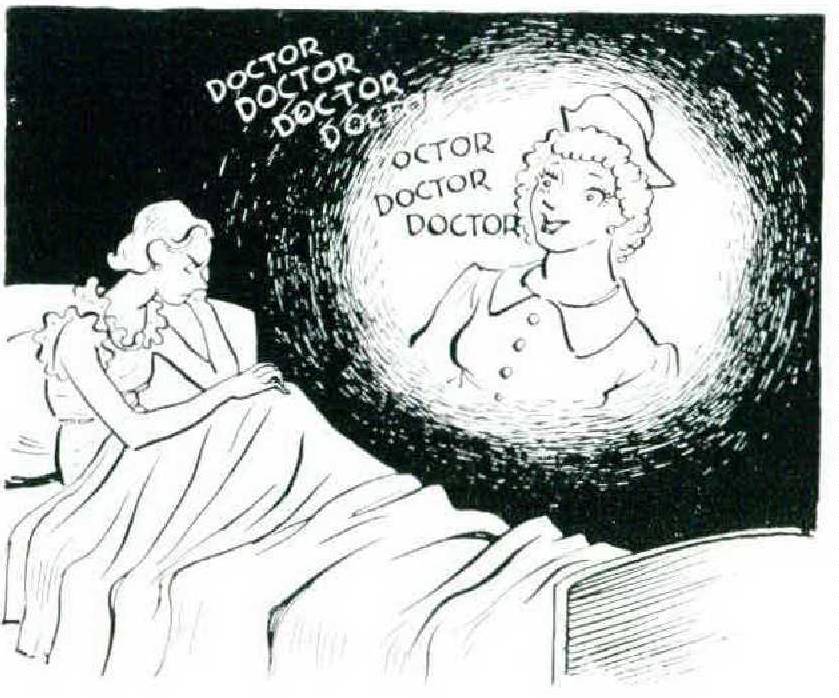
I never contrived to confront her with any of the examples, though; there were always too many people in the waiting room, or not enough time, or the time wasn’t right, or I simply lost my nerve. One time I did get so far as to say to her, “Now here’s the situation,”but when she looked up at me in that patient way she’d come to have with me, I choked up and that was the end of it for me.
It was not, however, the end of anything for her. Doctor was either out or in, or with a patient. Many, many times was Doctor in surgery. Every time I talk to her she still works it in somehow.