May 1954
In This Issue
Explore the May 1954 print edition below. Or to discover more writing from the pages of The Atlantic, browse the full archive.
Articles
Western Germany
Iran
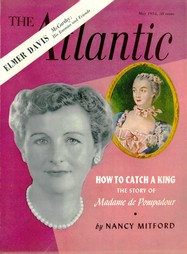
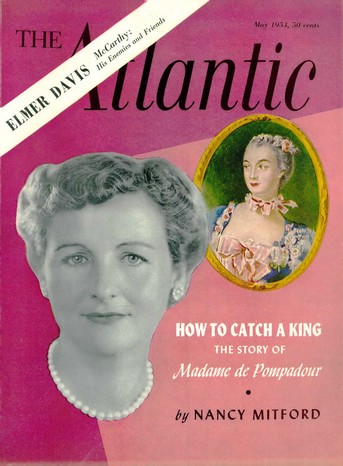
How to Catch a King: Madame De Pompadour
MANCY MITFORD has lived happily in the heart of Paris sitter the war. The first novel she wrote there was Love in a Cold Climate; her next, The Blessing, was a Book-of-the-Month Club selection in 1951. Now from aide reading and the liveliest observation she has drawn her gay, enchanting portrait of Madame de Pompadour, which is to be published by Random House hue this spring and from which the Atlantic has been privileged to draw the story of the King’s capture.
The Shortage in Education
In the article which follows, WALTER LIPPMANN,philosopher,author, and political analyst, driers home the fact that education is just as vital to our survival as military defense. The effort,“ he says, ” we are making to educate ourselves as a people is not nearly equal to our needs or our responsibilities,” and he asks for a radical adjustment before it is too late. This was the rousing address which Mr. Lippmann gave at the fifth annual dinner of the National Citizens’ Commission for the Public. Schools in San Francisco on March 19.
Ernest Hemingway: The Paris Years
The years 1916 to 1923 were the formative ones for Ernest Hemingway, and his development as a young writer is the substance of a forthright, illuminating book by CHARLES A. FENTON, from which the Atlantic has selected three telling installments. The earlier chapters depict Hemingway’s education in the high school of Oak Park, Illinois; his journalistic training on the Kansas City Start; his service as an ambulance driver in Italy, in the course of which he was severely wounded; his return to Chicago, and his friendship with Sherwood Anderson. In this installment we follow him to Paris. Mr. Fenton, an Instructor of English at Yale University, served in the Royal Canadian Air Force and took his Ph.D. at New Haven in 1953. His book, The Apprenticeship of Ernest Hemingway, will be published by Farrar, Straus & Young this month.
Burma
May Morning
JOSEPHINE JOHNSON is a native of Missouri whose first short story appeared in theAtlantic and who won the Pulitzer Prize with her beautifully descriptive novel, Now in November. Four years ago, she and her husband bought three acres on the outskirts of Cincinnati and a majestic house a hundred and thirty years old. There were bats in the attic — uncounted thousands who did not wish to be dislodged; and that struggle Miss Johnson described in her memorable article, ”Tenants of the House” (August, 1952). In the essay that follows she depicts the explorations which beckon on a May morning in Ohio.
The Challenge
X-Ray
Visit and Search: Dialogues of Whitehead
Philosopher, author, and mathematician, Alfred North Whitehead was born in England in 1861, taught long, full years at Cambridge University and at the University of London, and brought his career to a golden sunset at Harvard. He was one of the most illuminating conversationalists of our time. After his retirement, the world still wore a path to his door, and one of his frequent visitors was LUCIEN PRICE.Mr. Price, the author of We Northmen and Winged Sandals, has recorded with the discipline and accuracy of a trained journalist the audacity and the probing of the philosopher’s mind in his new book, Dialogues of Whitehead, which is appearing under the Atlantic-Little, Brown imprint. His record of the conversations was read and authorized by Whitehead.
Shaft and Wings of the Way It Was Once
When Typing Was in Flower
The advent of the typewriter on the American scene opened for the working woman the way to office employment, a field previously reserved for men. How best to operate the new gadget was hotly debated, and interest in contests between the two-finger and ten-finger factions was sufficient to fill Madison Square Garden. These droll footnotes from our social history are taken from a forthcoming book by BRUCE BLIVEN, JK., The Wonderful Writing Machine, to be published this spring by Random House.
McCarthy: His Enemies and His Friends
For going on sixteen years the calm, courageous common sense of ELMER DAVIS has helped to clear the air in this country. His style is that of a Hoosier — pithy, accurate, and penetrating: his new book, But We Were Born Free, published by Bobbs-Merrill, has gone through many printings this spring, and his Sunday broadcasts over the ABC network are listened to by millions. In the paper which follows he has scrutinized the latest and most controversial book about the Junior Senator from Wisconsin.
The Peripatetic Reviewer
Books: The Editors Like
Reader's Choice
The Prophet Armed
A Bed of Roses
A Pride of Lions
Accent on Living
The Alien Angler
ALEX FAULKNER is the New York correspondent of the London Daily telegraph, a tireless prober into any aspect of American life that at scems to him mysterious.
The Habits of Centaurs
Doctors Is in Surgery
DOROTHY BAKER, after an arduous career as novelist and faculty wife, now lives in comparative calm on a ranch in California with her husband and their two daughters.
Penchant Naturel
Literature on LPS
JOHN M. CONLY is a former New York and Washington newspaperman, now on the staff of High Fidelity Magazine. “They Shall Have Music" is a quarterly feature in the Atlantic.
Record Reviews