The Alien Angler
ALEX FAULKNER is the New York correspondent of the London Daily telegraph, a tireless prober into any aspect of American life that at scems to him mysterious.
by ALEX FAULKNER
ONE of the most baffling things to me about the United States is that in some parts of it I am not allowed to fish.
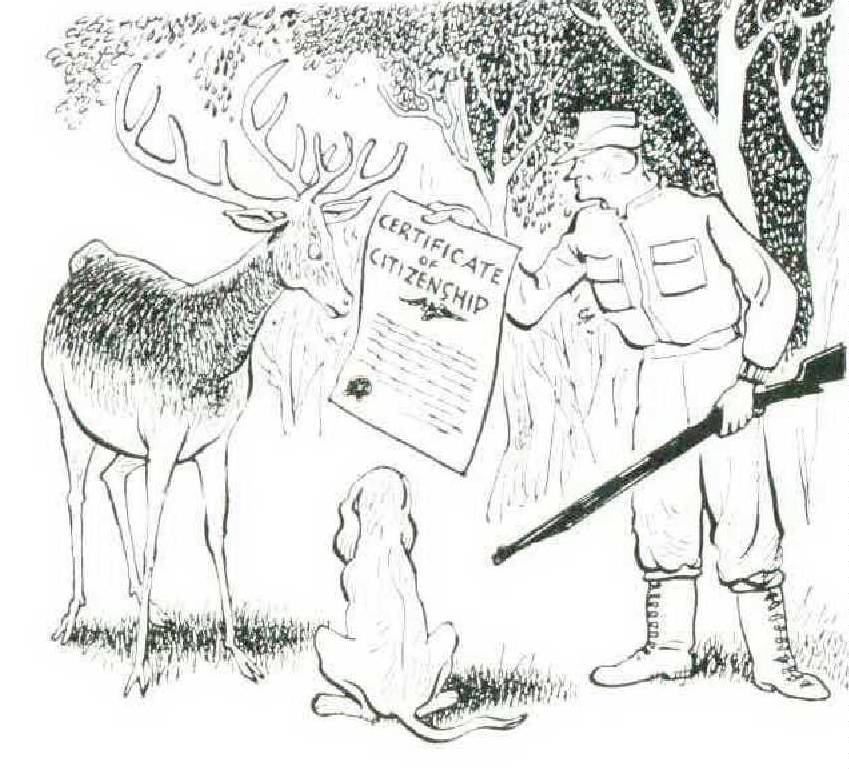
This awful truth dawned during an attempted holiday in Massachusetts, where I was told that foreigners who have not been domiciled there for a year or more are not eligible even for nonresident fishing licenses.
My American friends were incredulous. I must be joking. I must have been misinformed. Now I have it in writing from Mr. Gaylord B. Pike, the most appropriately named chief Conservation Officer. “Please be advised to the following: Any alien who has been a legal resident of this Commonwealth for at least one year may be issued a license to fish in the inland Witters of the Commonwealth. The cost of said license is $7.25.
This is a pretty serious matter. It antedates the Internal Security Act of 1950 and the Immigration and Nationality Act of 1952. It cannot he dismissed as some vagary of Senator McCarthy’s hunt for Communists, or even treated as a red herring; it is strictly a fresh-water problem.
It means that the most harmless and desirable type of human being, the angler, is under a cloud. No other category of foreign visitor is more likelv to be a reasonable, unsubversive, well-balanced person, the sort of chap that tiny country in its senses would want to encourage. Nothing could be better calculated to modify the rather lurid impressions of America that tourists sometimes receive in madhouses like New York, Chicago, and Hollywood than some experience of the woods and streams of this land, and the sort of people who are attracted to them.
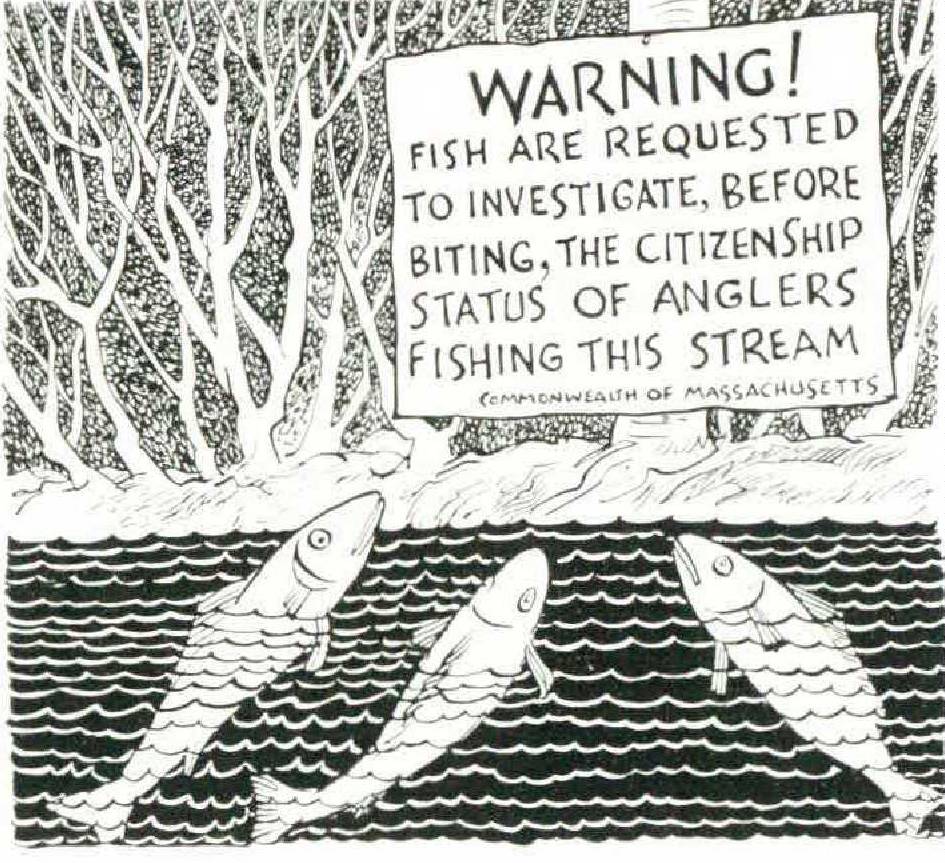
It is a situation that bristles with dangers. What will happen il it becomes known abroad that in some American states only American citizens may fish and hunt? It may be that in some countries there are demagogues who will demand a policy of retaliation. Americans from the offending states may find themselves ostracized by the game wardens of Canada and Scotland and even Kenya, where an Ernost Hemingway can buy his hunting license without demur.
These disturbing reflections prompted me to investigate further. I tried to buy a fishing license in New York State. There I was told (erroneously, as I later discovered) that as an alien I could not, although I have lived and paid taxes in this state for nearly twenty years.
I asked the Fish and Wildlife Service in Washington whether there were any other states like Massachusetts, to be avoided on future holidays. But there were no records kept there of the hunting and fishing laws of individual states. This is one field in which stales’ rights remain almost unimpaired. The only information available was that under a Federal aid program based on the excise tax on sporting arms, sporting ammunition, and fishing tackle, ten states had reported the sale of a total of 5860 alien fishing licenses during the year ended June 30, 1953. California topped the list with 2780.
New York came next with 1483, and this prompted some correspondence with that state’s Conservation Department, as a result of which I learned that foreigners can buy both fishing and hunting licenses if they use a special form provided for their benefit. To secure the hunting license, they must obtain a statement cert dying that “the applicant is a person of good moral character, and may safely be licensed to hunt, fish, or trap,”which must be signed by a county judge, a sheriff’, or the county clerk.
Anxious to find out for sure just how far the rot had spread, I next conducted a private poll of the fortyeight states, sending a letter to the fish and game departments of all except Maine, which definitely encourages holiday-makers and maintains an information bureau in New York for their benefit. In my letter I enclosed a stamped addressed postcard which on being completed was to show whether the slate allowed overseas visitors to fish or to hunt, or both. The response was remarkably good, and after jogging a few nonstarters with a follow-up note, I completed my review of the Union.
The score showed that six states will not let foreign visitors fish, and thirteen will not let them hunt.
The nonfishing states are Delaware, Kansas, Massachusetts, Ohio, Pennsylvania, and Virginia. In Pennsylvania, however, Canadians are regarded as native Americans; and, in addition, the Game Commission is empowered to issue licenses to “distinguished" foreigners.
The nonhunting states are Connecticut, Delaware, Illinois, Kansas, Massachusetts, Nebraska, New Jersey, New Mexico, North Dakota, Ohio, Pennsylvania, Utah, and Virginia.
There are local variations which sometimes soften the effect of the outright veto, such as the Massachusetts proviso that legal resilience of one year or more qualifies the applicant, or a report I received from one source in Ohio that in this state it may be possible for citizens of countries which allow Americans to fish and hunt to obtain licenses, although the Ohio Division of Wildlife replied with an unqualified “No” to both questions on my poll card.
In some states, including New Jersey and Connecticut, ownership of real estate saves the day for the foreign resident (value $2000 in New Jersey), and in Virginia he may fish or hunt without a license on land he owns; but these loopholes do not help the ordinary visitor, or even the ordinary citizen of a foreign country who is living in the United Slates. One legal expert said that being on the staff of the United Nations would not confer any sort of diplomatic immunity in this connection, but I did not pursue the point. A fair amount of research did disclose, however, that the fishing and hunting privileges of British subjects are not protected by any treaty of friendship and commerce between the British and American governments. If they were, state governments would of course have to bow to the force of any treaty ratified by the United States Senate.
It may be that outside the iron curtain there are foreign countries so benighted that they impose similar restrictions on Americans; and if there are, it would be interesting to hear about them.
The origin of the American regulations is puzzling, and so far I have not discovered a satisfactory explanation.
It cannot be said that foreigners are prohibited from fishing in some areas because they do not pay their footing, because in all cases where it is allowed, they have to buy nonresident licenses, which cost much more than the resilient licenses issued to people living in the state (a distinction which also applies to American citizens from other states). It may be, but it would be indelicate for me to make such a suggestion, that the angling prowess of foreigners is felt to be so great that it is feared they would clean out the local waters if they were allowed to get at them.
Hunting, some might maintain, is not in the same harmless category as fishing. It involves guns, and the ban on il might be regarded as a wise precaution against the dangers of a Soviet fifth column. I was told that the custom originated in the anxiety of some states in colonial days to keep “armed hostiles" north of the Canadian border, and a correspondent in New Mexico reported that it was a felony for any foreigner to have a firearm in that state “on account of our proximity to Mexico and the wetbacks.”But there are plenty of wetbacks in such neighboring states as California, where foreigners can hunt freely.
It is apparent that there is no agreement among the various states on this question, Colorado permits hunting, but is said to feel that it should be stopped. “Due to an inadvertent omission in a License Act, passed by the State Legislature in 1947, the Supreme Court has ruled that there is nothing in Colorado law prohibiting an alien from hunting in Colorado,”
I was informed. “There is a possibility that this omission may be corrected at the next session of the legislature.”
Nebraska, on the other hand, is apparently thinking of changing its law prohibiting aliens from possessing firearms. In Illinois I was told that the state legislature might be asked at its next session to expunge the ban on alien hunting, and the hope was expressed that “the Statutes may be modernized to fit ibis modern age of travel when many foreign guests find it convenient to come to America for business purposes and at the same time wish to enjoy some hunting and fishing in our great outdoors. It was added that the legislation was apparently passed “many years ago because of some incident in the Chicago area that may have caused some difficulty with reference to taking outdoor life” — a fascinating echo of Middle Western history, about which one would like to know more. And Mr. Lester Bagley, Game and Fish Commissioner of Wyoming, wrote: “Aliens are encouraged to come to Wyoming to hunt and fish. A special statute passed by our legislature many years ago grants aliens the right to bear arms for hunting purposes.”
Oklahoma, it seems, is willing, but has few takers. “Our law,” I was told there, “provides a $25 fee for an alien hunting license. Have never sold an alien hunting license. Many are probably hunting and fishing hereon regular resident licenses. In Utah any alien who is eligible to become an American citizen may purchase a hunting license after being domiciled in the state for fifteen years.
Dread of foreigners going around armed to the teeth is evidently not the sole cause of the reluctance of some states to let them bunt. In New Jersey and Connecticut foreign visitors must even refrain from pursuing game with bows and arrows. The whole thing remains, as the hero of The King and I put it, a puzzlement. Will no modern Teddy Roosevelt arise to appeal to the sporting instincts of the states?