Europe in the Off Season
MITCHELL GOODMAN is a New Yorker who has lived in France and Italy. After living in Vermont, he is once again in New York, where he is writing full time.
by MITCHELL GOODMAS
IN THESE days of mass tourism Europe (as Europe) is not easy to find if one comes to it in what the tourist industry calls the “season” (June through September). It’s there, all right, right out on display, stuffed with events,and with all the trimmings. (Prices to match.) Altogether it’s about as lively and natural as an oldfashioned museum with the result that too many travelers come home feeling they’ve seen the whole thing under glass. This is almost inevitable: Europe in the summer is a vast exhibition, ogled by millions of American and European tourists. The other eight months are called the “off season,” with the implication that there is something second-best about them. The opposite is true. In those eight months the bunting is off and Europe is just Europe, and that is the time to see it if one wants the sense of having been “inside.”
The European summer is loaded with pitfalls, side shows, and tourist traps. Under the smooth guidance of the well-oiled state tourist organizations, the Europeans try to give Americans what they think we’re looking for. In many places it’s a put-up job: illuminations, brass bands, false faces, and rigged celebrations, to say nothing of the leering emphasis on such national monuments as the Folies Bergères and the quaint clip joint with terrace on Montmartre. All at colorful “season” prices.
What’s more, in summer Europe is really only half there. Many Europeans lower the green iron shutter on the shop and get out of town, running from the heat and from the tourist flood. All the great cities are at least half asleep. Even Paris seems like a provincial town shut tight against the heat. Theaters and operas and concert halls are closed; the general slowdown is much more thorough than anything known in America.
And then, hemmed in by hundreds of thousands of half-familiar faces and seersucker suits, there are times when you can’t see the Europeans for the Americans. Anyone who has been in Florence in the past three summers can describe it: the feeling that perhaps you never left home. In midsummer even Paris seems semi-American, and the number of Americans in a Roman summer considerably dilutes the flavor of that ripe city.
There are other midsummer nightmares: the practical problems like finding a way through the crowd to t he kind of hotel one wants, or watching the clock and the calendar from city to city, tied to a string of advance reservations. In this tight situation there is a better than even chance of coming face to face with that embarrassing lust for dollars that overcomes many European tourist traders in what might be called the hunting season. These sportsmen go into the field muttering “Americans have all the money”; and even the majority who are not professional tourist-trimmers can’t see why the lucky exchange-favored Americans should pay the same prices they pay. But even if the trimmers are merciful, the summer is a lot more expensive than eight other perfectly good months of the year — simply because it is the time of a seller’s market in what the tourist buys. It means, specifically, that many prices are up 25 to 40 per cent over “off season,” including the prices on some everyday items.
From late September to the end of May there is more to be had, effortlessly, at lower prices. To start with, the unharried travel agent will be more likely to find the less expensive way, and his fee and/or commissions (some of which the client pays, whether he knows it or not) will be proportionately less. Then there is a saving in transatlantic fares. From the first of August to mid-April by boat the round-trip cost is off by $40 to $50 in tourist and cabin class, and by as much as $300 in flrst class. By plane (November through March) the saving is about $100 in first class and $70 tourist. Here, as elsewhere, there is a hidden gain in the more relaxed atmosphere and the better service. (More: it is often possible to get cabin class accommodations at tourist class rates.) The same applies to hotels — wider choice and better rooms are to be had for less, and no worry about where to sleep in the next town. In restaurants, again the prices are lower, the plate is piled higher, and the waiter is more affable. In hiring a car (or for garage, laundry, and other services) the off-season traveler gets the same good break, and the roads, most of them narrow, are less crowded. There is much more room in the trains and buses, and none of the summer turmoil of timetables and crowded stations. All in all, the off-season sensations are less those of a customer and more those of a guest.

But even the out-and-out customer — the shopper is better off: whether for haute couture or for souvenirs in the market place the off season is, to say the least, advantageous. For example, in the well-known basket and lace market near the Ponte Vecchio in Florence they will admit in a candid moment that between April 15 and midsummer their prices climb until they have just about doubled. The same goes for most of the shops on the tourist circuit.
Putting aside dollars and cents, Europe from the fall to the spring is a much more friendly, casual, and substantial place. Take as an example the Paris most. Americans never see, Paris in the fall. It is a very different thing to come to it then as an individual than to be washed in on the tourist tide in July or August. One finds oneself alone, as it were, with the Parisians, absorbed into the life of the city (even if only for a few days) at that exhilarating moment when it is reawakening from the long summer doldrums. The Parisians are more themselves after four months of sharing an overcrowded tourist city (one finds them strolling again, gazing reverently at the Seine and its bordering trees), and they are readier to accept the foreigner as an individual, not as one of a million sightseers.
This reawakening after the fallow summer is a kind of revival we hardly know in sleepless big-city America. There is a sudden return to life: the theaters, galleries, opera, concert halls are reopening, refreshed, and everywhere there is an atmosphere of people going eagerly back to work. Thousands of billboards announce the season’s events, from boxing to marionettes to political rallies. The movement in the streets is of a different quality — the bustling headlong zest that makes the ambiance of Paris street life. The heat is off — in more than one sense — and one is tempted to go for those long walks that bestow the sense of discovery and of something like participation in the life of the city. One begins to know the way, to feel at ease in the reasonable, coherent pattern of this city, so unlike the impersonal disorder of the other great cities. It is there now, totally actual, in all its dense detail—the cries of the street vendors, the smell of roasting chestnuts in sidewalk ovens along the Boulevard St. Michel, the spirited movement of students and painters on the Left Bank, the long relaxed conversations in the cafés, the stylish Parisienne browsing in the shops of the Faubourg St. Houoré; French faces and gestures and sounds everywhere replacing the tourist parade — the undiluted reality of Paris.
Walking along the Seine and through the contrasting quartiers (that are like a dozen or more separate villages) one comes to feel completely at home. Discoveries are made: the leaves falling in the Bois, the faint melancholy gray of the late afternoon streets telling their long history, the lively book and print shops near the Sorbonne, the autumn sunset over the Seine bridges. The traveler with a talent for walking comes into possession of odd streets with small out-of-the-way squares and churches the summer tourist never sees, the brisk gamy life of the markets, the easygoing local café that makes one feel like a native. It is Paris in depth; it absorbs the senses and the emotions, it becomes everyman’s second city.
And if he stayed long enough, a traveler might stand at a high window (of a well-heated hotel room) and watch the snow falling over the angled roofs and chimney pots to make an unexpected vision of Paris, strange under the street lights, muted, and as if thrown back to an earlier time. But the snow does not last, and though it may be damp and cold at times, it is not nearly as cold as New York or Boston. The life of the cafés goes inside, at least as lively over vin chaud as over pernod when the tables were out on the sidewalk. Or for another kind of warmth there are the Left Bank cellars for Le Jazz Hot with cognac (free of the craning, littering busloads of American Express sightseers). If one cares to go deeper, to get an impression of the facts of life in Europe today, to see the living details of the boucherie and the boulangerie that make the political headlines, this is the time for it. The easy summer, when fruits and vegetables at least were cheap, is over: in some parts of the city the bite of cold and inflation is felt; at that point Paris becomes more than an entertainment. To balance these hard facts there is the Paris Christmas: the midnight Mass in Notre Dame, and afterwards the celebrations called réveillon when the resilient gaiety of the Parisians overflows into cafés and restaurants full of oysters and white wine. For Paris, read London, Amsterdam, Geneva, Madrid, Milan, Florence, Rome, Naples. They are all dormant and tourist-catching in the summer, wide-awake and going their own ways in the off season.
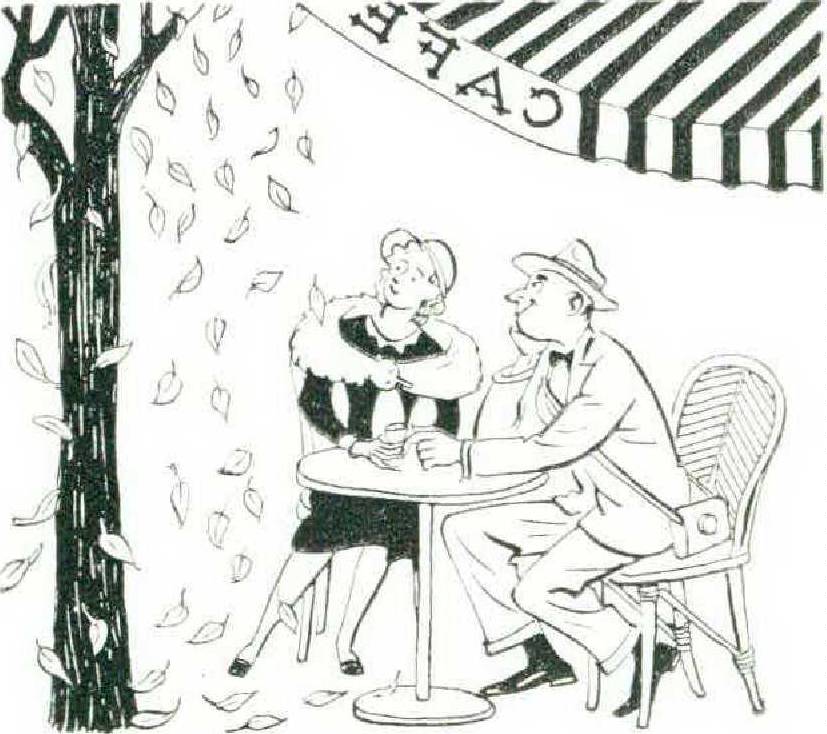
For those who come a little later, or stay a little longer, there is Paris in the spring — which is one reason few Parisians ever live anywhere else.
London, too, opens up in the fall, to expose, in sharp detail, all the rich and intricate life that is blurred by the soft edges of summer. The Londoners are back from Blackpool or their cottages up the Thames, or they come out from behind their hedges, and it begins to be clear why Ilenry James thought this the most interesting society in Europe. With no heat to buck and no crowd to follow, a man can walk; and walking is the only way to get the full impact of this metropolis — the long unplanned walk on a clear October morning, to find the little-known corners like old Mitre Tavern in Mitre Court, or the concealed surprises of Soho and Chelsea and Hampstead, that quiet village within the city with its hilly heath in autumn colors. Or Shepherd’s Market, or Fish Street Hill, or any of a thousand small streets that are missed in the summer rush — all the mixed and dusty facets of London that make their deepest impression in the somber lights of fall and winter.
A long day’s pottering through day-to-day London will evoke Dickens even for the man who has seen him only in the movies. And at the end of it he will come back through the misty lighted streets, past old red brick, as if he lived in them, to an open fire (still so prevalent) and tea, with the satisfaction of having immersed himself in the dense life of a great city. It is, he realizes, another of those old cities that are more themselves in fall and winter, more in character, like some old houses full of odd corners that are at their best in the light of a winter afternoon.
And here again there are pageants: the Lord Mayor’s Show early in November, the English Christmas, the London crowd in Piccadilly on New Year’s Eve. And then, from January to the end of March, perhaps it is a good idea to get out of London before the dust-heavy fog settles down and the chill gets to one even in bed. But who knows? Some may not want to leave even then: English is spoken, and in its theaters and music halls and lecture halls and shops and pubs London will provide an American with more indoor entertainment than any place on the continent.
If the craving is for springtime in January, Sicily is only overnight from Rome, that subtropical island rich with almond blossom and orange harvest, flowering cactus and long white beaches — or (until May) skiing in the sun on Mount Etna, the smoking volcano above and the winedark sea below. This is one example’ of the variety that off-season Europe offers. Another is the variety of springtimes. In March the traveler can go north from Sicily to the Neapolitan spring, and then north again in April for the coming of violets in Florence, and then again north to catch the first buds in Paris.
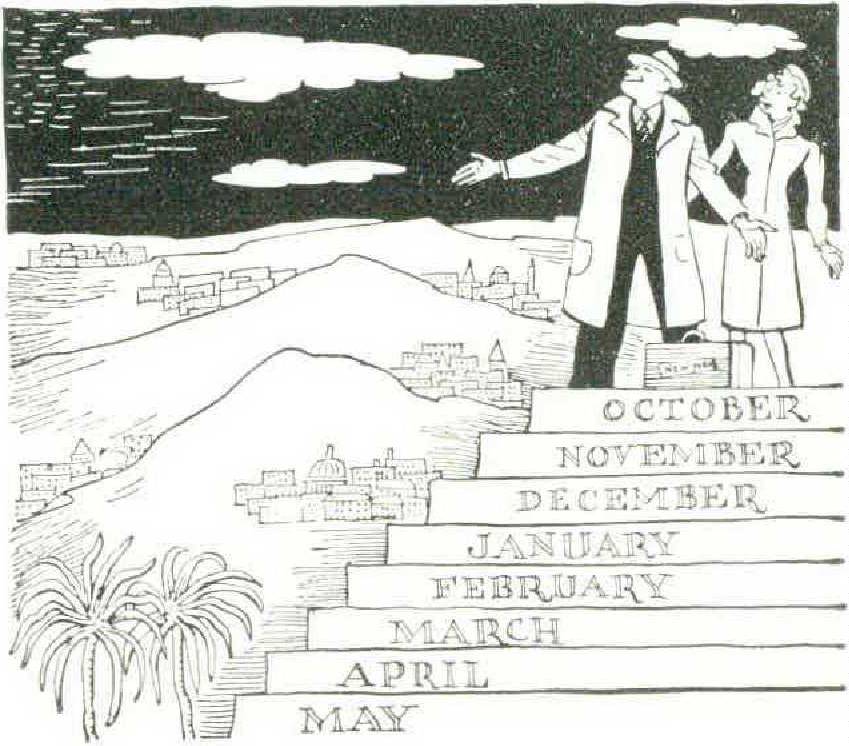
But it, hardly matters where the unimpeded off-season wanderer goes: he has avoided the terrible heat of the Florentine summer, seen the Loire Valley in autumn brilliance (far more appealing than the flat heavy green of summer), absorbed Holland’s miles of art gallery without heat or noise; he has had the Mediterranean beaches without the crowds. He can travel in well-heated trains to the sparkling Swiss winter or into Italy where Milan, Florence, Rome, Naples, Bologna, and five or six other beautiful towns arc resounding with music and theater and opera. Or he can escape from these wintry cities to the sheltered gardens of the Italian Riv iera Bordighera, Sun Remo. Rapallo — two or three hours away. The juxtapositions are marvelous; from the vigorous life of Milan and its La Scala (the most challenging city in Europe today, seeking new ways of living and working) it is possible to go in one hour to some of the best ski slopes iu Europe, or, in the other direction, in two hours lo the sun and flowers of the sheltered Riviera.
The Christmas festivals of Italy with their strong pagan undertones are worth remarking. There are the torchlight processions in the Alpine villages; there is Ceppo, the Father Christmas of Tuscany; there are the primitive reed pipes and bagpipes of rustic musicians around the altars of Calabria, the Matese, and the Abruzzi in the mountainous south; there are the best of the big-city celebrations in and around Naples. In Italy (as in Holland) there is what amounts to a double Christmas; first on the twentyfifth and then two weeks later in the Festa Befana (Epiphany), a festival of candy and toys for the children. This reaches its high point in Rome’s Piazza Navona in a passionate surge of rejoicing, amidst the marvelous figures made by the woodcarvers for the Christmas cribs.
Some miscellaneous tips for off-season travelers: 1) Unless one is a whiter-sports fanatic or wants to taste the arctic winter, stay away from Scandinavia before June and after September. Outside of Copenhagen (which some say is as gay as any city in Europe) there is not enough indoor recreation to compensate for conditions outside. 2) If warmth and recreation are first considerations, stick close to the big towns in winter, where there is usually plenty of steam heat. 8) The Mediterranean, serene in summer, can be very rough at other times, especially in the spring and fall, so that a Mediterranean cruise might fall short of expectations. 4) It is widely believed that Florence, with all its charm and treasure, is a good place to beat the winter. It is not — from January to mid-March it is stone-cold. 5) For the best break on the weather an itinerary should take account of gradalions in climate from north to south. If the plan is to cover the ground from Italy or Spain up to Scandinavia between, say, May I and June 30, start in the warmer countries and work north with ihe sun. If the trip extends from September 1 to October 30, start in the north and travel south. With planning and sonic luck it is possible to get the best of all worlds: England in September and October; Paris in October — ripe and clear; southern France and the top half of Italy for good mellow days in late October and November (and often into December); warm sun and flowers in December and January in the sheltered Riviera towns like Nice, Menton, Bordighera; and the Sicilian springtime in February.
In the end it comes back to this: in the summer the traveler can be no more than another tourist; in the other eight months he becomes the uncommon foreigner, who can lie an observer and a witness, and who may even join the party as a guest.