First Door on the Left
WEARE HOLBROOK, who lives in Hartsdale, New York, has written frequently for our Accent on Living pages.
by WEARE HOLBROOK
THERE probably isn’t a woman alive who doesn’t cherish the secret belief that, if the worst came to the worst, she could save the family fortunes by becoming an interior decorator. Sometimes the worst does come to the worst, and the belief ceases to be a secret. The average housewife, however, usually sublimates her professional ambitions and retains her amateur standing.
But even as an amateur she may work minor miracles — especially if she has the coöperation of her husband. Having just returned from a weekend with the Dithertons, I know what a couple of determined aesthetes can accomplish doublehanded.
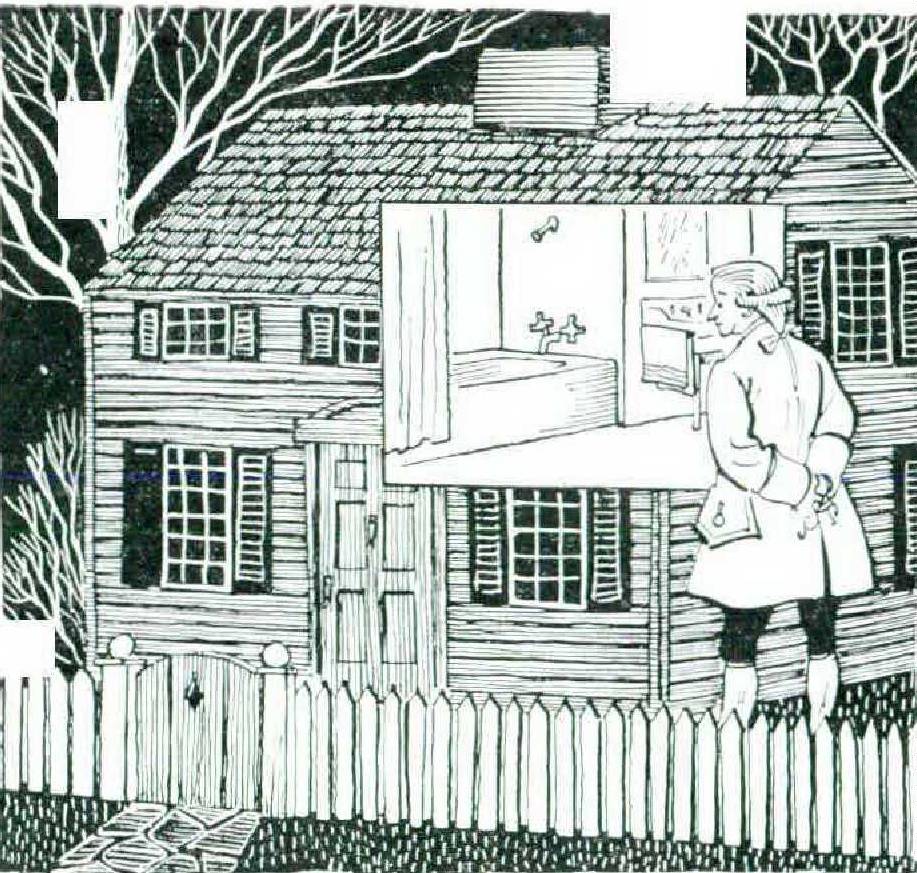
Last year the Dithertons bought an old farmhouse and remodeled it into an older farmhouse. The original structure was about a hundred years old and quite unpicturesque. Now it looks about two hundred years old and thoroughly picturesque. The reason for this turning-back of the calendar is that circa 1855 represents no particular Period, while circa 1755 is definitely pre-Revolutionary, and interior decoration without a Period is like wine without a label — it can’t be identified except by an expert.
When the Dithertons took over the house it had coal stoves, mail-order carpets, iron bedsteads, and graniteware kitchen utensils. These have been replaced by fieldstone fireplaces, hooked rugs, four-poster beds, and copper kitchen utensils. The oil lamps and golden-oak “suites" gave way to wrought-iron candelabra and certified antique furniture which Mrs. Ditherton wangled from little shops on Madison Avenue.
After the transformation of the old place had been completed its former owners wouldn’t have recognized it, but their grandparents might have. Entering it is like stepping back into the eighteenth century. You bump your head on low-hanging lintels and stumble over raised doorsills, just as our floundering fathers must have done in Colonial days. (In fact, it wouldn’t have surprised me to find a bronze plaque in the front hall reading “George Washington Tripped Here,” and I suspect that the fluffy white wigs so fashionable in his time were more than merely decorative: they protected the noggin from whacks against the hand-hewn beams of underslung ceilings.)
In their efforts to avoid anachronisms and hold the pre-Revolutionary line, the Dithertons have been as painstaking as any million-dollarmovie director. Everything in the house, down to the last rattail hinge and hickory floor-peg, is historically accurate — with one exception. Wandering down the candle-lighted hallway on random flooring billowy with age, it is easy to imagine that you are just getting your land legs after a cruise on the Mayflower.
But the moment you enter the bathroom, you are smack back in the twentieth century. At the flick of a switch, it jumps out at you from the shades of antiquity — a strictly contemporary lavatory glittering with tile and nickel plate, exactly like those in every unit of every elevator apartment house.
The Dithertons realize its incongruity and deplore it. “But what can we do?” Mrs. Ditherton cries despairingly. “ We tried pewter sconces, hoping that candlelight might at least soften the glare; but Horace simply couldn’t shave without cutting himself. No matter how much individuality a house may express, bathrooms are the same the world over. Apparently there’s no such thing as a Period bathroom.”
That’s where Mrs. Ditherton is wrong, though I didn’t tell her so. The first bathroom I ever used was distinctly Period. Not Colonial, to be sure, or even Regency. For purposes of historical identification it might be called Late Grover Cleveland. But it resembled the dazzling “modern convenience" of today no more than a Conestoga wagon resembles a hardtop convertible.
The color scheme of this bathroom, which my grandfather had had installed at great expense, was brown on brown. There wasn’t a white tile in the place. The woodwork was brown, the curly-cornered linoleum was brown; the oilcloth on the walls above the dado (an architectural term, and not what you think), though originally old ivory with a Delft pattern of little windmills, had faded to the color of well-seasoned meerschaum.
The outside of the tub, including its ball-and-claw feet, had been painted a rich chocolate, and so had the pipes above and below it. But the inside of the tub was a beautiful pale blue, and sometimes during a hot bath bits of this blue would flake off and float — a phenomenon which convinced the younger generation that Chicken Little’s falling sky was no mere pigment of the imagination.
Grandpa’s razor strop beside the washstand was brown, too, as was the stand itself with a mottled marble top the color of prune whip, and copper faucets whose rabbit-ears had to be squeezed with both hands to make the water run. Above the washstand hung an aged mirror which gave back wavy submarine reflections. It made you look as if you had been stung by bees while recovering from an attack of jaundice, and Grandma often complained about it; but Grandpa said he was used to that mirror, so there it stayed.
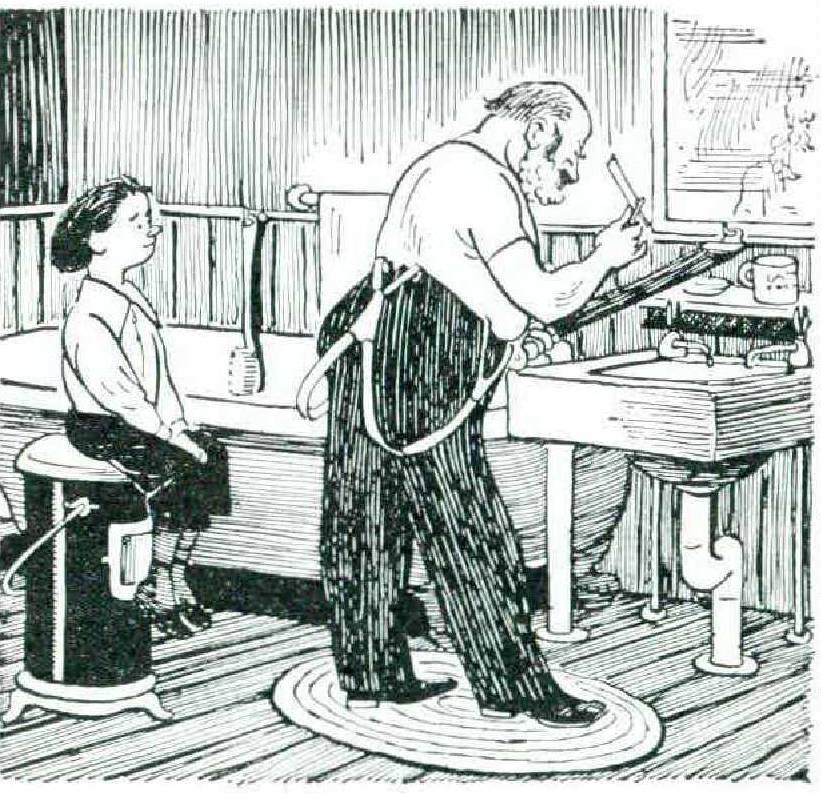
As for the toilet, it was a massive affair with a mahogany seat and an overhead tank operated by remote control with a chain. A pull on this chain produced a diapason worthy of a Wurlitzer, to which the whole house vibrated; and long after the echoes died away, the overhead tank muttered to itself like a distant thunderstorm.
In the summer the brown paint on the walls and the linoleum on the floor became slightly sticky. But in the winter they were glacially smooth and often reflected the glow of a portable oil heater with mica windows and a flat top for kettles of hot water to temper the chill of the bath. A mingled aroma of soap, steam, and kerosene meant Saturday night. It’s a miracle the bathers didn’t suffocate or get blown up, but they never did.
Unlike the assembly-line lavatories of today, that old bathroom had character— and so did the people who used it. They never referred to it familiarly as “the johnny.” In fact, they didn’t refer to it at all but merely mumbled something about going upstairs to wash their hands.