The Weimaraner
KEN W. PURDY,formerly editor of Argosy, True,and Parade,is now free-lancing. His book Kings of the Road was published by Atlantic̶ Little, Brown in 1952.
by KEN W. PURDY
LIKE sports cars and Italian movie actresses, the Weimaraner dog was a post-war phenomenon in this country. The Weimaraner is a big dog, built like a pointer, floppy ears and a docked tail, usually smoothcoated. His color is distinctive, ranging from liver-brown to silver-gray. He has blue or amber eyes. He’s strong, heavily muscled, fast-moving. He’s among the most beautiful of all dogs and among the most intelligent of all animals.
For 150-odd years the right to own a Weimaraner was a prerogative of the Prussian nobility, who used the dogs for hunting, as they did many other breeds, including such esoteric Hunde as the Benegalese Brache and the St. Hubertus Brache. But only the Weimaraner was kept in the house. He was a constant companion, and as a result, he developed an instinct. for protection that is now so strong it’s embarrassing — if you’re the thin-skinned type that gets queasy at the sight of blood.
I was given a Weimaraner a few years ago. He was named, if memory serves me, MacBain’s Discovery of Rock Ridge, and he was a handsome gift in more ways than one, since the going price of good Weimaraners at the time hovered around $1000. My son Geoffrey and I fetched him home from the kennel, seventy-five miles away, one Saturday afternoon. We were within five miles of home when the pup began to scratch at the door of the car. Geoff was convinced the dog had to meet a call of nature, and
to humor him I stopped the car and opened the door. Mac fell out and demonstrated that the boy was right. I suppose it was one of the last things his mother told him before he left her. He had never been in an automobile before.

It would be incorrect to say that Mac was bright. A bright dog, or a bright child, is one who learns quickly. The word inadequately covers one apparently born knowing. The intelligence of the Weimaraner is a cliché among his devotees — one I knew of used to answer the telephone when it rang, put it on a table, and sit there breathing heavily into it — but even rated by such standards Mac was exceptionally gifted. Moreover, he was kind, amiable, even-tempered. No dog ever bit a man to the bone with less display of animosity.
Mac was a year and a half old when he scored his first bite. He had formed the inevitable attachment of a Weimaraner for one member of the family— in his case, my wife. When Mac was alone in the house with her, nothing could persuade him to leave her side. He treated her like an idiot who must be kept from falling down the cellar stairs.
One winter day the newspaper delivery man came around to be paid. He and my wife chatted for a bit, Mac sitting beside her calmly enough, and then the fellow handed over a copy of the New York Times. Mac bit him just once on the wrist, hard enough to draw blood through a leather jacket and two woolen shirts, but he didn’t growl, strip his teeth, try to chew the arm, or do any of the other things a biting dog typically does; he just hit the man one dreadful lick and dropped him.
A few weeks later, at the mailbox down the road, a woman from a neighboring house, talking with my wife, suddenly said, “Oh, this is your magazine,” and handed it over. She was badly hurt, because her arm was bare. Mac watched with tail-wagging solicitude as my wife bandaged the arm. He couldn’t have been nicer about it. It was obvious that he re-
gretted the woman’s foolhardiness in attacking his mistress.
I consulted with other Weimaraner owners. Mine was a thrice-told tale, they assured me. One fellow had had an argument with a handy man over the dusting of some rosebushes. The man raised the tube of insecticide to show the quantity left; whereupon the faithful Weimaraner hit his arm so hard, at a dead run from about ten feet away, that he literally threw the poor fellow, as a wrestler would have done.
Another devoted owner had had two incidents on one Christmas Day. He’d been in his parked car and a woman friend had stuck her hand in to shake his. The fellow had just had time to wrap her wrist in his handkerchief and get her to a nearby doctor’s office when a man friend came along and did exactly the same thing with exactly the same results. To the Weimaraner, both offenses had been the same, too: willful and intentional trespass.
Were my friends and fellow members of the Weimaraner Club (membership was obligatory) thinking of giving up their dogs because of these peccadilloes? Certainly not. One, whose dog had scored eight bites, was moving to Florida to give the beast a fresh start in life. Another, asked by a stranger if he’d sell, replied, “If I weren’t sixty years old I’d knock you down for that.”
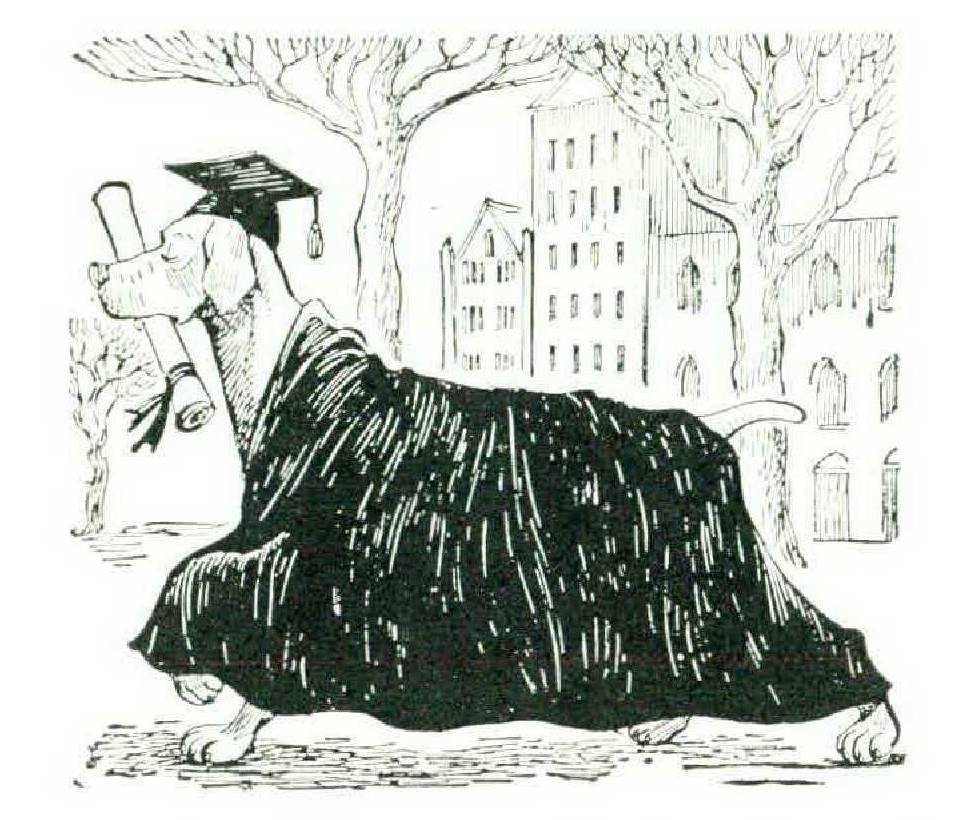
I was of the same mind. It was unthinkable to part from such a princely animal. Who could sell a dog that could learn in twenty minutes to go into the pantry and bring back a can of dog food, almost never slipping so far as to pull one off the shelves where the soup was kept? But I didn’t feel that I could reach far enough into the crevices of Mac’s doggy brain to change his ways myself. I looked for professional counsel. I sent Mac to a posh country training school — it called itself a college, as a matter of fact.
We missed him while he was away, but my wife confessed a certain relief. Aside from the sensation of having a short-fused grenade in her pocket that Mac gave her, she was happy to be able to come home and not be greeted by being slmmed up against the side of the house, another endearing Weimaraner trait. The only practical aid was a garbage-can cover. My wife would open the door of the pen and then spring back, the can cover in front of her like a gladiator’s shield. Whimpering happily, his front teeth chittering together like castanets, Mac would bounce off the poor woman ten or fifteen times before he felt she knew he was really glad to sec her. She became very adept.
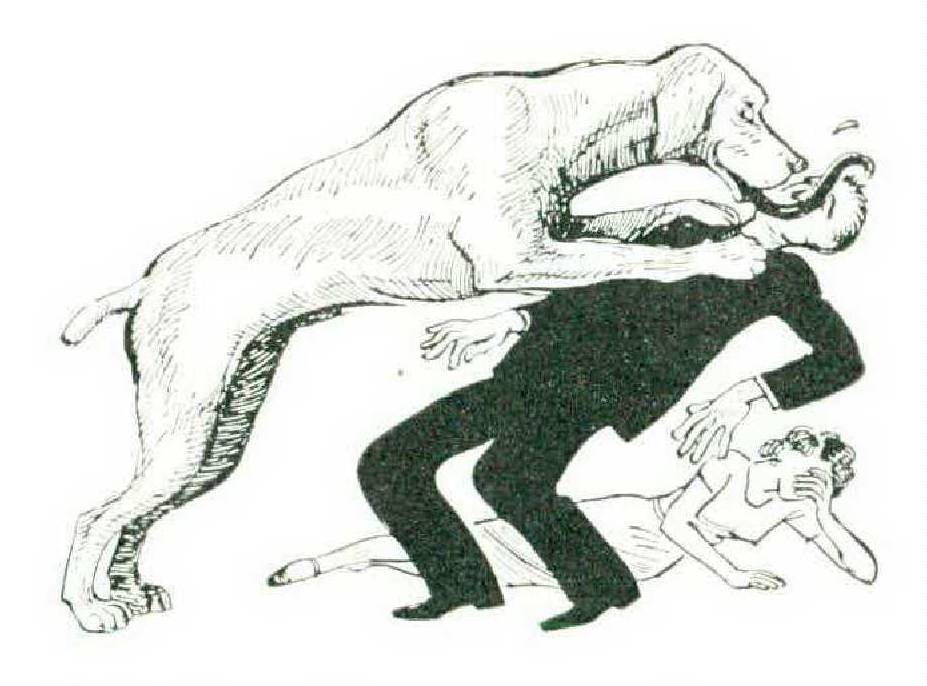
I have seen a Weimaraner slam a 175-pound man to the ground in the excess of emotion engendered by a four-hour absence. In my researches I encountered one Wisconsin owner who has twice been under doctors’ care as a result of such greetings. (Yes, I know: you are supposed to step on their toes. But a Weimaraner thinks you are just being clumsy, forgives you, and ignores it. Weimaraners have no pain thresholds.)
There was the matter of fur coats, too. The Weimaraner is likely to be upset by any moving object that seems to him excessively shaggy. As a rule, Mac was satisfied merely to point a woman wearing a fur coat. He would freeze and stare at her, his blue eyes unwinking. His first and only encounter with a man wearing one of the old-fashioned blackbear coats, wooden toggle-buttons and all, was more exciting. He pulled me six feet across a wooden floor against a chain-choke collar in his determination to have at the fellow.
The Weimaraner generally stays out of dogfights unless he’s provoked, and Mac was true to standard in that regard, too. He bit only two dogs: one English sheep dog, out of whom he tore enough hair to stuff a small mattress, and a boxer who bit first without warning and was rewarded with thirty-six stitches.
Eventually Mac was returned to us, sporting a diploma and impeccable manners. We picked him up at the school, and he didn’t knock either of
us down. He waited until he got us home, when he belted both of us all over the place. We should have taken warning.
Shortly after the home-coming my wife was alone with Mac one day when a neighbor boy came to the house on an errand. She gave him two cookies. Mac, as always, was standing at her left side. The child handed one cookie back, saying he couldn’t eat two. Mac’s muscles bunched violently, but he made no other move. My wife was delighted, and made mental note to send the trainer a bottle of Scotch. She left the room for a minute. Mac turned and gravely watched her go. When she was out of sight he reached over and bit the child, just once, very hard, and as amiably as ever. It was all too clear: the school had convinced him only that people didn’t like to see other people bitten. Very well, he would humor them.
Two days later I took him back to the school and gave him to the man who had trained him. I couldn’t bear to sell him but, on the other hand, I couldn’t stand the bloodshed that keeping him entailed.
A few weeks ago my wife saw a big Weimaraner waiting with his master for a Madison Avenue traffic light. Having once been an Owner, one can’t resist, and she fell into conversation with the man. She told him about Mac, and particularly about his propensity for fur coats. The fellow was fairly supercilious, a tendency that all Weimaraner owners have to some degree. Very amusing, he said, but his dog was much too well disciplined to commit any such breach of discipline. My wife looked admiringly at the noble animal. The hair on his neck was up. He rose from his haunches, pointed briefly a woman in
mink, loosed a scream of rage, and lunged for her.
We’re dogless now. We’re waiting for Modern Science to produce a biteless Weimaraner. Until then we’ll stick with Siamese cats.