What's New in Aluminum?
It has been said that today most of us are seldom more than a few feet from something made of aluminum. In the following interview, Nathanael V. Davis, president of Aluminium Limited, the independent Canadian producer which supplies an important amount of the aluminum ingot we use, answers some key questions which have been raised about this versatile metal.



A. We think it’s a future of promise. We foresee longterm growth of aluminum demand, not only in the United States and Canada, but all over the world. For example, last year, the free world produced close to 3,000,000 tons of primary aluminum. By 1960, we estimate the free world will turn out close to 4,500,000 tons a year — better than 1,000,000 tons in Canada and more than 2,500,000 tons in the U. S. This, of course, is a prodigious growth. There may be temporary surpluses while all this production is absorbed by the fabricating industry. But we and the whole industry are confident that the necessary demand will develop.
Q. This is a 50 per cent increase in only five years. What will it all be used for?
A. Let’s take the automotive field. The new 1957 cars have nearly 30 per cent more aluminum, on the average, than the 1956 cars. Since the automakers are working hard to keep weight down, the proportion of aluminum is bound to rise. They have given serious thought to the possibility of replacing chromium trim with aluminum, and gray iron with aluminum in some engine parts. You probably know that aluminum pistons are almost universal, and there is growing use of aluminum in automatic transmissions, instrument panels, and other components.
Q. Where else do you see new markets opening up for aluminum?
A. Packaging and canning is one area. We at Aluminium Limited think each will eventually consume large amounts of metal. We see a big growth in aluminum foil, packaging, and also in a newer field — seamless aluminum cans. Here, aluminum has a number of distinct advantages —light weight, absence of rusting and longer “shelf life.” Our studies on packaging fish, condensed milk, aerosols and other products — in can sizes where aluminum can compete economically with tinplate — indicate that by 1965 a growing share of the canning industry’s total output will be in aluminum cans.
Then, too, look at the electrical field: copper, as you know, has been widely used in all kinds of wire and electrical equipment. However, new copper production is increasing at the rate of only 4 per cent a year, while the world’s electrical industry is growing at twice that rate. This means that by 1960, aluminum will probably be used in substantial quantities in household wiring and telephone wire.
Our research experts conservatively estimate that by 1960 the world’s electrical industry alone will consume close to 800,000 tons of aluminum a year. That’s one-third of all the aluminum used today in the United States.
Q. In your opinion, what are the main reasons for this growth?
A. One major reason, of course, is price. Even though we have witnessed considerable inflation over the last decade, aluminum is selling today at a price only 25 per cent more than its average 1939 price, whereas prices of other metals have risen substantially. Copper, for example, is up 300 per cent; lead, 200 per cent; zinc, 130 per cent; tin is up 90 per cent. Steel bullets are up 125 per cent.
Also there has been a large population increase in recent years and living standards have risen. Per capita aluminum consumption has increased in the United States from 3½ pounds in 1947 to over 19 pounds in 1954. It is expected that with the growing industrialization and higher living standards throughout the previously underdeveloped world markets, aluminum use and consumption will increase in pace with their growth. Industry research and development programs have brought forth new uses for aluminum. And there has been a growing appreciation of the metal’s properties by consumers, manufacturers, engineers, architects and designers. Every one of us has noted the big increase in the use of aluminum for store fronts, roofing, siding, and low-cost prefabricated buildings. Right now, about 100 multistory buildings are being built in the United States using exterior aluminum “curtain walls.”
Q. What is Aluminium Limited doing in the way of developing new uses for aluminum?
A. One of the most significant advances which our research and development staff has come up with recently is a commercial process to anodize aluminum wire, coating it with a hard oxide insulation. If this development work now being carried out in our pilot plant continues satisfactorily, aluminum wire will be used for many types of electrical equipment, where its properties are particularly suitable. Like many such developments, a lot of time and effort must still be expended to determine the full market possibilities of this new coating. To hasten development of this product, we are working closely with major electrical companies.
I’ve mentioned before our work in canning. Our research and development staff in Canada and abroad is working in a number of cases in cooperation with American and European companies. At Goettingen, Germany, one of our subsidiaries is now setting up a fully automatic line to produce seamless aluminum cans for coffee and motor oil.
Q_. You have talked about aluminum in autos. What about other parts of the transportation field?
A. Well, the future certainly is bright. We foresee a large increase in the use of aluminum in truck bodies, buses, trains and ships. The use of aluminum in shipbuilding has long interested our technicians. Aluminium Limited’s principal subsidiary, the Aluminum Company of Canada, Ltd., has been working with the Royal Canadian Navy for a number of years on applying more aluminum to the building of naval vessels. A good example of aluminum as a seagoing metal is the new St. Laurent, the first of a class of fourteen Canadian destroyer escorts. She and her sister vessels represent probably the most modern anti-submarine vessels yet designed. They have a lot of aluminum in their superstructures, funnels, bulkheads, masts, furniture and other fixtures.
Freight cars may seem to be a less exciting form of transportation, but the Canadian National Railways by the end of the year will be operating nearly 7,000 box cars with aluminum roofs developed by Aluminium Limited research. This represents the biggest single use of aluminum in railroading in North America. We feel it is only the beginning in this field, where capital investment in rolling stock is so important. Each aluminum roof means 1,300 pounds more pay load.
Q. Is growth in the aluminum industry concentrated among the large metal products manufacturers today?
A. No, not by any means. Modern Metals, an authoritative light metals trade magazine, estimates that compared with 4,000 ten years ago, there are now about 24,000 companies in the United States which make products of aluminum. Some are big companies, but most are small businesses, employing as few as a dozen employees, and run by hard-working men with the vision to see aluminum’s great future.
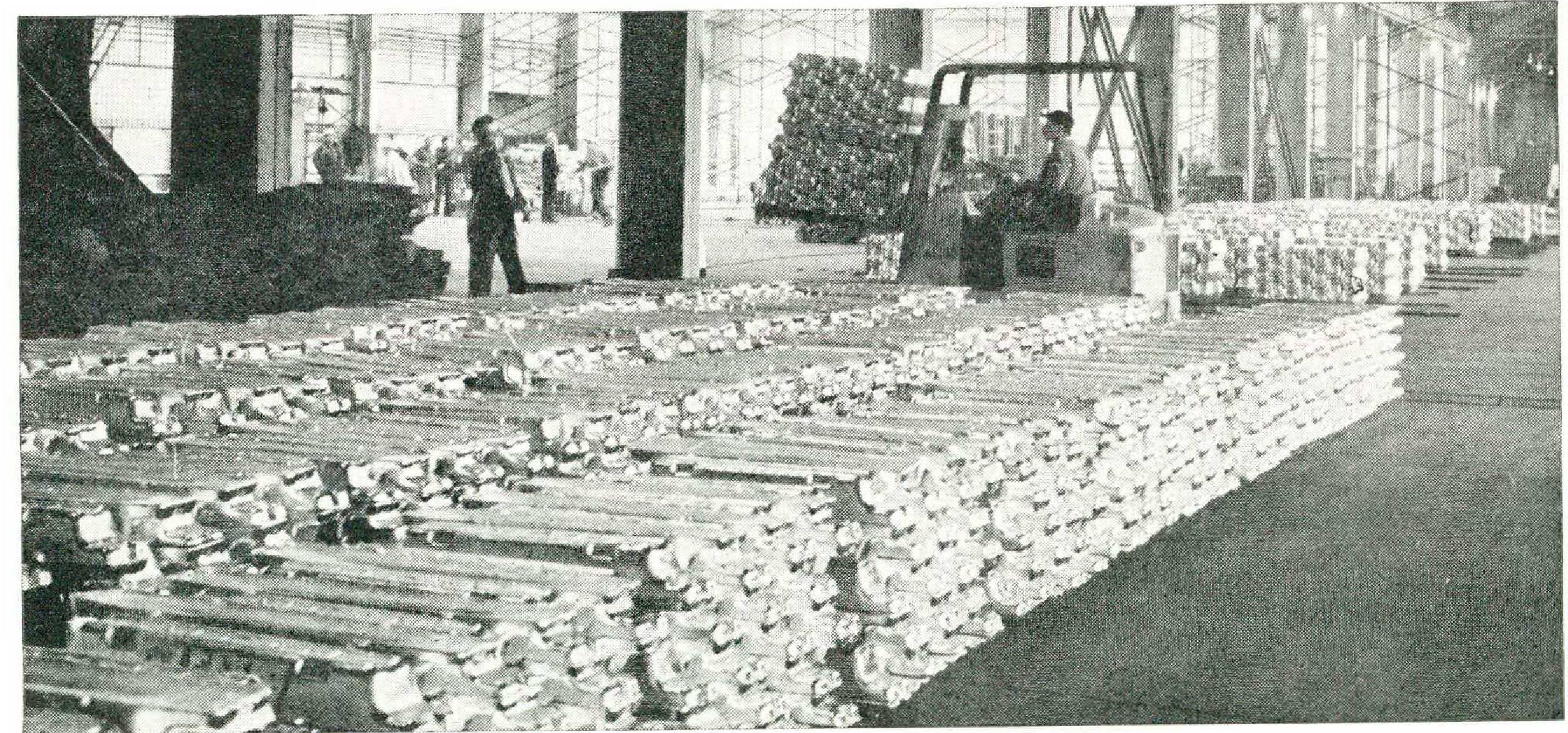
Aluminium Limited this year will ship to the United States about 250,000 tons of primary aluminum ingot. In other words, one ton in every eight tons of primary aluminum used this year in the United States will come from Canada. We supply aluminum producers in the United States as well as independent fabricators who have no ingot facilities of their own. We regard these independent metal fabricators as our natural market in the United States. We expect in the next few years to increase our shipments substantially to these companies.
Q. What is the aluminum industry doing to expand?
A. Aluminum producing companies here and in Canada are investing money, materials and manpower in an expansion program that is, in some respects, unique in the business world.
Supplementing the U. S. primary industry are our own facilities in the provinces of Quebec and British Columbia. These plants have a rated capacity of 732,000 tons. In addition, Aluminium Limited is building or has planned another 300,000 tons, to bring our capacity by 1960 to 1,032,000 tons.
What it adds up to is this: North American aluminum producers, having expanded 360 per cent since the war, are building more than 1,000,000 tons of new annual capacity, or a 47 per cent increase over today’s figure, to catch up with the ever-growing demand.
Q. Why did your company go to Canada?
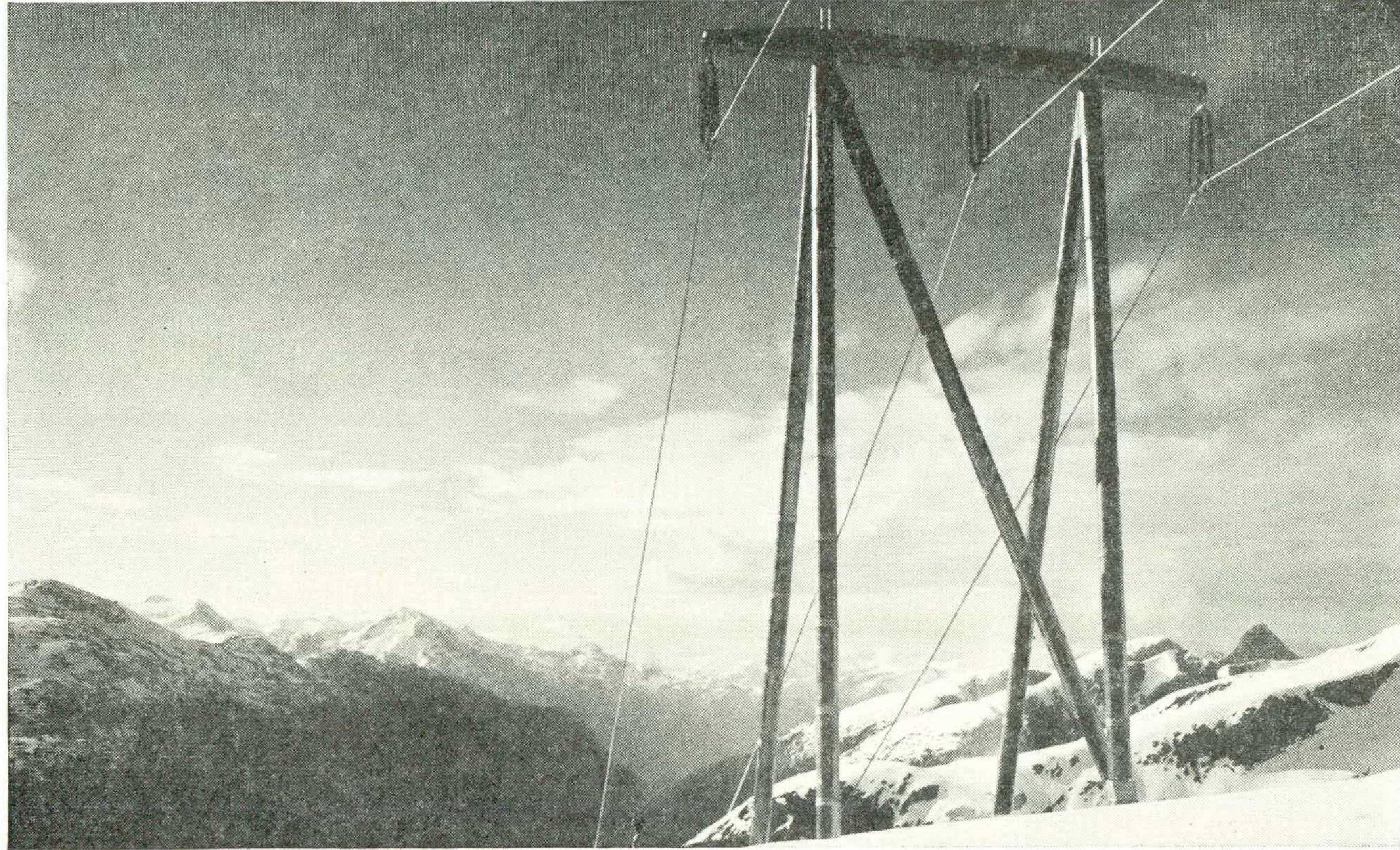
A. Power — hydroelectric power — is the answer. Aluminum reduction requires tremendous amounts of electricity, and Canada has great hydroelectric resources, far from the growing needs of cities and industries. Thanks to this power supply, we have been able to expand our smelting facilities greatly, and our expansion program is the largest single one in the industry. From 1951 through 1959 we will have spent more than $1,000,000,000 on it — or more than $2,000,000 a week. At Kitimat, British Columbia, a smelter is operating at 150,000 tons a year, and the expansion program now underway will more than double its size.
Across the continent, on the upper Peribonka River in Quebec, another big hydroelectric power development for aluminum production is in the making. Here, at Chute-des-Passes, men have started work on a power development which will generate 1,000,000 horsepower of electricity from the vast supplies of rushing water that is one of Canada’s greatest natural resources. This development will firm up hydroelectric power in the Saguenay and enable the company to add at least 120,000 tons smelting capacity.
Q. What is the relationship between your company and United States aluminum companies?
A. We are an independent Canadian corporation. We have no corporate connection with any aluminum company in the United States other than, of course, our own sales subsidiary, and we own no plants in the United States. We compete with all the other producers. Even though we are an independent Canadian company there is, as in other Canadian enterprises, a large U. S. stockholder interest. In fact, three-quarters of our shares are owned by American investors.
Q. One last question: From the long-term point of view, where do you see your market for aluminum developing?
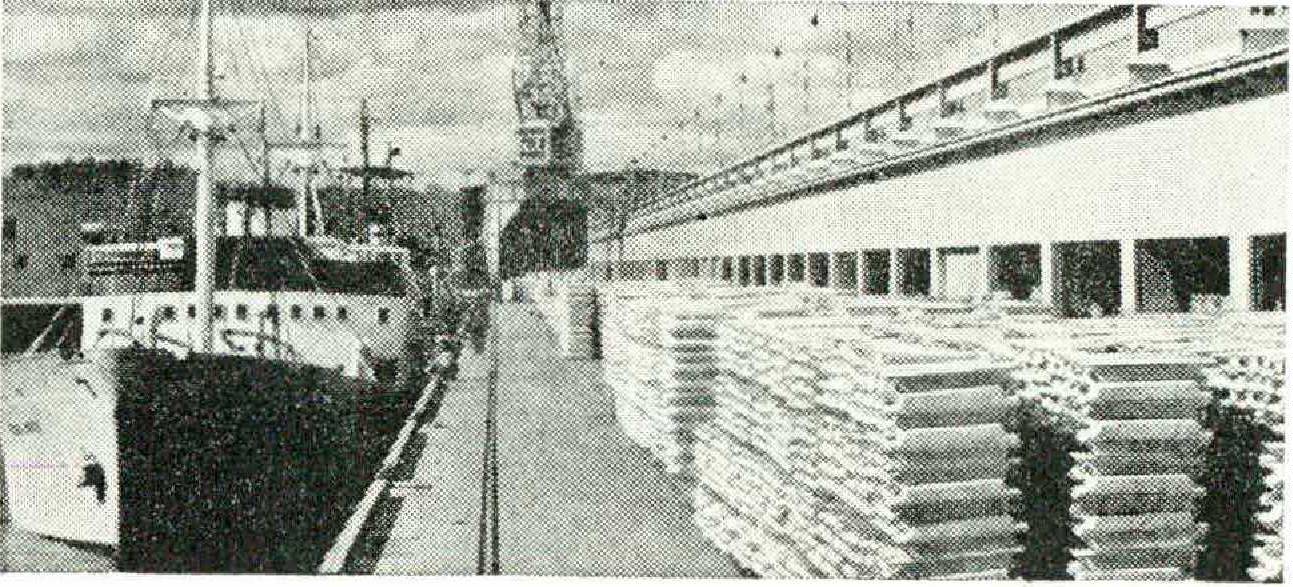
A. Canada at present consumes only 15 per cent of the aluminum ingot produced in that country. Therefore, a large proportion of our output is exported, principally to the United Kingdom and the United States. World trade, of course, is sensitive to exchange, import restrictions and tariff regulations. In recent years, there have been reductions in the U. S. tariff on aluminum, and trade has unquestionably benefited from these reductions. We believe strongly that a more liberal trade policy would certainly be in the interest of the aluminum industry as a whole.
Many people may not realize that Canada and the United States are each other’s best customers. Employment in American factories directly traceable to our two-way trade is surprisingly large. For example, Brooklyn sells more to Canada than does the whole of Argentina, and Detroit sells more to Canada than does Brazil. This impressive flow of products across the border helps provide Americans and Canadians with jobs and the highest standard of living in the world.